
Acoustic wavelength measurement 2026-10-14
An acoustic wavelength measurement makes an invisible spatial pattern readable with a ruler. The authored guide Interesting and inexpensive experiments for high school physics by Joe Wolfe places a loudspeaker near a pipe's open end, drives it with an oscillator, and slides a microphone attached to a metre rule through the pipe. An oscilloscope or computer displays the microphone signal. Its oscillation amplitude rises and falls with position; adjacent minima locate pressure nodes of a standing wave a distance apart. A cap gives a pressure antinode at the closed end; an open end has a pressure node just outside it. These are pressure patterns, distinct from displacement patterns. The guide advises wavelengths longer than the pipe diameter, sufficient pipe length to locate both a node and an antinode, and frequency spectrum analysis to distinguish the intended tone from other sounds.[ref]
Interesting and inexpensive experiments for high school physics by Joe Wolfe. pp. 10–11, Standing waves. Reflection and transmission. Speed of sound; apparatus, microphone scan, and pressure-node distinction
The inference follows from superposition of two oppositely directed acoustic plane waves. In an ideal uniform, lossless pipe, taking equal pressure amplitudes and a rigid cap at givesThe time-varying pressure perturbation has local oscillation amplitude . Its zeros are separated by . Unequal incident and reflected amplitudes leave nonzero minima, but their spacing remains in this ideal model. A microphone detects that pressure variation through a changing electrical signal, rather than watching a wave crest move. Record the tone's frequency too, then infer phase speed .
For proposed controls, keep the drive frequency and amplitude fixed during a scan, verify the frequency on the recorded signal, and repeat the scan in both directions. Fit several minimum positions using linear regression to reduce dependence on one pair of positions. Check the ruler scale and use one consistent reference point on the microphone. Compare with the source switched off to locate background measurement noise; use frequency spectrum analysis to check for additional tones, and reduce drive if the trace ceases to resemble a sinusoid. Record air temperature and avoid strong air motion. These are suggested controls, not additional procedures or observations attributed to the guide.
The pipe must support approximately plane waves over the measured region: transverse structure at shorter wavelengths, the microphone's finite size, and disturbance by the ruler can compromise the interpretation. Weak reflection gives shallow minima, while damping and other reflections can shift the extrema of the simple two-wave model. Measure interior spacings rather than assuming the first minimum is exactly at the pipe lip. A short scan may not include enough minima to estimate reliably, and drift during sequential scanning can imitate spatial variation.
For an explicitly hypothetical calculation, and give , , and . No such measurements are claimed here. If independent small measurement errors in and fitted have standard deviations and , first-order error propagation gives . A systematic scale error or changing air conditions requires separate assessment.
Duistermaat-Guillemin trace formula 2026-10-14
For the positive Laplace-Beltrami operator on a closed manifold, the singular support of the wave trace lies in zero together with signed lengths of closed geodesics. Under the clean fixed-set hypotheses, its singularity at a periodic-geodesic length has an expansion determined by the geodesic flow and its linearized return map. In particular, when the relevant leading coefficient does not vanish through cancellation, that length is determined by the spectrum. The inclusion of singular supports alone does not justify an unconditional recovery of every geodesic length.
Solute potential 2026-10-14
Solute potential is the contribution to water potential from dissolved material, with pure water assigned zero. In the nearly incompressible description, . In a dilute ideal chemical solution, , where is the osmotic concentration of dissolved particles. Thus solute potential is negative while the corresponding osmotic pressure is positive: . This sign difference distinguishes a contribution to water potential from the compensating mechanical pressure.[ref]
30.5 Transport of Water and Solutes in Plants. Biology 2e, §30.5, Solute Potential: negative concentration contribution
Braess's paradox 2026-10-14
Adding a link to a nonatomic traffic flow network can increase the equilibrium travel delay. Extra routes change the incentives defining a Wardrop equilibrium, so the new equilibrium need not retain an earlier good allocation. The system-optimal delay cannot worsen when the old allocation remains feasible; the paradox concerns selfish equilibrium.
Massless leptonic W decay width 2026-10-14
The chiral weak charged current vertex gives the spin-averaged squared matrix element for an on-shell W boson decaying to a massless charged lepton and antineutrino. Integrating two-body Lorentz-invariant phase space gives . The massive-vector spin average divides by three; an extra neutrino-helicity factor would incorrectly double count the chiral projector.
Tree-level W branching fractions 2026-10-14
With three massless lepton families, two accessible up-type quarks, three colors, and no Quantum chromodynamics radiative correction, a W boson has total decay width . With an identity CKM matrix, each leptonic channel has branching fraction and each of the two allowed quark-flavour channels has . With mixing, each accessible quark channel is weighted by , while row unitarity preserves the total at this order if all down-type channels are accessible.
W boson propagator 2026-10-14
In unitary gauge, the free massive W boson has the displayed momentum-space propagator. At external momentum small compared with , its leading term is . Inserting it between two weak charged current vertices produces the local Fermi interaction, with when each vertex is written with . Higher momentum terms give higher-dimensional operators; other gauges distribute the longitudinal contribution differently while giving the same physical amplitudes.
Voter-model duality 2026-10-14
Independent Poisson process copying arrows construct the voter model. A backward ancestral line from a site follows a continuous-time random walk; lines that meet then coincide. Thus a finite collection of Ising spins at time equals initial Ising spins at the positions of coalescing random walks. In particular , and the probability of disagreement at two sites is bounded by the probability their ancestral walks have not yet coalesced.
Vortex charge neutrality 2026-10-14
For the Villain model on a periodic two-dimensional lattice, the vortex charge is the oriented curl of its integer bond variable. Summing over all faces cancels every bond twice, proving neutrality. In an infinite plane, a configuration with net winding has far-field spin wave action , so finite-energy localized configurations must have . At an open boundary the total winding instead equals the boundary circulation; neutrality cannot be imposed without a boundary condition.
On a rectangular torus, an integer height for the integer-current representation of the Villain model may have twists . Subtract to get a periodic real height. Its Gaussian energy splits into the ordinary gradient energy and . Height Poisson summation supplies a phase with dipole moments and . A further Poisson summation of the twists gives, up to a charge-independent factor,Here is the inverse lattice Laplacian on the mean-zero subspace. This keeps the smooth spin wave determinant separate, while correctly retaining the coupling between vortex dipole moments and global winding sectors at finite volume. Dropping those sectors without stating boundary conditions is not an exact torus duality.
For a steady Keplerian accretion disk with inward accretion rate and vanishing inner torque, the outward angular-momentum torque is . It transports energy outward at rate . The binding-energy acquisition rate between radii and is . Integrating the vertical viscous dissipation and then the annulus givesSince , subtraction proves the displayed energy balance. Far from the inner edge , whereas the boundary torque powers vanish for the complete disk and . Local dissipation is therefore not supplied solely by local changes in orbital binding energy.
A constant-tension slender viscous thread loses the same cross-sectional area along each material element: . Volume conservation gives material stretch . Near an isolated quadratic minimum of , integration over a shrinking material width proportional to gives total extension exponent . A uniformly thin thread has the same divergent stretch everywhere and exponent . The localized coefficient is independent of remote endpoints.
Oscillator energy dissipation 2026-10-14
For the damped harmonic oscillator, the mechanical energy is the sum of kinetic energy and spring potential energy:Thus is the power transferred out of the oscillator's mechanical energy. For , the rate vanishes instantaneously at a turning point, despite nonzero stored potential energy; it is not a constant loss per unit time. In eddy-current damping the loss becomes Joule heating. [ref]
For an underdamped response, advancing one oscillation period multiplies both displacement and velocity by , so . This exact cycle relation does not imply that instantaneous energy is a pure exponential function throughout each cycle.
Damping ratio 2026-10-14
The damping ratio is the dimensionless ratio . Substituting the exponential function into the viscous damping model gives the characteristic equation and its characteristic roots:For , underdamping gives a pair of complex conjugate roots with negative real part. For , critical damping gives the repeated negative real root. For , overdamping gives two distinct negative real roots. At the roots are purely imaginary and the harmonic oscillator is undamped; this boundary case has no energy loss. With , negative would inject energy and lies outside the dissipative model.
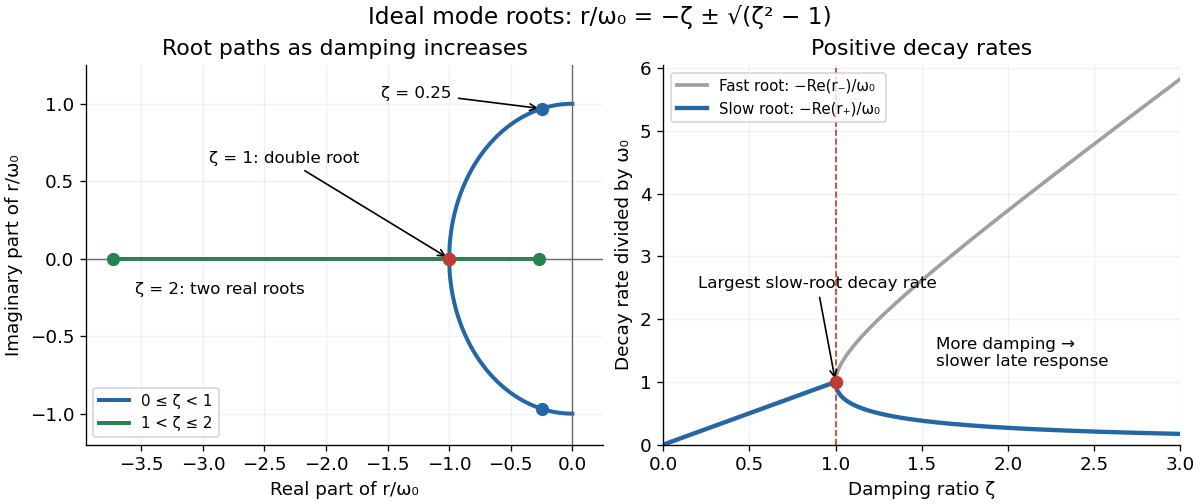
Characteristic roots of an ideal viscous oscillator and their dimensionless decay rates as the damping ratio varies
. Details. 
The left panel locates in the complex plane; the imaginary part gives the damped angular frequency, while the negative real part gives the exponential decay rate. The right panel shows the positive rates . Beyond critical damping, one root moves toward zero, explaining slow late motion for generic initial conditions. The repeated-root solution also has a polynomial prefactor, so these rates alone do not describe its complete response.
Batchelor scalar microscale 2026-10-14
At the Batchelor scalar microscale, molecular diffusion rate balances the smooth Kolmogorov strain rate . For this scale is much smaller than the Kolmogorov length scale.
For , balance to obtain radius proportional to . Axial lubrication conservation then makes the axial length proportional to as well. The displayed variables reduce the lubrication equation for a bubble with viscous exterior to . The physical interface slope is , compatible with a slender neck when and the dimensionless profile varies on order-one scales.
Let a continuous function satisfy both viscosity inequalities for the Laplace operator. On any relatively compact ball, take its harmonic replacement with matching boundary values. If has a positive maximum, the function still lies below somewhere for sufficiently small positive , while matching it on the boundary. At an interior maximum of their difference it is a valid upper test, but its Laplacian is , a contradiction. The opposite perturbation excludes a negative minimum. Thus throughout the ball and is a smooth harmonic function. A locally defined test is extended near its touching point using a smooth cutoff function when global tests are required.
Write the virtual character as with integer coefficients and irreducible characters . Character orthogonality gives . Norm one forces exactly one coefficient to be or , and positive degree selects the positive sign.
Brauer's characterization of characters 2026-10-14
A complex class function on a finite group is a generalized character if and only if is a generalized character of every elementary subgroup. Equivalently, for every such and . Ordinary characters additionally have nonnegative global irreducible multiplicities; integrality of the virtual-character lattice is the conclusion of this criterion.
Critical closed bosonic strings have independent left- and right-moving Virasoro constraints. Positive modes in both sectors annihilate physical kets, while both zero-mode conditions impose the mass shell and closed-string level matching. Quotient by physical null string states, equivalently use the appropriate BRST cohomology. With , the result is and . Negative matter modes are adjoints rather than additional ket-annihilation constraints.
There are unlisted articles, also show them or only show them.