
For a continuous and a family satisfying a large deviation principle at speed , the displayed exponential tail condition extends Varadhan's lemma to unbounded above. Apply the bounded-above result to and split the full integral into and its tail; the tail is negligible and the truncated variational suprema increase to . A sufficient condition is for some , since the tail is at most .
Collect the distinct nonzero values among the as with positive multiplicities . The first power sums imply for . The coefficient matrix is an invertible weighted Vandermonde matrix, so all vanish, a contradiction unless . Its invertibility also follows because a polynomial vanishing at zero and all the has distinct roots and degree at most .
Andrews's carbon dioxide experiment 2026-10-14
The 1869 The Bakerian Lecture: On the Continuity of the Gaseous and Liquid States of Matter by Thomas Andrews describes dried carbon dioxide trapped above mercury in a sealed capillary tube. A steel screw pressurized water in a strong copper tube; movable mercury transmitted the load. A second capillary tube held air as a pressure gauge. Flowing water around the visible capillary tubes controlled temperature; a thermometer read the bath. A cathetometer read column positions, converted to volume readings using weighed-mercury calibration.[ref]
The Bakerian Lecture: On the Continuity of the Gaseous and Liquid States of Matter by Thomas Andrews. Andrews, pp. 576–578 and Plate LXIII, figures 3 and 5–7: sample preparation, screw, coupled capillaries, water jackets and optical readout
Below the critical temperature, compression produced a visible liquid–gas boundary; above it, large density changes occurred without that boundary. Three trials gave as his critical temperature. Purity checks detected residual air; mercury height corrections accounted for unequal hydrostatic pressures. He explicitly left air nonideality and pressure-induced tube-capacity corrections unresolved, so his air-gauge pressures were approximate. These readouts support a liquid-gas critical point; they do not measure a homogeneous unstable loop or establish universal quantitative accuracy of the later Van der Waals equation.[ref]
The Bakerian Lecture: On the Continuity of the Gaseous and Liquid States of Matter by Thomas Andrews. Andrews, pp. 576, 578–580 and 583: residual air, approximate air-gauge pressure, hydrostatic corrections and three critical-temperature trials
Van der Waals liquid-gas coexistence 2026-10-14
Below , the equilibrium liquid and gas have the same temperature, pressure , and per-particle chemical potential. For macroscopic bulk thermodynamic phases, neglect interface contributions. The Maxwell equal-area construction determines and byIt expresses equality of chemical potentials, since at fixed temperature. Equivalently, the equilibrium Helmholtz free energy per particle follows a common tangent line between the two endpoint states, lying below the homogeneous continuation between them. The construction uses that mathematical continuation to compare endpoints; it is not a physical compression path through negative isothermal compressibility states.[ref]
Statistical Physics by David Tong. §5.1.1, equation 5.5, Maxwell Construction and figures 36–37: chemical-potential equality and flat coexistence intervals
Here is a reproducible calculated example at . With , the homogeneous intersections solve the cubic equationThe Maxwell construction givesAll three roots of a polynomial satisfy . Only the smallest and largest are the phase coexistence endpoints; the middle one has negative isothermal compressibility. Equal pressures at three admissible values of volume therefore do not imply three stable thermodynamic phases. An analytic area check isAt full numerical precision, the residual is below in reduced units; independent numerical integration gives the same cancellation. At , the spinodal points are instead and .
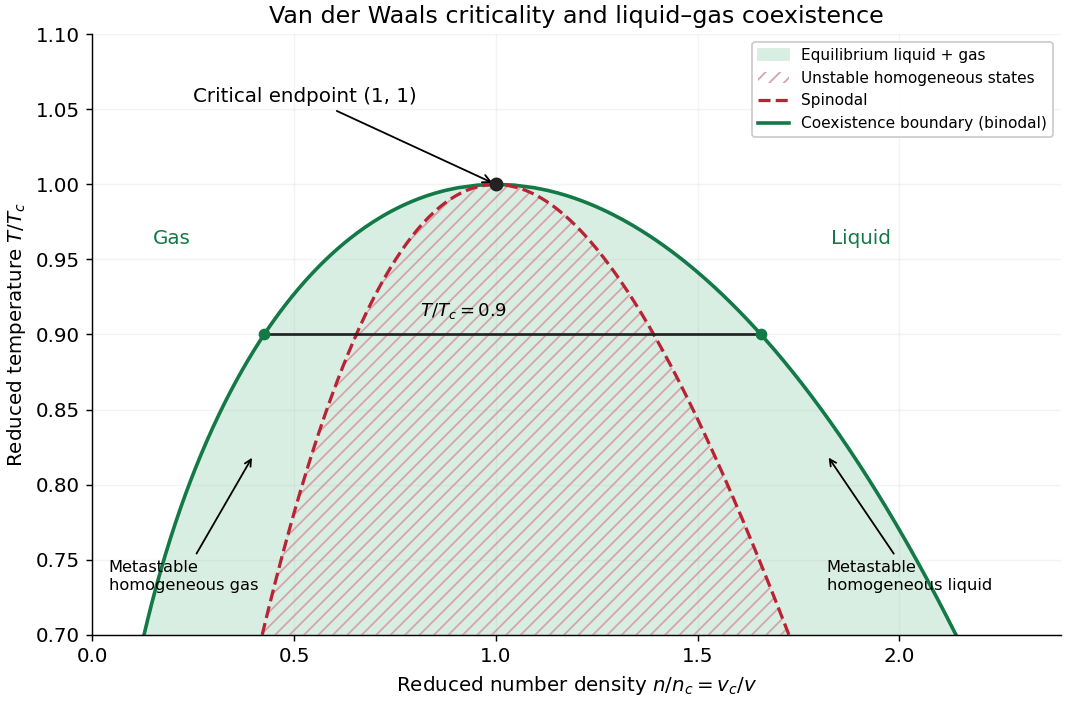

The equilibrium plateau changes the phase fraction rather than the endpoint densities. For a gas particle fraction and mean particle volume , the lever rule readsThus at gives : this is a particle fraction, not the volume fraction occupied by gas. Differentiating equality of chemical potentials along this model's phase coexistence curve yields the same Clapeyron equation explained below, , with latent heat per particle. Both endpoint differences vanish as the Van der Waals critical point is approached; the equation's critical limit must be taken as a ratio.
Van der Waals critical point 2026-10-14
The liquid-gas critical point of the Van der Waals equation occurs where its two subcritical stationary points merge into a horizontal inflection point. The conditions are . The short calculation isDividing these relations gives , henceSubstitution gives the Van der Waals law of corresponding states and the parameter-independent ratio . That ratio belongs to this equation of state; reducing a real fluid's variables does not enforce it.[ref]
Statistical Physics by David Tong. §5.1.3, equations 5.7–5.8: critical values, reduced equation and compressibility ratio
An exact rearrangement of the reduced critical Van der Waals isotherm makes its flatness visible:The first nonzero departure near is . On the critical particle volume approached from , andThe divergent isothermal compressibility and cubic flattening explain why the critical region is mechanically soft. These are mean-field theory predictions; thermal fluctuations limit their use for real fluids very close to a thermodynamic critical point.
Van der Waals isotherm 2026-10-14
A Van der Waals isotherm is the pressure–particle volume curve at a fixed temperature. Put , , and , using the Van der Waals critical point values below. Then the existing Van der Waals law of corresponding states becomesAll curves in the figure are calculations in this reduced model.
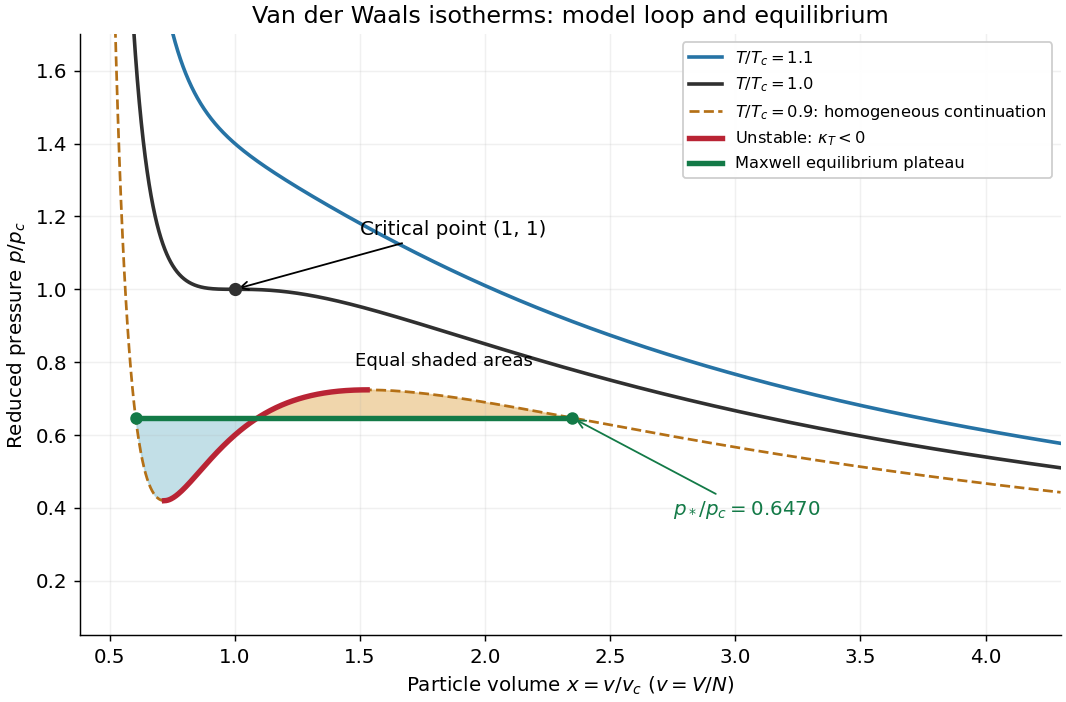
Van der Waals isotherms below, at and above the Van der Waals critical point
. The dashed subcritical homogeneous continuation contains an unstable red segment. The green Maxwell construction plateau describes equilibrium phase coexistence; the two shaded areas are equal. Curves are model calculations, not carbon dioxide measurements. Details.
For a uniform thermodynamic phase, the isothermal compressibility isThus the upward-sloping portion of a subcritical Van der Waals isotherm has : compression would reduce pressure, allowing a density disturbance to grow. It is mechanically unstable. The spinodal points bound that portion; setting the derivative to zero gives their curve . Negative slope alone guarantees only local mechanical stability: portions between the spinodal and the phase coexistence endpoints have metastability. Equilibrium replaces the entire interval between those endpoints, including these metastable portions, by a Maxwell construction plateau.[ref]
Statistical Physics by David Tong. §5.1, equation 5.3 and §5.1.1, Maxwell Construction and Meta-Stable States: unstable middle branch and coexistence versus spinodal
At density , planar duality gives crossing probability for the -by- lattice rectangle. A self-avoiding left-right crossing passes through one of its middle-column vertices. At that vertex its two halves are disjoint edge witnesses for two copies of the radius- connection event. The BK inequality and the union bound give , proving the estimate.
For increasing events under a finite Bernoulli distribution product measure, first assume all parameters are at most . Write and for last-coordinate sections. The zero-section of their disjoint occurrence of increasing events is ; its one-section is . The intersection in this union contains . If , and the last parameter is , mathematical induction bounds disjoint occurrence by . The product of the two marginal probabilities exceeds this bound by . For a larger parameter , replace that coordinate by the logical disjunction of independent bits with parameter . Disjoint original witnesses lift to disjoint bit witnesses. Apply the small-parameter inequality and then pass to degenerate parameters by continuity.
For odd , both possibilities occur at : contains -torsion, while does not. Both extensions are totally ramified of degree by the Eisenstein criterion. In the second field, if with , the cyclotomic equation reduced after division by would give in , contradicting . For , always permits the root , so the torsion exponent is exactly one and the zero-exponent alternative is impossible.
Vacuum energy density 2026-10-14
The vacuum energy density is the bulk limit , with boundary effects removed and a fixed convention for the Hamiltonian. In an effective field theory at a homogeneous vacuum it is the value of the renormalized scalar potential. A global supersymmetry algebra expresses the regulated vacuum energy as a sum of supercharge norms, giving nonnegative density; the scalar potential of supergravity instead includes a negative gravitational term.
For the equation , the second-order forward difference has Fourier symbol . The nonpositive real part gives a contractive semidiscrete evolution in the discrete L2 norm. Equivalently, for the unitary lattice shift , . A centred difference in another direction contributes only a skew-adjoint term, preserving this energy estimate.
Center of an upper unitriangular group 2026-10-14
The upper unitriangular group is generated by adjacent elementary transvection matrices . Commuting a matrix with each such generator forces every entry above the diagonal to vanish except possibly its entry: comparing with kills the entries above position in column and to the right of position in row . The surviving matrices do commute with the entire group. In particular the group center has order ; it distinguishes from despite their common order .
Upper Darboux integral 2026-10-14
The upper Darboux integral of a bounded real function on a closed interval is the infimum of its upper Darboux sums over all partitions of an interval. Refinement decreases an upper Darboux sum, and the function is Riemann integrable precisely when this infimum agrees with its lower Darboux integral.
Lower Darboux integral 2026-10-14
The lower Darboux integral of a bounded real function on a closed interval is the supremum of its lower Darboux sums over all partitions of an interval. Refinement increases a lower Darboux sum. A common refinement of two arbitrary partitions of an interval proves that every lower Darboux sum is at most every upper Darboux sum, hence the lower Darboux integral never exceeds the upper Darboux integral.
Hebbian learning 2026-10-14
Activity-dependent strengthening associated with coactivation of an input and its postsynaptic output. The idealized update requires normalization, competition or other constraints to prevent indefinite weight growth.
Sparse coding 2026-10-14
Represent inputs accurately using few strongly active coefficients, for example by minimizing . Learning basis functions on natural images can yield localized oriented filters resembling simple-cell receptive fields. This demonstrates one possible functional account of selectivity, not a proof that cortex implements that exact objective or learning algorithm.
Multidimensional scaling 2026-10-14
Construct low-dimensional coordinates representing a dissimilarity matrix. Different methods preserve different features: classical multidimensional scaling approximates a centered Gram matrix, while other methods minimize discrepancies between fitted and supplied distances or preserve distance ordering. The method and dimension determine what geometric claims the resulting display supports.
For and in the Unscaled Papkovich–Neuber representation, the Newtonian fluid stress tensor gives the displayed traction at . The contribution is the Stokeslet stress; the contribution is twice the viscosity times the Hessian of its harmonic scalar potential. The prefactor is , not . The rigid translating-sphere limit is a direct normalization check.
Unramified residue generator integral basis 2026-10-14
For an unramified extension of local fields , an integral element whose residue generates generates : its degree is at least the residue degree . The reduced powers are a basis of the residue field extension. If , factor out a coefficient of least valuation. Reduction of the remaining sum is nonzero by that residue basis, so . Consequently is integral exactly when all are integral.
C-star unitization by left multiplication 2026-10-14
The left multiplication representation of a C-star algebra is isometric: test on to get . For a nonunital algebra, its closed image plus the identity operator is the algebraic unitization. For a formal and , . Thus ; applying the same estimate to proves the algebra involution is isometric and the C-star identity holds. This gives a unitization without first assuming an operator representation on a Hilbert space.
There are unlisted articles, also show them or only show them.