
Choose maximal such that for the displayed , and take the OR of AND blocks of size , ignoring unused coordinates. Its failure probability is , between one quarter and three quarters. Active coordinates have influence and unused ones have zero influence. Maximality gives ; for , , so every influence is below . The construction is therefore a quite fair Boolean function with small influences for every . The logarithmic bound cannot hold at , where every quite fair function has influence one.
Forward substitution 2026-10-14
Forward substitution solves a linear system with a lower triangular matrix and nonzero diagonal, from the first row downward:The first sum is empty, so . Each subsequent row uses only components already found. For a unit triangular matrix , omit the division because . The complementary procedure, back substitution, solves an upper triangular matrix system from the last row upward.[ref]
If , the triangle count in a binomial random graph has expectation at most , so the Markov inequality shows there are no triangles in a graph with probability tending to one. If , the triangle variance in a binomial random graph divided by the squared mean is . The second moment method then gives at least one triangle in a graph with probability tending to one. At the intermediate scale , a nontrivial Poisson limit for triangles in a binomial random graph describes the count.
Choose and a binomial random graph of edge probability . With high probability its maximum degree is at most , it has triangles, and every independent set has size at most . Delete one vertex per triangle. The resulting triangle-free graph has chromatic number at least . Appending a disjoint star of degree , if necessary, makes the maximum degree exactly without lowering the chromatic number. Thus the order is unavoidable.
Tree scattering with pseudoscalar exchange 2026-10-14
The pseudoscalar Yukawa interaction with coefficient has the displayed Feynman vertex. Its two-fermion tree-level Feynman diagrams are the and exchanges; antisymmetry of the final identical fermions requires their relative minus. Fermion-antifermion scattering has exchange and annihilation, again with a relative minus. With initial and final states ordered as and , the normal-ordered current contributes in the exchange channel but and in the annihilation channel. These fermionic signs fix the overall sign as well as their interference; changing an external-state phase changes both terms together.
Fixed-order tree-component window 2026-10-14
For fixed and , the expected number of tree components of order is asymptotic to throughout the displayed window. It tends to infinity: split at and to obtain lower bounds of orders , , and . Distinct overlapping vertex sets cannot both be components; disjoint sets have joint-to-product probability ratio . Thus the relative variance vanishes, proving a component of order exists with high probability.
Assume treatment receipt gives event risk , nonreceipt gives risk , and a fraction in each equally sized randomized arm crosses to the opposite treatment. The two assignment risks are and . Subtracting yields the displayed attenuation, with . It depends on the stated equal crossover fractions and unchanged receipt-specific risks; it is not a universal formula for every form of treatment contamination.
For a gravity-current nose of height on a small incline of slope , the travelling front of a gravity-driven thin film satisfies . Close to its dry tip, . The slope becomes order one at , giving an region where lubrication theory fails. The main nose length is . Comparing capillary pressure gradients with gravitational forcing gives the crossover . This concerns the main nose length; capillarity may already matter in a much smaller tip region.
Composite trapezoidal rule 2026-10-14
On an equal-panel partition of an interval, with , sum the trapezoidal rule over adjacent panels:There are distinct quadrature nodes. Each interior sample belongs to two panels and therefore has quadrature weight , while each endpoint has quadrature weight . Equivalently, the composite trapezoidal rule integrates the piecewise linear function obtained by linear interpolation exactly.[ref]
For and , summing panel quadrature errors givesfor some . Thus panel quadrature errors of order accumulate to order , using big O notation.[ref]
3.5 Quadrature, subsection (i) Trapezoidal Rules. §3.5(i), equations 3.5.2–3.5.3: composite formula and signed error
On a nonuniform partition of an interval with widths and largest width , the bound is .For the polynomial on , direct summation yieldsBoth quadrature errors shrink by exactly four when doubles, with opposite signs. This exact relation belongs to this polynomial example; the trapezoidal rule is not always twice as inaccurate as the midpoint quadrature rule.
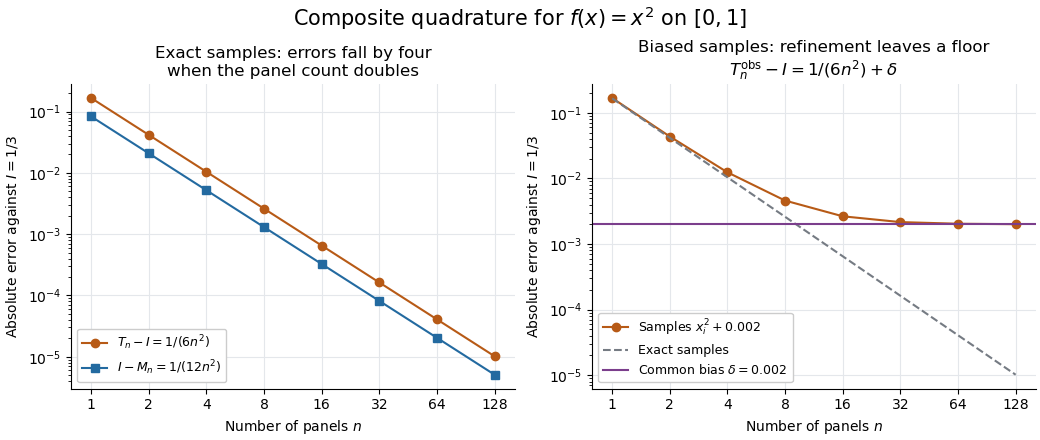
Quadratic quadrature errors fall by four on refinement while a common sample bias persists
. Details. 
The left plot uses exact polynomial sums; the right adds a common sample bias to the composite trapezoidal rule. That mathematical model converges to , showing why smaller panels alone do not ensure accuracy for noisy samples. It illustrates noise sensitivity of a quadrature rule, rather than measured data.
Periodizing the bulk transverse tangent correlation of a stretched worm-like chain gives , where is the distance to zero on the periodic interval. Summing the geometric series yields the displayed result. At zero separation its finite-length factor is ; for the bulk result is recovered. Periodic tangent fluctuations are a mathematical boundary convention, not a claim that a pulled physical chain forms a closed loop.
Transverse preimage theorem 2026-10-14
If satisfies transversality of a map to a submanifold , its nonempty preimage is an embedded submanifold of the displayed codimension. Choose a slice chart for an embedded submanifold around in which is the zero set of the first coordinates. Their composition with has surjective derivative on its zero set, so the regular level set theorem gives a local embedded slice of dimension . These slices give the subspace topology and a compatible smooth atlas on the preimage. Its tangent space is
General position for curves in a manifold 2026-10-14
Smooth maps of finitely many circles into a manifold of dimension at least three can be perturbed within their homotopy classes to disjoint embeddings. The transversality dimension count for two curve branches is , so their images avoid one another after perturbation; one also removes self-intersections and obtains immersions by the jet version of transversality. This allows disjoint representative loops for relators in high-dimensional surgery constructions of prescribed fundamental groups.
Elementary transvection matrix 2026-10-14
This matrix adds times coordinate to coordinate . Left multiplication performs the corresponding row addition. Such matrices generate the special linear group over a finite field: row elimination also realizes signed interchanges and compensating diagonal scalings using products of these matrices.
Transvection conjugacy over a finite field 2026-10-14
Every nonidentity transvection has an adapted basis in which it is . Thus all such maps are conjugate in the general linear group. In dimension at least three, a scaling of a third basis vector centralizes this matrix and has arbitrary nonzero determinant; adjusting a conjugator by this scaling proves conjugacy in the special linear group as well.
// Target: algebra.bigb
In the Weyl representation of the gamma matrices, with . The antisymmetry of gives , and direct multiplication gives and . Any two such intertwining matrices differ by a scalar: their ratio commutes with all gamma matrices, whose products span the full four-by-four matrix algebra. Changing spinor basis sends to , so transpose antisymmetry is basis-independent. Its sign is therefore fixed, not merely one of the two alternatives supplied by the general transpose symmetry of a charge-conjugation matrix argument.
For shipments with factory row sums at most capacities and shop column sums exactly demands , the displayed dual potentials give . The sign ensures . Equality proves optimality. It occurs when every used cell is tight and every row with spare capacity has , the relevant complementary slackness conditions. A dummy demand column with zero costs converts unused capacity into a balanced transportation problem.
A finite word over an alphabet is locally admissible for a zero-one symbolic transition matrix if every consecutive pair is permitted. Its length counts symbols, so length corresponds to transitions. The number with endpoints is by matrix multiplication. Local admissibility does not always imply occurrence in a two-sided subshift of finite type: the matrix permits the word but admits no two-sided sequence. If every row and column has a nonzero entry, every locally admissible word extends in both directions.
Structure group of a vector bundle 2026-10-14
A complex vector bundle has structure group when it admits fiber-linear local trivializations whose transition matrices take values in . Replacing frames by changes transitions to in the frame convention. Reducing the structure group means choosing new trivializations with values in a specified subgroup. The same transitions glue by left multiplication to a right principal bundle.
Prediction optimism 2026-10-14
Prediction optimism is the difference between expected squared prediction error on new independent responses at the training covariates and expected training error. Reusing responses to fit and assess a model tends to make training error too favorable. The covariance formula for prediction optimism measures this reuse without assuming a linear fitting rule.
// Target: probability-and-statistics.bigb
Fredholm determinant 2026-10-14
For a trace-class operator on a Hilbert space, the Fredholm determinant is the convergent product over its eigenvalues, counted with algebraic multiplicity. For self-adjoint , spectral theorem for compact self-adjoint operators reduces the product to a diagonal calculation. For , . This identity exposes the successive cumulants in a Gaussian quadratic exponential moment.
There are unlisted articles, also show them or only show them.