
Past exam of the general relativity II course of the University of Oxford 2015 1 b i Solution 2026-10-25
For a Conformal Killing vector field, the same metric compatibility calculation givesThus its Conformal Killing equation is . Taking the tensor contraction with the inverse metric, and using , determines the conformal Killing factor:Parentheses include the factor in tensor index symmetrization.
Past exam of the general relativity course of the University of Oxford 2021 2 d iv Solution 2026-10-25
Gravitational waves also exhibit diffraction: the geometrical optics ray description fails when a propagation structure or lens delay is not large compared with the wave's wavelength or period. For a compact lens of mass , a useful dimensionless parameter is ; of order one signals potentially appreciable wave effects, with cosmological lens redshift supplying an additional factor when needed. Astrophysical gravitational lensing can therefore produce diffraction and frequency-dependent amplification. Ordinary objects are poor opaque screens for gravitational waves, so everyday slit-and-screen demonstrations are implausible despite the large wavelengths, which are about km at Hz.
Past exam of the general relativity course of the University of Oxford 2021 2 d iii Solution 2026-10-25
In a local inertial frame in vacuum, gravitational waves travel at in general relativity; there is no ordinary material index of refraction analogous to a transparent dielectric. Ordinary matter couples so weakly that laboratory prisms for gravitational waves are implausible. Propagation through a varying background gravitational field nevertheless changes ray directions and travel times, giving gravitational lensing and Shapiro time delay. In weak static coordinates , the null condition gives an effective coordinate index of refraction . This useful description depends on coordinates and does not change the local propagation speed. Thus astronomical gravitational refraction is plausible, while a substantial everyday material effect is not.
Past exam of the general relativity course of the University of Oxford 2021 2 d ii Solution 2026-10-25
Gravitational waves can exhibit interference. In linearized gravity, overlapping strains add, so coherent contributions can enhance or cancel the measured response. Independent astrophysical sources generally have unrelated phases and average to a stochastic background rather than stable fringes. More plausible coherent paths arise when gravitational lensing sends different parts of the same signal to the detector with different delays; fringes require sufficient overlap and coherence. The relevant quadratic radiative energy flux contains the cross terms even though the leading wave equation is linear.
Past exam of the general relativity course of the University of Oxford 2021 2 d i Solution 2026-10-25
Gravitational radiation admits polarization: general relativity has two transverse tensor modes, plus polarization and cross polarization, whose relative amplitudes and phase give linear, elliptical or circular gravitational-wave polarization. Their axes transform through twice a rotation of the transverse coordinate frame, unlike the vector polarization of electromagnetic radiation. Measuring these modes is physically plausible with several differently oriented detectors; a single detector generally measures only one projected combination.
Past exam of the general relativity course of the University of Oxford 2021 2 a iv Solution 2026-10-25
Yes, for genuine precession of a nonspherical disc. Let its unit normal be . Its trace-free mass quadrupole moment has the axisymmetric formThe entries vary at , and at . Their nonzero second and third time derivatives give an oscillating far-field metric perturbation and positive average radiated power. For the terms vanish but the terms remain. The precise condition is and : the literal inequality also allows , where the normal is fixed and no such gravitational radiation occurs. For a uniform thin disc of mass and radius , , confirming that it is not zero.
Past exam of the general relativity course of the University of Oxford 2021 2 a iii Solution 2026-10-25
No, for a uniform or otherwise axisymmetric disc in steady rotation. Although individual material elements accelerate, the mass density and mass current at every spatial point remain constant, and the mass quadrupole moment is time independent. There is no gravitational radiation. Axisymmetry of the material distribution is necessary for this conclusion: the source does not explicitly specify the disc's density. A counterexample to an unconditional answer is a disc with two equal dense spots at opposite radii; their rotating mass quadrupole moment produces gravitational waves at twice the rotation angular frequency.
Past exam of the general relativity course of the University of Oxford 2021 2 a ii Solution 2026-10-25
No, for steady rotation of the uniform sphere. Its mass quadrupole moment is zero by spherical symmetry; its rotating mass current is stationary when the rotation axis and rate are fixed. A stationary source does not emit gravitational waves. Rotation by itself is insufficient: a time-dependent nonaxisymmetric distribution, or another changing radiative multipole moment, is required. The conclusion concerns a sphere with the stated constant density and steady motion, rather than a deformed or time-varying rotator.
Past exam of the general relativity course of the University of Oxford 2021 2 a i Solution 2026-10-25
No. A motionless isolated point mass produces a static gravitational field. All its mass multipole moments are time independent, so there is no outgoing gravitational radiation. In the quadrupole formula, .
Using the supplied iron parameters givesAn internal Weiss molecular field depends on temperature through . Its low-temperature saturation estimate uses :At and above the zero-applied-field magnetization vanishes in this model, so this is a saturation estimate, not the field at .
Use the paper's stipulated face-centered cubic lattice, which has twelve nearest neighbours. The saturated one-ion alignment scale isDividing the effective field among twelve equivalent neighbours gives the per-bond exchange interaction scaleTo specify the convention, write the Heisenberg model as , with dimensionless angular-momentum operators and each bond counted once. Then , so here. A convention with instead has . The total saturated interaction energy per ion is ; the factor of one half avoids counting each bond twice.
For positive , a fluctuation of magnetization produces a Weiss molecular field in the same direction, reinforcing alignment. The mean-field self-consistency equation isLinearizing in the paramagnetic phase givesAt zero applied field, the right-hand side's slope at is . Below this exceeds one, and the saturation of the Brillouin function allows stable nonzero solutions of opposite sign: spontaneous ferromagnetism. Above , only the zero-field solution remains stable. The stated linear susceptibility is the paramagnetic branch for ; it must not be continued as a negative susceptibility below the transition.
The terms in the Brillouin function cancel. Keeping the linear terms givesConsequently,Use the dimensionless SI magnetic susceptibility and , as in the source's molecular-field convention. The Curie law isIf susceptibility is instead defined as , its coefficient is and is dimensionful. The SI convention above makes the subsequent Curie–Weiss law and consistent.
The Brillouin function is odd, increases monotonically through zero, and approaches for . Its small- slope is . For , the magnetic ions overwhelmingly occupy the largest field-aligned moment projection, so the magnetization reaches magnetic saturation:The sketch shows several values; all have the same limiting values, while their slopes differ.
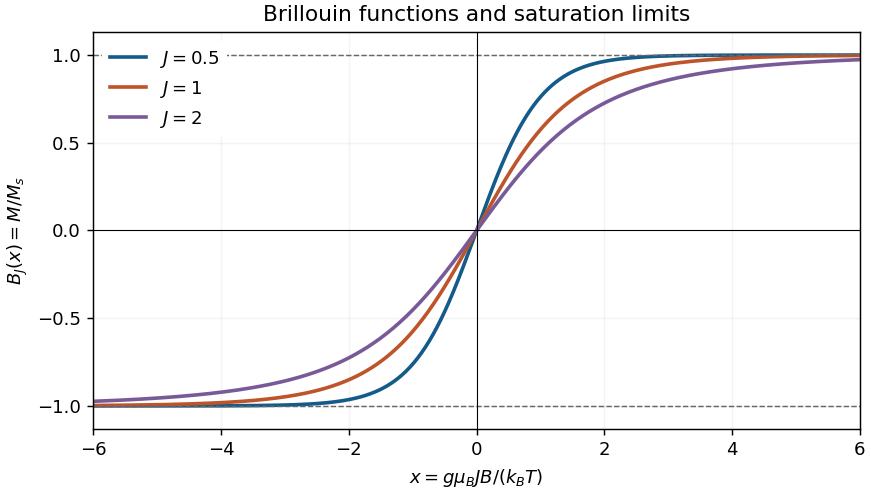
Brillouin functions approaching magnetic saturation
. Details. There are two electrons per primitive unit cell; a spin-degenerate energy band accommodates exactly that number. A semiconductor results when the first band is full and does not overlap the second. In the leading two-wave/four-wave approximation, compare the first-band maximum at with the second-band minimum at :This is an indirect band gap; a nonzero local splitting at alone is insufficient. At the onset,With , gives , henceFor more negative than this value the estimated indirect band gap is positive; at equality the bands just touch. This is the onset estimate within the source's nearly-free electron model truncation, not an exact critical potential after coupling all plane waves.
Normalize the plane waves in a periodic crystal of area or volume . The Fourier coefficients of the periodic potential obeyTranslation of the integral by any lattice vector leaves it invariant but multiplies it by . A nonzero result therefore requires to be a reciprocal lattice vector.
Near an isolated Bragg scattering degeneracy, ordinary nondegenerate perturbation theory fails because the free energies coincide. Retain the resonant plane waves , and apply degenerate perturbation theory. Absorb the constant into the energy origin. Since a real potential has , the projected Schrödinger equation has coefficient matrixA nonzero eigenstate requiresOff-resonant plane waves give higher-order energy shifts omitted in this leading nearly-free electron model.
Put . At , the free energy is . The four cyclic combinations in the supplied secular equation give the four-plane-wave splitting at a square-zone cornerFor example, the normalized coefficient vectors in the source's cyclic basis are , , , and . Because , these are ordered as written: a lower singlet, a central doublet and an upper singlet. The sketch puts the and energies on one common scale; its representative negative couplings are stated in the caption.
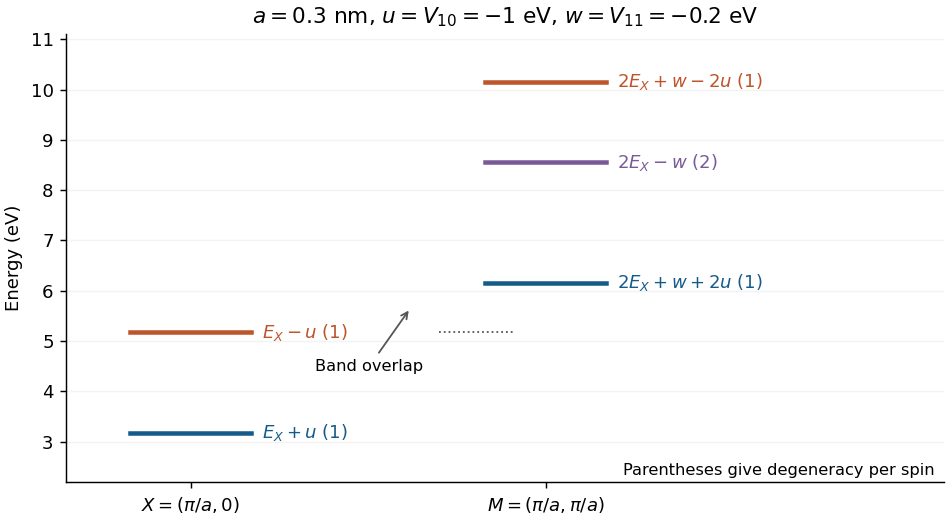
Let andAt the two degenerate plane waves have momenta and and coupling . ThusTheir symmetric and antisymmetric combinations are the lower and upper states respectively. The local band gap is .
For the Lennard-Jones potential,Its minimum and harmonic spring constant areUsing the monatomic-chain dispersion relation,The maximum is at . Taking the argon atomic mass as and givesThese are the stipulated one-dimensional nearest-neighbour model estimates; a three-dimensional argon crystal has additional neighbours and phonon polarizations.
With atomic displacement , the harmonic potential energy is . Newton's second law givesFor a periodic chain of atoms, its normal modes are , with and one representative per Brillouin zone. Substitution yields the monatomic-chain dispersion relationA real general displacement is a superposition of these normal modes and their complex conjugates. The mode is a rigid translation. At small , the acoustic phonon branch is linear, with speed of soundFor , the group velocity is and vanishes at the zone boundary. The dashed initial tangent in the sketch has slope .
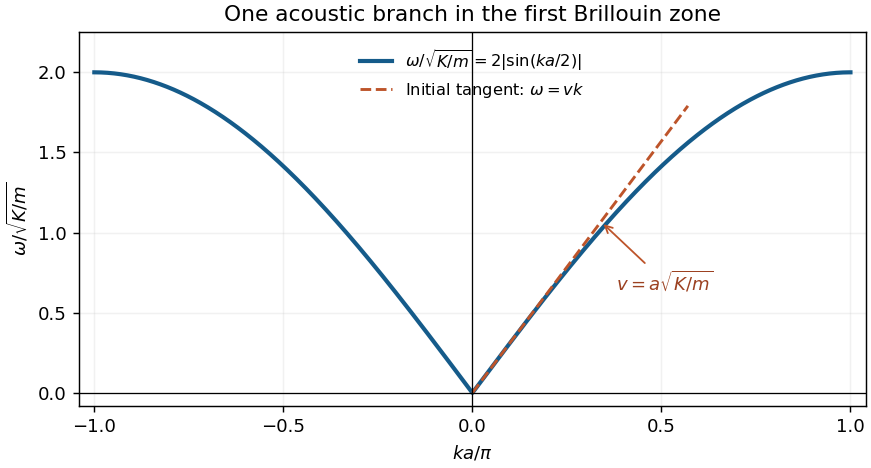


Let be a stable equilibrium separation: , . With bond extension , the Taylor expansion isThe harmonic approximation applies when the typical thermal and zero-point bond fluctuations satisfy and the higher terms are negligible, for example and . The relevant small quantity is the relative displacement of neighbouring atoms. Small bond excursions about a stable minimum give an amplitude-independent spring constant . Large thermal excursions, bond breaking or appreciable anharmonicity invalidate the approximation.
There are unlisted articles, also show them or only show them.