
General-position hemisphere count 2026-10-14
Choose points of such that every of their position vectors are linearly independent. Any equatorial hyperplane then contains at most points. If , at least one of each opposite pair of open hemispheres contains points. Such configurations exist: take distinct real parameters and normalize ; the Vandermonde determinant proves the required independence. This weaker one-of-two guarantee already suffices for the topological lower bound in Lovász theorem on Kneser graphs.
Planar rotation as a one-parameter subgroup 2026-10-14
Differentiate the planar rotation matrix at angle zero:The even and odd powers in the matrix exponential therefore giveThis exact formula gives the whole one-parameter subgroup. Taking means unit angular velocity: at , sends to , a counterclockwise quarter-turn. At , it equals ; at , it returns to . Choosing reaches the quarter-turn at . Changing the generator changes the speed, while preserving the circular path.
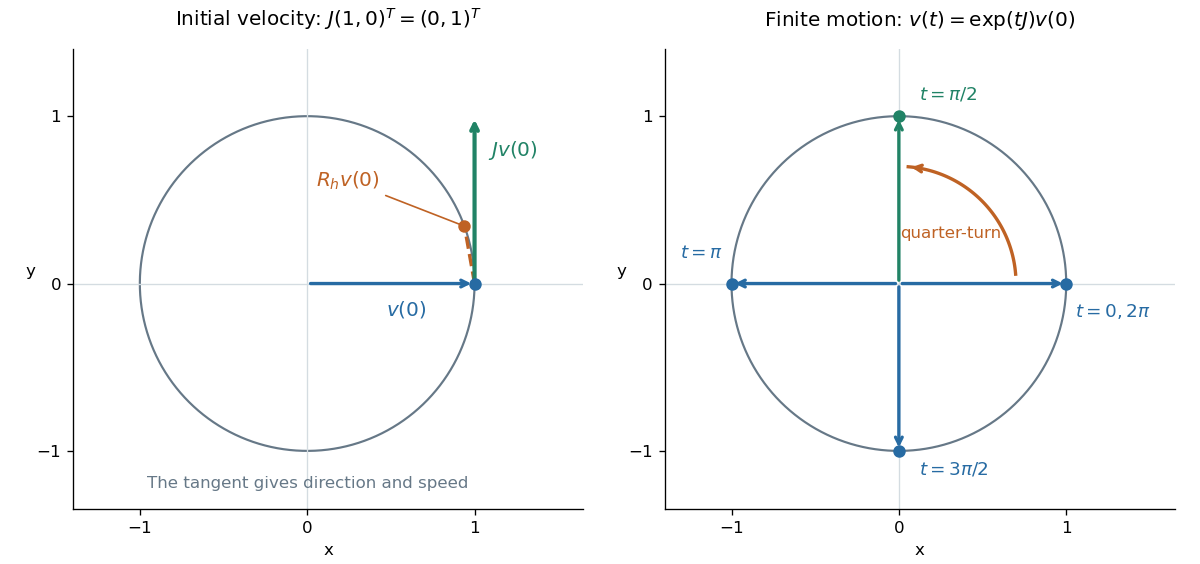

For a moving vector , the ordinary differential equation says its velocity is perpendicular to its position. The beautiful compression is that one constant matrix specifies every angle of this endless family of rotations.
Mean measure of Poisson-Dirichlet components 2026-10-14
For , whenever the absolute integral is finite. Apply the Mecke formula for a Poisson random measure to a selected jump and the remaining total , whose density is . Changing variables to and factors out a Gamma function and gives the displayed measure. Weighting it by gives a probability density , the Beta distribution of a size-biased component.
This density is supported where all and , and gives the expected sum over ordered distinct components of . Apply the iterated Mecke formula for a Poisson random measure to selected jumps and the remaining gamma total . With and , the Jacobian is and the integral in is , giving the density. It describes joint counts of large components, beyond the first-moment measure.
For , at most one component exceeds , so . Below one half several components can exceed the threshold. Put and use the finite identity , with the factorial moment densities of Poisson-Dirichlet components. It gives the full probability distribution as finite inclusion-exclusion over , . In contrast, a size-biased component is beta-distributed.
With , the one-loop renormalization-group beta function is . For and , its two nonnegative renormalization-group fixed points are zero and . Differentiating the beta function gives the displayed thermal eigenvalues, so the nonzero point has correlation-length critical exponent to leading order. At the zero eigenvalue requires nonlinear analysis: is marginally relevant for , but the perturbative spin-wave theory has a line of fixed points and omits vortices.
For , the scalar one-loop determinant has the displayed local divergent potential. If is a quartic polynomial, then has degree at most two and has degree at most four. Its subtraction therefore uses the original polynomial couplings and a vacuum-energy term. A polynomial potential of degree instead produces degree , requiring new couplings. This is a direct potential-level illustration of power counting in quantum field theory and renormalizability.
At quadratic order, for . Solving the linear equation for gives the displayed expression. If , the ultraviolet limit is zero and the infrared limit is . Initial data above reach a Landau pole at a finite ultraviolet scale. The interacting value is the Wilson-Fisher fixed point along the quartic coupling direction; the full scalar theory also has a thermal relevant direction at the Wilson-Fisher fixed point, so a critical infrared limit requires mass tuning.
For a positive weak quartic scalar field theory coupling in four dimensions, the one-loop renormalization-group beta function is , . Integration gives the displayed inverse-coupling law, so tends to zero logarithmically as and grows toward the ultraviolet. The interacting Wilson-Fisher fixed point of dimensions merges with the Gaussian fixed point at . This describes the quartic direction in the massless or critically tuned infrared regime, not disappearance of every finite-energy interaction in a massive theory. The ultraviolet Landau pole signals breakdown of that perturbative extrapolation; one loop alone does not prove a nonperturbative triviality theorem.
Wick-rotated cutoff tadpole mass shift 2026-10-14
With interaction , the tadpole diagram has symmetry factor one half. After Wick rotation and a rotationally invariant Euclidean cutoff, its self-energy is . The sphere area and radial integral give the displayed shift. It is independent of external momentum, so no one-loop momentum-dependent wave-function renormalization arises from this graph. Different regulator schemes can treat power divergences differently while defining the same chosen pole mass.
With equatorial qubit measurement vectors , the gate in one-bit teleportation is . Direct multiplication gives and . Moving a Pauli frame through this gate therefore exchanges its and exponents and reverses the angle if the old exponent is one, as displayed up to global phase. A measurement outcome adds a further factor. This calculation supplies adaptive angle choices and the final classical output-bit correction of a linear cluster state computation.
For circular Couette flow with , the rotating-frame reduction of circular viscoelastic shear gives shear rate . The total shear stress is , and the azimuthal minus radial normal-stress difference is in the stress convention where . Radial force balance without inertia is , which integrates to the displayed pressure. The pressure constant is undetermined by these equations.
Torque reversal of a linear Oldroyd fluid 2026-10-14
In an inertialess cone-and-plate rheometer, reverse a steady torque from T to -T at time zero. The polymer shear stress remains continuous while the positive solvent viscosity allows the rate to jump. The linear stress equation gives and the displayed velocity for t>0, where . The transient backward speed exceeds the final backward speed because stored polymer stress initially retains its former sign.
Put in the Oldroyd-A model. It obeys . Pulling back as converts this to an ordinary linear relaxation equation. With decayed remote-past initial memory, its solution isAt a finite initial time, include the homogeneous transported term . The integral-only law is not equivalent to all arbitrary initial-value solutions without a memory condition.
Steady simple shear of an Oldroyd-A fluid 2026-10-14
For constant simple shear flow rate , the nonpressure stress in the component-first gradient convention isThus the first normal-stress difference is , while the second is . Adding the incompressibility pressure changes neither difference.
Let a fixed simple three-uniform hypergraph have hypergraph edges, with one host vertex of a hypergraph class for each vertex of a hypergraph. Assume each hypergraph edge triple has indicator , subset density , and balanced three-dimensional box norm at most . The normalized labelled hypergraph copy count is . Telescope this product against . In each error term, fix all variables outside the three vertices of a hypergraph of its balanced hypergraph edge. Every other hypergraph edge intersects that triple in at most two vertices of a hypergraph, so the remaining factors group into three pair functions bounded by one. The pair-factor correlation bound for the three-dimensional box norm bounds the error by . Summing givesFor the three-uniform tetrahedron, . The same argument with a common host set counts homomorphisms; excluding collisions of distinct abstract vertices of a hypergraph changes the count by at most .
Flux-distance degeneracy 2026-10-14
One observed radiative flux cannot determine both luminosity and Euclidean distance: for every , replacing by leaves unchanged. In particular, at parsecs produces the same observed radiative flux as at parsecs. This is a concrete failure of identifiability in an inverse problem.
An independent stellar parallax fixes the distance and breaks this degeneracy; alternatively, a calibrated standard candle supplies the luminosity. Interstellar extinction can further reduce the observed radiative flux, and a photometric passband measures only a selected spectral range. At cosmological distances, use luminosity distance in the bolometric relation. Each inference must specify which radiative flux was measured and what propagation assumptions connect it to luminosity.
For fixed vertical wavenumber one, write the stationary threshold as , with and . The nonmagnetic minima are with ; a small positive field selects the negative one. Expanding the stationarity condition gives , , andFor large , the magnetic penalty forces toward its unique zero . Since , and . Thus strongly magnetized rolls align their wavevector perpendicular to the imposed field, rather than continuing to raise their stationary threshold proportionally to field strength.
At inclination and vertical wavenumber one, the nonmagnetic minimizing wavenumber also satisfies . The stationary threshold is the sum of and a nonnegative magnetic penalty that vanishes there. Therefore and for every . The selected disturbance is constant along the imposed field, so the linear resistive induction equation produces no magnetic perturbation and there is no field-line tension penalty.
For a complex-valued harmonic function in the first quadrant, write and as independent holomorphic functions. Prescribe on the imaginary axis and on the real axis. If , set . Reflection into four quadrants produces a scalar Riemann-Hilbert problem with parity and known jumps. Provided its corner and large-arc contributions vanish, the Cauchy integral formula givesComplex boundary data do not justify replacing by the conjugate of .
There are unlisted articles, also show them or only show them.