
Space charge 2026-10-18
Electric charge distributed through a region, whose own electric field can alter the motion of further charged particles.
Charge invariance Created 2026-10-18 Updated 2026-11-05
Charge invariance means that the total electric charge of a specified collection of particles is unchanged by a Lorentz transformation. It differs from conservation of electric charge, which compares the same isolated system at different times. For a convective charge distribution with rest density , the four-current is , where is its four-velocity; its measured charge density increases under a boost while the simultaneous spatial volume contracts, leaving total charge unchanged.
Free charge Created 2026-10-18 Updated 2026-10-20
In macroscopic electromagnetism, free charge is the part of the charge density represented explicitly as , separately from bound charge associated with the electric polarization of matter. The electric displacement field satisfies . The word free does not imply zero force or zero energy: it distinguishes this source from the polarization response in the chosen material description.
Magnetoelastic coupling 2026-10-18
Magnetoelastic coupling links a material's magnetic state to its strain and stress. Magnetostriction describes a resulting deformation; mechanical loading can also change the magnetic state.
Eigenstrain Created 2026-10-18 Updated 2026-10-20
An eigenstrain is a local preferred deformation in the absence of stress. Constraints or incompatibility can make the actual strain differ from it, generating stress. Magnetostrictive strain is one example.
In four dimensions, the contracted Bianchi identity gives for the displayed equation. Its trace is . For ,Compatibility with covariant stress-energy conservation for unrestricted conventional matter therefore requires , yielding the Einstein tensor. Other coefficients impose constant trace on conserved sources. The exceptional equation instead requires ; conservation additionally makes constant. A trace-free equation sourced by is a different system and does not impose vanishing matter trace.
Radiative balance in a nondegenerate two-level atom Created 2026-10-18 Updated 2026-10-20
Let be the spontaneous emission coefficient and let be the induced transition rate per atom under a resonant radiation spectral energy density . For nondegenerate levels the Einstein coefficients obey . In a closed two-level system with no collisional or other population transfer, steady state requiresFor nonzero upper population and drive, division gives the ratio of total spontaneous and stimulated emission rates in the title. In particular when ; continuous driving of this closed model approaches equal populations but cannot create a population inversion. No thermal population law is assumed.
A liquid in rigid rotation about a vertical axis is at rest in its rotating reference frame. Constant surface pressure makes constant along the free surface, giving the displayed paraboloid. Comparing with gives the focal length . The result assumes uniform gravitational acceleration, a vertical rotation axis and negligible surface-tension corrections. It explains how a rotating liquid can form a reflecting surface or a mould for a mirror.
Work by Edward Victor Appleton 2026-10-18
Work by Edward Mills Purcell 2026-10-18
Work by Edoardo Amaldi 2026-10-18
Work by Edmund Frederick Robertson Created 2026-10-18 Updated 2026-10-24
Work by Duncan Peck MacDougall 2026-10-18
Work by Douglas Dean Osheroff Created 2026-10-18 Updated 2026-10-24
Double heterostructure laser Created 2026-10-18 Updated 2026-10-20
A double heterostructure laser electrically pumps its central layer for stimulated emission. Band offsets confine charge carriers; refractive index contrast confines the optical normal mode.[ref]
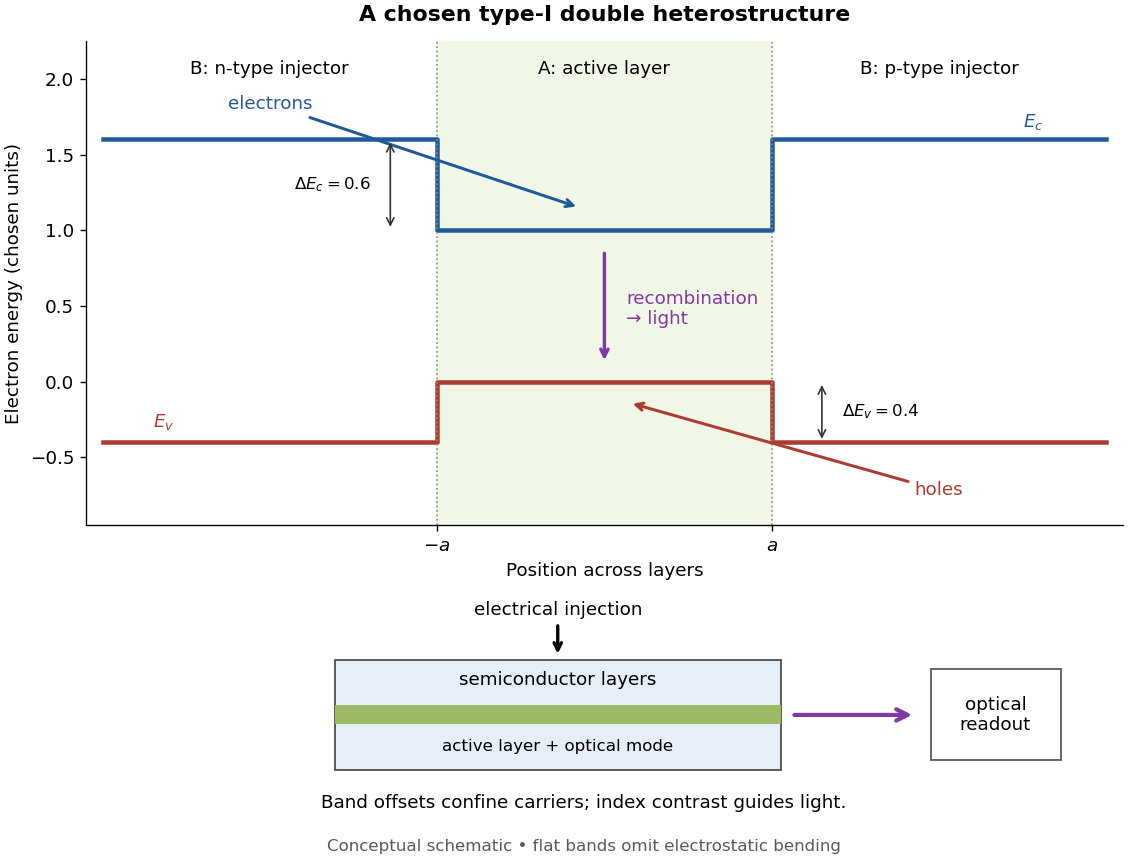
Chosen type-I band alignment: carrier injection and optical readout
. Original schematic using stipulated energy units. The upper panel plots electron energy band edges across the layers; the lower panel separates electrical pumping from the emerging light. Flat segments omit band bending. The curves do not reproduce a historical device. Source. Details.
For an original bookkeeping model, let be the injected pair rate per unit area, the active-layer thickness, its excess pair number density, a recombination lifetime, and an escape time. Before appreciable stimulated emission, supposeChoose two otherwise identical devices with and . The resulting steady state populations are and : improved confinement raises the population by a factor at fixed injection. This linear model assumes equal excess electron and electron hole densities, fixed lifetimes, and no laser gain clamping.
Optical confinement enters separately. For a chosen optical normal mode, define as its gain-overlap factor with the active layer. With material optical gain , internal loss , and mirror loss , a simple laser threshold condition isFor stipulated losses in inverse-length units, requires , whereas requires . This calculation varies optical overlap only; the preceding population calculation varies carrier escape only. Their combination explains the usefulness of controlling both the energy band profile and the optical normal mode.
Herbert Kroemer proposed the double heterostructure laser in 1963; he did not participate in its 1970 experimental realization.[ref]
Nobel Lecture: Quasielectric fields and band offsets: teaching electrons new tricks by Herbert Kroemer. §IV, p. 787
Zhores I. Alferov describes his group's independent 1963 proposal and later experimental program.[ref] Work by Donna Strickland 2026-10-18
Work by Donald E. Groom 2026-10-18
Work by Donald Arthur Glaser Created 2026-10-18 Updated 2026-10-24
Work by Domenico Pacini 2026-10-18
Sequencing primer 2026-10-18
There are unlisted articles, also show them or only show them.