
Work by Ernest Ambler 2026-10-18
Work by Eric A. Cornell Created 2026-10-18 Updated 2026-10-24
System of equations 2026-10-18
A system of equations requires one choice of unknowns to satisfy several equations at once. Its solution set is the intersection of the solution sets of the individual equations. For example, and ask for intersections of a unit circle and a parabola. A linear system is the special case in which every equation is linear in the unknowns.
Implicit equation Created 2026-10-18 Updated 2026-10-24
An implicit equation specifies a relation between variables without isolating a designated output as an explicit function of the inputs. For example, specifies a circle. On , it determines the two real branches , each an implicit function when one branch is selected. The implicit function theorem gives local conditions for a unique differentiable branch; implicit differentiation computes its derivative without first solving explicitly.
Work by Enrico Fermi 2026-10-18
Excitation energy Created 2026-10-18 Updated 2026-11-05
Excitation energy is an energy level's energy above a specified ground state. Emitted photon energies measure differences between levels, with a small recoil correction when the emitter has finite mass.
Nuclear energy level Created 2026-10-18 Updated 2026-10-20
A nuclear energy level is an energy eigenvalue of an atomic nucleus. Differences between levels give nuclear excitation energies and the approximate gamma ray energies of transitions.
Energy barrier Created 2026-10-18 Updated 2026-10-20
An energy barrier is an increase in energy that must be overcome along an allowed route between states. Its value depends on which paths or single-step moves are allowed; specifying only the energies of the endpoints does not determine the barrier.
Binding energy Created 2026-10-18 Updated 2026-10-20
Binding energy is the energy required to separate a bound state into specified free constituents. For an electron bound in a chemical atom, neglecting this cost is an assumption of the free-electron Compton scattering model.
Q value Created 2026-10-18 Updated 2026-10-20
The Q value of a reaction or particle decay is the initial total rest energy minus the final total rest energy. Positive releases kinetic energy; a negative requires energy supplied by incident motion or another source. Atomic and bare nuclear mass conventions must be distinguished when counting electrons in beta decay.
Microsome 2026-10-18
A microsome is a closed lipid bilayer compartment produced during disruption of a biological tissue; rough endoplasmic reticulum-derived microsomes provide a sealed compartment for protein targeting experiments.
Secretory protein routing 2026-10-18
Secretory protein routing connects entry into the endoplasmic reticulum, protein folding and sorting, transfer to the Golgi apparatus, and delivery onward. In the conventional soluble-cargo route, transport vesicles carry lumenal contents between compartments; exocytosis releases cargo outside the cell membrane. Resident endoplasmic reticulum proteins can be retained or retrieved, and defective cargo can be held back. Many cytosol proteins never enter this route.[ref]
The Endoplasmic Reticulum. The Cell: A Molecular Approach, 2nd edition by Geoffrey M. Cooper; Protein Folding and Processing in the ER, Figure 9.14; Export of Proteins and Lipids from the ER, Figures 9.20 and 9.21
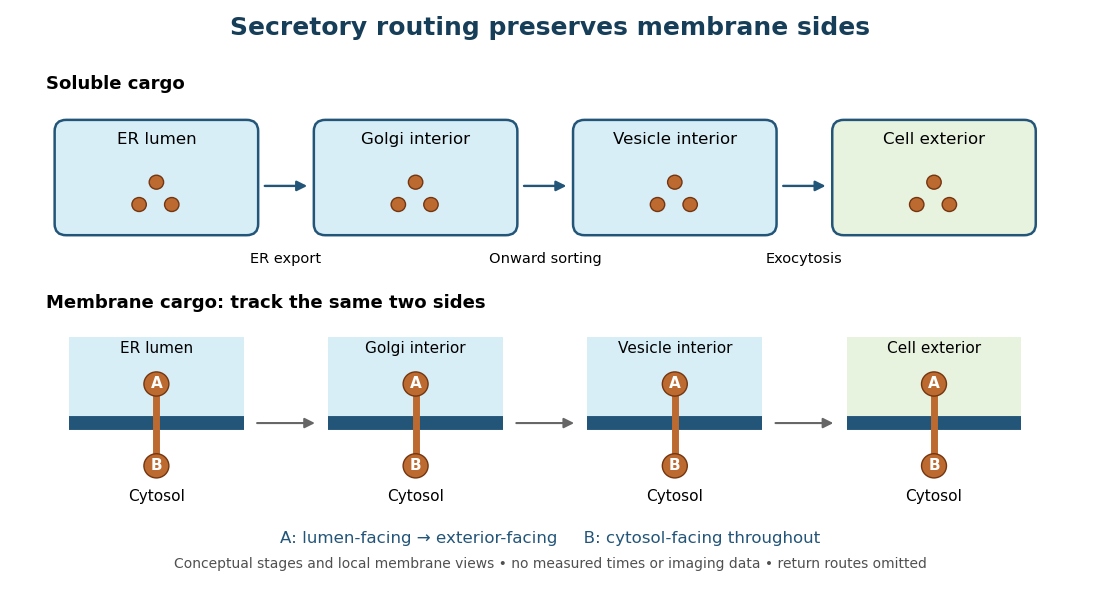
Secretory protein routing preserves membrane sides
. Original conceptual route for soluble cargo and a membrane protein. Intermediate compartments and return routes are omitted. Arrows show connectivity, not measured timing, fluorescence or electron microscopy. Details.
The useful geometric rule is preservation of membrane sides: during budding and fusion, a lumen-facing region of a membrane protein stays lumen-facing, then faces the exterior after exocytosis; its cytosol-facing region stays cytosolic.[ref]
Work through the schematic using two distinguishable labels A and B on a stipulated membrane protein. Start with A facing the ER lumen and B facing the cytosol. At each budding or fusion step, carry the surrounding membrane together with the labels; do not turn the protein over. The resulting pair is A facing the Golgi apparatus interior and B facing the cytosol, then A facing a transport vesicle interior and B facing the cytosol, and finally A facing the exterior and B facing the cytosol. This is a stepwise argument about the depicted operations, not a claim that the compartments have identical chemical contents. Likewise, once soluble cargo is inside the ER lumen, this schematic reaches the exterior with zero further crossings through a lipid bilayer: enclosed spaces join when membranes fuse. Delivery therefore need not mean repeatedly pushing a folded protein through a membrane.
Smooth endoplasmic reticulum 2026-10-18
Smooth endoplasmic reticulum lacks attached ribosomes. Specialized regions support lipid metabolism and processing of foreign compounds; the endoplasmic reticulum also stores and releases calcium ions. Regional specialization does not split the network into two separate organelles, nor make every smooth region perform every function.[ref]
The Endoplasmic Reticulum. Molecular Biology of the Cell, 4th edition by Bruce Alberts and others; Smooth ER Is Abundant in Some Specialized Cells, Figures 12-38A and 12-38B and calcium-storage paragraphs
Rough endoplasmic reticulum 2026-10-18
Rough endoplasmic reticulum bears attached ribosomes on its cytosol surface. In a common mammalian route, protein targeting delivers a nascent chain into the ER lumen during biological translation. Other proteins enter the membrane. Free and attached ribosomes share the same basic machinery; targeting depends on their cargo.[ref]
The Endoplasmic Reticulum. Molecular Biology of the Cell, 4th edition by Bruce Alberts and others; Membrane-bound Ribosomes Define the Rough ER, Figures 12-36 and 12-37; Translocation Across the ER Membrane Does Not Always Require Ongoing Polypeptide Chain Elongation
ER lumen Created 2026-10-18 Updated 2026-10-20
The ER lumen is the internal aqueous compartment of the endoplasmic reticulum. A ribosome attached to its membrane sits on the cytosol side, not inside the ER lumen. This distinction separates the machinery making a protein from the compartment receiving it.[ref]
The Endoplasmic Reticulum. Molecular Biology of the Cell, 4th edition by Bruce Alberts and others; Membrane-bound Ribosomes Define the Rough ER, Figure 12-36: cytosolic ribosomes and lumenal delivery
List of endocrinologists 2026-10-18
Work by Emmett Leith 2026-10-18
Work by Emilio Segrè 2026-10-18
Work by Émile Verdet 2026-10-18
Polarization ellipse Created 2026-10-18 Updated 2026-10-20
The polarization ellipse is the curve traced by the transverse electric field of a monochromatic wave at a fixed point. Its orientation and signed ratio of minor to major semiaxis specify a pure polarization. A zero minor semiaxis gives linear polarization, and equal semiaxes give circular polarization.
There are unlisted articles, also show them or only show them.