
Rectangular electromagnetic cavity Created 2026-10-18 Updated 2026-10-20
A closed rectangular perfect conductor cavity has discrete normal modes selected by zero tangential electric field at the walls. Each frequency has the displayed form. With all three indices positive there are two independent polarizations of an electromagnetic wave; modes with exactly one zero index have one, and those with two zero indices are absent. For example the family can have , independent of . It satisfies the wall conditions because is normal to the faces and tangential to the side walls. Omitting such zero-index families is harmless for leading bulk density of states, but changes the low-temperature physics of a thin cavity.
Synchrotron radiation Created 2026-10-18 Updated 2026-11-05
Synchrotron radiation is electromagnetic radiation emitted by relativistic charged particles undergoing transverse acceleration, typically when a magnetic field bends their paths. For ultrarelativistic particles, emission is concentrated near the instantaneous direction of motion rather than distributed isotropically.
A circulating electron beam therefore loses energy even when the bending magnet itself does no work. Radiofrequency accelerating fields replenish that loss in a storage ring. The extracted radiation is useful as an intense source for spectroscopy and imaging; its angular distribution, polarization and optical spectrum depend on particle energy and magnetic geometry. In synchrotron cooling, those same radiation losses reshape a particle population.
Radiation reaction Created 2026-10-18 Updated 2026-11-05
Radiation reaction is the influence on a source's motion of its own electromagnetic field, including the balance of radiated energy and momentum with changes of the near field. For sufficiently weak radiation loss, an averaged power balance can give the leading damping law without solving the full self-field dynamics. Replacing a constant-frequency radiation formula by its instantaneous slowly varying value requires an additional time-scale assumption; it is not an exact treatment of arbitrarily rapid motion changes.
Mutual induction 2026-10-18
Mutual induction is electromagnetic induction in one electrical circuit associated with a changing electric current in another. In a fixed linear arrangement, mutual inductance quantifies the coupling.
Inductive impulse outside a switched solenoid Created 2026-10-18 Updated 2026-10-20
Changing the magnetic flux through a long solenoid produces an exterior azimuthal electric field by Faraday's law of induction. A charge whose displacement is negligible during the switching receives mechanical momentumThe result assumes the usual quasistatic field approximation and neglects the particle's displacement while the pulse acts. It describes an electromagnetic induction effect, distinct from the static Aharonov-Bohm effect.
Integrated circuit 2026-10-18
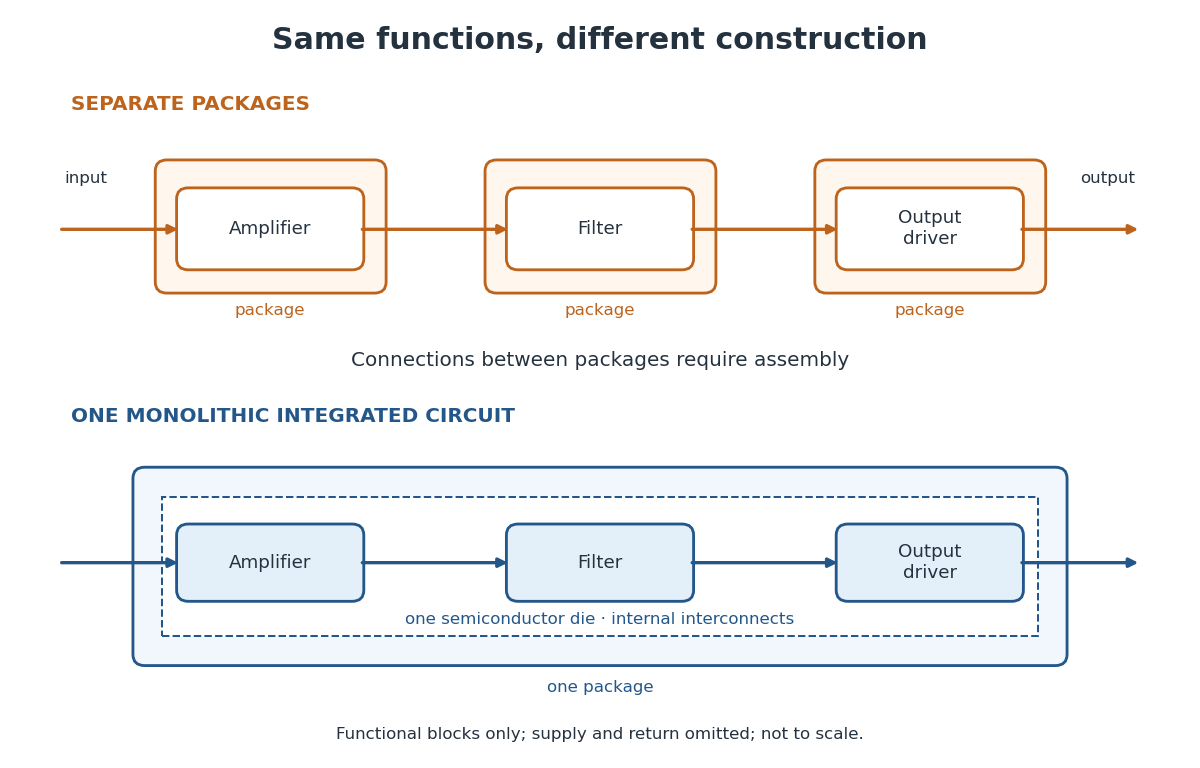
An integrated circuit combines interconnected electrical circuit elements in a fabricated structure. A monolithic integrated circuit forms its elements in or on one piece of semiconductor, rather than merely putting separately manufactured components into one enclosure. Transistors supply control in electronic amplifiers; resistors and capacitors can supply bias and timing. Jack St. Clair Kilby's patent describes making such functions from a common semiconductor body with compatible fabrication steps.[ref]
Miniaturized electronic circuits by Jack St. Clair Kilby. Description, opening statement of the invention and discussion preceding Figs. 1–5a
The useful change is to fabricate connections and functions together. Shrinking an enclosure still leaves individual parts to position and join. Integration makes their relative arrangement part of a repeatable fabrication pattern. The distinction is functional as well as geometric: one small piece can implement a whole electrical circuit, while its external terminals expose only the connections needed by its surroundings.

Gas-discharge tube Created 2026-10-18 Updated 2026-11-05
A gas-discharge tube conducts electric current through a gas made partially ionized by an applied electric field. Initial free electrons gain energy between collisions and can cause further ionization and excitation, producing a conducting discharge rather than ordinary conduction through a metal.
The behavior depends on gas composition, pressure, electrode spacing and the external circuit. Excited species can emit light, making a gas-discharge lamp; other designs use the discharge to switch current. A current-limiting external element often matters because discharge voltage need not increase with current like an ordinary resistor.
Biasing 2026-10-18
Setting steady electric potential differences and electric currents in an electrical circuit to choose its operating point.
Amplifier 2026-10-18
Series circuit 2026-10-18
A series circuit connects components along one unbranched path, so any electric current through the connected components is the same. Oriented terminal electric potential differences add along that path. In an open-circuit measurement, negligible electric current permits the electromotive forces of serially connected sources to add without appreciable internal electrical resistance drops.
Current-voltage characteristic 2026-10-18
A current-voltage characteristic describes the relation between terminal electric potential difference and electric current for specified physical conditions. A resistor obeying Ohm's law gives a straight line; a diode has an asymmetric relation.
LC circuit 2026-10-18
An ideal electrical circuit exchanges energy between an inductor and a capacitor. With no electrical resistance or applied drive, the electric charge obeys , giving angular frequency . A series RLC circuit adds dissipation and can include an external drive.
Parallel circuit 2026-10-18
A connection in which branches share both terminal nodes and therefore the same electric potential difference. Branch electric currents add. For sinusoidal signals, the total electrical admittance is the sum of branch electrical admittances; ideal capacitances add.
Two-port network 2026-10-18
A two-port network relates voltage and current, or incoming and outgoing travelling-wave amplitudes, at two pairs of electrical terminals. Power-normalized scattering parameters obey . In a reciprocal network with equal reference impedances, . A load reflection at port 2 can return through both transmission coefficients to port 1.
Wien bridge 2026-10-18
An alternating-current electrical circuit comparing a parallel resistor-capacitor arm with a series resistor-capacitor arm. Let the upper-left arm have electrical impedance , the lower-left arm , and the upper-right and lower-right arms have electrical resistances . For input between the upper and lower nodes and an unloaded difference measurement between the arm junctions, voltage divider balance requires . Separating real and imaginary parts givesThe balance angular frequency is positive for positive components. Equal and require and . Reversing which reactive arm is upper changes the divider ratios, so the connections must always be specified.
Virtual ground 2026-10-18
A circuit node held close to zero electric potential by active feedback, without being directly connected to the reference conductor. In an ideal linear operational amplifier with its non-inverting input grounded and stable negative feedback, while neither input draws electric current. External branch currents meeting the inverting node therefore obey Kirchhoff's current law without flowing into the amplifier input. Equality of the input potentials fails when the output saturates or the feedback ceases to enforce linear operation.
Open circuit 2026-10-18
An ideal open circuit permits no conduction electric current through a terminal pair, corresponding to infinite load electrical impedance. At the end of a lossless transmission line, its voltage-wave reflection coefficient is and the terminal current is zero. Real open terminals may retain parasitic capacitance and radiation loss.
Short circuit Created 2026-10-18 Updated 2026-11-05
An ideal short circuit fixes zero electric potential difference across a terminal pair, corresponding to zero load electrical impedance. At the end of a lossless transmission line, its voltage-wave reflection coefficient is and the terminal voltage is zero. The available current is still limited by source and circuit impedances; real short circuits can dissipate substantial Joule heating.
Electric field line Created 2026-10-18 Updated 2026-10-20
An oriented curve whose tangent points along the local electric field. Where the field is nonzero, choosing arc length gives . These curves visualize the direction of the force on a positive test charge; they are not generally particle trajectories, since a particle can have inertia and initial velocity. In electrostatics, they are normal to equipotential surfaces and cannot form a closed loop in a region with a single-valued potential that strictly decreases along the line. A field null can separate families of lines.
Charged particle Created 2026-10-18 Updated 2026-11-05
A charged particle carries nonzero electric charge and couples to an electromagnetic field. For a classical point particle, the Lorentz force is in SI, distinguishing electric acceleration from velocity-dependent magnetic deflection.
An electron, a proton and an ion are examples with different masses and charge-to-mass ratios. A magnetic field can bend their tracks in a particle detector, while ionization along the path makes them observable in a cloud chamber or bubble chamber. A neutral particle can still interact electromagnetically through internal structure or moments; zero net charge does not imply total electromagnetic invisibility.
There are unlisted articles, also show them or only show them.