
Summation loop verification Created 2026-10-18 Updated 2026-10-31
Compute , the triangular number , for a nonnegative integer . The empty sum gives zero when . Use exact mathematical integers and keep the input unchanged; every comparison and variable assignment is a terminating operation. The original sequential procedure isThe order of the two variable assignments matters: the addition uses the newly incremented . For , the pairs at successive condition checks are . At the last check, is false, and the returned sum is .
require n is an integer and n >= 0
i = 0
s = 0
while i < n:
    i = i + 1
    s = s + i
return s
The precondition is with , under the exact-arithmetic model just stated. The postcondition for returned value is , with still equal to its starting value. At each condition check use the loop invariantand the loop variant . The equation says that the accumulator is the triangular number for precisely the processed prefix ; the inequalities connect that prefix to the loop's condition.
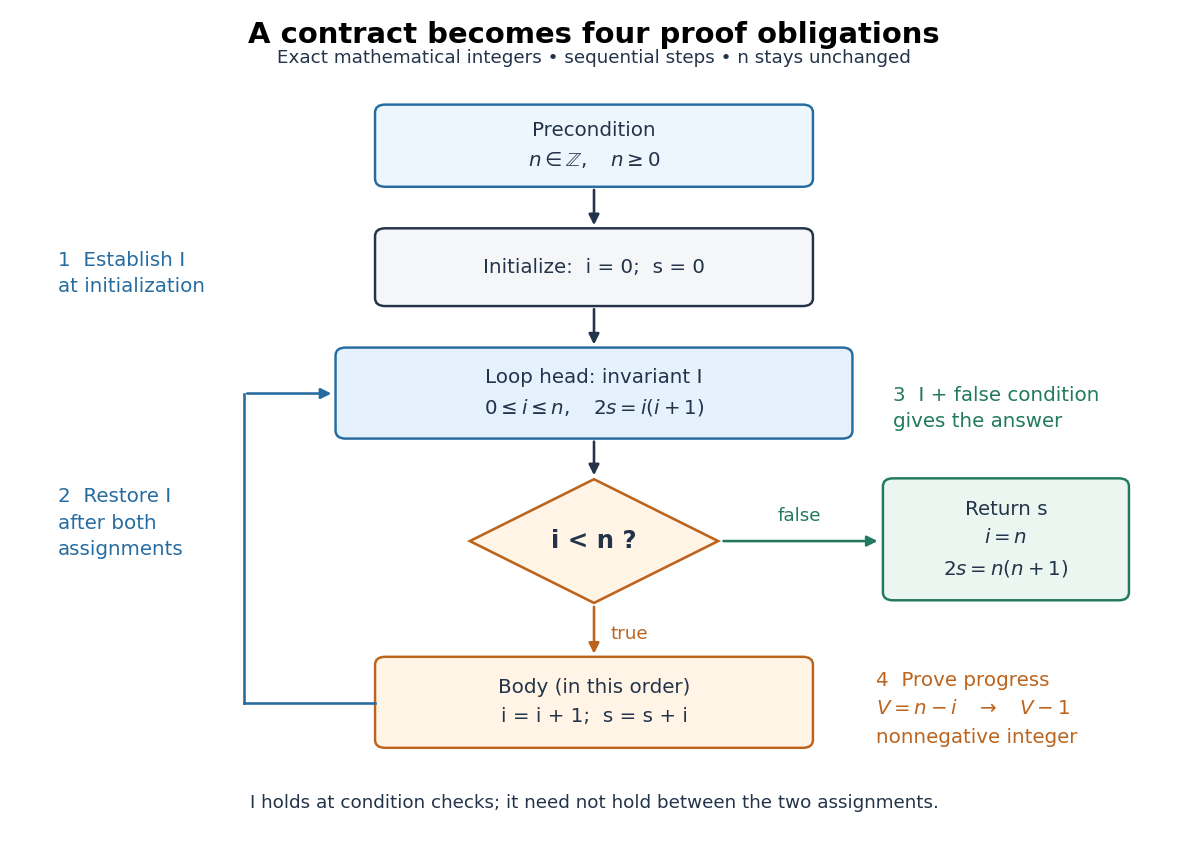
The summation loop restores its invariant before each condition check
. Original sequential control flow for the summation loop verification. The blue loop head carries the loop invariant; the orange body increments before adding it to . A false condition leads to the postcondition. The loop variant decreases on the return arrow. All values are mathematical integers and remains unchanged. Details.
Initialization gives , so holds, including when . For preservation, let the old values satisfy and . Write and for the values after both variable assignments. Since are integers, gives , andThus the completed body restores . Between the two variable assignments, the equation can be false; the loop invariant is required at the loop head. This preservation step is mathematical induction on the number of completed iterations.
At exit, the false condition gives , while gives . Hence , so : this proves partial correctness. For algorithm termination, gives the nonnegative integer . When the condition is true, ; the terminating body gives . Therefore the loop cannot repeat forever. Together these arguments prove total correctness for every permitted input, including .
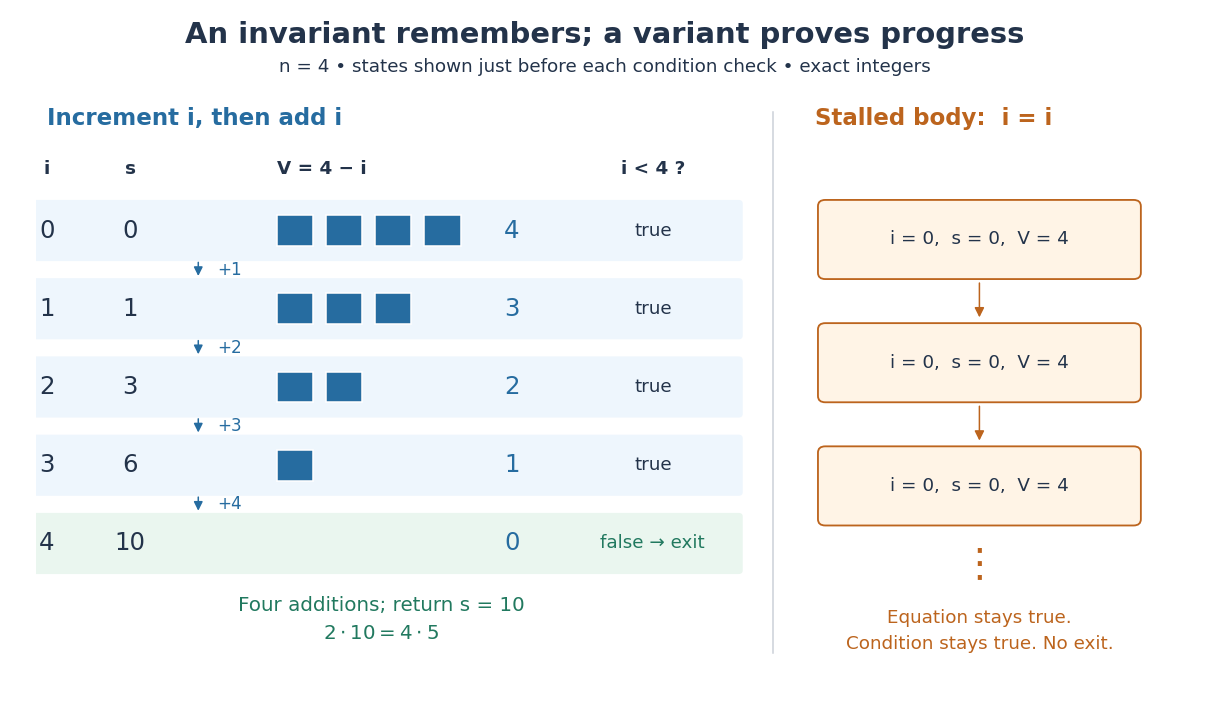

Two changes expose what the proof checks. Swapping the two body instructions computes , returning rather than for . Leaving unchanged can preserve an initial equation forever without producing any answer. The first change breaks the intended postcondition; the second breaks algorithm termination. A trace can reveal these failures, while the two proof obligations explain them.
The exact-arithmetic assumption has a concrete boundary. In a stipulated unsigned eight-bit model where each addition wraps modulo , fits in the input representation, but its intended triangular number is . The stored accumulator instead finishes at , so the mathematical postcondition fails. This is integer overflow, and the proof above does not apply to that altered model. Restricting the same implementation to prevents overflow in its stored loop values, since ; alternatively use a representation supporting the required exact integer arithmetic. The equations in the proof are mathematical statements, not instructions to evaluate products in eight bits.
Force per unit length 2026-10-18
A force per unit length describes a distributed force on a filament and has units . For a charged filament with linear charge density and longitudinal current , the external Lorentz force is . Length, density and force must all refer to the same measurement frame. An infinite uniform filament generally has a finite force density but no finite total force.
Entropic force 2026-10-18
An entropic force is the part of a generalized force arising from the dependence of entropy on a coordinate. At fixed temperature, the system's force is , where is the Helmholtz free energy. If the internal energy is independent of the coordinate, the force is entirely entropic. For an ideal chain whose configurations become less numerous on extension, it acts toward shorter extension. The external tension holding the chain extended has the opposite sign. Thus the force depends on the statistical number of available configurations, even when the energy of each configuration is unchanged.
Thrust Created 2026-10-18 Updated 2026-10-20
A propulsive force exerted on a body by an engine or another momentum-transfer mechanism. In a vehicle moving through a fluid, its direction need not coincide with the vehicle's actual velocity, and a transverse component can steer the motion. The component along the velocity contributes mechanical power ; a purely transverse component changes direction without doing instantaneous work. Rocket thrust is one particular mechanism and includes momentum carried by expelled material.
FADH2 Created 2026-10-18 Updated 2026-11-05
Global convergence of a square-root iteration Created 2026-10-18 Updated 2026-10-31
For every , this recurrence relation converges to the unique nonnegative fixed point . If , then , since . If , then . Thus the iterates form a monotone bounded sequence, and continuity forces their limit to be . A cobweb plot alternates vertical steps to and horizontal steps to , approaching the same intersection from either side. More quantitatively,so the error keeps its sign and decreases in absolute value by at least the uniform factor . The asymptotic factor is .
Ground state of a finite square well Created 2026-10-18 Updated 2026-11-05
For on and outside, the lowest bound state is even about , has no nodes, and has . Write and . The interior wavefunction is proportional to ; the exterior tails decay exponentially. Wavefunction matching at a finite potential step gives the displayed condition. Its lowest root has , so , the infinite square well ground state energy. As increases, the penetration length tends to zero and that limiting energy is approached from below.
MOSFET 2026-10-18
A metal-oxide-semiconductor field-effect transistor, with an insulating layer separating the gate from the semiconductor. Its gate electric field controls the channel's mobile charge carriers; a semiconductor inversion layer can form a two-dimensional electron gas.
Junction field-effect transistor Created 2026-10-18 Updated 2026-10-20
A junction field-effect transistor controls a conducting semiconductor channel using reverse-biased p-n junctions at its gate. Changing gate voltage changes the depletion region and therefore the cross-section available to mobile charge carriers. A depletion-mode n-channel device normally conducts at zero gate-source voltage and is depleted by a more negative gate. The small reverse gate electric current gives high input resistance, while a source-drain supply provides output power.
Zero sound 2026-10-18
Zero sound is a collisionless collective Fermi surface deformation sustained by Landau quasiparticle interactions.[ref]
Oscillations in a Fermi Liquid by Lev Davidovich Landau. Opening and section 1, pp.101–103
A useful analogy is a crowd whose members respond to their neighbors' density without repeatedly bumping into them: the restoring interaction can remain effective when collisions cannot relax the distribution within one cycle. Zero sound is collective; it is not a single Landau quasiparticle outrunning every other excitation.
Landau quasiparticle 2026-10-18
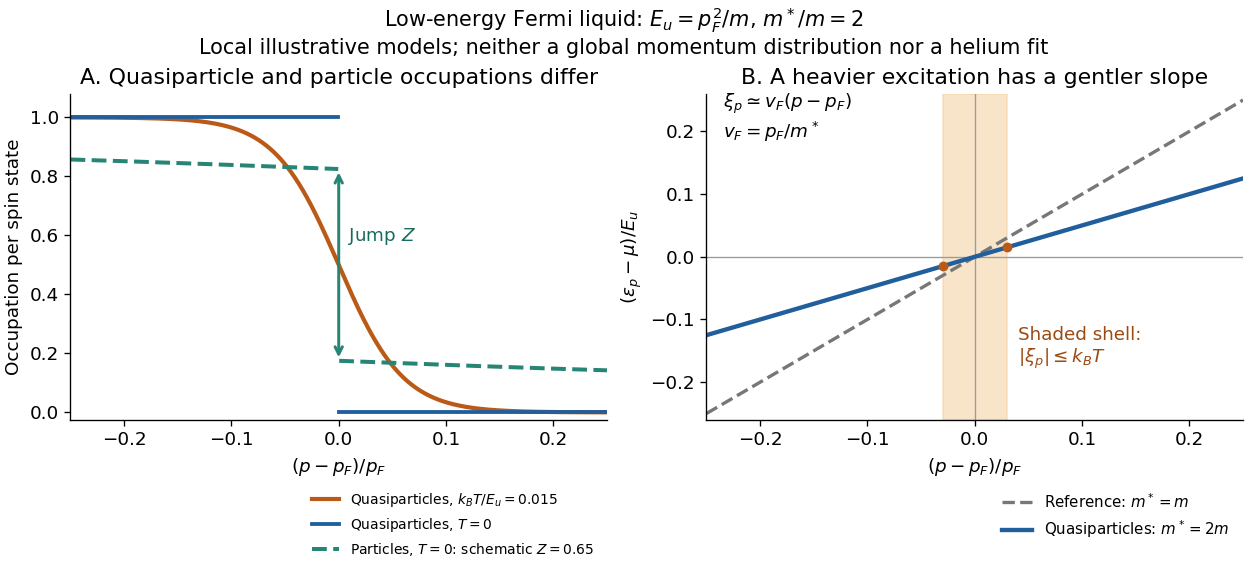
A Landau quasiparticle is a fermionic excitation connected continuously to a Fermi gas particle when interactions preserve the phase. Near an isotropic Fermi surface, its energy relative to the chemical potential is , with Fermi momentum and Fermi velocity .[ref]
The Theory of a Fermi Liquid by Lev Davidovich Landau. Section 1, pp.921–922
The Pauli exclusion principle restricts decay. For a three-dimensional normal Fermi liquid with regular short-range interactions, a representative low-energy lifetime model isHere is an energy scale and is dimensionless; sharpness requires at zero temperature.[ref]
Renormalization Group Approach to Interacting Fermions by Ramamurti Shankar. Section VIII, manuscript p.114, quadratic lifetime corrections
For an original example, stipulate and . At , the decay energy is , just of the excitation energy; halving reduces that ratio to . Approaching the Fermi surface improves the particle description even though the microscopic interaction has not weakened. This quadratic illustration is three-dimensional; low-dimensional corrections require separate analysis.

Work by Ferenc Krausz 2026-10-18
Work by Felix Bloch 2026-10-18
Work by Farrokh Vakili 2026-10-18
Work by F. Duncan M. Haldane Created 2026-10-18 Updated 2026-11-05
Gauge length 2026-10-18
The gauge length is the initial separation of the points whose extension defines a reported engineering strain. It need not equal the full deforming length between grips.
For a constant-rate radiation measurement through identical absorbing sheets, a simple Poisson distribution model has expected counts . Here is the unattenuated signal rate, is attenuation per sheet, is an additive background rate and is exposure. At low attenuation the signal is approximately exponential; at strong attenuation the observed rate approaches . Consequently a logarithmic plot of raw counts bends towards a plateau rather than remaining a straight line. Measure background independently with the source absent, or fit it with its uncertainty; subtracting it and then taking a logarithm is unreliable when the net count is small or negative.
Work by Evgeny Epelbaum 2026-10-18
Work by Evangelista Torricelli 2026-10-18
Total time derivatives preserve fixed-endpoint Euler-Lagrange equations Created 2026-10-18 Updated 2026-11-05
Adding a total derivative to a Lagrangian changes its action only by . Under fixed-endpoint variations, this boundary term is constant, so the Euler-Lagrange equations and their minimizing paths are unchanged. Componentwise, by equality of mixed partial derivatives. Endpoint freedom would require reconsidering the resulting natural boundary conditions for a free endpoint.
There are unlisted articles, also show them or only show them.