
Sanger sequencing Created 2026-10-18 Updated 2026-10-20
Sanger sequencing determines a DNA nucleotide sequence by extending a common sequencing primer and occasionally incorporating a dideoxynucleoside triphosphate. A normal deoxynucleoside triphosphate already has hydrogen in place of a hydroxy group; it retains the hydroxy group. A dideoxynucleoside triphosphate lacks that hydroxy group too. It can join the growing strand because the preceding nucleotide supplies the reacting hydroxy group. Once incorporated, its own end cannot form the next phosphodiester bond. Thus the blocked step is the next addition, not attachment of the terminator itself.[ref]
Isolating, Cloning, and Sequencing DNA. Alberts and others, Molecular Biology of the Cell, 4th edition (2002), Isolating, Cloning, and Sequencing DNA, Figure 8-36 and accompanying dideoxy-method explanation
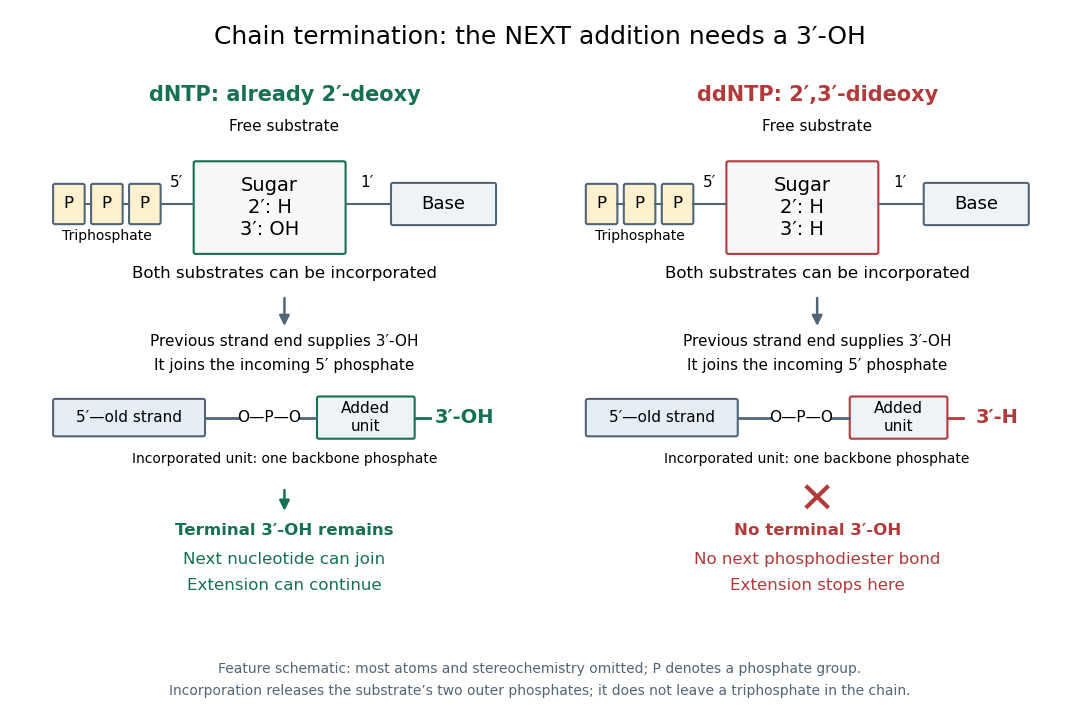

In the historical four-reaction format, each tube receives copies of the same template, the same sequencing primer, a DNA polymerase and all four ordinary deoxynucleoside triphosphates. The tubes differ in their terminating substrate: ddATP, ddCTP, ddGTP or ddTTP. In the A reaction, ordinary dATP can allow copying to continue past one A position, whereas incorporation of ddATP stops another copy there. Competition produces a family of endpoints, rather than every strand stopping at the first A. Adjusting substrate proportions makes later endpoints detectable. A lane identifies the terminating nucleobase in the new strand, not the complementary template letter.[ref]
Sequencing Genomes. T. A. Brown, Genomes, 2nd edition (2002), section 6.1.1, Chain termination sequencing in outline
The readout requires gel electrophoresis capable of separating single-stranded DNA fragments differing by one nucleotide. Historical denaturing polyacrylamide gel electrophoresis suppressed strand folding and resolved these adjacent lengths; radioactive labels were detected by autoradiography. An ordinary agarose gel electrophoresis comparison with a 100-base pair DNA ladder does not supply that resolution. Four separate reaction lanes carry the identities in this format.[ref]
Origin of replication 2026-10-18
An origin of replication is a DNA region at which DNA replication is initiated. Its function depends on compatible cellular machinery.
Replicon 2026-10-18
Dideoxynucleoside triphosphate 2026-10-18
Charge stabilization of colloids Created 2026-10-18 Updated 2026-10-20
Like-charged colloids can resist aggregation because bringing their electric double layers together costs free energy. In DLVO theory, screened electrostatic repulsion competes with attractive Van der Waals forces. A repulsive barrier much larger than suppresses thermally activated aggregation, although the dispersion can remain metastable. Lower ionic strength generally lengthens the Debye–Hückel screening length, while multivalent counterions or added salt shorten it and can lower the barrier. The surface charge, charge regulation and solvent-dependent attraction also matter; screening length alone does not guarantee stability.
Closest point on a plane 2026-10-18
For a nonzero normal vector and the plane equation , the closest point on a plane to isIt subtracts only the normal displacement. Substituting gives , so lies on the plane; the difference is a scalar multiple of its normal vector. These two checks identify the orthogonal projection onto a plane without solving a three-variable minimization problem.
For , , and , the residual givesIndeed, , and . Choosing the plane point instead gives distance : being on the plane does not make a point the nearest one.
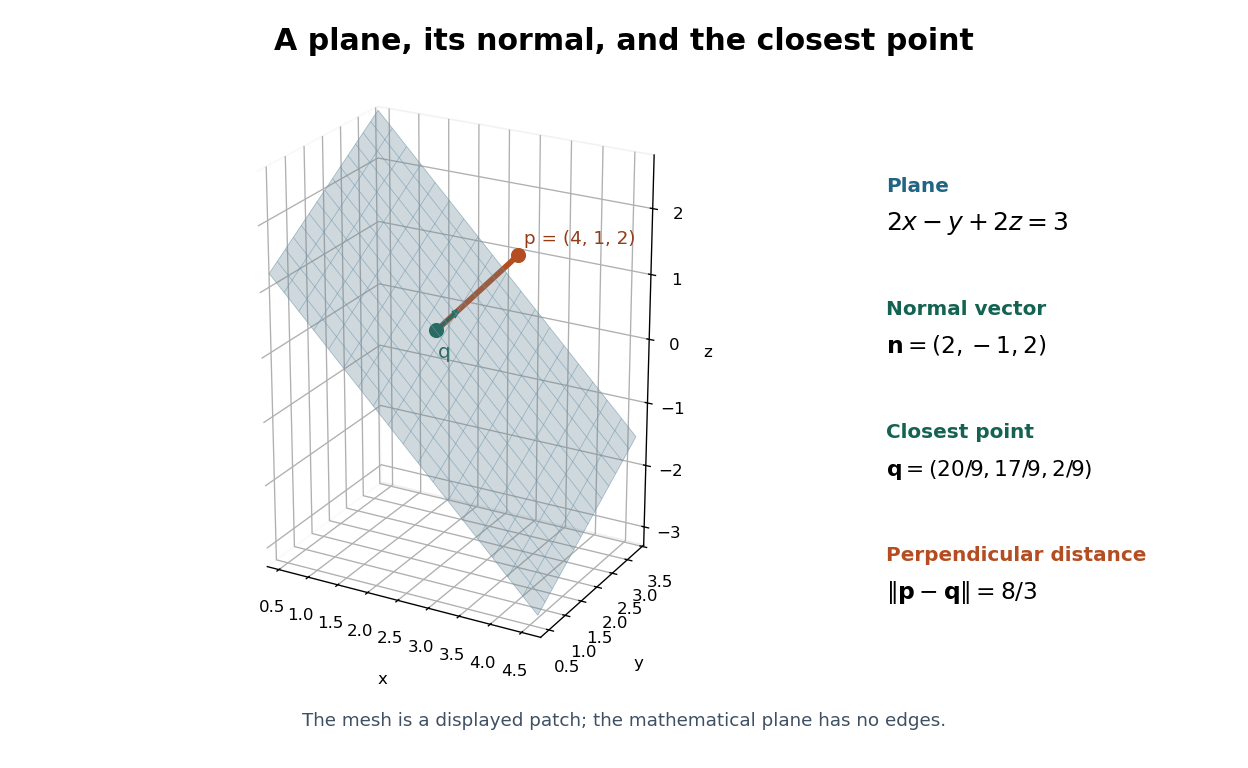
The closest point on a plane is reached along its normal vector
. Original three-dimensional example , with and . The finite mesh is only a displayed patch of the infinite plane; it is not a physical measurement. Details.
As a function of , this projection isIt is an affine map, becoming a linear map when . Projecting a second time changes nothing. It preserves displacements along the plane and removes the normal displacement, so it is a concrete example of an idempotent map.
Mean displacement 2026-10-18
The mean displacement is the expected value of a particle's displacement over a time interval. It describes systematic transport, while the mean squared displacement also measures fluctuations. For one component with finite second moment,For constant drift speed and ordinary diffusion of coefficient , the mean displacement is and its centered variance is , so the uncentered mean squared displacement is . With fixed initial velocity and free inertial Langevin dynamics, the mean displacement is , where is the velocity relaxation time. Its fluctuation variance is given by the integrated Ornstein-Uhlenbeck displacement.
Path compression 2026-10-18
Path compression changes parent pointers during a disjoint-set find operation so that future queries traverse fewer edges. Full path compression first follows the entire parent route to its root of a tree, then makes every member on that route point directly to that same root of a tree. No member changes its block of a set partition or its disjoint-set representative. Pointers outside the traversed route stay as they were. The following iterative Python implements full path compression and union by rank;
parent and rank are initially indexed arrays with parent[x] = x and rank[x] = 0 for every valid member.def find(x):
root = x
while parent[root] != root:
root = parent[root]
while parent[x] != x:
following = parent[x]
parent[x] = root
x = following
return root
def unite(x, y):
a, b = find(x), find(y)
if a == b:
return False
if rank[a] < rank[b]:
a, b = b, a
parent[b] = a
if rank[a] == rank[b]:
rank[a] += 1
return TrueStarting from the displayed disjoint-set forest,
find(3) traverses , returns and changes only from to . The route still has two edges. Then find(5) changes only from to . The final parent array is ; every stored rank retains its displayed value. The rooted tree at now has height one although its root's rank is two. Root still represents a separate singleton set.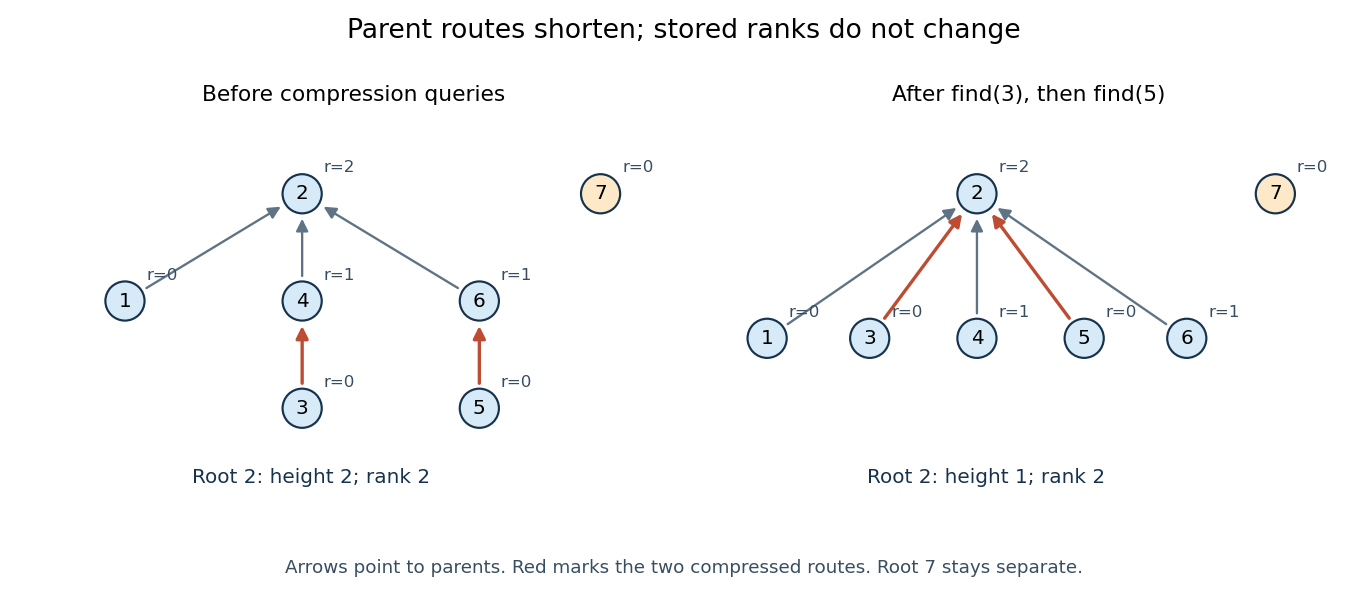
find(3) followed by find(5). Labels record stored ranks, including historical ranks at nonroots. Details.
The two-pass algorithm first discovers the answer and then reuses it. During the second pass, saving
following before overwriting the pointer preserves the remaining route. Every replacement pointer targets the original root of a tree, proving that the partition of a set is unchanged.Full path compression is one specific rule. The authored
UF.java implementation instead uses path halving, redirecting a visited member to its parent's parent while advancing along the route. Its union by rank rule agrees with the one above.[ref]UF.java. Algorithms, 4th edition by Robert Sedgewick and others; UF.java, find and union methods: halving assignment versus the full-compression algorithm here; lower-rank linking and equal-rank increment
Union by rank 2026-10-18
Union by rank keeps a nonnegative integer rank, initially zero, for each member. For each input, obtain its root of a tree using the disjoint-set find operation, then compare the resulting ranks. Attach the lower-rank root of a tree below the higher-rank root of a tree, leaving both ranks unchanged. When the two disjoint-set representatives differ but their ranks are equal, choose either survivor and increase its rank by exactly one. A redundant disjoint-set union operation changes no ranks. Path compression also changes no ranks. The surviving root's rank bounds the height of its rooted tree, measured in edges; after path compression it need not equal that height.[ref]
COS 226 Bob’s Notes 1: Union-Find and Percolation (Version 2) by Robert Tarjan. Robert Tarjan, COS 226 Bob’s Notes 1: Union-Find and Percolation, Version 2, Fall 2010, p. 4: rank linking, equal-rank increment and upper-bound interpretation after compression
In our example, let the first argument's root of a tree survive equal-rank ties. The first two merges create roots , each of rank . The third gives and increases the rank of to . The fourth creates root of rank . The fifth attaches below without increasing any rank. Before any subsequent compression queries, the indexed arrays areThe redundant call on leaves these arrays unchanged. In particular, the disjoint-set representative of is , although is the minimum member of its block of a set partition.
Two short arguments explain the rank invariant. First, a root of rank has at least members in its block of a set partition: rank zero starts with one, and increasing rank combines two disjoint blocks of a set partition with at least members each. Unequal-rank linking only adds members. Thus every rank is at most for stored members, using the floor function and logarithm. Second, height is initially zero; unequal-rank linking adds at most one to the lower height, while equal-rank linking raises the available bound by one. Path compression only shortens routes. These arguments prove a height bound, not the stronger amortized analysis below.
Work by Dirk Bouwmeester 2026-10-18
Harmonic extension 2026-10-18
A harmonic extension of boundary data is a harmonic function satisfying those Dirichlet boundary data in a specified solution class. Existence and uniqueness depend on the domain, the regularity of the data and, on unbounded domains, growth conditions. A Poisson kernel constructs such an extension on standard domains.
In outside the circle with , the displayed bounded harmonic function is zero on the imaginary axis and on the circle. Put . The circle is the Apollonius circle ; its centre and radius are and . The point lies inside the excluded disk and outside the half-plane, so the logarithmic modulus is harmonic throughout the physical domain. Local branches of the complex logarithm suffice; its real part is globally single-valued even though a global complex logarithm need not exist. The potential tends to zero at infinity. A boundedness or far-field condition is needed to infer uniqueness from the finite boundary data. This is also the geometry of cylinder-plane image charges.
Work by Dinene Crater 2026-10-18
Leibniz integral rule 2026-10-18
For differentiable endpoints and a function with suitable continuous partial derivative in the parameter, the moving-endpoint rule isTo prove it locally, put for a fixed reference endpoint . The original integral is . Apply the chain rule, use the fundamental theorem of calculus for , and use differentiation under the integral sign for . The two boundary terms account for the moving endpoints, while the remaining integral accounts for variation of the integrand with the parameter. For improper integrals, convergence and a suitable domination condition must be verified before interchanging the derivative and integral.
Logarithmic quadratic parameter integral 2026-10-18
For every real parameter ,where . For , differentiation under the integral sign and a partial fraction decomposition giveSolving this first-order linear differential equation yields . To fix the constant, dominated convergence gives ; the last absolutely convergent integral changes sign under . Thus . Oddness in supplies the result for negative parameters. The initial value alone does not determine , since every solution tends to zero as .
For real , the displayed improper integral converges and is an even function of . For , differentiation under the integral sign and partial fraction decomposition giveFor , use . Integrate the resulting rational functions and extend to by continuity. Integrating in and using gives for ; evenness gives the formula for negative parameters. Thus away from zero. At zero the one-sided derivatives are opposite, so is continuous but not differentiable. Substituting into the pointwise differentiated integrand would therefore be an invalid interchange.
Logarithmic sine integral 2026-10-18
For every real , define . The apparent endpoint singularity at is removable, with limit , and the bound ensures integrability. Differentiation under the integral sign is justified by the integrable bound on the parameter derivative. Thuswhere and the last integral is a Laplace transform. Since , integrating with respect to gives . This obtains an integral with a logarithmic denominator by differentiating away that denominator, then restoring the parameter dependence with one elementary antiderivative.
Logarithmic moments of a power on the unit interval Created 2026-10-18 Updated 2026-10-24
For real and integer , start from and differentiate times with respect to . Each derivative adds one factor , givingTo justify differentiation under the integral sign, restrict to a compact interval with lower endpoint . The derivatives are dominated by , which is integrable: turns its integral into . A power of is integrable against this decaying exponential. This also explains why is the convergence threshold.
ABBA measurement sequence 2026-10-18
Alternating sample and reference readings can suppress instrument drift. In this original four-reading model, measure objects at equally spaced times . Assume the objects are stable during that short sequence and each reading is its object's length plus the same affine function of time, . Thenbecause both pairs have mean time . The constant offset and linear drift cancel. With a further drift term , direct substitution instead leaves bias . A shorter sequence reduces that term, but neither this ordering nor averaging corrects unequal temperatures, sample changes or reference measurement uncertainty. This is a modern illustrative protocol; the historical account below establishes alternation, without attributing this particular four-reading sequence to Charles-Édouard Guillaume.
Stationary solution 2026-10-18
A stationary solution of an evolution differential equation is independent of time. Substituting leaves the spatial boundary value problem that determines its profile. For an ordinary differential equation this is an equilibrium; for a partial differential equation it may vary in space. A stationary profile need not have zero flux, although zero flux is forced in a one-dimensional conserved system with reflecting endpoints.
There are unlisted articles, also show them or only show them.