
Alexander Reid Created 2026-10-18 Updated 2026-11-05
An experimental physicist who studied electron diffraction by sending cathode rays through thin celluloid films. His contemporary scientific obituary identifies this research and the definitive paper that followed the preliminary report. A transmitted electron beam developing an angular diffraction pattern tests the matter wave description of electrons, connecting a particle beam produced in a vacuum apparatus with phenomena familiar from wave optics.[ref]
Obituary of Alexander Reid in Nature. Scientific-work paragraph: diffraction of cathode rays through thin celluloid films and the preliminary and definitive reports
Hugo Atterling Created 2026-10-18 Updated 2026-11-05
Hugo Atterling's scientific memoir of Manne Siegbahn explains how apparatus and source composition shaped early X-ray spectroscopy. One example traces two unexpected lines in a 1914 spectrum to a silver layer beneath a platinum coating, observed in first and second diffraction orders. The account connects identification of a chemical element with the interpretation of the instrument, rather than treating each observed line as a new property of the nominal target. His memoir also documents the development of precision and vacuum spectrometers.[ref]
Manne Siegbahn, His Research by Hugo Atterling. Early work on X-ray spectroscopy; development of precision spectroscopy; authored memoir published 1991
Physics.[ref]
https://www.ne.se/uppslagsverk/skola/avancerad/hugo-atterling. Independent professional profile
Werner Heisenberg Created 2026-10-18 Updated 2026-11-05
Werner Heisenberg's 1925 reformulation of quantum mechanics replaced unobservable classical electron orbits with quantities attached to transitions between stationary quantum states. Transition frequencies combine as , suggesting the indexed product rule that became matrix multiplication. The resulting physical quantities need not commute. This approach made measured spectral lines and transition strengths the starting data for a new dynamics rather than requiring a miniature classical planetary model of the atom.[ref]
On the quantum reinterpretation of kinematical and mechanical relationships by Werner Heisenberg. 1925 paper, transition quantities and their multiplication rule

Portrait of Werner Heisenberg
. Source. Enrico Fermi Created 2026-10-18 Updated 2026-11-05
Enrico Fermi developed neutron bombardment as a way to create and investigate radioactive isotopes. Unlike a charged projectile, a neutron does not face the same repulsive potential barrier when approaching a positive atomic nucleus. Induced radioactivity supplies a delayed readout of reactions that occurred during irradiation. His Nobel lecture describes how comparing target materials, projectile conditions and the subsequent decay products connected experimental activation with the structure and transformations of atomic nuclei.[ref]
Artificial Radioactivity Produced by Neutron Bombardment. 1938 Nobel lecture, neutron bombardment and induced activity
A physicist.[ref]
https://www.nobelprize.org/prizes/physics/1938/fermi/biographical/. Independent professional profile

Portrait of Enrico Fermi
. Source. Edoardo Amaldi Created 2026-10-18 Updated 2026-11-05
Edoardo Amaldi coauthored the 1934 investigation of hydrogenous materials and neutron-induced radioactivity. The enhanced activation observed with paraffin wax showed that the material between source and target could improve the production of radioactive nuclei. Neutron moderation supplies the physical connection: collisions change the neutron energy distribution and hence the chance of a later nuclear reaction.[ref]
Azione di sostanze idrogenate sulla radioattività provocata da neutroni. I by Enrico Fermi and others. 1934 communication, collected translation no. 105b, pp. 761–762
A physicist.[ref]
https://home.cern/about/who-we-are/our-people/edoardo-amaldi/. Independent professional profile

Portrait of Edoardo Amaldi
. Unknown photographer (Mondadori Publishers), 1960; existing Commons crop by Materialscientist. Public domain in Italy (PD-Italy simple photograph, expired term). Source usage terms, via Wikimedia Commons. Source. Franco Rasetti Created 2026-10-18 Updated 2026-11-05
An experimental nuclear physicist who coauthored the study of hydrogenous substances in neutron-induced radioactivity. Placing paraffin wax around a source and target could enhance activation rather than merely absorb the radiation. Collisions with light nuclei slow the neutrons, connecting neutron moderation to the probability of subsequent nuclear reactions.[ref]
Azione di sostanze idrogenate sulla radioattività provocata da neutroni. I by Enrico Fermi and others. Collected translation no. 105b, pp. 761–762: hydrogenous materials and enhanced activation
Emilio Segrè Created 2026-10-18 Updated 2026-11-05
Emilio Segrè coauthored experiments showing that hydrogen-rich material can enhance neutron-induced radioactivity. Placing paraffin wax around the irradiation arrangement changed activation rather than merely shielding the target. Collisions with light nuclei slow the neutrons, altering their subsequent nuclear-reaction probabilities. This made the surrounding material part of the experiment and helped establish neutron moderation as a method for controlling induced radioactivity.[ref]
Azione di sostanze idrogenate sulla radioattività provocata da neutroni. I by Enrico Fermi and others. 1934 communication, collected translation no. 105b, pp. 761–762
A physicist.[ref]
https://www.lbl.gov/people/excellence/nobelists/emilio-segre/. Independent professional profile

Portrait of Emilio Segrè
. Photolab; LBL Collection; 28 April 1954. Public domain in the United States: publication without copyright notice (PD-US-no-notice). Source usage terms, via Wikimedia Commons. Source. Bruno Pontecorvo Created 2026-10-18 Updated 2026-11-05
Bruno Pontecorvo helped uncover the importance of slowing neutrons in induced radioactivity. While investigating the activation of silver, he noticed that the supporting material changed the resulting activity. Comparing a wooden table with other surroundings led to tests of hydrogen-rich materials and the enhancement caused by slower neutrons. His later neutron well-logging work used returning radiation to probe geological layers, connecting the same moderation physics with an applied measurement.[ref]
The Scientist by the Bruno Pontecorvo Department Centre. Silver-activation and wooden-table passage; neutron well-logging account
A physicist.[ref]
The Scientist by the Bruno Pontecorvo Department Centre. Independent professional profile

Portrait of Bruno Pontecorvo
. Unknown photographer; existing portrait crop by Mdd from Bruno Pontecorvo 1955.jpg, via Wikimedia Commons. Public domain in Italy under Commons PD-Italy for a simple photograph. File includes conditional U.S. reuse language; no separate U.S. determination is claimed here. Source usage terms, via Wikimedia Commons. Source. Jerrold R. Zacharias Created 2026-10-18 Updated 2026-11-05
An experimental atomic physicist who coauthored the molecular-beam method for measuring nuclear magnetic moments. Instead of determining a moment solely from a beam's static deflection, the experiment found the Larmor frequency in a known magnetic field. A resonance-induced loss of focused beam intensity made this frequency measurable with high precision.[ref]
The Molecular Beam Resonance Method for Measuring Nuclear Magnetic Moments by Isidor Isaac Rabi and others. p. 526: frequency measurement and loss of beam focusing
Sidney Millman Created 2026-10-18 Updated 2026-11-05
An experimental atomic physicist who coauthored the Rabi molecular beam magnetic resonance experiment. Two nonuniform-field magnets focused a beam onto a detector, while an oscillating field in the intervening uniform region drove magnetic transitions. At resonance, changed magnetic states disrupted the focusing and reduced the detected intensity, allowing nuclear magnetic properties to be measured through a frequency.[ref]
Polykarp Kusch Created 2026-10-18 Updated 2026-11-05
Polykarp Kusch and Henry Michael Foley measured atomic magnetic resonance frequencies to determine the electron magnetic moment. Different quantum states weight orbital angular momentum and spin contributions differently, allowing ratios of magnetic responses to isolate the spin contribution. The inferred electron spin g-factor differs slightly from two. The Kusch-Foley magnetic moment experiment thus probes a microscopic interaction through accurately counted frequencies, rather than a mechanical measurement of an isolated electron.[ref]
A physicist.[ref]
https://www.nasonline.org/wp-content/uploads/2024/06/kusch-polykarp.pdf. Independent professional profile


Felix Bloch Created 2026-10-18 Updated 2026-11-05
Felix Bloch developed the nuclear-induction description of nuclear magnetic resonance. A precessing transverse magnetization generates an oscillating magnetic flux and therefore a voltage in a surrounding coil. The signal provides direct access to the collective motion of nuclear magnetic moments. His equations include both precession in the applied magnetic field and relaxation toward equilibrium, connecting the coherent nuclear motion with the decay and recovery measured in an experiment.[ref]
Nuclear Induction by Felix Bloch. Physical Review 70, 460 (1946), nuclear induction and magnetization dynamics
A physicist.[ref]
Our History by Stanford University Physics Department. Independent professional profile

Portrait of Felix Bloch
. Stanford University Photographic Department / Courtesy Stanford University News Service. Creative Commons Attribution 3.0 Unported; Wikimedia VRT permission ticket 2008121710024441., via Wikimedia Commons. Source.
Edward Mills Purcell Created 2026-10-18 Updated 2026-11-05
Edward Mills Purcell, Henry Cutler Torrey and Robert Vivian Pound observed nuclear magnetic resonance through absorption in a bulk solid. A static magnetic field separates nuclear magnetic energy levels, and an applied radiofrequency field drives resonant transitions. Measuring the absorbed signal connects a microscopic nuclear moment with a laboratory electromagnetic circuit. The experiment helped make nuclear-spin behavior accessible in ordinary condensed samples.[ref]
Resonance Absorption by Nuclear Magnetic Moments in a Solid by Edward Mills Purcell and others. Physical Review 69, 37 (1946), bulk resonance-absorption observation

Portrait of Edward Mills Purcell
. Unknown photographer; Nobel Foundation, Les Prix Nobel en 1952, editor Göran Liljestrand, Stockholm 1953. Commons PD-Sweden photograph claim, with a request for an additional US public-domain tag. Rights elsewhere are not independently determined., via Wikimedia Commons. Source.
Percy Williams Bridgman Created 2026-10-18 Updated 2026-11-05
Percy Williams Bridgman developed apparatus that made very high pressures useful as a controlled experimental variable. A pressure-assisted seal tightens as the load increases, helping contain conditions that would defeat a simple fixed gasket. Measuring changes of volume, phases and other properties under pressure reveals how strongly compressed matter differs from its ordinary state. His account connects the mechanical design of the pressure vessel with the reliability and range of the resulting physical measurements.[ref]
General Survey of Certain Results in the Field of High-Pressure Physics by Percy Williams Bridgman. Nobel lecture, high-pressure apparatus and measured material properties
A physicist.[ref]
https://www.rheology.org/SoR/Awards/Bingham/BridgmanP.aspx. Independent professional profile
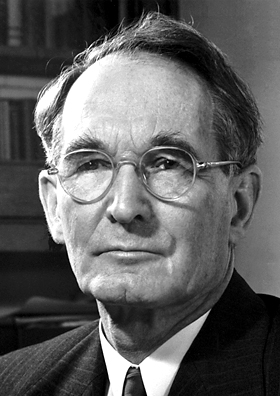
Portrait of Percy Williams Bridgman
. Source. 
Edward Victor Appleton Created 2026-10-18 Updated 2026-11-05
Edward Victor Appleton investigated the ionosphere by measuring how radio signals return from the upper atmosphere. Comparing direct and returning radio waves makes their path difference experimentally accessible and constrains the effective height of the reflecting region.
The response changes with frequency because the atmosphere's free electrons alter electromagnetic propagation. Scanning frequency and observing the returning signals helps distinguish ionized layers and their changing conditions. His Nobel lecture connects these measurements with the physical basis of long-distance radio propagation.[ref]
The Ionosphere by Edward Victor Appleton. Nobel lecture: reflected radio signals, effective heights, critical frequencies and ionized layers

Portrait of Edward Victor Appleton
. Nobel Foundation, portrait dated 1947; individual photographer unspecified. Commons asserts Swedish-photograph public-domain status and additionally records a United States PD-1996/URAA public-domain claim., via Wikimedia Commons. Source.
Miles Aylmer Fulton Barnett Created 2026-10-18 Updated 2026-11-05
A physicist whose work with Edward Victor Appleton tested the return of radio waves from the upper atmosphere. Their experiments supplied evidence for reflecting ionized layers and distinguished returns from different heights. The Appleton-Barnett radio interference experiment thus connects an observed ground-level interference signal to the structure of the ionosphere, explaining how radio communication can reach beyond the direct line of sight.[ref]
Barnett, Miles Aylmer Fulton by John Gabites. Research paragraphs: Cambridge radio propagation experiments and evidence for two ionized reflecting layers
Hideki Yukawa Created 2026-10-18 Updated 2026-11-05
Hideki Yukawa proposed explaining the short range of the nuclear interaction through exchange of a massive field quantum. A schematic static Yukawa potential has the form : the exponential introduces a range of order , linking an inferred force range with a predicted particle mass. His 1935 proposal made the observed nuclear scale a clue to a new particle, while the later distinction between muons and pions was an experimental question.[ref]
On the Interaction of Elementary Particles. I by Hideki Yukawa. 1935 paper, finite-range field and intermediate-mass quantum; modern static-potential notation
A physicist.[ref]
https://www.ndl.go.jp/portrait/datas/6080. Independent professional profile
[ref]https://www.kyoto-u.ac.jp/sites/default/files/embed/jaaboutpublicissueresearch_activitiesdocuments2012nobelvol2nobelallpages.pdf. Independent professional profile

Portrait of Hideki Yukawa
. Source. 
Marietta Blau Created 2026-10-18 Updated 2026-11-05
An experimental particle physicist who coauthored observations of nuclear disintegration in photographic emulsions with Hertha Wambacher. A cluster of charged-particle tracks sharing one origin provided evidence for an interaction induced by cosmic rays. Recording such events photographically made rare nuclear processes available for repeated microscopic examination and measurement.[ref]
Disintegration Processes by Cosmic Rays with the Simultaneous Emission of Several Heavy Particles by Marietta Blau and Hertha Wambacher. Research letter, Nature 140, 585 (1937): disintegration stars
Hertha Wambacher Created 2026-10-18 Updated 2026-11-05
An experimental particle physicist who, with Marietta Blau, studied nuclear disintegrations recorded in photographic emulsions exposed to cosmic rays. Several heavy charged tracks emerging from a common point identified a nuclear event. The emulsion served simultaneously as target and persistent track detector, allowing the geometry of a rare interaction to be examined after exposure.[ref]
Disintegration Processes by Cosmic Rays with the Simultaneous Emission of Several Heavy Particles by Marietta Blau and Hertha Wambacher. 1937 research letter: multiple heavy-particle tracks from disintegration events
John Douglas Cockcroft Created 2026-10-18 Updated 2026-11-05
John Cockcroft and Ernest Walton used accelerated protons to produce the disintegration of lithium in 1932. A high-voltage accelerator supplied the projectile beam, while the energetic alpha particles leaving the target provided the reaction signal. The reaction releases nuclear binding energy, so the outgoing particles can carry far more kinetic energy than the incident proton. This connected a controlled electrical accelerator with a quantitative nuclear reaction.[ref]
A physicist.[ref]
https://www.nobelprize.org/nomination/archive/show_people.php?id=1855. Independent professional profile
[ref]https://archives.chu.cam.ac.uk/collections/guide-holdings/. Independent professional profile

Portrait of John Douglas Cockcroft
. Source. 
There are unlisted articles, also show them or only show them.