
Joseph John Thomson Created 2026-10-18 Updated 2026-10-24
A physicist.[ref]
https://www.nobelprize.org/prizes/physics/1906/thomson/biographical/. Biographical identity and professional specialization
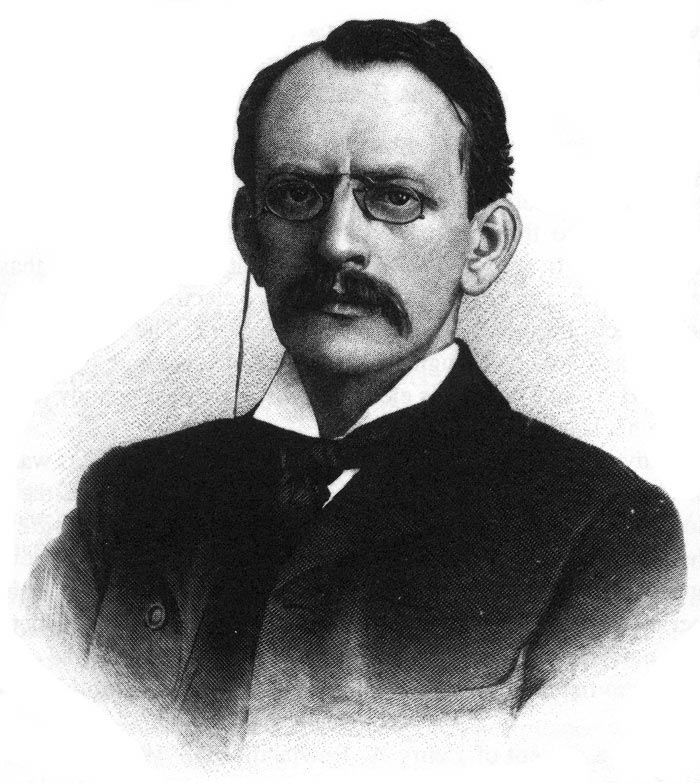
Portrait of Joseph John Thomson
. Source. 
The Thomson charge-to-mass experiment used electric and magnetic deflections of cathode rays to investigate their charged constituents. It determines a charge-to-mass ratio; separating electric charge from mass requires additional information.
Johannes Stark Created 2026-10-18 Updated 2026-11-05
Johannes Stark measured the splitting of atomic spectral lines in a strong electric field. The Stark effect connects that applied field with changes in atomic energy levels and therefore the frequencies of emitted light. Resolving the splitting requires control of the electric field, the emitting region and the spectral resolution. Different observed components need not shift equally: the pattern tests how the electric perturbation changes the available quantum states, rather than merely showing that the light source is affected.[ref]
Observation of the Separation of Spectral Lines by an Electric Field by Johannes Stark. 1913 experimental communication
[ref]Structural and Spectral Changes of Chemical Atoms by Johannes Stark. Nobel lecture: electric-field effects on spectra

Portrait of Johannes Stark
. A. B. Lagrelius & Westphal, Stockholm; Les Prix Nobel 1919 (1920), p. 121; Nobel Foundation source. Commons PD-Sweden photograph claim. File requests an additional United States public-domain tag; worldwide status is not asserted., via Wikimedia Commons. Source.
Carl David Anderson Created 2026-10-18 Updated 2026-11-05
Carl David Anderson identified the Positron through curved tracks in a cloud chamber. A lead plate changed a particle's momentum, helping determine its direction of travel from the curvature on either side. The combined curvature and range excluded a proton interpretation for the light positively charged particle. His 1933 paper separates the measured charge and mass constraints from speculative explanations then considered for the particle's origin.[ref]
The Positive Electron by Carl David Anderson. 1933, lead-plate photographs, direction of travel and range/curvature argument
A physicist.[ref]
Carl David Anderson by William Hayward Pickering. Biographical Memoirs: Volume 73; Independent professional biography and identity

Portrait of Carl David Anderson
. Unidentified photographer; Smithsonian Institution Libraries, Dibner Library, Scientific Identity portrait collection, SIL14-A5-01. No known copyright restrictions: Smithsonian / Flickr Commons institutional determination; not a Creative Commons license or a blanket public-domain assertion., via Wikimedia Commons. Source.
James Chadwick Created 2026-10-18 Updated 2026-10-31
A physicist.[ref]
https://www.nobelprize.org/nomination/archive/show.php?id=5348. Independent professional biography and identity

Portrait of James Chadwick
. Los Alamos National Laboratory. Unless otherwise indicated, this information has been authored by an employee or employees of the Los Alamos National Security, LLC (LANS), operator of the Los Alamos National Laboratory under Contract No. DE-AC52-06NA25396 with the U.S. Department of Energy. The U.S. Government has rights to use, reproduce, and distribute this information. The public may copy and use this information without charge, provided that this Notice and any statement of authorship are reproduced on all copies. Neither the Government nor LANS makes any warranty, express or implied, or assumes any liability or responsibility for the use of this information. Los Alamos National Laboratory attribution permission, via Wikimedia Commons. Source.

Walther Bothe Created 2026-10-18 Updated 2026-11-05
Walther Bothe developed the coincidence counting for connecting signals from separate particle detectors. Requiring pulses within a short time window helps distinguish a common physical event from unrelated counts. For independent rates and , accidental coincidences scale with and the window duration; narrowing that duration therefore reduces a calculable background. The method turns timing information into evidence about particle paths and correlated processes, rather than relying on the count in one detector alone.[ref]
The Coincidence Method by Walther Bothe. Authored 1954 award lecture, printed pp. 271–275; accidental-rate scaling explained here
A physicist.[ref]
https://www.mpg.de/957380/10_person3-1954. Independent professional biography and identity

Portrait of Walther Bothe
. Nobel Foundation; individual photographer unidentified. Commons PD-Sweden photograph claim. File requests an additional United States public-domain tag; worldwide status is not asserted., via Wikimedia Commons. Source.
Irène Joliot-Curie Created 2026-10-18 Updated 2026-11-05
Irène Joliot-Curie and Frédéric Joliot identified induced radioactivity by following the Positrons emitted from irradiated light elements after the source was removed. Their 1934 paper reports continuing activity in aluminium, boron and magnesium, with different decay times. The falling count rate is a readout of unstable products left in the material, connecting controlled irradiation with the creation and measurement of radioactive isotopes.[ref]
Artificial Production of a New Kind of Radio-Element by Frédéric Joliot and Irène Joliot-Curie. 1934 abstract, irradiated aluminium, boron and magnesium and their continuing activity
A physicist.[ref]
https://www.nobelprize.org/prizes/chemistry/1935/joliot-curie/biographical/?print=1. Independent professional biography and identity

Portrait of Irène Joliot-Curie
. Studio Harcourt / Wellcome Collection, via Wikimedia Commons. Public domain in France and the United States according to the actual File page’s PD-France and PD-1996 licensing declarations; attribution retained. Source usage terms, via Wikimedia Commons. Source.
Norman Feather Created 2026-10-18 Updated 2026-11-05
An experimental nuclear physicist who studied collisions of neutrons with nitrogen nuclei in 1932. Tracks in an expansion cloud chamber revealed both recoils and disintegration events, allowing charged reaction products to expose an otherwise invisible neutral projectile. The experiment established a concrete route to studying nuclear reactions initiated by neutrons.[ref]
The collisions of neutrons with nitrogen nuclei by Norman Feather. Introduction, cloud-chamber apparatus and analysis of disintegration tracks
Charles-Édouard Guillaume Created 2026-10-18 Updated 2026-11-05
Charles-Édouard Guillaume investigated iron-nickel alloys whose thermal changes are unusually small. Invar has low thermal expansion over a useful temperature range, making it valuable for dimensional references. Elinvar addresses a related metrological problem through a small temperature dependence of elasticity, useful when an instrument's behavior depends on an elastic element. These materials show why composition and magnetic behavior can matter as much as geometrical precision when building a stable measuring instrument.[ref]
Invar and Elinvar by Charles-Édouard Guillaume. Nobel lecture, alloy properties and precision-instrument applications
A physicist.[ref]
https://library.ethz.ch/en/collections-and-archives/short-portraits/guillaume-charles-edouard-1861-1938.html. Independent professional biography and identity
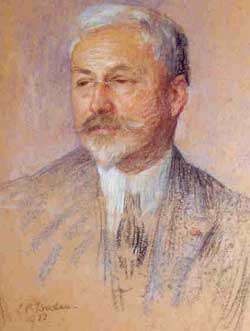
Portrait of Charles-Édouard Guillaume
. Source. 
Herbert Becker Created 2026-10-18 Updated 2026-11-05
An experimental nuclear physicist who, with Walther Bothe, investigated penetrating radiation produced by bombarding beryllium with alpha particles. Initially interpreted as gamma rays, the radiation motivated tests of the recoil it produced in other materials. James Chadwick's subsequent experiments identified the neutron, illustrating why observing penetrating radiation and correctly identifying its carrier were separate experimental steps.[ref]
The Existence of a Neutron by James Chadwick. Opening discussion of Bothe–Becker beryllium radiation and its interpretation
Owen Willans Richardson Created 2026-10-18 Updated 2026-11-05
Owen Willans Richardson studied thermionic emission, the release of electrons from a heated surface. In the ideal Richardson form, the emitted current density is , where is a work function, is temperature and is an appropriate prefactor. A plot of against has slope under the model's surface and collection assumptions. This turns a strong temperature dependence into a way to infer the electronic escape barrier.[ref]
Thermionic Phenomena and the Laws which Govern Them by Owen Willans Richardson. Nobel lecture: temperature dependence and electron-emission laws
Physics.[ref]
https://makingscience.royalsociety.org/people/na7014/owen-willans-richardson. Independent professional profile
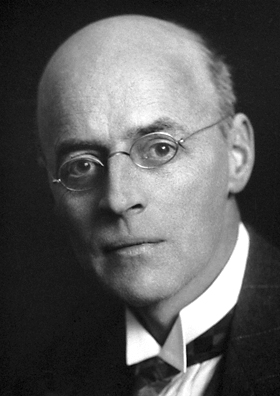
Portrait of Owen Willans Richardson
. Source. 
Immanuel Estermann Created 2026-10-18 Updated 2026-11-05
An experimental atomic physicist who coauthored measurements of the gravitational deflection of long atomic beams. Slower potassium and caesium chemical atoms spend longer in flight and fall farther; the beam's vertical intensity profile therefore reveals its velocity distribution. The experiment turned a small gravitational displacement into a measurement of thermal beam statistics.[ref]
The Free Fall of Atoms and the Measurement of the Velocity Distribution in a Molecular Beam of Cesium Atoms by Immanuel Estermann, Oliver Cecil Simpson, and Otto Stern. Abstract: gravitational deflection and modified Maxwellian velocity distribution
Oliver Cecil Simpson Created 2026-10-18 Updated 2026-11-05
Oliver Cecil Simpson coauthored atomic-beam measurements using gravitational free fall to investigate the velocity distribution of cesium atoms. Gravity makes a particle's displacement depend on its travel time, so slower atoms are deflected more during a given path. For an ideal horizontal flight of length at speed , the downward displacement is . The measurement connects a beam's spatial distribution with its microscopic velocities, using gravity as a timing-dependent probe.[ref]
Physics and solid state science.[ref]
https://physicstoday.aip.org/obituaries/oliver-cecil-simpson. Independent professional profile
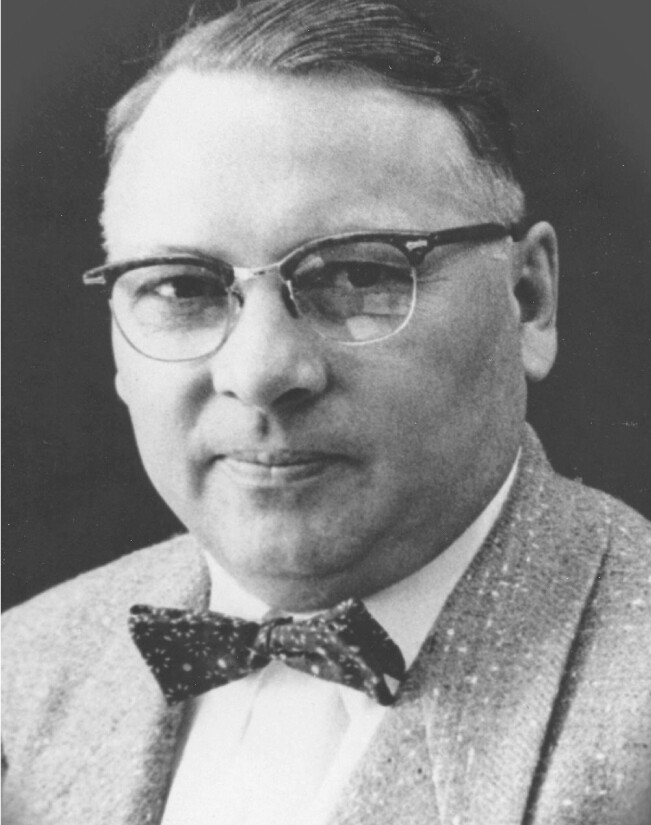
Portrait of Oliver Cecil Simpson
. James Franck Created 2026-10-18 Updated 2026-11-05
James Franck and Gustav Ludwig Hertz measured the transfer of kinetic energy from free electrons into atomic excitation. In Mercury vapor, the collected electric current changes repeatedly as the accelerating voltage rises. Below an excitation threshold, an electron cannot excite the relevant atomic quantum state; above it, an inelastic collision can remove a characteristic energy. Repeated acceleration and energy loss produce the successive features, linking the Franck-Hertz experiment to quantized atomic structure.[ref]
Über Zusammenstöße zwischen Elektronen und den Molekülen des Quecksilberdampfes und die Ionisierungsspannung desselben by James Franck and Gustav Ludwig Hertz. Mercury-vapor electron-impact measurements
[ref]Transformations of Kinetic Energy of Free Electrons into Excitation Energy of Atoms by Impacts by James Franck. Nobel lecture: interpretation of excitation-energy transfer

Portrait of James Franck
. Source. 
Gustav Ludwig Hertz Created 2026-10-18 Updated 2026-11-05
Gustav Ludwig Hertz and James Franck accelerated electrons through Mercury vapor and measured the collected electric current as the accelerating voltage changed. Repeated features in that curve indicate a preferred loss of kinetic energy in inelastic collisions. An electron must first acquire enough energy to excite the relevant atomic transition; further acceleration can enable another such collision. The Franck-Hertz experiment therefore connects an electrical current–voltage measurement with discrete atomic excitation energies.[ref]
Über Zusammenstöße zwischen Elektronen und den Molekülen des Quecksilberdampfes und die Ionisierungsspannung desselben by James Franck and Gustav Ludwig Hertz. Original collision experiment: accelerating voltage, collected current and characteristic energy loss
Physics.[ref]
https://mathshistory.st-andrews.ac.uk/Biographies/Hertz_Gustav/. Independent professional profile

Portrait of Gustav Ludwig Hertz
. Source. 
Louis de Broglie Created 2026-10-18 Updated 2026-11-05
Louis de Broglie proposed associating a wave with material particles, relating its wavelength to the particle momentum by . This connects a particle quantity with an experimentally testable wave scale: increasing the momentum decreases the expected diffraction wavelength. His account of matter waves helped motivate a description in which standing-wave conditions select allowed atomic motions, and his Nobel lecture discusses the relation between this proposal and later electron-diffraction experiments.[ref]
The Wave Nature of the Electron by Louis de Broglie. 1929 Nobel lecture, matter-wave wavelength and electron diffraction
Theoretical physics.[ref]
https://archives.collections.ed.ac.uk/repositories/2/archival_objects/237297. Independent professional profile

Portrait of Louis de Broglie
. Agence Rol; Bibliothèque nationale de France, département Estampes et photographie, EI-13 (1675), Rol 142233. Commons records public-domain status in France for this historical agency photograph and in the United States for pre-1931 publication; mechanical scan marked PD-scan. Other jurisdictions may differ., via Wikimedia Commons. Source.

George Paget Thomson Created 2026-10-18 Updated 2026-11-05
George Paget Thomson demonstrated wave behavior of electrons by passing an electron beam through thin material and recording diffraction patterns. Many crystal orientations in a thin polycrystalline film produce rings, whose geometry can be compared with the wavelength associated with the electron momentum. The experiment connects a photographic pattern with the de Broglie wavelength, making electron interference observable at energies and in a geometry different from a reflected crystal beam.[ref]
Electronic Waves by George Paget Thomson. Nobel lecture, transmission diffraction and electron-wave interpretation
Physics.[ref]
https://archives.trin.cam.ac.uk/index.php/catalogue-of-the-papers-and-correspondence-of-sir-george-paget-thomson-frs-1892-1975. Independent professional profile

Portrait of George Paget Thomson
. Nobel Foundation; individual photographer unidentified. Commons PD-Sweden claim plus US URAA/formalities claim; its PD-URAA tag is flagged as needing updating., via Wikimedia Commons. Source.
Louis Dunoyer de Segonzac Created 2026-10-18 Updated 2026-11-05
An experimental atomic physicist who demonstrated a thermal atomic beam of sodium in 1911. Vapor escaped through narrow slits into an evacuated vessel and condensed on a wall cooled with liquid air. The deposit matched the geometry predicted for straight-line trajectories, giving a visible test of molecular motion between collisions and a foundation for later molecular beam experiments.[ref]
The Method of Molecular Rays by Otto Stern. Opening description of Dunoyer’s sodium beam, slit geometry and cooled-wall deposit
Harvey Fletcher Created 2026-10-18 Updated 2026-11-05
Harvey Fletcher worked with Robert Millikan on the development of the oil drop experiment. His recollection describes replacing rapidly evaporating droplets with oil and observing individual charged drops for longer times. The measurement combines motion under gravity and Stokes drag law with the effect of an applied electric field. Estimating the drop's size and comparing its motion before and after charge changes makes small increments of electric charge measurable. His account therefore connects the experimental choice of droplet material with the precision of the charge measurement.[ref]
My Work with Millikan on the Oil-Drop Experiment by Harvey Fletcher. Authored recollection, pp. 44–47; editorial sidebar excluded
Physics and acoustics.[ref]
https://archives.lib.byu.edu/agents/people/3946. Independent professional profile

Portrait of Harvey Fletcher
. American Institute of Physics (AIP), Emilio Segrè Visual Archives. Attribution permission: unrestricted reuse, derivatives and commercial use permitted with attribution to American Institute of Physics (AIP), via Wikimedia Commons. Source.
Theodore Lyman Created 2026-10-18 Updated 2026-11-05
An experimental atomic physicist who developed ultraviolet spectroscopy at wavelengths strongly absorbed by air. Evacuated optical apparatus made this region experimentally accessible, and the Lyman series of hydrogen became a fundamental example of atomic line structure. The apparatus work mattered as much as the wavelength measurement: removing absorption along the optical path was necessary to observe the radiation at all.[ref]
Theodore Lyman, Pioneer of Ultraviolet Vacuum Spectroscopy by Paul Horowitz. pp. 1, 3–4 and Figures 2–5: extreme-ultraviolet apparatus and vacuum techniques
Paul Horowitz Created 2026-10-18 Updated 2026-11-05
Paul Horowitz works on experimental electrical circuits and astronomical instrumentation, including radio and optical searches for extraterrestrial signals. His institutional account describes designs that combine optical collection with fast photodetectors.[ref]
Paul Horowitz by Harvard Department of Physics. Authored research description: experimental electronics and optical/radio searches
Such searches turn a candidate pulse into a measurement problem involving timing, noise, detector response and independent checks. Instrument sensitivity and interference rejection determine which signals a null result can exclude; absence of a detection alone does not specify every possible source model.
There are unlisted articles, also show them or only show them.