
Face-pair orbits of cube rotations Created 2026-10-14 Updated 2026-11-05
The rotational symmetry group of a cube has three group orbits on ordered pairs of faces: equal faces, opposite faces, and adjacent faces. Their sizes are respectively , and . Fixing one face leaves its cyclic group of four quarter-turns, which acts transitively on the four adjacent faces; this proves transitivity in the last orbit rather than merely counting its points.
Kernel of the cube face-axis action Created 2026-10-14 Updated 2026-11-05
Permuting the three pairs of opposite faces gives a group homomorphism from the rotational symmetry group of a cube to . Its kernel consists of the identity and the half-turns about the three coordinate axes: these are precisely the diagonal sign matrices with determinant one. Thus it is a normal subgroup of order four, a Klein four-group.
For cube vertices , the four vertices of coordinate product and the four of product form the two inscribed regular tetrahedra. A cube rotation is a signed permutation matrix of determinant one and maps each product class to one class. A quarter-turn about a coordinate axis exchanges the classes. The orbit of either tetrahedron therefore has size two, while the cube rotation group has order 24. The orbit-stabilizer theorem gives its setwise stabilizer subgroup order 12; this is the tetrahedron's proper rotation group.
Rotary encoder 2026-10-14
A rotary encoder converts shaft rotation into a readout of angle or changes in angle. The PS-2120A uses interruptions of a light beam to encode shaft motion; its product specification gives 4000 divisions per revolution. That count is a resolution specification, not a guarantee of the precision of an inferred angular acceleration or moment of inertia. [ref]
Axial isotropy of rolls and hexagons 2026-10-14
Write the translation group action as . Modulo lattice translations, the stabilizer subgroup of , with nonzero real , is the sixfold rotation group. Its fixed-point subspace of a group action is the real line . The stabilizer subgroup of , with nonzero real , consists of the circle together with a half-turn; its fixed-point subspace of a group action is the real line . The equivariant branching lemma therefore supplies generic branches of both axial types.
For the rotational hexagon amplitude equations, put and . A roll with has transverse eigenvalues , each twice, radial eigenvalue , and one neutral translation. A hexagon with has real-amplitude eigenvalues and ; its imaginary-amplitude eigenvalues are . These follow by diagonalizing the cyclic Jacobian matrix. Stability is understood modulo translations. If and , the upper positive hexagon branch reaches a Hopf bifurcation at , .
Oblate-rotator flattening proxy 2026-10-14
The simplified moment prescription , with and , gives the displayed relation by solving for . The prescription is an approximation, not a consequence of the tensor virial theorem for arbitrary oblate density profiles. For constant azimuthal streaming , the one-component streaming second moment is .
Five-mode rotating-convection truncation Created 2026-10-14 Updated 2026-11-05
A Galerkin method retaining one stream function mode, two temperature modes and two transverse-velocity modes produces five coupled amplitudes. A useful normalization gives , , , , . Here is the Prandtl number, , and measures squared rotation. The trivial equilibrium point has characteristic polynomial in its three coupled linear modes; the remaining two modes decay. Stationary bifurcations and oscillatory onset meet at , when .
Single-error test from two binary BCH syndromes Created 2026-10-14 Updated 2026-11-05
Let a binary cyclic code of length have defining zeros of a cyclic code and , with of multiplicative order . A single error in position has error polynomial and syndromesThus and are necessary for a single-error pattern. Search the distinct powers of for ; if it is absent, this is not a single-error syndrome. Otherwise flip the unique coordinate and test membership in the full cyclic code, for example by divisibility by its entire generator polynomial of a cyclic code.
Checking only the two roots is sufficient only when they generate all defining checks, including their field conjugates. A cyclic code with additional defining roots requires those checks too. If the full membership test succeeds and the minimum Hamming distance is at least five, the corrected codeword is the unique codeword within two errors of the received word: two such codewords would be at Hamming distance at most four. The two-syndrome relation alone does not establish membership.
Parasitic amplification root 2026-10-14
An amplification root of a multistep method is parasitic when it represents an additional numerical mode rather than the principal mode approximating the exact differential-equation flow. For a consistent method the principal root starts at one as the step tends to zero, while other roots can start elsewhere. A simple parasitic root on the unit circle is compatible with zero-stability, but its motion outside the circle for a negative test parameter can destroy absolute stability. Fixed-time convergence and all-time damping must be distinguished.
Equal-rate rocket burning and accretion Created 2026-10-14 Updated 2026-10-20
If stationary mass arrives at the same constant time rate as fuel is ejected, total rocket mass stays fixed. The rocket equation with stationary mass accretion is then . For initial rest, speed approaches the relative exhaust speed exponentially with relaxation time . This is the regular equal-rate limit of the unequal-rate mass-power formula.
Poisson uniqueness with a nonnegative Robin normal coefficient Created 2026-10-14 Updated 2026-10-31
On a bounded region, two sufficiently regular solutions of the Poisson equation with the same forcing and boundary condition , where , have harmonic difference . Green's first identity gives . Hence is constant on each component, and the boundary condition makes that constant zero. The proof never divides by , so it includes variable coefficients and Dirichlet portions where .
A continuous symmetric coercive bilinear form on a real Hilbert space and a continuous linear functional give a unique minimum of . The parallelogram identity makes any minimizing sequence Cauchy in the energy norm; coercivity and completeness give its limit. Differentiation gives , and proves uniqueness. A nonsymmetric operator instead differentiates to its symmetric part. Mere pointwise positivity without a lower bound in the chosen norm need not yield a minimizing vector.
Commutative ring spectrum 2026-10-14
A commutative ring spectrum, in the homotopy-category convention, satisfies , where interchanges the factors of the smash product of spectra. This condition alone does not assert an refinement.
For the frame fixed by zero mean height and zero first height moment, the variance profile is . It obeys , and . Integrating a white noise curvature field twice, subtracting its affine projection and integrating the squared kernel proves the profile. These free-end conditions must not be confused with physically clamping the ends.
Curvature-noise representation of a free filament Created 2026-10-14 Updated 2026-11-05
The quadratic bending energy makes curvature a white noise field in the generalized thermal description. Integrate it twice, then subtract the affine least-squares projection to fix translation and tilt. With and , the dimensionless kernel is . Its second spatial derivative is the source delta and its mean and first moment are zero. Its squared integral yields the free-filament variance with fixed translation and tilt.
Right-inverse characterization of the axiom of choice Created 2026-10-14 Updated 2026-11-05
The statement that every surjective function has a right inverse is equivalent to the axiom of choice.
Given a surjective function , each fiber of a function is nonempty. The axiom of choice selects from that fiber for every , so and is a right inverse. When is the empty set, the unique empty function supplies without a choice.
Conversely, take an indexed family of nonempty sets. The projection map from the disjoint union to is surjective. A right inverse assigns , selecting one for every index. This is a choice function, so the asserted splitting of all surjections gives the axiom of choice.
Orientation-reversing Riemannian isometry 2026-10-14
An isometry between oriented Riemannian manifolds that reverses orientation. Its differential is orthogonal with determinant minus one in oriented orthonormal frames, so it reverses the oriented volume form while preserving the associated positive volume measure. Reflection in a geodesic of the hyperbolic plane is an example. An orientation-reversing isometry still identifies the scalar Laplace spectra, even though it does not preserve the chosen complex orientation of a Riemann surface.
In a relatively compact coordinate ball the Riemannian metric norm is bounded above and below by positive multiples of the Euclidean norm. A coordinate segment gives the upper distance bound. A path leaving the ball has a positive lower length bound before its first exit; paths staying in it have the Euclidean displacement lower bound. Consequently distinct points have positive Riemannian distance, and the resulting metric topology equals the manifold topology. Connectedness makes the distance finite because smooth manifolds are locally path connected.
Riemannian distance on a circular cylinder 2026-10-14
On the lateral surface of an infinite circular cylinder of radius , the induced metric is . Lifting a curve to the unrolled plane preserves its arc length. If the endpoints differ by angular coordinate and height , the possible lifted endpoint displacements are for integers . Each straight segment gives a geodesic, and the shortest of their lengths isChoose the representative of with smallest absolute value modulo ; if its absolute value is , the two angular directions tie. This minimum is attained because the candidate lengths tend to infinity as . The formula concerns travel on the lateral surface; it does not allow a shortcut through the cylinder's interior or across end caps.
For , take and in surrounding Euclidean space. The angular difference is and height difference is . The route has length . The route goes the other way around and has length . Both are among the geodesics on a circular cylinder, but only the first is a minimizing geodesic between these endpoints.
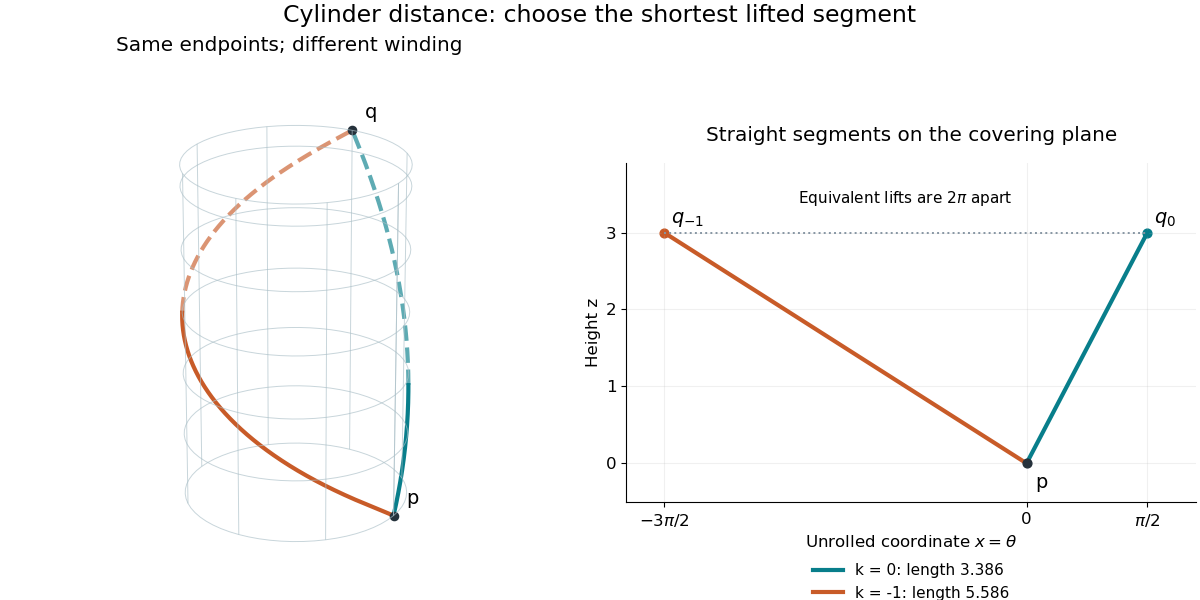

This is a global consequence of intrinsic flatness of a circular cylinder: locally everything is Euclidean, yet the periodic angular coordinate leaves several competing routes. A shortest-route problem on the curved surface becomes a family of ordinary planar distance calculations.
There are unlisted articles, also show them or only show them.