
Functor represented by a scheme Created 2026-10-14 Updated 2026-10-25
The functor of points describes a scheme through its morphisms from test schemes. On commutative rings, it is covariant because a ring homomorphism reverses the corresponding affine-scheme map. A functor on rings is represented by in the algebraic-geometric sense when it is naturally isomorphic to . The representing scheme need not be affine; this is different from demanding a representable functor in the category of rings itself.
// Target: module-theory.bigb
Scanning tunneling microscope Created 2026-10-14 Updated 2026-10-20
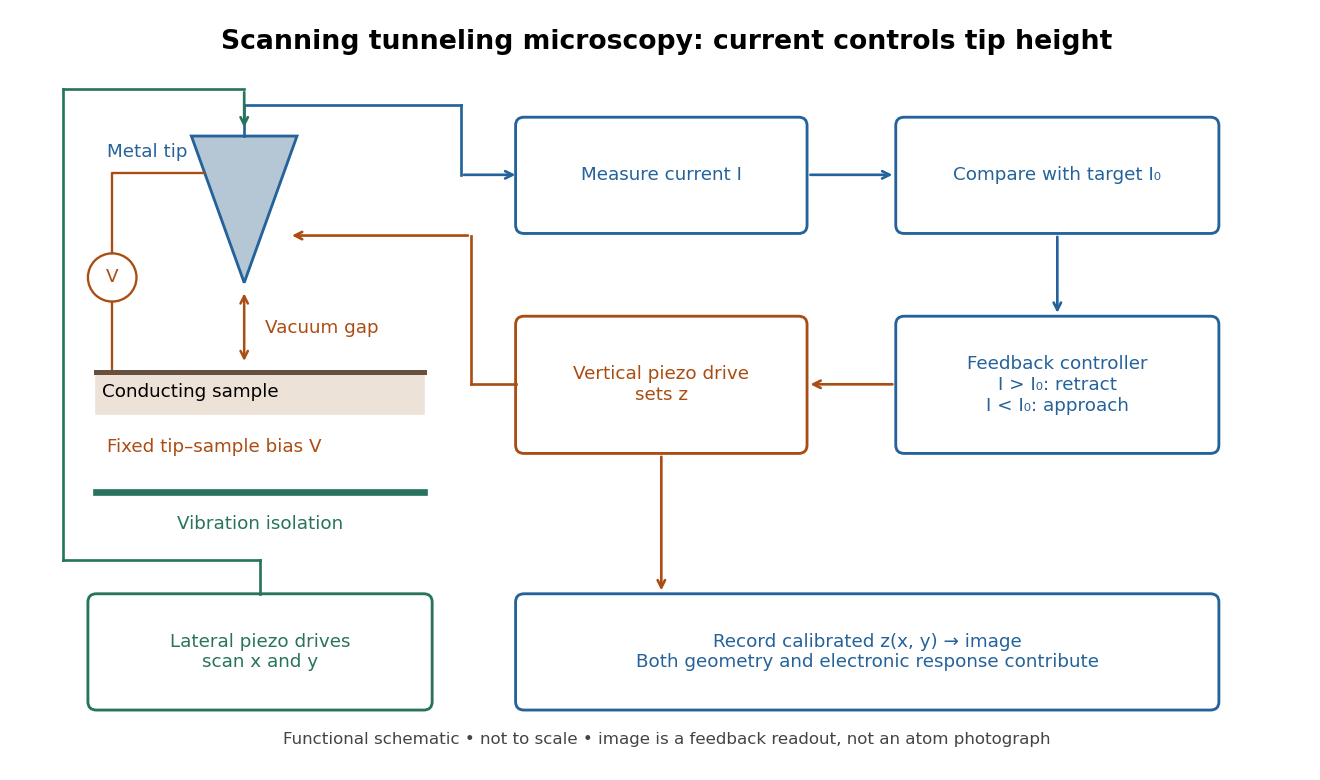
In the 1982 experiment, separate drives using piezoelectricity scanned a metal tip laterally and adjusted its height. A control unit held electric current fixed at constant tip-sample electric potential difference; calibrated drive voltages supplied the displacement readout. Their Fig. 1 explicitly contrasts a surface step with apparent height from contamination changing the work function.[ref]
Surface Studies by Scanning Tunneling Microscopy by Gerd Binnig and others. pp. 58–59, Fig. 1, equation (1), piezodrive calibration
Gerd Binnig and Heinrich Rohrer describe a later vibration isolation system using two spring stages and eddy current damping inside a vacuum chamber, with sputtering and annealing for surface preparation. These measures addressed unwanted motion and surface condition separately.[ref]

Let a real measurable Fourier transform equal one on , vanish on , and satisfy the displayed complementary identity on the positive transition band. On a fundamental interval, either only the central translate is nonzero, or exactly the two complementary translates contribute. Thus orthonormal translates and Fourier periodization holds. The periodic mask defined on by for and otherwise satisfies the scaling refinement equation in Fourier form. A concrete even transition is on the transition bands. For complex-valued , ordinary squares cannot replace absolute squares: transition values and have squares summing to one but squared moduli summing to three.
Scale-free potential and bulk-flow variance 2026-10-14
For a matter power spectrum at a fixed epoch, the Poisson equation gives potential Fourier amplitudes proportional to , and the growing-mode peculiar velocity is proportional to . With a spherical top-hat window function, their variances are proportional to and , respectively. Rescaling gives the displayed powers when the integrals converge: for the averaged potential and for the bulk velocity. Absolute averaged potential has infrared sensitivity; band-limited fluctuations or potential differences can have different convergence requirements. The density variance converges only for , so these three absolute averages cannot all converge for one unbroken power law at every scale.
A supersymmetry transformation mixes the bosonic and odd coordinates of superspace. A bare derivative with respect to an odd coordinate therefore acquires a spacetime-derivative term under the coordinate Jacobian and is not a covariant spinor superfield. Supersymmetric covariant derivatives add terms linear in the other odd coordinate; their graded anticommutation with the supercharges makes their application to a scalar superfield transform covariantly.
Let with independent , and let be independent of them. Then has Rayleigh distribution and has the displayed cumulative distribution function for and density . Indeed, conditioning on gives , and a Gaussian integral completes the calculation. Independence is essential: choosing has the same Gaussian marginal but makes the ratio bounded by .
In the long-time growing horizontal-gradient branch, independent vertical shear noises combine as . The signed inclination satisfies the displayed Ornstein-Uhlenbeck stochastic differential equation. For its stationary density is , with variance . The Fokker-Planck probability current vanishes at infinity and gives this Gaussian by one integration. At and nonzero noise there is no normalizable stationary density.
Minimal-subtraction scalar four-point bubble channels Created 2026-10-14 Updated 2026-11-05
For one real phi-fourth theory field, each of the three labeled one-loop four-point channels has symmetry factor . In , the displayed expression is its amplitude through the finite part. The three poles require , and differentiating at fixed bare coupling gives in four dimensions. The minimal subtraction scheme retains ; modified minimal subtraction absorbs that constant. The Feynman-parameter logarithm is left unevaluated.
If no -set were shattered, the Sauer-Shelah lemma would bound the number of traces by . This strict middle-layer gap contradicts the displayed lower bound. Therefore a family with such traces at every even size has unbounded finite VC dimension.
Spherical current-dipole logarithmic kernel 2026-10-14
For and , the displayed kernel satisfies . The limit at is . Differentiating along , which preserves , gives . Thus it generates the normalized magnetic scalar potential in the Sarvas formula.
Sampling fraction 2026-10-14
The sampling fraction is the sample size divided by the finite population size. In simple random sampling, it determines how much the finite population correction reduces the variance relative to .
A finite nonzero Saffman integral gives in the standard isotropic spectrum normalization. This follows by expanding the radial spectral transform at small wavenumber. A further analytic term requires additional correlation moments.
Saffman decay law 2026-10-14
With nonzero invariant , a self-preserving integral scale of turbulence gives . Combining this with freely decaying high-Reynolds-number viscous dissipation gives and . The closure assumptions, not the invariant alone, determine this exponent.
Half-size prime cyclic Freiman model 2026-10-14
For a nonempty integer set with doubling constant at most , Plünnecke-Ruzsa inequality bounds by . Embed the set modulo a sufficiently large auxiliary prime , randomly dilate it, and select the more populated of two half-intervals of representatives. Differences of two pair sums on that half have absolute value less than , so the lift preserves original relations. Every nonzero original difference is uniformly dilated among nonzero residues; avoiding all residues represented by nonzero multiples of of absolute value less than has positive probability when . Reduction modulo then yields a Freiman 2-isomorphism on the selected half.
For , one can take . Embed in a much larger prime cyclic group and choose a dilation avoiding the residues of all nonzero multiples of of absolute value below that prime for every nonzero eightfold difference. A union bound ensures such a dilation. Retain a most-populated ninth-interval of representatives. Eight-term sums then have range shorter than the prime, and reduction modulo both preserves and reflects eight-term additive relations.
Cardinality-controlled cyclic Freiman model 2026-10-14
A nonempty finite integer set has a subset of the displayed size Freiman s-isomorphic to a subset of . Embed in a sufficiently large auxiliary prime modulus and randomly dilate. Avoid the residues of every nonzero multiple of of absolute value less than that prime for all nonzero members of ; a union bound gives a successful dilation. Retain a most-populated one of short intervals of representatives. Its -term sum differences have absolute value less than the auxiliary prime, so reduction modulo both preserves and reflects relations. Under , this gives .
One-loop inverse gauge coupling evolution Created 2026-10-14 Updated 2026-11-05
From and , the chain rule gives . Taking its reciprocal makes the differential equation linear, proving the displayed relation. It assumes a fixed set of active fields and constant one-loop coefficients between the two scales; mass thresholds require piecewise matching. A negative coefficient gives asymptotic freedom.
Two-loop asymptotic running coupling 2026-10-14
For , define and . Then . In the asymptotically free regime , successive substitution gives the displayed expansion. If the beta function is exactly truncated to two loops, then , after choosing the integration constant. Its next term is . Thus the generic remainder after the first two terms is not when . Higher-loop terms change the constant coefficient of , but not the forced term.
Two-exponential-mixture survival probability Created 2026-10-14 Updated 2026-11-05
In the classical risk model with probability density function and relative safety loading , the claim mean is and . The convolution terms satisfy . Applying to yields . Its solution is fixed by , and , giving the displayed probability. The derivative condition comes from the original integral equation and excludes spurious solutions of the higher-order equation.
Reduced row echelon form Created 2026-10-14 Updated 2026-10-18
A row echelon form is in reduced row echelon form when every pivot element is one and is the only nonzero entry in its column.[ref]
Row Reduction. Interactive Linear Algebra by Dan Margalit and others; §1.2.2, reduced echelon conditions 4 and 5
This extra reduction displays each pivot unknown directly in terms of the free variables in a linear system. The zero matrix also satisfies the definition: it has no pivot elements.Every matrix has exactly one reduced row echelon form under elementary row operations, with its size and column order held fixed.[ref]
Row Reduction. Interactive Linear Algebra by Dan Margalit and others; §1.2.3, theorem preceding the Row Reduction Algorithm
Ordinary row echelon form is not unique: multiplying a nonzero row by two over the rational numbers keeps the staircase but changes the matrix. The reduced conditions remove that freedom.For a fixed number of columns, each row space has a unique reduced matrix after zero rows are removed; at a fixed full size, the number of appended zero rows is also determined. Thus reduced row echelon form represents a vector subspace independently of the starting basis. This is the uniqueness used by Gaussian binomial coefficients to count vector subspaces over a finite field.
The fixed column order matters. Elementary column operations can change the row space, the kernel and the resulting reduced row echelon form. For instance, swapping the columns of over the rational numbers gives , whose reduced row echelon form is instead of . When solving a linear system, a column interchange also requires tracking the corresponding interchange of unknowns.
There are unlisted articles, also show them or only show them.