
Tracer diffusion in a power-law accretion disk Created 2026-10-14 Updated 2026-11-05
In a steady Keplerian accretion disk with , , and tracer diffusivity , the trace passive scalar concentration obeys the displayed constant-coefficient advection-diffusion equation in logarithmic radius. Contaminant mass is proportional to , because . A radial impulse therefore has logarithmic amplitude and evolves by the Gaussian heat kernel centered at . The full-line solution idealizes radii far from the disk boundaries.
Wind-loaded Keplerian disk evolution Created 2026-10-14 Updated 2026-11-05
Subtract local specific angular momentum times mass conservation from conservation of angular momentum including wind losses S,T. With outward radial mass flux and outward viscous torque in an accretion disk , this gives . For Keplerian rotation and , substitution in mass conservation yields the displayed equation. A wind with q=1 removes local angular momentum but supplies no additional drift term; q>1 can drive accretion even with zero viscosity.
Compact self-similar disk with density-linear viscosity Created 2026-10-14 Updated 2026-11-05
The Keplerian viscous diffusion equation with the displayed kinematic viscosity has two such nontrivial finite-support self-similar solutions: , , and , . Both have for . Matching powers of radius eliminates the third power only when . The first solution conserves disk angular momentum; the second conserves disk mass but requires an inner torque.
Turbulent kinetic energy dissipation rate 2026-10-14
The positive rate per unit mass at which molecular viscosity removes turbulent kinetic energy, with the fluctuating symmetric velocity-gradient tensor. Its dimensions are velocity squared per time. The integral-scale estimate is , expressing transfer over turnover time ; numerical constants depend on the convention for the turbulent velocity and length scales.
Fay solution 2026-10-14
The Fay solution is a periodic solution of the negative-flux viscous Burgers equation for . Its Fourier series has exponentially decreasing coefficients at each positive . Expanding and summing the sine series givesFor , the first harmonic gives . The Fay shock-layer asymptotics describe its opposite, small- regime.
Modified Burgers equation with cubic flux Created 2026-10-14 Updated 2026-11-05
The cubic-flux variant replaces the quadratic conservative flux of Burgers' equation by . Its inviscid characteristic speed is , while positive diffusivity regularizes shock waves. It is not linearized by the usual Cole-Hopf transformation.
Viscous Burgers travelling shock 2026-10-14
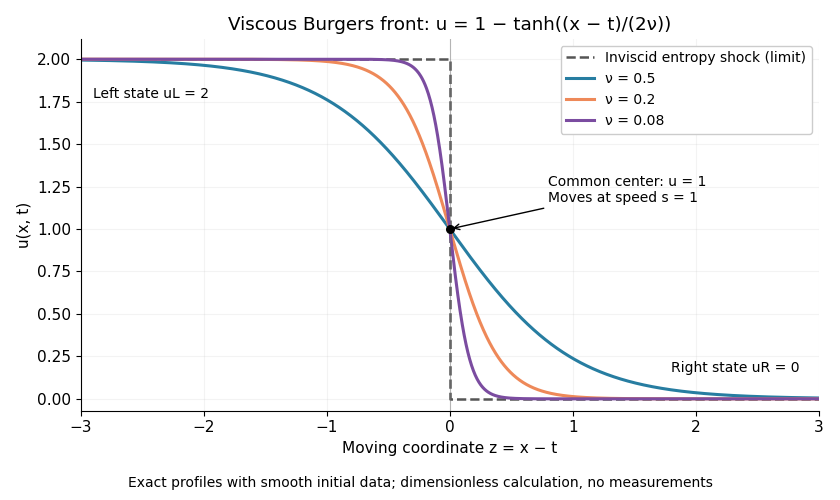
A travelling wave of the viscous Burgers equation can connect constant states through a smooth decreasing layer. Require , , , , and at both ends. Substitution and one integration giveThe speed follows by evaluating the integration constant at both end states. It is precisely the Rankine-Hugoniot condition for conservation law flux . Choosing the center gives the displayed hyperbolic tangent profile. Its characteristic width scales as ; a smaller positive makes a thinner smooth layer.
For an original worked example in dimensionless quantities, take , and :This is an exact classical solution on with its own smooth initial condition and limiting states . It is a family of moving profiles, not the finite- solution starting from an exact discontinuous step. For that different initial condition, the Cole-Hopf transformation supplies the evolution. At , this front starts from the same profile as the Burgers characteristic breaking example: positive diffusion maintains a smooth moving layer while the inviscid profile breaks at .
To check the partial differential equation explicitly, set and . ThenThe independent Rankine-Hugoniot condition check gives , using and . At fixed , the vanishing viscosity approximation tends to the entropy shock for and for . At the center the smooth profiles stay at ; changing the value on the discontinuity does not change the limiting weak solution.

For , the same integrated ordinary differential equation has between the two states when , so it cannot supply an increasing connecting front. The inviscid admissible expansion is the rarefaction wave of the Burgers Riemann problem with positive flux.
Corotational Jeffreys fluid 2026-10-14
A corotational Jeffreys fluid obeys , with deviatoric stress , rate-of-strain tensor , Jaumann derivative and relaxation time . Put . In the corotating-frame representation of a Jaumann derivative, . An integrating factor gives an exponentially weighted history transported between the rotating frames. The infinite-past formula selects histories with as ; finite initial data also contribute an exponentially decaying homogeneous term.
Viscometric functions Created 2026-10-14 Updated 2026-11-05
The three viscometric functions describe steady homogeneous simple shear flow: its shear viscosity and the first and second normal-stress differences per squared shear rate. Take x as the flow direction, y as the gradient direction and z as the vorticity direction, so and . Isotropic pressure drops out of these differences.
Linear viscoelastic fluid Created 2026-10-14 Updated 2026-11-05
A linear viscoelastic fluid has causal stress response linear in the deformation history, often expressed as . The approximation requires small deformation and rotation over the relevant memory times. High frequency is allowed at sufficiently small amplitude. An integrable decaying relaxation modulus gives a finite zero-shear viscosity; an instantaneous solvent term may be written separately.
Stress relaxation Created 2026-10-14 Updated 2026-11-05
Stress relaxation is decay of stored stress after a deformation is imposed and then held fixed. It probes a material's memory through its relaxation modulus. An instantaneous generalized Newtonian fluid has no stored shear stress once the shear rate is zero and cannot describe a nontrivial relaxation tail.
Kelvin-Voigt model 2026-10-14
The Kelvin-Voigt model puts a spring and dashpot in parallel. Their common displacement makes their forces add. With the convention , the complex stiffness is , giving storage stiffness and loss stiffness . Under a force step, with . The series spring–dashpot is a Maxwell fluid analogue and has different relaxation and creep behavior.
Dashpot Created 2026-10-14 Updated 2026-11-05
Differential pom-pom model 2026-10-14
This differential model separates normalized molecular orientation from scalar stretch . With component-first velocity gradient , it evolves by and . Its relaxed state is , , . The displayed constant-relaxation stretch law is an idealization; variants can add saturation or nonlinear relaxation.
Deborah number Created 2026-10-14 Updated 2026-11-05
The Deborah number compares a material's viscoelastic relaxation time with the time scale of an imposed process. A small value allows substantial stress relaxation during that process; a large value can reveal stored elasticity. In small-amplitude oscillatory shear, one commonly uses . Large frequency does not by itself invalidate a linear viscoelastic fluid approximation if the deformation amplitude remains sufficiently small.
Weissenberg number Created 2026-10-14 Updated 2026-11-05
The Weissenberg number measures deformation accumulated over a viscoelastic relaxation time, often as the product of that time and a shear rate or an extension rate. Its precise rate convention should be stated. Unlike a Deborah number based on externally imposed temporal variation, it can remain nonzero in a steady flow. A weak-flow constitutive expansion generally requires both slow temporal change and small deformation over the memory time.
Phan-Thien-Tanner fluid Created 2026-10-14 Updated 2026-11-05
The affine linear PTT fluid considered here uses a symmetric dimensionless tensor with and polymer stress . Here is the upper-convected derivative, and the nonlinear relaxation parameter is usually positive. Linearizing about rest gives the Maxwell fluid relaxation modulus . The PTT family also admits other relaxation functions and nonaffine derivatives; their nonlinear predictions need not equal those of this specified version.
Small Type I and Type II sums Created 2026-10-14 Updated 2026-11-05
Extend by zero, and assume . In one dyadic endpoint convention, Type I sums are -small if for every dyadic and every choice of integer intervals , . Type II sums are -small if for all dyadic and coefficients . Empty tails are handled by zero extension.
Integrating every angle in the bond Fourier series of the Villain model imposes the Kronecker constraint . Thus its dual variables are divergence-free integer currents. On a planar lattice such currents are rotated gradients of integer heights on faces. Noncontractible current sectors must additionally be retained on a torus.
Vortex Coulomb gas 2026-10-14
In two dimensions, the integer defects on dual faces are vortices of winding . Here is the inverse positive lattice Laplacian with its boundary or zero-mode convention specified. At separations large compared with the lattice spacing, , yielding the pair action and core self-energies. Like charges repel and opposite charges attract. With periodic boundaries the total charge is zero and the inverse is taken on the mean-zero subspace; harmonic winding sectors require their own factors.
There are unlisted articles, also show them or only show them.