
Recursive powerset mapping 2026-10-14
A map is recursive if every map admits a unique with . This holds exactly when the predecessor relation is a well-founded relation. For the forward construction, take the union of all consistent partial solutions on downward-closed domains; well-founded induction proves compatibility, and a minimal missing point allows extension. Conversely, a nonempty subset with no minimal point has an upward reachability closure satisfying exactly when some predecessor is in . With and exactly when , both the zero map and the indicator of solve the recursion, contradicting uniqueness.
Weighted Euclidean inner product Created 2026-10-14 Updated 2026-10-18
A symmetric positive-definite matrix defines an inner product on real coordinate vectors byFor diagonal , positive diagonal entries weight the squared coordinate errors. This is the finite-coordinate version of a weighted inner product; the positive-definite matrix example appears in Francis Narcowich, Inner Products and Norms, standard inner products, example 8.
For , the squared norm of is . A first-coordinate error of one costs as much as a second-coordinate error of two. The unit sphere is the ellipse , and orthogonality means . Thus “closest” and “perpendicular” depend on the chosen inner product. The orthogonal projection residual example shows how this changes a best approximation.
Polynomial recurrence for the absolute value 2026-10-14
Starting with on , this polynomial recurrence gives and . Indeed the error satisfies . Its pointwise limit solves , so it is . Dini's theorem gives uniform convergence. Each continuous piecewise linear function is an affine function plus a finite linear combination of . Scaling and translating the recurrence therefore gives polynomial approximation of every such function, and their density gives the Weierstrass approximation theorem.
On , the polynomials converge in supremum norm to the zero function, since . But for every , whereas the zero function has left derivative zero at that endpoint. Thus uniform convergence of function values does not imply uniform convergence of derivatives. This does not contradict uniform convergence of Bernstein polynomial derivatives, which has a particular approximation construction and additional differentiability hypotheses.
Cyclic ternary channel capacity 2026-10-14
A discrete memoryless channel on the additive group maps to with probability and to with probability . Every input gives the same conditional entropy , whereas the output Shannon entropy is at most . A uniform input produces a uniform output since every column of the transition matrix sums to one. Hence the channel capacity is bits per use. This cyclic-error channel differs from a channel distributing its error probability equally over both other output symbols.
Weak type (1,1) 2026-10-14
For a nonnegative sublinear operator, weak type is the displayed level-set bound for all integrable inputs and positive thresholds. It supplies an exceptional-set estimate for approximation errors; the uncentered maximal weak-type inequality is a central example.
Weak type with a normed domain 2026-10-14
For a normed space and , an operator is of weak type when the displayed distribution bound holds uniformly over and . No completeness of is needed. A sublinear operator has pointwise triangle domination and absolute homogeneity; its outputs may be understood modulo almost everywhere equality.
Let be a sublinear operator with positive constants and and . Split into its part above and its bounded remainder. The latter contributes at most , so the weak bound controls the superlevel measure by . Integrating this estimate with layer cake representation proves the displayed bound for and . In particular it gives the strong estimate for the Hardy-Littlewood maximal function.
Weak-star fixed point theorem for an adjoint operator Created 2026-10-14 Updated 2026-10-31
If for a bounded operator on a separable Banach space, and is a nonempty weak-star closed convex subset of the dual unit ball with , then has a fixed point in . The Cesàro averages of the orbit remain in , and minus the identity sends those averages to vectors of norm at most . Weak-star compactness supplies a cluster point, and the adjoint action is weak-star continuous. The corresponding assertion with only weak closedness is false for the right shift on the probability simplex in , the dual of .
Viscosity solution 2026-10-14
For a partial differential equation whose operator is nonincreasing in the Hessian variable, a continuous viscosity subsolution satisfies whenever a smooth test function touches it from above. A viscosity supersolution satisfies the reverse inequality for tests touching from below. A viscosity solution satisfies both conditions. For , these conditions are respectively and . They make sense even when has no classical second derivatives.
Zariski's lemma 2026-10-14
If a field is finitely generated as an algebra over a subfield , then is a finite algebraic extension of . Applying this to a residue field of a polynomial ring proves the Weak Hilbert Nullstellensatz.
Locality of weak differentiability 2026-10-14
A locally integrable function has weak derivatives on an open set exactly when it has them near every point. Local derivatives agree almost everywhere on overlaps because they define the same distributional derivative. A countable local cover therefore gives globally defined, locally integrable derivative functions. A smooth partition of unity subordinate to the cover splits each compactly supported test function; summing the local integration identities yields the global weak-derivative identity.
Bounded isolated-point removability for weak first derivatives Created 2026-10-14 Updated 2026-10-31
A bounded function which is away from one point in dimension , and whose classical gradient is locally integrable across that point, has that gradient as its weak derivative. Cut a test function off within distance of the point. The error from differentiating the cutoff is bounded by and vanishes. The other terms converge by local integrability. In dimension one the Heaviside step function is a counterexample: its classical derivative off the point is zero, but its distributional derivative is a Dirac delta.
Mazur's lemma 2026-10-14
If converges weakly to in a Banach space, there are convex combinations of each tail that converge in norm to .
Concentration prevents weak compactness in L1 Created 2026-10-14 Updated 2026-10-25
The nonnegative Lp space functions have norm one. Any weak limit tested against indicators supported outside the origin must vanish almost everywhere. Testing against the constant bounded function one would nevertheless require integral one. This contradiction applies to every subnet whose indices tend to infinity, so the unit ball is not weakly compact. The abstract Banach-Alaoglu theorem remains valid: weak compactness of the unit ball is a different assertion from weak-star compactness of a dual ball.
Spatial sampling of a wave 2026-10-14
In spatial sampling of a wave, a detector records a wave at positions separated by pitch . Angular wavenumbers differing by , with integers , give identical samples of a complex Fourier mode:This is spatial aliasing. To distinguish arbitrary sinusoids within a prescribed band, require , equivalently , the Nyquist spatial frequency. Thus for the shortest allowed wavelength. At equality a sine can vanish at every sample, so phase information can be lost. The Nyquist–Shannon sampling theorem states the precise reconstruction conditions for a bandlimited function; a finite scan introduces further limitations.
The synthetic two-tone snapshot iswhere both count cycles per metre. The component wavelengths are and . With , both lie below the Nyquist spatial frequency of cycles per metre. With , the -cycle component aliases to the -cycle component: at every , . The sampled sum is therefore indistinguishable from , although the continuous curves differ between samples. Drawing lines between sample points cannot resolve this ambiguity.
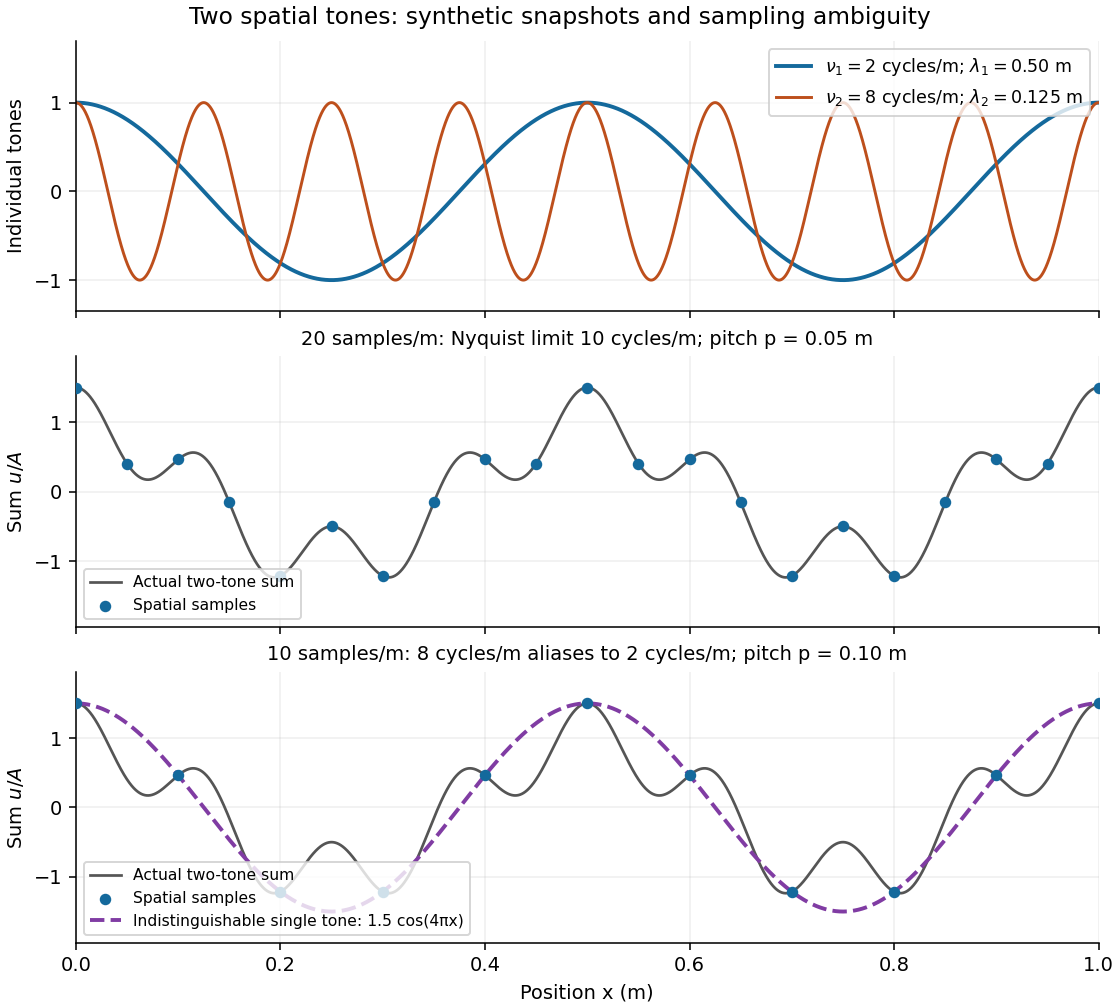
Synthetic two-tone spatial waveform: fine samples distinguish the components, coarse samples hide the shorter wavelength
. Details. 
Spectroscopic wavenumber Created 2026-10-14 Updated 2026-10-18
A spectroscopic wavenumber commonly means the reciprocal of the vacuum wavelength of electromagnetic radiation, often in . It is an ordinary spatial frequency, so the vacuum angular wavenumber is . Specify vacuum or in-medium wavelength: the same frequency can have different wavelengths in different media. IUPAC's “wavenumber in medium” entry defines the in-medium reciprocal and notes that unqualified spectroscopic usage often means the vacuum reciprocal.[ref]
For example, a vacuum wavelength of corresponds to . Multiplication by gives . Converting centimetres to metres and converting cycles to radians are separate operations.
Waveguide phase and group velocities Created 2026-10-14 Updated 2026-10-18
For a propagating branch of an ideal vacuum-filled rectangular electromagnetic waveguide, the phase velocity tracks constant wave phase along the axis, whereas the group velocity describes a sufficiently narrow, weakly distorted wave packet. Using givesThus , , and . Differentiating the dispersion relation proves the second formula; dividing it by proves the first. This is the same mathematical structure as Klein-Gordon packet velocities. In the stipulated example,Over , the corresponding narrow-envelope delay is , approximately . Timing a carrier wave crest would give ; it does not time the arrival of a newly introduced message.
There is an independent energy check. For the forward fields, the average axial Poynting vector is . Integrating across the guide gives average power and average electromagnetic energy per unit length :The transverse sine and cosine squared each integrate to ; then makes the integrated electric and magnetic contributions to equal. The axial energy transport therefore agrees with the group velocity in this ideal model.
As , and ; exactly at cutoff is undefined. Strong wave dispersion close to cutoff also limits the narrow-packet approximation. Neither a large phase velocity nor a pulse peak establishes superluminal information velocity; front velocity asks a separate causal question. In a uniform filling with constant positive permittivity and magnetic permeability , replace by , giving . Frequency-dependent material response or significant loss requires differentiating the actual dispersion relation, so this product is not universal.
Consider two identical two-segment paths from an inlet to a distal junction, with equal resistive beds at the two intermediate junctions and the distal junction. The segment transfer matrix and junction flow balances determine all pressures. If one inlet branch is removed and the beds are weakly loading the waves, the remaining segments form a three-segment chain with an effectively closed far end. The altered reflection pattern can raise peripheral oscillatory flow amplitudes even though a branch was lost; the incident wave amplitude, rather than total inlet pressure or flow, is the prescribed forcing.
Slowness 2026-10-14
Slowness is the reciprocal of phase velocity, measured in time per distance. A plane wave with wavevector and angular frequency has vector slowness . Its direction is the wavefront normal, which need not be the group velocity direction in an anisotropic medium.
There are unlisted articles, also show them or only show them.