
Work by Pál Turán 2026-10-14
Work by P. R. Mueller 2026-10-14
Work by Oscar Levin 2026-10-14
List of optical microscopists 2026-10-14
Polarimetry Created 2026-10-14 Updated 2026-10-18
Polarimetry measures optical rotation with a polarimeter. The vertical Vernier Go Direct instrument uses a light-emitting diode source, fixed polarizer, sample cell, motor-driven polarimeter analyzer, photodetector and optical rotary encoder. Calibrate using the same solvent at fill height; rinse with sample, fill to , and read the meniscus to . The readout plots illumination against analyzer angle; a maximum near zero or a cosine-squared fit locates .[ref]
Go Direct Polarimeter User Manual by Vernier. Using the Product steps 2–4; Specifications; How the Sensor Works
An actual teaching experiment in the Truman State University-hosted Optical Activity Laboratory handout, revised July 2013, uses sucrose chemical solutions. Weigh the sucrose, dissolve completely without heating, and measure final solution volume for concentration. Use one polarimeter throughout; measure the water blank's extinction reading, then each sample's extinction reading and actual liquid path length near . Subtract the blank and plot corrected optical rotation against concentration. The attached apparatus description specifies a vertical light path, an incandescent or tungsten source with yellow filter, sheet polarizers and a rotating eyepiece polarimeter analyzer. Its coarse demonstration permits temperature control to the nearest , path length to the nearest millimeter and approximately angular precision. These are design tolerances, not measured results.[ref]
Optical Activity Laboratory, Truman State University. Optical Activity Laboratory, revised July 2013, pp. 1–2 Experiment 1; p. 3 The Design and General Use of Simple Polarimeters
For a quantitative comparison, equilibrate blank, reference and sample at the same recorded temperature; use a thermostatted cell when needed. This is a recommended control, not a claim that the teaching instruments provide a thermostat. A yellow filter also passes a band of wavelengths, so its result need not match a narrow-source reference exactly. The laboratory's concentration series tests the linear model rather than establishing it in advance; a second series varying only path length tests the other factor.
For our original ideal model, Malus's law giveswhere is light intensity immediately before the ideal polarimeter analyzer, after sample transmission. It is not the intensity of the original unpolarized source. The angle difference is evaluated in consistent units; the plotted degree values are converted to radians before computing the cosine. Assume transmitted light retains linear polarization, with negligible scattering and no polarization-dependent absorption. The pure positive model, mixture and racemate shift the maxima to , and , respectively. Minima shift by the same amount, to , and . Thus an extinction measurement and a maximum measurement recover the same shift after their respective blanks are subtracted.
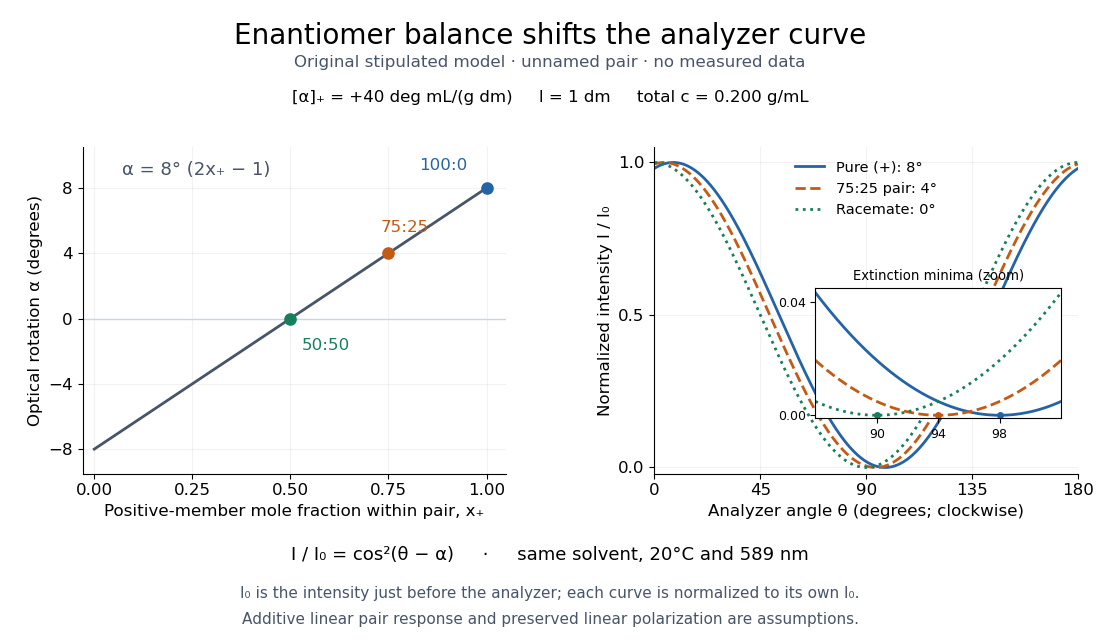

Repeat blanks and use a reference to check drift and scale. Bubbles, particles, stressed windows and sample absorption can spoil the ideal curve. Vernier specifies accuracy; the manual's fit reproducibility does not establish that accuracy. It warns against interpreting its illumination readout quantitatively and requires a transparent homogeneous sample.[ref]
Go Direct Polarimeter User Manual by Vernier. Using the Product, cosine-squared fit; Specifications; Troubleshooting, illumination and sample limits
Neither a zero reading nor a matching specific rotation uniquely identifies a molecule. Optical rotation Created 2026-10-14 Updated 2026-10-18
Optical rotation is the signed angle measured in polarimetry. Positive rotation is clockwise for an observer facing the incoming light; negative rotation is counterclockwise. State the viewing convention, wavelength, temperature, solvent, concentration and path length when comparing measurements. R and S configuration specifies spatial arrangement, and does not predict the sign of optical rotation.[ref]
5.5 Sequence Rules for Specifying Configuration. McMurry, Organic Chemistry, §5.5, discussion after Figure 5.10: no simple relation between R/S and rotation sign
Here the observer stands beyond the sample, on the detector side, looking back toward the source. Measure both the polarimeter analyzer angle and the optical rotation clockwise from the blank's polarization direction. Looking from the source end reverses the apparent sense. A line has no distinguished arrowhead, so an intensity scan alone determines its orientation only modulo ; continuity or additional information must choose the appropriate rotation branch.
Numerical method Created 2026-10-14 Updated 2026-10-18
A numerical method is an algorithm for computing an exact or approximate solution to a mathematical problem through finitely many arithmetic operations and other prescribed steps. For example, Gaussian elimination solves a linear system exactly in exact arithmetic, whereas finite precision can introduce roundoff error.
Work by Nimrod Megiddo 2026-10-14
NADH 2026-10-14
NADH is the reduced form of nicotinamide adenine dinucleotide.
Spectator ion 2026-10-14
A spectator ion cancels from the chosen net ionic equation because its net inventory is unchanged. This label does not make it physically irrelevant: dissolved spectator ions contribute to ionic strength, which affects activity coefficients. Their concentrations can also change during dilution even though their amount of substance remains fixed.
Multiplication table Created 2026-10-14 Updated 2026-10-31
A multiplication table lists the products of the factors labeling its rows and columns. Each cell is determined by one multiplication; the same arrangement can serve as a spreadsheet tabular model.
Work by Michael R. Clarkson 2026-10-14
Work by Max Born 2026-10-14
Matroid greedy algorithm 2026-10-14
Assign each element of the finite ground set a real number . The matroid greedy algorithm sorts elements by nonincreasing weight, starts with the empty set, and admits an element exactly when the enlarged selection is a matroid independent set. Ties can be resolved arbitrarily. After all elements have been considered, the result is a matroid basis of maximum total weight among all matroid bases. This holds even with negative weights: the task is to produce a full matroid basis. [ref]
Maximizing weight over all matroid independent sets is a different task when weights can be negative. For that task, skip negative elements; zero-weight additions are optional. With weights , , in the weighted three-vector matroid, the heaviest matroid basis is with weight , while the heaviest matroid independent set is with weight . For nonnegative weights, every matroid independent set can be extended to a matroid basis without reducing weight, so the optimum values coincide.
Proof outline. Let be the admitted elements in order, and order any competing matroid basis by nonincreasing weight. If , exchange would let one of augment . That element was considered before and, by heredity, was admissible even at that earlier stage, a contradiction. Hence for every , and summing proves optimality. Rejected elements remain inadmissible as the selection grows, by heredity, so the final selection is maximal. The guarantee depends on the matroid independence axioms and on weights adding independently across elements; interactions between chosen elements are a different objective.
Graphic matroid 2026-10-14
For a finite undirected graph, the graphic matroid has its edges as the ground set. A subset is a matroid independent set when its edges form a forest on the original vertices, including isolated vertices. Its matroid bases give a spanning tree in each connected component of a graph; for a connected graph, each matroid basis is a spanning tree.
For a graph triangle on vertices , label the edges , , and , with weights . The empty set, all singletons, and all pairs are forests; the triple contains the graph cycle . Thus its eight subsets have exactly the independence pattern checked in the weighted three-vector matroid, and the same fifteen exchange comparisons pass. The matroid greedy algorithm chooses , chooses , and rejects , producing the heaviest spanning tree, of weight .
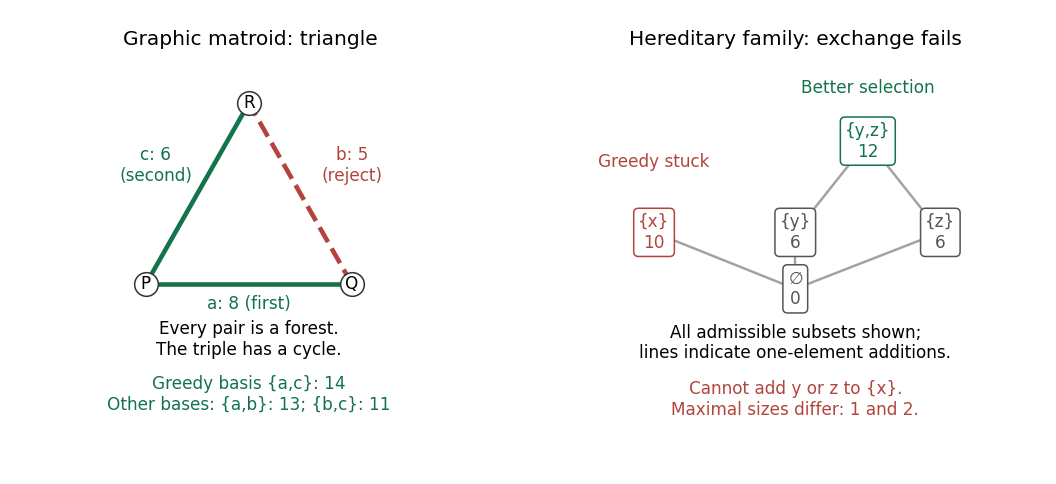
A weighted graph triangle admits greedy selection of a matroid basis; a hereditary independence system without exchange traps a greedy algorithm at weight instead of
. Details. 
Exchange outline. Deleting edges cannot create a graph cycle. If forests have , some edge of joins different connected components of a graph of : otherwise, within each such component, would have at most its number of vertices minus one edges, giving . Adding that edge keeps a forest. This is the matroid independence axioms expressed through connectivity.
Linear matroid 2026-10-14
A linear matroid has a finite ground set indexing a family of vectors in a vector space over a specified field. A subset of labels is a matroid independent set precisely when its vectors are linearly independent. Labels distinguish repeated vectors; the ground set is not required to consist of distinct numerical vectors. The matroid bases correspond to bases for the linear span of all the supplied vectors.
Exchange outline. The linear span of linearly independent vectors has dimension . If , not all the linearly independent vectors indexed by can lie in that linear span. A vector outside it can be added to . Heredity follows because a linear dependence in a subset would also be a linear dependence in the full selection.
Rank of a matroid 2026-10-14
For a subset of the ground set, the rank of a matroid on is the maximum cardinality of a matroid independent set contained in :Thus is the common size of the matroid bases, and . The weighted three-vector matroid has , even though its ground set has three labels.
Basis of a matroid 2026-10-14
A matroid basis is a matroid independent set that is a maximal element under inclusion of subsets: no additional element of the ground set can be admitted. Maximum cardinality means having the largest size among all matroid independent sets. Maximality tests whether this particular selection can grow; maximum size compares it with every selection. In a matroid the two conditions coincide, so all matroid bases have a common size. They need not have equal weight. [ref]
Matroid optimization by Michel Goemans. Michel X. Goemans, Matroid optimization, section 5.1, p. 1, maximal independent sets and bases
Proof outline. If a maximal matroid independent set were smaller than another matroid independent set , the matroid independence axioms would admit an element of , contradicting maximality. Finiteness allows every matroid independent set to grow to a matroid basis by successive admissible additions. In a general independence system, maximal selections can have different sizes, as in the hereditary nonmatroid greedy obstruction.
Independent set of a matroid 2026-10-14
A matroid independent set is a subset belonging to the family . Independence refers to the chosen matroid: for a linear matroid it means linear independence, and for a graphic matroid it means that the chosen edges contain no graph cycle. It is different from an independent set, which selects vertices with no edge between them.
Matroid independence axioms Created 2026-10-14 Updated 2026-10-24
Let be a finite set and a family of subsets, where is the power set. The matroid independence axioms areThe second condition is heredity; the third is exchange, also called augmentation. The set difference matters: the new element must actually increase the cardinality of . Exchange adds one element without requiring any deletion from . Nonemptiness together with heredity is equivalent to the first condition. [ref]
There are unlisted articles, also show them or only show them.