
Gyroscope vector geometry Created 2026-10-14 Updated 2026-10-18
Choose a fixed support point and nonrotating axes in an inertial frame. All angular momenta, torques, and moments of inertia below refer to . Let point along the axle from toward the centre of mass, and let point vertically upward. Write for their angle. For a rapidly spinning symmetric top, the dominant angular momentum is , where is signed and is the axial principal moment of inertia. The sign of the axial angular velocity follows the right-hand rule.
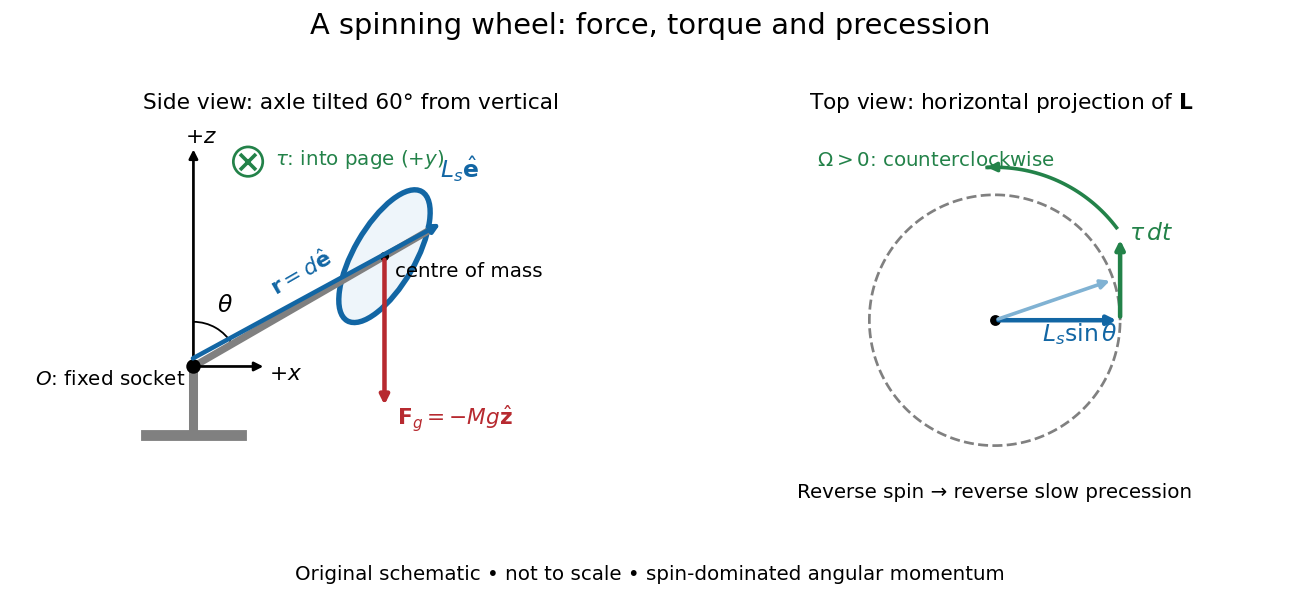
A fixed wheel support separates the downward gravitational force from the transverse torque and sideways precession
. Details. 
With mass , centre of mass distance , and constant gravitational acceleration , the gravitational force and its torque areAn ideal support applies a force at , so its lever arm and torque about vanish. At the instant the axle lies in the plane with a positive component, the gravitational torque points along . It adds toward , rather than along the downward force. The dot product identity shows why perpendicular torque changes direction without instantly changing magnitude. This vector balance and the slow-turning relation are developed in Chapter 20: Rotation in space (sections 20-2 and 20-3, equations 20.13–20.15).
For steady precession about the vertical, and . Equating the two cross products givesThe angular momentum tip traces a circle of radius : its sideways speed is . Both that radius and the gravitational lever arm contain , explaining its cancellation for . Exactly vertical alignment has zero gravitational torque and no distinguishable azimuthal precession to infer by this cancellation. Positive gives positive precession, counterclockwise viewed from above; reversing the spin reverses the slow precession. [ref]
11.4 Precession of a Gyroscope. University Physics Volume 1, section 11.4, equation 11.12 and the torque and precession-circle derivation
Moving Gumbel cutoff in an inverse-power tail Created 2026-10-14 Updated 2026-10-25
For fixed and , the factor is a translated Gumbel distribution cumulative function, with transition near . Integration by parts transforms the integral to an exponentially small boundary term plus . Expanding the latter against its finite logarithmic moments gives the displayed two terms because , with Euler's constant. The smooth cutoff shifts the first correction even though replacing it by a step gives the leading tail.
If is a left Noetherian ring and a right Noetherian ring, and is a poly-(cyclic or finite) group, then satisfies both chain conditions. Induct along the subnormal series. A finite factor gives a finite free extension on each side, handled by finite-module extension preserves Noetherianity. An infinite cyclic factor gives a skew Laurent polynomial ring, with the twisting automorphism induced by conjugation by a lift of the cyclic generator. The noncommutative Hilbert basis theorem and clearing negative powers prove the required chain conditions at that step. In particular is Noetherian.
In a unital Banach algebra, if a subsequence of inverse norms remained bounded, would be invertible for large subsequence indices by the Neumann series. This contradicts noninvertibility of . If is a closed unital subalgebra of a larger Banach algebra and the lie in , then such a limit cannot be invertible in either: continuity of inversion in a Banach algebra would make their inverses converge in to , which closedness puts in .
Left inverse of an algebra element 2026-10-14
A left inverse of an element of a unital associative algebra is an element with . A right inverse instead satisfies . If both exist, they agree: . A one-sided inverse alone need not imply invertibility in an infinite-dimensional Banach algebra.
Right inverse of an algebra element 2026-10-14
A right inverse of an element is an element with . A left inverse of an algebra element and a right inverse of an algebra element, when both exist, coincide. For the unilateral shift operator , but , exhibiting the distinction in the Banach algebra of bounded operators.
Suppose in a unital Banach algebra, with each invertible. If , then , so is invertible eventually by the Neumann series. Then is invertible, and . The analogous argument with treats a right inverse of an algebra element. Thus a noninvertible such limit admits neither type of one-sided inverse.
Finite products of Banach algebra exponentials form a subgroup: inverses are and conjugation sends to . Each product is joined to the identity by . The logarithm of an element near the identity puts a norm neighborhood of in this subgroup, so its cosets are open and its complement is open. It is therefore exactly the identity component of a topological group, and is an open, closed, normal subgroup. A product of exponentials need not be a single exponential in a noncommutative algebra.
Torsion-free finite extension of a lattice Created 2026-10-14 Updated 2026-11-05
For a specified finite group action on , extensions are classified by . For an element of prime order , a lift satisfies ; changing the lift changes by . Thus the extension is torsion-free precisely when every restriction to a prime-order cyclic subgroup is nonzero in . Any finite-order element has a prime-order power, so this tests all torsion. An arbitrary finite quotient must not be confused with faithful holonomy on a maximal translation lattice.
Center of the infinite dihedral group algebra Created 2026-10-14 Updated 2026-11-05
Write the group algebra as , with and . Commuting with forces , and commuting with forces . Every symmetric Laurent polynomial is a polynomial in , using the recursion . The algebra is free of rank four over this center, with basis ; the relation proves spanning, and applying proves independence of .
Complex group algebra detects p-nilpotency 2026-10-14
The matrix-block sizes in the Artin–Wedderburn theorem for recover the irreducible character degrees with their multiplicities. They determine the degree-square sum and the number of linear characters. Isaacs' character-degree criterion for p-nilpotency therefore detects each normal p-complement and applying it for every prime also detects nilpotent groups. The set of distinct degrees without multiplicities does not contain the same information.
Localizing a Bell pair from a GHZ state Created 2026-10-14 Updated 2026-11-05
Charlie measures his qubit of a GHZ state in the basis. The two equally likely outcomes leave Alice and Bob in the Bell states or , respectively. Charlie sends the outcome bit to Bob, who applies the Pauli operator , giving in either case. This is deterministic LOCC entanglement localization. If Charlie's record is ignored, Alice and Bob instead have the separable mixture . The classical outcome is necessary to turn the conditional entanglement into a known usable Bell pair.
If is constant on the boundary and is a regular harmonic function throughout a volume, the divergence theorem applied to gives . The constant boundary value factors out; a second application of the divergence theorem makes the remaining flux . This requires enough regularity to use Green's first identity over the entire volume.
Extension of a partial colouring by neighbour-colour savings Created 2026-10-14 Updated 2026-10-31
In a proper partial graph coloring, let count coloured neighbours and count their distinct colours. The saving leaves available colours for only initially uncoloured neighbours. If the displayed inequality holds at every vertex, ordinary greedy completion succeeds. Each additionally coloured neighbour removes at most one available colour while also reducing the number of uncoloured neighbours by one.
For great circles on a sphere, with no coincident circles or triple intersection, the number of open regions is . The first circle gives two regions. Each subsequent circle meets the previous circles at distinct points and is divided into that many arcs, each splitting a previous region. Summing the increments proves the formula. If the circles are , each region has one fixed sign vector . Conversely a realized strict sign vector has a connected region: its cone is an intersection of open half-spaces, and radial projection of line segments connects any two points.
For , , a front joining behind it to zero at its tip has . Integrating once gives andNear the tip, . Its unbounded slope signals the failure of the small-slope lubrication approximation sufficiently close to the contact line.
Inertia criterion for an inclined viscous film Created 2026-10-14 Updated 2026-11-05
For a film of thickness , axial length , and velocity , the ratio of convective inertia to transverse viscous stress in lubrication theory is . On a small incline of slope , lubrication gravity-current flux gives when , and when . The respective criteria are and . Unsteady inertia also requires if the evolution timescale is independent of .
Parabolic-channel sediment-current box model 2026-10-14
A well-mixed particle-laden gravity current in a prismatic channel with has volume . Negligible entrainment gives fixed . Vertical particle deposition flux is , so . Close the front by , where . Eliminating time givesThe concentration tends to zero at a finite limiting runout length of a gravity current, although reaching that limit takes infinite time in this model.
In a horizontal prismatic V-shaped valley with section area , a fixed-volume high-Reynolds-number gravity-current box model has and front speed . Integrating gives after the initial release scale is neglected. This is an inertial closure, distinct from the viscous V-shaped channel gravity current, whose exponent is different.
For a constant-volume unit-width particle-laden gravity current with , define the particle-fluid reference reduced gravity , so the current has . A constant front Froude number and absorbing-bed hindered settling give and . Eliminating time and integrating gives the displayed runout length of a gravity current. For large runout and dilute initial concentration, . This is buoyancy per unit particle fraction, not the initial current reduced gravity .
There are unlisted articles, also show them or only show them.