
Principal congruence modular curve genus 2026-10-14
For , the principal congruence subgroup has projective index , no effective elliptic stabilizers, and all cusp widths equal to . Hence the number of cusps is , and the genus formula for a modular curve gives the displayed formula. The exceptional levels one and two both have genus zero; the full genus-zero list is . Level six has genus one and every larger level has positive genus.
Reading frame Created 2026-10-14 Updated 2026-10-18
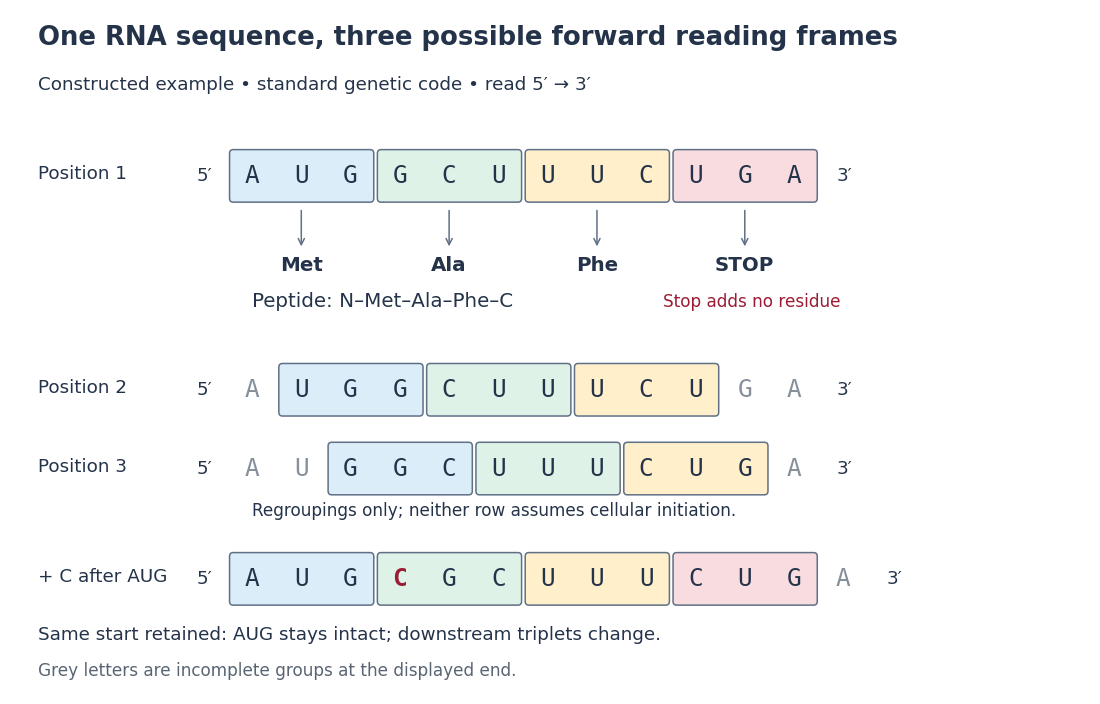
A reading frame specifies how consecutive nucleotides are grouped into codons. Starting at position 1 of AUGGCUUAA gives AUG / GCU / UAA; starting at position 2 gives UGG / CUU with AA left over. The letters are unchanged but the groups differ. A possible grouping alone does not establish an actual biological translation initiation site.
For the twelve-nucleotide example, number positions from the end. The three possible forward reading frames start at positions 1, 2 and 3:Parentheses enclose incomplete trailing groups. The second and third rows do not assert initiation of biological translation in a biological cell. A chosen start fixes which positions belong together; the ribosome then advances through consecutive codons rather than searching each three-letter window independently.
Codon Created 2026-10-14 Updated 2026-10-18
A codon is a three-nucleotide unit read in a specified reading frame during biological translation. For example, GCU specifies alanine in the standard genetic code. Its letters are read .
For an original example, choose the messenger RNA segment and stipulate initiation at the displayed AUG in a suitable eukaryotic context. Under the standard genetic code, its first three codons specify methionine, alanine and phenylalanine; the fourth is a stop codon. The resulting peptide before processing is N–methionine–alanine–phenylalanine–C. Twelve nucleotides therefore specify three amino acid residues and termination. The displayed segment omits the surrounding initiation signals; its nucleotide sequence alone is not a complete expression system.
A codon belongs to an oriented nucleotide sequence: GCU and UCG are different ordered triplets. Four possible nucleobases, adenine, cytosine, guanine and uracil, allow triplets because each position can be chosen independently when enumerating possible sequences. This is a counting argument, not a claim that nucleobases occur independently in real RNA. Sixty-one triplets are sense codons, meaning amino acid assignments, and UAA, UAG and UGA are stop codons in the standard genetic code.[ref]
Biology 2e by Mary Ann Clark and others. §15.1, The Genetic Code, Figure 15.4 and following paragraph: triplets and standard assignments

The useful unit is the ordered triplet together with its reading frame and genetic code, rather than three letters viewed in isolation. That combination lets DNA sequencing data support predictions about protein sequences after identifying the relevant messenger RNA. The Nirenberg and Matthaei experiment illustrates how the correspondence became experimentally accessible.
Minimal generating set of a group 2026-10-14
A generating set of a group from which no element can be deleted. This is inclusion-minimal, rather than necessarily having least cardinality. For finite p-groups, the Burnside basis theorem makes all such sets have the same size.
For the positive-shape generalized Pareto distribution with shape and scale , the expected Fisher information matrix for one observation isThe orthogonalization equation for two statistical parameters gives at fixed new nuisance coordinate. Thus is a global interest-respecting reparametrization. In coordinates , the information is diagonal with entries and .
Differential shear viscosity Created 2026-10-14 Updated 2026-11-05
Differential shear viscosity measures the incremental shear-stress response around a given positive base shear rate. It differs from the secant shear viscosity mu. A regular locally stable stress-to-rate inversion needs positive differential viscosity. Zero differential viscosity makes a first-order stress perturbation singular, and negative differential viscosity identifies a decreasing constitutive branch.
Probit model 2026-10-14
Binary probit regression sets , where is the standard normal distribution function. Its intercept score is a weighted sum of residuals, so an intercept does not generally force .
Generalized linear model offset 2026-10-14
An offset is a known term in a generalized linear model's linear predictor, with coefficient fixed to one. With a log link and exposure , choosing gives a mean count . Its role differs from that of a fitted explanatory-variable coefficient.
Gamma regression with canonical link 2026-10-14
For a Gamma distribution with fixed shape , choose dispersion , canonical parameter , and cumulant . The canonical link function is the displayed negative reciprocal; reversing its sign is an equivalent regression convention. For independent observations, the score function is and the Fisher information matrix is . The deviance is , with twice the log-likelihood ratio equal to this divided by . The fitted mean is the inverse link applied to , not itself.
Represented homology theory 2026-10-14
A topological spectrum represents the reduced generalized homology theory on based spaces, where the smash product of spectra is derived. It is covariant in .
A population-averaged log-rate model with exposure gives an annual rate ratio . A generalized estimating equation can account for repeated observations within clusters through a working correlation and sandwich covariance matrix. Independent Poisson standard errors do not account for clustering. An exposure-weighted population rate and an equally weighted average of cluster rates are different estimands.
For independent subjects with repeated Bernoulli observations, specify marginal means . A generalized estimating equation uses their derivative matrix and working covariance matrix to solve . Subject-level sandwich covariance matrices give robust uncertainty when the mean is correctly specified but the working correlation is not. The coefficients describe population odds ratios; this mean specification does not prescribe a complete joint distribution within a subject.
Working correlation matrix 2026-10-14
A working correlation matrix is a positive-definite proposed correlation structure used to weight a generalized estimating equation, with the diagonal matrix of marginal variances. It need not equal the actual correlation matrix. Correct marginal means and independent sampling clusters keep the estimating equations unbiased; a cluster-level sandwich covariance matrix estimates their actual large-sample covariance. For three exchangeable observations, positive definiteness requires .
Atiyah-Hirzebruch spectral sequence 2026-10-14
The skeletal filtration of a CW complex gives this spectral sequence, with differential of bidegree in cohomological grading. For a finite complex the filtration is finite and convergence is bounded. In a multiplicative theory the associated graded product is the ordinary cohomology product with coefficients in the theory's coefficient ring.
Multiplicative generalized cohomology theory 2026-10-14
A generalized cohomology theory with natural unital cup products compatible with relative groups, suspension, and the cohomology axioms. Its coefficient groups form a graded ring. Thom orientations make the cohomology of a bundle's Thom space a shifted module over the cohomology of the base.
// Target: geometry-and-topology.bigb
Represented cohomology theory 2026-10-14
A topological spectrum represents the reduced generalized cohomology theory . For an Omega-spectrum this equals , taking for negative . It is contravariant in .
Affine Bloch equation 2026-10-14
A time-independent Lindblad equation becomes an affine linear equation for the Generalized Bloch representation. If , then and for traceless basis indices. The offset vanishes exactly when the dynamics are unital. Equilibria solve , and deviations evolve as .
Purity bound for generalized Bloch vectors 2026-10-14
For a Hilbert-Schmidt orthonormal traceless Hermitian basis, the Generalized Bloch representation gives the displayed identity by orthogonality. Nonnegative eigenvalues of a density operator sum to one, so their squared sum is at most one, with equality precisely for a rank-one projector. For , the radius bound alone does not guarantee positivity: for a rank-one projector has trace one and squared norm one, but one negative eigenvalue.
Hamiltonian rotations of Bloch vectors 2026-10-14
In a Hilbert-Schmidt orthonormal operator basis, the generator is represented on the traceless Hermitian subspace by a real skew-symmetric matrix. Its propagator is therefore in the special orthogonal group and preserves the purity of a density operator. For , these rotations form the adjoint image of the accessible unitary group, generally a proper subgroup of the full Euclidean rotation group; preservation of the full spectrum of the density operator imposes further constraints.
Clearance time after closing an infinite-server queue Created 2026-10-14 Updated 2026-11-05
Stop new arrivals at time in an initially empty general-service infinite-server queue. The number remaining time units later is Poisson with mean . Thus the probability that clearance has not occurred is one minus the exponential of the negative of that mean. Letting gives the displayed equilibrium formula, since . The clearance time is zero when no customers remain at closing.
There are unlisted articles, also show them or only show them.