
Apply heralded remote preparation of an arbitrary qubit independently to shared singlet states. The sender reports one bit indicating whether every local outcome was successful. A positive flag certifies that the receiver's block is the desired product of pure states; its probability is . A negative flag need not identify which states failed, since the whole block can be discarded.
// Target: algebra.bigb
Simple-root Hensel lifting by successive residues Created 2026-10-14 Updated 2026-11-05
Coprime-factor Hensel lifting Created 2026-10-14 Updated 2026-11-05
A monic polynomial over a complete discrete valuation ring factors with prescribed coprime monic residue factors. Given monic lifts correct modulo , the degree-bounded map is a bijection over the residue field, by coprimality and equality of dimensions. Solve it for the error , and replace the lifts by . Their coefficients converge by completeness and the limiting product is . The completeness assumption cannot be replaced just by localization.
Duvall law Created 2026-10-14 Updated 2026-11-05
For a high-order stellar acoustic mode, neglecting buoyancy and representing surface reflection by a phase, WKB quantization gives , where and . Thus the scaled frequencies depend mainly on , rather than independently on degree and radial order. A frequency-dependent surface phase can be fitted when a constant is inadequate.
Solar rotational mode splitting Created 2026-10-14 Updated 2026-11-05
Slow stellar rotation breaks the azimuthal degeneracy of a stellar oscillation. First-order rotational frequency shifts are weighted integrals of the angular velocity with kernels computed from the unperturbed mode. Multiple radial orders and angular degrees provide overlapping constraints on internal rotation. Surface rotation alone cannot replace these internal measurements, and a finite kernel set does not give pointwise uniqueness.
Single-excitation subspace Created 2026-10-14 Updated 2026-11-05
For a network of spin-one-half sites with and , the single-excitation subspace has exactly one spin in state and dimension . Excitation-conserving exchange interactions preserve it. Its restricted Hamiltonian is a hopping matrix whose entries connect the corresponding sites. Controllability within this subspace need not imply controllability on the full -dimensional space.
Excitation-number conservation in XXZ spin chains Created 2026-10-14 Updated 2026-11-05
For , Pauli commutators give cancellation between the and terms in , while each term commutes individually. Hence total spin magnetization is conserved. Local controls preserve the same law, so dynamics split into fixed-excitation sectors even when a particular sector is controllable.
Magnetization sectors of a spin chain Created 2026-10-14 Updated 2026-11-05
With , a computational basis vector containing excitations has eigenvalue . There are distinct eigenspaces, of dimensions . Any Hamiltonian commuting with preserves each sector and their population weights. In particular, a state supported in one sector cannot be transferred to a different sector by such controls.
Grössencharacter of the square-lattice elliptic curve Created 2026-10-14 Updated 2026-11-05
For over , the Hecke character has conductor and ideal infinity type . Its value on an ideal prime to is its unique primary Gaussian integer generator. Rational -torsion fixes the unit ambiguity of the Frobenius value. At a split prime , its value reduces to the degree- Frobenius isogeny; at an inert rational prime , its value is , reducing to the -power Frobenius isogeny.
Subexponential distribution (heavy-tailed) Created 2026-10-14 Updated 2026-11-05
For nonnegative independent and identically distributed random variables with unbounded support, this is the displayed two-summand tail asymptotic. The probability that the maximum exceeds is , so the sum and maximum have asymptotically the same tail. This is the basic single-large-arrival effect relevant to queue overflow. The concentration-theory sub-exponential random variable uses a separate light-tail convention.
Nutation Created 2026-10-14 Updated 2026-10-20
Variation in the inclination of a rotating body's axis, distinguished from its azimuthal precession. For a heavy symmetric top, the cyclic angular momenta reduce the motion to with and cubic. Its admissible interval and turning points describe the nutation.
Nusselt number Created 2026-10-14 Updated 2026-11-05
The Nusselt number compares heat exchange associated with flow with a reference conductive exchange across a chosen length. If a surface has convective heat-transfer coefficient , fluid thermal conductivity and characteristic length , thenHere is the relevant normal heat flux, and must use the temperature difference specified for that geometry, such as surface-to-bulk fluid temperature.
A thin thermal boundary layer gives a large surface temperature gradient and can produce a large Nusselt number: flow continually brings fluid that can accept or supply heat. In a reference planar layer with purely conductive transport and thickness , the same definition gives one. The numerical value depends on the chosen geometry, length and thermal boundary conditions, so values quoted with different conventions cannot be compared without conversion. A measured surface power and temperature difference can determine and hence .
Duhamel's principle 2026-10-14
For a linear evolution equation with zero initial data, Duhamel's principle integrates the homogeneous propagator against the forcing time. For the forced heat equation,
Heat operator 2026-10-14
For the sign convention , the heat operator is the differential operator . The heat equation is . If is the positive Laplace-Beltrami operator, the same operator is . A Riemannian heat kernel is a fundamental solution with the initial Dirac delta distribution.
For zero Dirichlet boundary conditions on the unit square, the modes have heat-reaction growth rates . Their largest rate is . Hence the solution is an L2 norm contraction for and decays uniformly at positive times as when the inequality is strict. At equality the first sine mode is stationary. For larger fixed the equation remains well posed on every finite time interval, but has a growing mode; long-time contractivity is a different property from finite-time well-posedness.
Bounded smooth initial data alone do not guarantee a pointwise large-time limit for the heat equation on Euclidean space. In four dimensions, has modulus one. At the origin its heat kernel average is asymptotic to , which oscillates indefinitely. Initial data vanishing at infinity do have heat averages tending to zero. This distinction matters when using Duhamel principle to construct a stationary solution for a time-independent source.
Reaction-diffusion spectral decay threshold Created 2026-10-14 Updated 2026-10-18
On the unit interval with zero Dirichlet boundary conditions, has sine-mode growth rates . Every finite-energy initial condition decays exactly when the largest rate is negative, namely . A centered finite difference grid with has eigenvectors and growth rates . Its all-data decay threshold is the displayed , strictly less than and approaching it from below. Equality leaves a stationary lowest mode; exceeding the threshold allows growth.
Clément-Desormes experiment 2026-10-14
The Clément-Desormes experiment infers heat capacity ratio from a rapid pressure reduction followed by reheating. Use a rigid bottle, pump or bellows, a quick release valve, and a U-tube pressure gauge connected to the bottle and atmosphere. First pump to a small excess pressure, close the inlet, and wait for thermal equilibrium with the room at . Measure , where is local absolute atmospheric pressure. Briefly open the release valve until the bottle reaches , then close it promptly. The remaining gas is cooler than the room. As it warms back to at fixed bottle volume, its pressure rises to , with in the ideal procedure. The rebound reveals cooling during release. [ref]
https://labs.physik.kit.edu/prakt-nebenfach-manuals/Experiments/Adiabatenexponent_Luft/. KIT Faculty of Physics, Clément-Desormes laboratory protocol: release and pressure rebound
The bottle loses molecules while the valve is open: it is not a closed system whose geometrical volume expands. In the well-mixed, negligible-heat transfer discharge model with constant heat capacity ratio, the remaining gas obeys . Subsequent heating at fixed amount of substance and bottle volume gives by the ideal gas law. Eliminating the unmeasured yieldsThe logarithms use absolute pressure ratios. The approximation requires small gauge pressures ; are signed height differences between the two liquid surfaces, and the final equality uses the same liquid in both readings with hydrostatic equilibrium. It is not an instruction to insert gauge readings into the logarithmic formula. For synthetic states generated with , and , the model gives . The logarithmic inference recovers ; the small-pressure approximation gives approximately .
Wait for a stable initial pressure after pumping and for a stable final pressure after closing. Vary the valve-open interval and initial excess pressure across repeated trials: closing too early leaves residual excess pressure, while leaving the valve open during warming lets more gas escape and suppresses the rebound. Test the seal for leaks, and read both liquid levels consistently. In a variant with incomplete release, measure the actual immediate post-release absolute pressure and replace the numerator by . The Zurich laboratory manual explains that liquid-column oscillations can delay this reading until appreciable reheating has occurred; its proposed backward extrapolation assumes an exponential thermal relaxation and must be checked against the recorded readings. These controls separate a thermal signal from valve timing, instrumental lag and leakage. [ref]
https://www.physik.uzh.ch/~matthias/espace-assistant/manuals/en/anleitung-cd_e.pdf. University of Zurich, PHY112/122 laboratory manual, §1.3 and Appendix 1.4(a): pressure readings and reheating correction
Rüchardt experiment Created 2026-10-14 Updated 2026-10-25
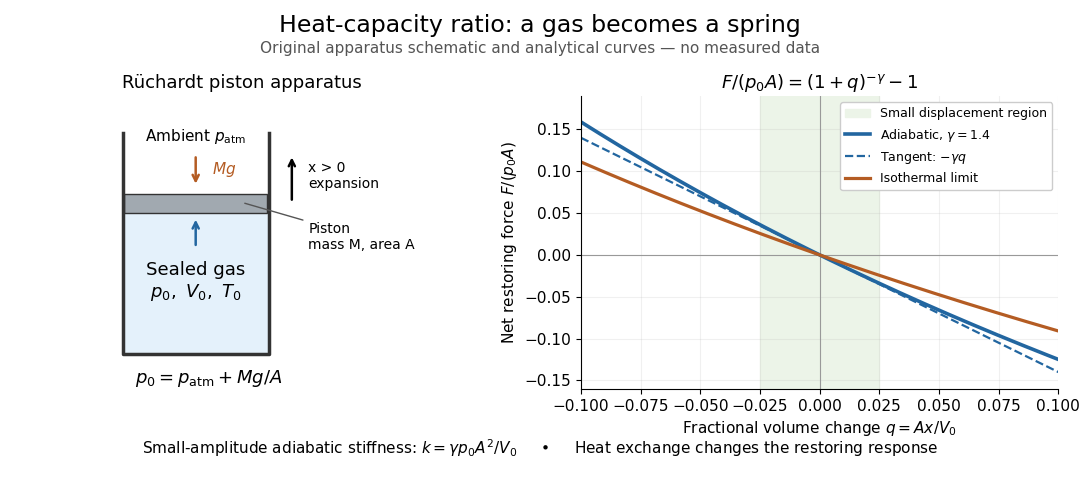
The Rüchardt experiment infers heat capacity ratio from the period of an oscillation of a piston supported by trapped gas. Use a vertical precision cylinder with a close-fitting movable piston, known moving mass , face area , trapped equilibrium volume , and local atmospheric pressure . With negligible static friction, force balance gives the absolute gas pressure , where is gravitational acceleration. Displace the piston slightly and release it: compression raises pressure, and expansion lowers it, producing a restoring force. The oscillation is a mechanical probe of thermal response, without separately measuring two heat inputs. [ref]
https://groups.ist.utl.pt/wwwelab/wiki/index.php?title=Determination_of_the_Adiabatic_Constant. Instituto Superior Técnico e-lab, Determination of the Adiabatic Constant: piston apparatus and period model
Let be upward displacement from equilibrium, so . For constant heat capacity ratio and a reversible adiabatic process, the net upward force, including the ambient load and weight, isThe linear approximation requires . Applying Newton's second law gives simple harmonic motion withHere is the undamped angular frequency and the undamped oscillation period, rather than temperature. Record repeated cycles, measure independently, and include all connected trapped volume. An illustrative model with , , , , and gives and . These stipulated values are not measurements.

In Shearwood and Sloan's implementation, piston-mounted magnets induce an electromotive force in a stationary coil through Faraday's law of induction; an oscilloscope records the signal. They observed faster oscillations at smaller trapped volume values and stronger damping at small cylinder volume values. The signal tracks velocity locally, so its amplitude is not directly piston displacement. Calibration also identified inlet dead space beyond the graduated cylinder volume. [ref]
https://arxiv.org/html/2209.03323v1. Chris Shearwood and Peter A. Sloan, The Rüchardt experiment revisited, §§3–4: signal, dead volume and observations
Repeat at smaller initial amplitudes to test the linear approximation, and compare several values. Heat transfer weakens the restoring force toward the isothermal process limit, biasing the inference toward . Check leakage through resting-piston drift and before-and-after trapped volume readings. For viscous damping with envelope , the measured angular frequency obeys ; this correction does not remove thermal leakage. Internal equilibration must be faster than an oscillation period, with heat transfer and leakage slow over a run. Large amplitude or sticking friction require a richer model. [ref]
Heating curve Created 2026-10-14 Updated 2026-11-05
A heating curve records temperature against accumulated supplied heat under a specified constraint. Within one thermodynamic phase, its slope is , where is the constrained heat capacity. A latent heat plateau instead records changing phase fraction at the phase coexistence temperature. The sensible heat example combines two sloping intervals and a melting plateau in one heating budget.
There are unlisted articles, also show them or only show them.