
Hilbert class field of Q of square root 229 Created 2026-10-14 Updated 2026-11-05
The polynomial is irreducible with discriminant , so its splitting field has Galois group and quadratic subfield . The splitting field is cyclic cubic over that subfield. It is unramified outside 229, and at 229 its inertia is a transposition, meeting the alternating cubic subgroup trivially. All roots are real. It is therefore everywhere unramified over the quadratic field. The ideal class group of Q of square root 229 has order three, so this extension is exactly the Hilbert class field.
The three reduced primitive binary quadratic forms of discriminant are and , so the class number is three. The displayed cubic has discriminant and is irreducible. Its splitting field has Galois group and is cyclic cubic over . Modulo it factors as . Lift the simple factor; the remaining quadratic has discriminant valuation one, so its local inertia group has order two. Its intersection with is trivial. Thus the relative cyclic cubic extension is everywhere unramified and equals the Hilbert class field.
Class number divisibility for a CM extension 2026-10-14
For a CM-field over its maximal real subfield , the ordinary Hilbert class field is totally real because its real places split. Thus . Its compositum with is an abelian extension of of degree , and is everywhere unramified by unramified extensions remain unramified under base change. It lies in , giving the divisibility. The argument does not require injectivity of extension of ideal classes.
The bulk tangent covariance is twice the inverse Fourier transform of , one term for each transverse direction. Equivalently the inverse of is . This gives the displayed correlation and identifies a force-dependent correlation length, different from the zero-force persistence length. Finite chains require endpoint conditions or a periodic convention.
Higgs conjugate doublet 2026-10-14
Set , whose Pauli matrix identity is . Exponentiation gives for . Hence complex conjugating a Higgs doublet and multiplying by restores the fundamental representation of , while reversing hypercharge. A Higgs field of hypercharge yields a conjugate doublet of hypercharge . Its product with a lepton doublet of hypercharge transforms in the trivial representation of the whole electroweak gauge group. At vacuum , this composite is .
A nonzero Higgs doublet has a real radial magnitude and three real angular coordinates. For a normalized vector , the SU(2) matrix satisfies . Near the vacuum, the three broken generators can equivalently be parameterized by . A local gauge transformation removes these angular fields in unitary gauge. This coordinate choice is local about a nonzero vacuum and need not extend through zeros or topological defects.
Monolithic galaxy formation Created 2026-10-14 Updated 2026-11-05
Monolithic galaxy formation idealizes a galaxy as forming in one early rapid dissipative collapse, followed mainly by passive evolution. Rapid formation of the stars is distinct from early assembly of all those stars into their final object; hierarchical galaxy formation can assemble old stellar populations later.
Downsizing in galaxy formation Created 2026-10-14 Updated 2026-11-05
Downsizing denotes the tendency for the characteristic mass of actively star-forming galaxies to decrease with time, together with related evidence that more massive quiescent systems formed their stars earlier or over shorter intervals. It does not assert that their dark-matter haloes assembled earlier: stellar formation and halo or stellar assembly are separate histories.
Galactic angular-momentum catastrophe Created 2026-10-14 Updated 2026-11-05
The galactic angular-momentum catastrophe is the excessive loss or redistribution of baryonic specific angular momentum in early simulated galaxy formation, producing overly compact disks or large central concentrations. Premature cooling, gravitational torques, interactions, and resolution contributed. Improved stellar feedback and gas accretion histories can mitigate it; it is a historical simulation problem rather than a theorem against cold dark matter.
A normal local effect can be represented by a standardized latent variable independent of the hyperparameters, with . This preserves the hierarchical model while changing the coordinates explored by Markov chain Monte Carlo. It often improves mixing when individual effects are weakly informed, reducing strong scale-effect dependence. Centered coordinates can be better with very informative individual data. The stochastic prior on implements the transformation correctly; re-expressing an existing density directly instead requires the appropriate Jacobian determinant.
Unknown hospital event probabilities can be modelled as exchangeable random variables conditional on shared hyperparameters, for example independently. Different sample sizes affect the binomial observations but do not by themselves invalidate exchangeability of the risks. Known systematic covariate differences, such as case mix or procedure type, should instead enter the risk model; only residual effects may then be exchangeable. Exchangeability permits heterogeneous realized risks and is not an assertion that all risks are equal.
// Target: biology.bigb
In the hexagonal convection amplitude equations, a pure convection roll has and . The transverse diagonal linear growth cancels because self and cross cubic coefficients coincide. Broken up-down symmetry leaves the off-diagonal coupling , giving eigenvalues and an unstable orientation perturbation whenever . With zero quadratic coupling these directions are neutral at the retained order, so that degenerate case cannot be declared strictly unstable by this calculation.
Rotational hexagon amplitude equations 2026-10-14
For a resonant three-wave triad with rotational and translational symmetry but no spatial reflection, the cubic amplitude equations have the cyclic form . A half-turn induces complex conjugation, so all coefficients are real. The coefficient distinguishes the two cyclic cross-couplings that a reflection would interchange.
Variance comparison for compound portfolio approximations Created 2026-10-14 Updated 2026-11-05
Put , , and . A compound Poisson distribution with count mean and severity law has variance . A compound binomial distribution with trials, probability , and that same severity law has variance . The individual-policy variance is . The Cauchy-Schwarz inequality gives , proving the ordering. Equality of the first two variances requires constant ; it need not imply equality of the distributions. If all probabilities and severity laws are identical, the binomial compound approximation is exactly the individual model.
Monomial orthonormal basis on the unit torus Created 2026-10-14 Updated 2026-11-05
Integrate a polynomial times the conjugate of another over the product of unit circles, with normalized product angular measure. Fourier orthogonality makes the monomials an orthonormal basis of the polynomial vector space. The Hermitian form is positive definite because the squared norm is the sum of squared absolute values of the finitely many coefficients. No completion or infinite series is needed to obtain this algebraic basis.
Hermitian form over a quadratic finite field 2026-10-14
Over the finite field , a sesquilinear form relative to is linear in its first argument and conjugate-linear in its second. It is Hermitian when . Its diagonal values belong to ; it is nondegenerate when for every forces . This definition applies in characteristic two as well.
Hermitian inner product Created 2026-10-14 Updated 2026-10-20
A Hermitian inner product is a Hermitian form on a complex vector space which has positive definiteness: for every nonzero vector . It is precisely a complex inner product. Only with this definiteness condition doesdefine a norm rather than a seminorm or an expression that may not be real. The standard Hermitian inner product on is ; positive weights give , with squared norm .[ref]
https://linear.axler.net/InnerProduct.pdf. Sheldon Axler, Linear Algebra Done Right, third edition, §6.A, definitions 6.3 and 6.9 and examples 6.4
A Hermitian inner product need not have a real matrix. For instance, with the linear-first coordinate convention,The last expression proves positive definiteness without a lengthy calculation of eigenvalues. For it gives , while for it gives . These unequal values expose why a silent switch to would change this particular Hermitian inner product: with these same entries it gives at . All entries must keep their roles from the matrix of a Hermitian form.
The Cauchy-Schwarz inequality for a Hermitian inner product statesEquality holds exactly when are linearly dependent, including when either is zero. For a nonzero , outline the proof by setting and . Then , and the Pythagorean theorem givesNonnegativity proves the inequality, while positive definiteness makes equality equivalent to . The scalar has no extra conjugate because the first argument is linear.[ref]
https://linear.axler.net/InnerProduct.pdf. Axler, Linear Algebra Done Right, third edition, orthogonal decomposition 6.14 and Cauchy-Schwarz inequality 6.15
The Cauchy-Schwarz inequality also holds for a positive semidefinite Hermitian form, but equality need not imply linear dependence: for , the independent vectors and give . Equality then describes dependence after passing to the quotient vector space by the radical of a Hermitian form. The indefinite Hermitian form in Hermitian form shows that conjugate symmetry alone does not even guarantee the inequality.
For a worked orthogonal projection, take , and . Then , and , with and for the squared norms. The residual is perpendicular in this Hermitian inner product even though its ordinary real dot product with is . For complex , the same orthogonal projection uses ; rotating multiplies by , while rotating multiplies by . This combines geometric decomposition with sensitivity to the relative complex arguments of the multipliers.
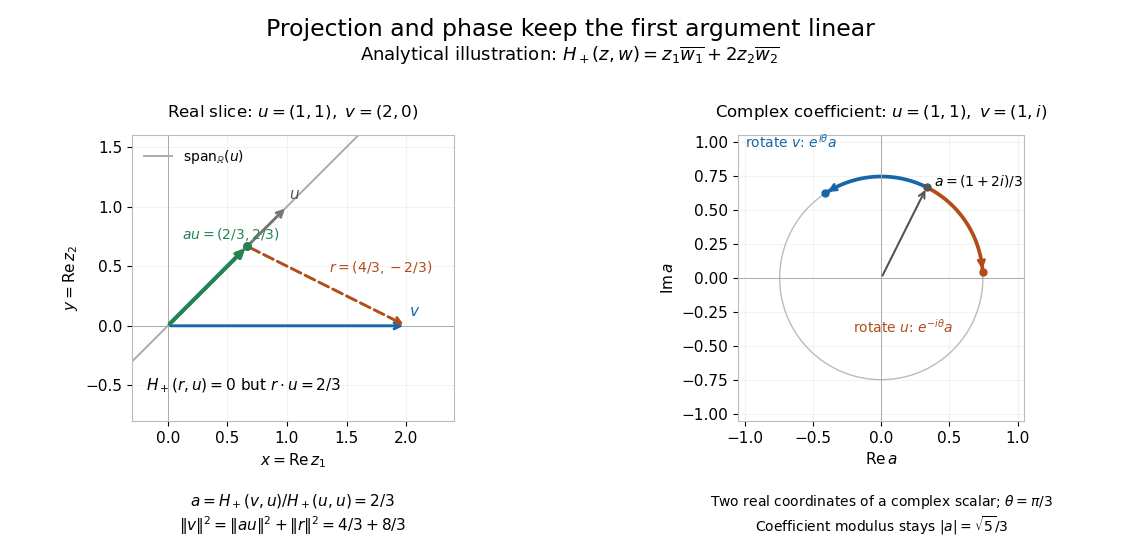
Analytical illustration: weighted orthogonal projection on a real slice and opposite changes of complex argument of its projection coefficient
. Details. 
A Hermitian inner product therefore supplies more than a positive diagonal: orthogonality, orthogonal projection onto a span, and the triangle inequality for its norm make approximation and distance meaningful. For the function space of complex continuous functions on , has positive definiteness, because a nonzero continuous function has positive modulus on a small interval. The same construction turns overlap under integration into lengths and best approximation in finite-dimensional vector subspaces.
Let be a closed star-subalgebra of a unital Hermitian Banach algebra , containing the same identity. For Hermitian , the complement of is connected. The resolvent belongs to at large modulus by the Neumann series; its membership in is both open and closed in that complement, so . If is invertible in , both and are invertible there and Hermitian algebra elements, hence invertible in . Their inverses supply respectively a right and a left inverse for in , proving invertibility there. Applying this to proves the spectrum equality.
Hermite function Created 2026-10-14 Updated 2026-10-18
The normalized Hermite functions multiply the physicists' Hermite polynomials by a Gaussian. They form an orthonormal basis of and satisfy . With and , they are and the quantum harmonic oscillator is . For completeness, if is orthogonal to all of them, all moments of vanish. Its transform is entire by Cauchy-Schwarz inequality, has every derivative zero at zero, and hence vanishes identically. Uniqueness of the Fourier transform gives .
Let be a finite-dimensional basic algebra over an algebraically closed field and a hereditary ring. The radicals of its indecomposable projectives are projective and satisfy , where are the Ext quiver arrow multiplicities. Hence , forcing strict dimension decrease along arrows and therefore acyclicity. Lifting an arrow basis in gives a surjective path algebra homomorphism . The number of paths starting at satisfies the same dimension recursion. Equality of total dimensions proves the homomorphism is an isomorphism. Sums of vertex idempotents over connected components are precisely the primitive central idempotents, so components give the blocks.
There are unlisted articles, also show them or only show them.