
Casimir invariant of a transport equation 2026-10-14
For an incompressible transport flow, every integrable function of the transported scalar has constant integral: the scalar is unchanged along characteristics and the flow's Jacobian determinant equals one. For a finite integral on infinite phase space, require integrability; and compactly supported data are one common choice. For a whole-space conservation statement also require no escape or boundary flux at infinity.
For a nonnegative classical solution of a finite-horizon Hamilton-Jacobi-Bellman equation with nonnegative running reward , the process is a local supermartingale under every admissible control. The Itô formula gives nonpositive drift because the chosen control cannot exceed the supremum in the equation. Stop where the stochastic integral becomes a true martingale, take expectations and apply the Fatou lemma. Nonnegativity prevents loss of a lower bound when removing the stops, giving the verification upper bound. A maximizing control attains the bound when its stopped reward processes are uniformly integrable.
Hall matching of maximal separated sets 2026-10-14
Two maximum-cardinality -separated subsets of a compact metric space have a bijection that moves each point by less than . Join to when their distance is below . If had fewer than neighbours, replacing these neighbours in by would create a larger separated set. The Hall marriage theorem therefore supplies a perfect matching. This allows empirical averages on a compact isometry group to be made approximately invariant without assuming a prior Haar measure construction.
Random bipartite matching from empty-rectangle exclusion Created 2026-10-14 Updated 2026-10-14
In the equal-part random bipartite graph with fixed edge probability , rule out empty rectangles of side and vertices with at least nonneighbors. A union bound gives the displayed asymptotic estimate. Small vertex sets satisfy Hall's condition by the degree bound; intermediate sets do so because their omitted-neighbor rectangle would contain a forbidden square; large sets meet every vertex in the other part. Thus Hall's marriage theorem gives a perfect matching asymptotically almost surely. This does not mean probability one at any finite size.
Incompressible Hall-MHD wave dispersion Created 2026-10-14 Updated 2026-11-05
For a uniform guide field, write the transverse perturbation in velocity units as . Linear momentum gives . Linear induction gives . The helicity decomposition of a transverse Fourier mode then yields the displayed dispersion relation. Its two positive frequency magnitudes are , approaching the Alfvén wave frequency for . For , the fast branch is a whistler wave and the slow branch tends to .
For field amplitudes of order the guide field, the ion Lorentz-force response over time is . The electron-current velocity is of order , larger than a bulk velocity of order . Thus the leading Hall magnetohydrodynamics induction equation becomes the closed electron magnetohydrodynamics equation, while ions remain fixed to leading order on this fast scale. The first nonzero ion response need not have zero acceleration. This limit retains the fast branch of incompressible Hall-MHD wave dispersion, not the slow branch; very oblique modes must separately satisfy the fast-time ordering.
Induct on the alphabet size . For an -colouring, choose an -insensitive combinatorial subspace whose dimension forces a monochromatic combinatorial line over the first letters. The inductive Hales-Jewett theorem supplies that line. Changing all of its active parameters from to , one at a time, preserves the colour by the alphabet insensitivity lemma. Thus the line extends to all letters. The one-letter alphabet is the base case.
For a nonempty radially open convex set disjoint from a vector subspace , there is a nonzero linear functional whose kernel of a linear map contains and avoids . Choose and the Minkowski functional of . On , set . Disjointness implies , which gives for negative ; nonnegativity of gives it for nonnegative . The algebraic Hahn-Banach theorem extends to . For , , so . Also and .
Separation from an absorbing convex set 2026-10-14
If a convex set in a real normed vector space contains , every admits a continuous linear functional with for all , even if is not closed. Its Minkowski functional is sublinear functional, satisfies , , and . Extend by the dominated Hahn-Banach theorem. The resulting domination applied to and makes continuous and supplies the separation inequalities.
Hadamard squared-distance inequality 2026-10-14
For the constant-speed geodesic from to in a Hadamard space, the displayed inequality follows by repeatedly applying the midpoint inequality and passing from dyadic parameters to all . Applying it on two sides of a triangle gives , where , and . The right side is the squared comparison distance by the Euclidean cosine rule.
Subtract a test function's value at zero before integrating near zero, and retain the ordinary tail integral. This defines an even tempered distribution. Changing the subtraction cutoff adds a multiple of the Dirac delta distribution. Multiplication by gives .
Normalized squared Cauchy kernel 2026-10-14
For , this holomorphic function has H1 space on the unit disk norm one: its boundary modulus is the unit-mass Poisson kernel on the circle. The radial integrals are bounded by that boundary integral by subharmonic comparison and tend to it by continuity. Choosing at depth comparable to an arc's length makes bounded below by the reciprocal length throughout its hyperbolic geodesic cap. It tests necessity in the Carleson embedding theorem on the disk.
For an analytic H1 space on the unit disk function, its fixed-aperture non-tangential maximal function obeys the displayed strong bound. First replace by , . The fact that modulus powers of holomorphic functions are subharmonic gives . Since a Poisson maximal function is dominated by the Hardy-Littlewood maximal function, the strong Hardy-Littlewood maximal inequality yields . Pointwise interior convergence and the Fatou lemma remove . Analyticity permits this endpoint estimate; general boundary data have only a weak maximal bound.
A bounded holomorphic function on the unit disc has finite nontangential limits almost everywhere on its boundary. To outline a proof, bounded real and imaginary harmonic parts have boundary representations: apply the Banach-Alaoglu theorem to their circular traces and pass to the limit in the Poisson integral on the unit disk. Almost every boundary point is a Lebesgue point. The fact that a Poisson integral converges nontangentially at Lebesgue points gives the desired limits. Their norm equals the interior supremum norm, and the Poisson integral recovers the original function. Exceptional points can lack even radial limits; is a bounded example at the boundary point one.
Rapid-rotation mean gyrotactic orientation Created 2026-10-14 Updated 2026-11-05
Zero-flow steady gyrotactic orientation distribution Created 2026-10-14 Updated 2026-11-05
For aligning rate , positive rotational diffusivity and , the zero-current steady Fokker-Planck equation gives . Normalization over the unit sphere gives the displayed density per unit solid angle. Its mean direction is , the Langevin function. As , it concentrates weakly into a point mass at the upward pole; the limit is not an ordinary bounded probability density.
Stresslet correction to gyrotactic pipe flow 2026-10-14
Let weak excess-cell buoyancy be and the swimming stresslet coefficient be . Set and use the leading gyrotactic focusing in a downward pipe flow density . With active stress entering as , the axial momentum equation integrates from the regular axis to the displayed derivative. The wall condition gives . Both terms of the integrand are positive for , so the correction increases downward flow. A negative stresslet strength can oppose this effect; reversal at a given radius requires smaller than minus the ratio of the integrated buoyancy and stresslet coefficients. This convention must be specified before attaching extensile or contractile sign labels.
Gyroscope direction reference 2026-10-14
For a rotor spinning about a principal axis with its support at the centre of mass, uniform gravity supplies no torque about that centre. With other external torques negligible, conservation of angular momentum preserves its direction in an inertial frame. A mount that permits free axis motion lets the housing rotate relative to that persistent direction, giving an orientation reference when external landmarks are unavailable. This is the useful limit opposite to the deliberately off-centre support in the spinning-wheel precession experiment. It supplies a direction, not a position or a full three-axis orientation from one axis alone.
For a small accumulated transverse torque about the centre of mass, the change in the direction unit vector is, to first order,Here is approximately constant over the short interval. Large angular momentum reduces drift for the same integrated transverse torque; parallel torque instead changes its magnitude. For , a constant transverse torque of over produces approximately , or , of direction change. This is another synthetic calculation. The persistent direction belongs to an inertial frame; its components can change in a rotating reference frame even with zero external torque.
Slow steady gyroscope precession 2026-10-14
Model the assembly as a heavy symmetric top with a fixed frictionless support, a uniform gravitational field, and centre of mass on its symmetry axis. Assume constant spin, negligible damping, and initial conditions prepared for uniform precession of a heavy symmetric top. Large spin means the transverse angular momentum from precession is small: . Also require . A large spin rate alone does not select steady motion after an arbitrary release.
For an original illustrative calculation, stipulateThe transverse principal moments of inertia are about the pivot, including the parallel axis theorem contribution. These inputs giveThe ratio is small; the more direct angular momentum ratio is small too. These are model calculations, not experimental results.
Check the approximation against the existing exact uniform precession of a heavy symmetric top condition. Its total angular momentum isAt constant , differentiating this expression and equating it to the gravitational torque givesFor the slow solution can be evaluated without subtracting two nearly equal numbers:It exceeds by about . The other solution is about and violates the assumed slow precession; the quadratic's two roots must not be conflated. Its discriminant must be nonnegative for these steady solutions to exist.
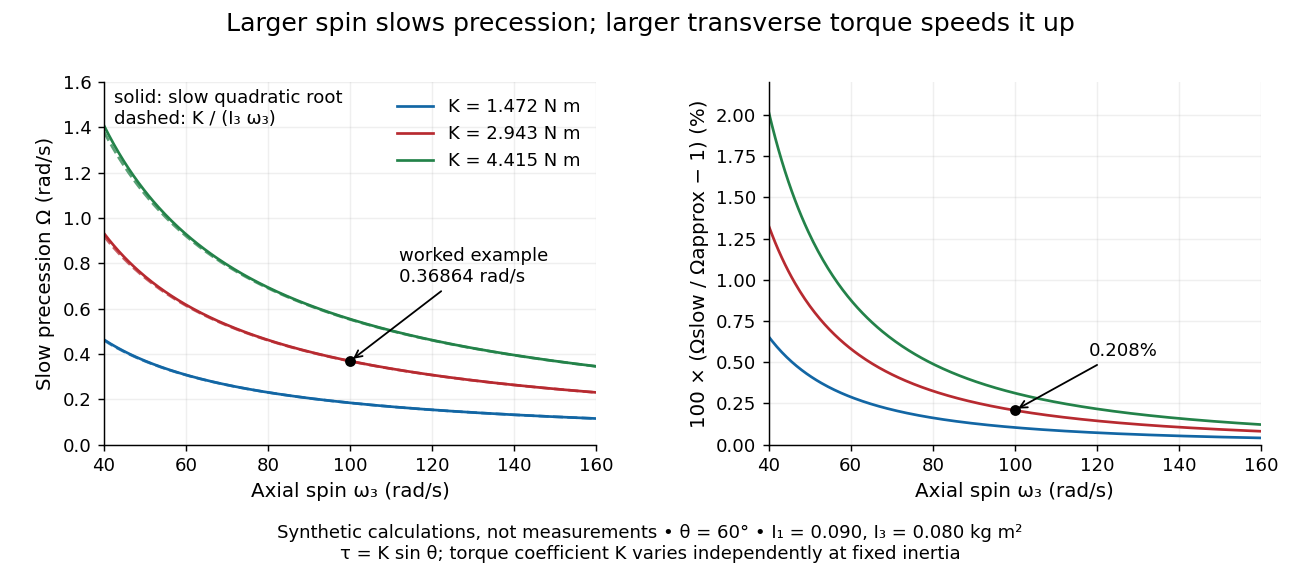
Synthetic steady-precession calculations: larger spin slows the drift and larger transverse torque speeds it up
. Details. 
The original curves hold fixed and vary spin and the imposed torque coefficient in . For gravity alone, ; the other curves are hypothetical changes in the transverse torque, not observations of this wheel. Solid curves use the slow quadratic root; dashed curves use . The second panel displays their relative difference. Increasing spin improves this approximation for the parameters shown. It does not remove nutation caused by inappropriate initial conditions.
Spinning-wheel precession experiment 2026-10-14
Purdue's Bicycle Wheel Gyroscope demonstration uses a bicycle wheel on a long axle, with a ball at one end seated in a freely rotating socket on a heavy stand. Spin the wheel by hand or with the supplied motor, seat the ball, and release the nearly horizontal axle. The readout is the axle sweeping around the vertical while the wheel continues spinning. Compare with the stopped wheel, which falls when one end is released; reverse the spin with the same support and the precession reverses. These are the page's documented apparatus, presentation, and reversal checks. [ref]
Bicycle Wheel Gyroscope by Purdue University, Department of Physics and Astronomy. 1Q-30, apparatus paragraph, Directions, and Suggestions for Presentation; page updated 30 November 2023
An alternative in Physics Demonstrations by Julien Clinton Sprott (section 1.3, Materials and Procedure) suspends one axle end by stainless steel wire and a fishing-line swivel. The swivel allows precession without winding up the suspension. Sprott describes the axle bobbing as nutation and precession becoming faster as spin decreases. A suspended support can move, whereas the calculation here assumes a fixed ; use the socket version for the closest realization. [ref]
Bicycle Wheel Gyroscope (section 1.3). section 1.3, Bicycle Wheel Gyroscope: Materials, Procedure, and Discussion
A proposed quantitative extension is to record an overhead view of an axle marker against a fixed angle scale, together with a side view for . Time successive overhead passages to estimate ; count passages of a rim mark to estimate . Record the spin sense too. Measure and the centre of mass offset of the whole moving assembly, and determine its axial moment of inertia independently. Wheel, axle, support, release angle, and observation interval should stay the same between spin trials. Measuring both and distinguishes azimuthal precession from nutation; an overhead movie alone can miss the latter. These camera readouts and parameter checks are proposed here, not reported measurements from the demonstration pages.
For slow precession, compare with , and test whether reversing reverses with nearly unchanged magnitude. A brief interval minimizes spin loss from friction; repeat at several starting spin rates rather than interpreting an entire slowing run as one steady state. A suspension restoring torque governed by its torsion constant, socket friction, support motion, a misplaced centre of mass, and a push at release can all supply extra torque or change the initial conditions. The swivel reduces the twist that activates the suspension's torsion constant; it does not demonstrate zero torque.
Steady precession keeps constant; nutation changes while the axle may also precess. Sudden release generally excites both. A small initial drop is consistent with conservation of energy and conserved vertical angular momentum: some gravitational potential energy supplies the motion around the vertical, and the axial contribution to vertical angular momentum adjusts. Bearing friction may damp the bobbing, but an ideal undamped heavy symmetric top need not settle into steady precession. Chapter 20: Rotation in space explicitly distinguishes uniform precession from release transients and nutation (section 20-3, paragraphs following equation 20.15).[ref]
Chapter 20: Rotation in space. section 20-3: sudden release, nutation, and the small drop needed for precessional angular momentum
There are unlisted articles, also show them or only show them.