
Axion-dilaton 2026-10-14
The complex scalar combines the IIB axion and dilaton. Its imaginary part is for a constant background. S-duality acts by fractional linear transformations, corresponding to changes of torus basis in the M-theory torus duality.
(p,q) string 2026-10-14
A (p,q) string carries units of fundamental string charge and units of D1-brane charge. Coprime integers label an elementary primitive charge vector; nonprimitive vectors describe multiple units. The displayed tension uses the string metric and vanishing axion. In the M-theory torus duality, it comes from an M2-brane wrapped on the corresponding primitive one-cycle.
(p,q) five-brane 2026-10-14
The IIB five-brane doublet combines NS5-brane and Ramond–Ramond five-brane charges. Its toroidal M-description involves wrapped M5-branes or Kaluza-Klein monopoles, depending on whether the IIB circle lies along or transverse to the five-brane. Electric–magnetic charge bases fix the order and signs of the integer labels.
Massless type IIB spectrum 2026-10-14
The NS-NS fields are a graviton, Kalb–Ramond field and dilaton, with physical polarizations. The RR fields are , with polarizations; the five-form field strength of is self-dual. Two same-chirality Majorana-Weyl gravitini contribute polarizations, and two Majorana-Weyl dilatini of the opposite chirality contribute . Potential components, dual potentials and physical polarizations are different counts.
Massive type IIA supergravity Created 2026-10-14 Updated 2026-11-05
Massive type IIA supergravity is a deformation of type IIA supergravity with a nonzero zero-form Ramond–Ramond sector field strength, the Romans mass . The parameter modifies field strengths, gauge transformations and scalar interactions; it is not a statement that every field, including the graviton, has acquired an ordinary particle mass.
In the presence of a D8-brane, the value of can differ on the two sides of the brane. This links the deformation to charged domain-wall solutions and distinguishes it from the simplest circle reduction of eleven-dimensional supergravity. The limit recovers the ordinary massless theory, but a nonzero flux must be retained consistently in both field equations and source matching.[ref]
Non-BPS D8-branes and Dynamic Domain Walls in Massive IIA Supergravities by A. Chamblin and others. abstract and introduction: D8-branes, Romans bulk theory and domain-wall matching
Type II gamma-factor mass poles Created 2026-10-14 Updated 2026-11-05
At generic fixed , the factor has simple poles at the displayed nonnegative values of . Its denominator is finite there. The factors do not generically cancel those poles under . Factorization identifies massless and massive intermediate states at those masses. The factor has no negative-mass-squared poles; special polarization or momentum choices can suppress individual residues and cannot establish the degeneracy of an entire level.
Superconducting mixed state Created 2026-10-14 Updated 2026-11-05
The superconducting mixed state is the equilibrium vortex regime of a type-II superconductor, between its lower critical magnetic field and upper critical magnetic field in the ideal bulk description. Magnetic flux enters through Abrikosov vortices, while the surrounding material retains a nonzero superconducting order parameter.
Each vortex has a suppressed-order core and circulating electric currents; in the appropriate bulk limit, a singly wound vortex carries one superconducting flux quantum. Their mutual interactions can produce an Abrikosov vortex lattice. Increasing the field increases the vortex density until superconductivity is destroyed at the upper critical field. Defects can immobilize vortices through flux pinning, so a prepared sample's magnetization need not coincide with the equilibrium curve. Spatial coexistence here means vortex cores within superconducting matter, rather than arbitrary macroscopic patches of two phases.[ref]
Nobel Lecture: Type-II superconductors and the vortex lattice by Alexei Alexeyevich Abrikosov. discussion of the vortex solution and triangular lattice
Hubble diagram Created 2026-10-14 Updated 2026-11-05
A Hubble diagram plots a distance indicator, such as standardized supernova apparent magnitude or distance modulus, against redshift. The low-redshift relation sets a distance-scale intercept, while curvature of the relation at larger redshift tests the expansion history through luminosity distance. A common unknown absolute magnitude remains degenerate with the Hubble constant; the diagram's redshift-dependent shape can still constrain other cosmological parameters.
Independent permissive gates in an ion channel Created 2026-10-14 Updated 2026-10-25
A permissive gate allows conduction when it is open. Suppose an ion channel conducts only when all gates are open, where is a positive integer. If the gate-open events are mutually independent events and each has the same open probability at the time considered, thenThis follows from the multiplication rule for independent events. Identical transition rates alone do not guarantee independence: the initial gate states must also be independently prepared, and the model must not couple their transitions. Gates sharing a fluctuating membrane potential can be correlated; the simple product requires an appropriate independence assumption, for example independent gates at an externally fixed voltage.
At , channels requiring permissive gates have open probabilities , and . For four independent gates there are possible open/closed configurations, equally probable at ; only the all-open configuration conducts. Thus is the gate-open probability, while is the whole-channel open probability. Neither is a fractional state of one observed channel. Among independently prepared identical four-gate channels, the expected value of the open count is , although an actual count fluctuates.
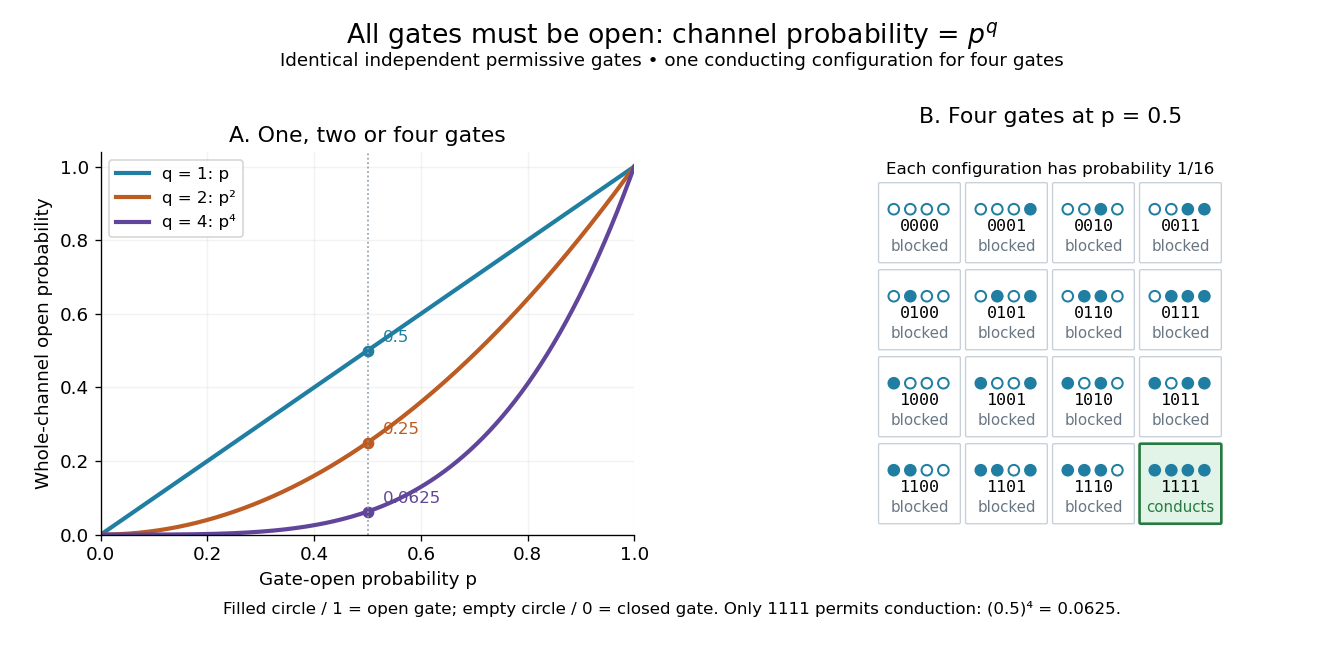
Independent permissive gates in an ion channel: an all-open requirement
. Left: whole-channel open probability for one, two and four identical independent permissive gates. Right: all sixteen configurations of four gates at , each with probability ; filled circles are open gates and empty circles closed gates. Only the highlighted all-open configuration permits conduction. This is an illustrative model, not a molecular structure or an ionic electric current measurement. Details.
For unequal independent gate-open probabilities , use rather than . This is the distinction behind the Hodgkin-Huxley model's : and are different activation and inactivation-availability variables, rather than one common . Its uses four identical activation factors. Independence and the all-open requirement are model assumptions; correlated gates or alternative conducting configurations require a different calculation. The simple product is useful because a modest gate-open probability can produce sharply suppressed whole-channel availability without any additional gate interaction.
Average the four correlated local Pauli operations to remove coherences in the Bell states basis. A one-party Pauli operation can permute the largest of the four resulting weights into the singlet sector; that weight is at least . Correlated common local unitaries then permute the three triplet projectors, while collective-unitary covariance of the two-qubit singlet keeps the singlet projector unchanged. Averaging all six permutations makes the triplet weights equal, producing a two-qubit Werner state. Shared randomness or local operations and classical communication coordinates these local operations. Common unitaries alone cannot increase an initially small singlet weight, because that weight is invariant under them.
Concurrence of a two-qubit Werner state 2026-10-14
For any normalized pure two-qubit vector, its squared overlap with a maximally entangled state is at most : in a Schmidt decomposition the overlap is bounded by . Averaging gives . Equality follows from the six-state ensemble , with equal weights, where , and . The coherences cancel and each coefficient determinant gives pure concurrence .
Write , with . For positive matrices and , the success probability is . It is at least . Squaring the middle comparison leaves .
A geodesic on the embedded two-dimensional de Sitter spacetime is the intersection with a two-plane through the ambient origin. For initial point and tangent satisfying , , , its affine parametrization is when timelike, when null and when spacelike. These solve . The spacelike geodesics are closed; timelike geodesics and null geodesics extend to both conformal infinities with infinite affine length.
The conformal time satisfies and . Multiplying the physical metric by gives a finite conformal compactification with periodic spatial coordinate. Its past and future conformal boundaries are spacelike circles. Null geodesics have slopes .
The unrestricted spatial coordinate unwraps the spatial circle of two-dimensional de Sitter spacetime. The conformal time lies in , and null geodesics have slopes . Constant- lines are Cauchy hypersurfaces: along any causal curve , so a curve cannot escape to spatial infinity in a bounded conformal-time interval. The covering spacetime is therefore globally hyperbolic, despite its observer-dependent cosmological horizons. Identifying modulo gives the de Sitter cylinder, also globally hyperbolic.
On the universal cover, and . The two conformal boundaries are timelike. Null geodesics are and can travel from either boundary to the center in finite coordinate time, despite taking infinite physical affine parameter to reach the boundary. There is no event horizon for the complete central static observer. The spacetime is not globally hyperbolic, unlike the global conformal cylinder of two-dimensional de Sitter spacetime; well-posed field evolution requires boundary conditions as well as initial data.
A geodesic of the unit embedded hyperboloid lies in the plane spanned by its initial point and tangent. The constraint forces the displayed ambient acceleration. Timelike geodesics are , null ones are , and spacelike ones are . Timelike geodesics are closed on the hyperboloid but lift to complete nonclosed curves on its universal cover. In static coordinates, conserved gives and . Null affine parameters obey , proving completeness at both spatial ends.
Greedy two-bin scheduling bound 2026-10-14
Put each successive item into a currently lighter bin. Before receiving weight , that bin contains at most half the total weight already assigned, hence at most , where is the overall total. Apply this to the last item in a finally heaviest bin to get . Since , the approximation ratio is at most . Ordered weights give loads rather than the optimal , proving the bound is sharp. Its relative-error guarantee is .
For integer weights, subset-sum dynamic programming finds the greatest achievable total at most in time , where is the total weight. For rational weights and , scale by and round down to . The scaled total is at most , so exact dynamic programming costs arithmetic operations. Lifting its partition to the original weights increases the maximum load by at most . Thus it is a fully polynomial-time approximation scheme for this two-bin problem. Bit complexity also accounts for the rational input and epsilon encodings.
Projective twistor space 2026-10-14
The projective space of one-dimensional complex subspaces of twistor space. A point corresponds to an alpha-plane in complexified compactified Minkowski space; a projective line corresponds to a spacetime point.
There are unlisted articles, also show them or only show them.