
Complex plane is not conformally equivalent to the upper half-plane Created 2026-09-24 Updated 2026-09-24
Composing a hypothetical conformal equivalence with a Cayley transform would give a nonconstant bounded entire function, contradicting the Liouville theorem.
Punctured plane is not conformally equivalent to the punctured unit disc Created 2026-09-24 Updated 2026-09-24
A conformal map from into the punctured unit disc would be bounded near its isolated singularity at zero, hence extend to a bounded entire function. The Liouville theorem would make it constant.
Induced charge on a conducting sphere in a uniform electric field Created 2026-09-24 Updated 2026-09-24
Charge on connected concentric spherical shells Created 2026-09-24 Updated 2026-09-24
Two connected concentric spherical shells form one equipotential conductor. In the absence of charge in the inner cavity, all net charge lies on the exterior surface of the outer shell.
Charge sharing between distant connected spheres Created 2026-09-24 Updated 2026-09-24
Electrostatic boundary conditions at a conductor Created 2026-09-24 Updated 2026-10-14
The electrostatic boundary conditions at a conductor relate the one-sided total electric fields at a smooth metal–vacuum interface. Choose a unit normal from metal into the adjacent vacuum, let and be the two limiting electric fields, and let be the signed surface charge density. A thin Gaussian pillbox with cap area has outward cap normals on the vacuum side and on the metal side. As its height tends to zero, its side electric flux tends to zero for bounded local electric fields, leavingThe minus sign comes from the second outward cap normal, not from the sign of the electric charge. A shrinking rectangular loop across the interface and the zero closed line integral in electrostatics give continuity of the tangential component:For a conductor in electrostatic equilibrium, , henceThus positive surface charge density gives an electric field away from metal and negative surface charge density gives an electric field toward metal. The derivative uses the same chosen unit normal, from the vacuum side. The ideal surface layer has no unique electric field value on the layer itself; these are limiting values. Ordinary surface electric charge preserves continuity of electric potential; an ideal electric dipole sheet would require a different model. [ref]
https://farside.ph.utexas.edu/teaching/em/lectures/node70.html. Richard Fitzpatrick, Boundary conditions for E and D: pillbox and loop conditions
.Here “exterior” means just outside the metal, including the vacuum within a cavity in a conductor. On a spherical inner wall of radius , its unit normal from metal into the cavity in a conductor is . A central positive point charge gives there, soThe outward normal of the cavity in a conductor as a volume is instead ; confusing these two unit normals reverses the inferred sign. For a stipulated spherical enclosure with inner radius , outer radius , no external sources and total isolated metal electric charge , spherical symmetry and Gauss's law give the analytical modelIts outer surface charge density is . Grounding to with zero electric potential at infinity instead gives and zero exterior electric field, while preserving the same nonzero electric field inside the charged cavity in a conductor.
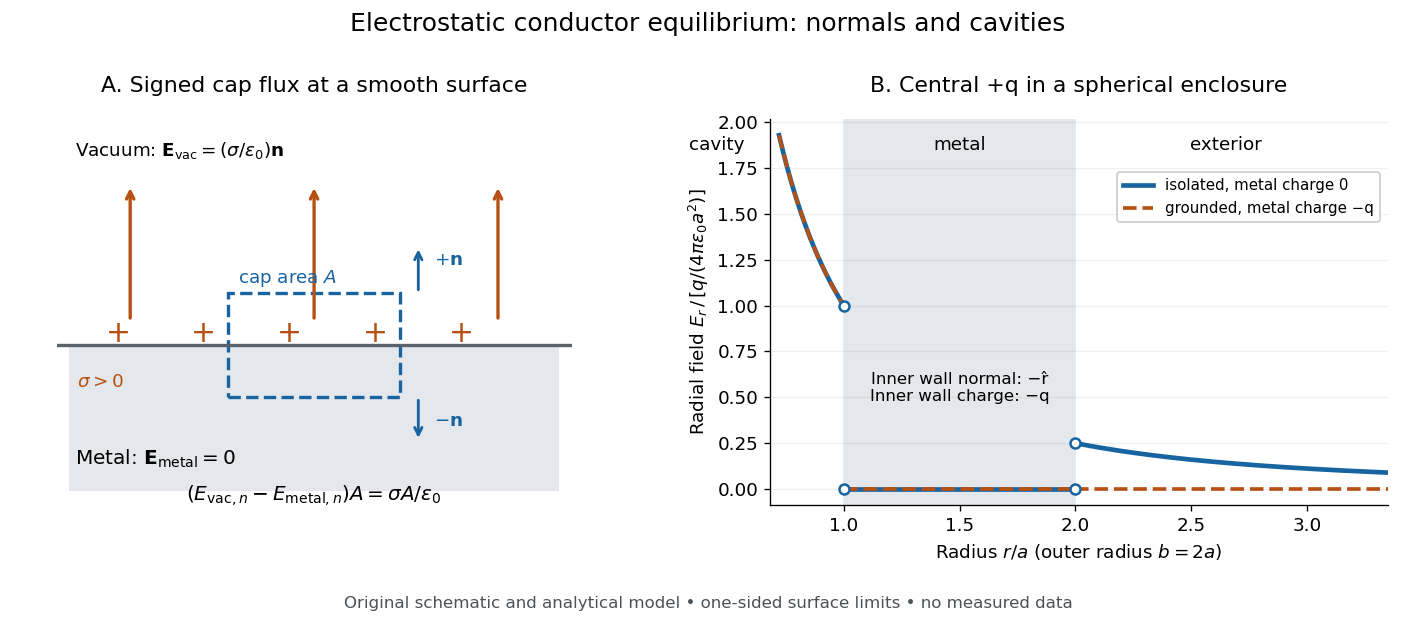
Signed Gaussian pillbox accounting and an analytical charged cavity in a conductor
. Original schematic and analytical model, not measured data. Left: the two cap normals give the normal electric field jump at a positive metal–vacuum surface. Right: a central positive point charge in a spherical enclosure with ; solid blue is an isolated initially neutral enclosure, and dashed orange is a grounded enclosure. Both have zero electric field in the metal and the same nonzero electric field in the cavity in a conductor. The jumps show one-sided limits, with the point-source singularity excluded. Details.
As a numerical sign check, stipulate , , and . The inner electric field is approximately along , but and . An isolated neutral enclosure has on the outer wall, approximately and just outside. Multiplying each surface charge density by its spherical surface area recovers the signed wall electric charges.
The local result uses the total electric field, including all induced and imposed sources. The factor follows from the zero metal-side electric field; a symmetric isolated sheet in vacuum instead has magnitude on each side. [ref]
https://www.feynmanlectures.caltech.edu/II_05.html#Ch5-S9. Feynman, Leighton and Sands, II.5.9: why a conductor differs from an isolated charge sheet
. At sharp corners, limiting electric fields can be singular and the smooth local pillbox argument needs care. In material outside the metal, use the normal free-charge jump of the electric displacement field and the material's permittivity, as in electrostatic interface boundary conditions. [ref]https://farside.ph.utexas.edu/teaching/em/lectures/node70.html. Richard Fitzpatrick, Boundary conditions for E and D: free and bound surface charge
. Conditional distribution Created 2026-09-24 Updated 2026-09-24
A conditional distribution is the probability law of one random quantity given information about another.
Bayes' theorem Created 2026-09-24 Updated 2026-10-14
For a finite measurable partition with positive probabilities, and an event of positive probability,Its beauty is that a model predicting observations from a hidden state can also describe uncertainty about the state after an observation. Each numerator is a joint probability; the denominator, supplied by the law of total probability, makes the answers sum to one. This is a direct consequence of conditional probability, rather than an extra axiom.
Select the coin from law of total probability once, then toss that same coin repeatedly, with conditionally independent tosses given its identity. Let denote the -head coin, initially of prior probability . After one head , its posterior probability isThe likelihood of a head is larger under , but remains less likely than the other coin because its prior probability was smaller. A large likelihood for an observation does not itself imply a large posterior probability for the hypothesis.
After an ordered sequence containing heads and tails, its likelihood ratio between the two coins is . Bayes' theorem therefore gives posterior oddsEach head multiplies the odds by and each tail by . Three heads give posterior probability , still below one half; four give , above one half. The finite-model update and the distinction between prior probability, likelihood and posterior probability are set out in MIT 18.05, Reading 11: Bayesian Updating with Discrete Priors.
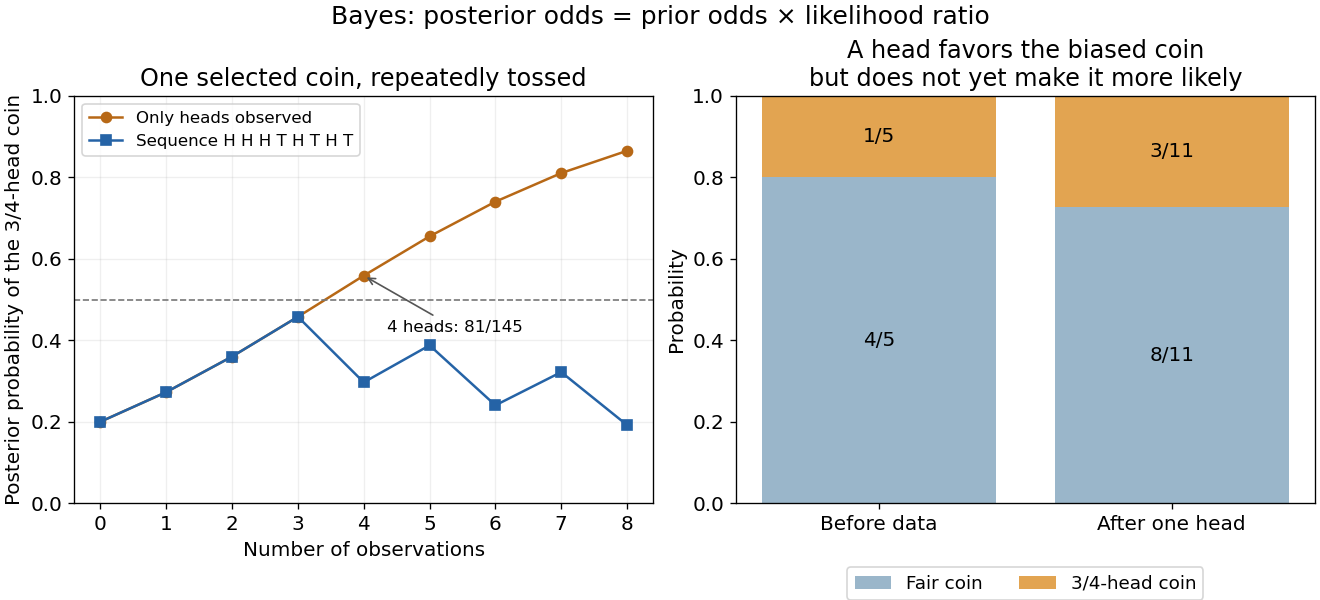
Updating uncertainty about one selected coin after repeated observations
. Details. 
The hidden selection also creates dependence. Each toss has marginal head probability , but two heads have joint probability , greater than . Their indicator covariance is . Seeing a head makes the head-favoring coin more likely, so it also raises the chance of a future head. This is covariance induced by a shared latent variable, despite conditional independence of the tosses given the coin.
Historically, Thomas Bayes's essay on an unknown success probability appeared in 1763 after his death, communicated by Richard Price. Its opening problem asks how observed successes and failures constrain that unknown probability; Price's introductory letter explains the connection to reasoning from experience. That is a more substantial inference problem than simply rearranging today's elementary identity. [ref]
https://www.gtfp.cs.rhul.ac.uk/pulskamp/Bayes/bayesessay-rjp.pdf. Bayes, An Essay towards solving a Problem in the Doctrine of Chances, 1763; original text transcribed, introductory letter and statement of the problem
Entropy of a sum of independent finite-group variables Created 2026-09-24 Updated 2026-09-29
If independent random variables take values in a finite additive group, thenIndeed, , and symmetrically for . Independence is essential: taking makes the sum constant.
Conditioning reduces entropy Created 2026-09-24 Updated 2026-10-14
For finite discrete random variables , knowing reduces the information entropy of on average:Equality holds exactly when and are independent random variables. The average over observations is essential: can exceed for a particular . All logarithms here have base two, giving bits, and zero-probability terms contribute zero.[ref]
For Bayesian inference, this compares a prior distribution with the posterior distributions produced by possible observations. An unexpected report can make previously unlikely alternatives plausible, while useful reports reduce uncertainty overall. For lossless source coding, an observation shared by encoder and decoder lets them choose descriptions for the appropriate conditional distribution; sending that observation also has a cost. The example below makes both the saving and that cost explicit.
In A Mathematical Theory of Communication by Claude Shannon (1948), the definition of conditional entropy is already an average over observations, followed by the inequality and its independence condition in section 6, property 6. The phrase “knowledge reduces uncertainty” must be read with that averaging convention.[ref]
A Mathematical Theory of Communication by Claude Shannon. p. 12; title page identifies C. E. Shannon and the 1948 journal publication
Conditional entropy under a deterministic change of variables Created 2026-09-24 Updated 2026-10-06
If is a bijection of for every fixed , thenIn particular, translating a random variable in a finite group by a value determined by the conditioning variable does not change its conditional entropy.
Strictly concave function Created 2026-09-24 Updated 2026-10-07
A function is strictly concave when its concavity inequality is strict for distinct points and coefficients strictly between zero and one. A strictly concave function has at most one maximizer on a convex set.
Halting problem Created 2026-09-24 Updated 2026-10-14
The halting set is computably enumerable but undecidable, and its complement is not computably enumerable.
Quadratic substitution for a square-root endpoint singularity Created 2026-09-24 Updated 2026-09-24
One-dimensional representation kills the commutator subgroup Created 2026-09-24 Updated 2026-09-24
The image of a one-dimensional representation lies in the abelian group , so its kernel contains the commutator subgroup of the represented group.
Faithful representation Created 2026-09-24 Updated 2026-10-14
A representation is faithful when its kernel is trivial.
Isomorphic representations Created 2026-09-24 Updated 2026-09-24
Representations and are isomorphic when an invertible linear map intertwines the actions: for every .
Degree of a representation Created 2026-09-24 Updated 2026-09-24
Continuous representation of a topological group Created 2026-09-24 Updated 2026-10-03
A finite-dimensional continuous representation of a topological group is a continuous homomorphism , where is a finite-dimensional complex vector space.
Cohomology ring of complex projective space Created 2026-09-24 Updated 2026-09-28
There are unlisted articles, also show them or only show them.