
Hilbert-Schmidt operator Created 2026-09-24 Updated 2026-10-14
A bounded linear operator on a Hilbert space is Hilbert-Schmidt when for one, equivalently every, orthonormal basis. Every Hilbert-Schmidt operator is a compact operator.
Peculiar velocity Created 2026-09-24 Updated 2026-10-06
Peculiar velocity is motion relative to the homogeneous Hubble flow. In comoving coordinates,where is physical velocity and is peculiar velocity.
Abelianization Created 2026-09-24 Updated 2026-10-14
The abelianization of a group is the quotient groupwhere is the commutator subgroup. Its elements are cosets, and its operation is . The result is an abelian group: the two products and differ by a group commutator, which disappears in the quotient group.
For the symmetric group , the sign of a permutation realizes , as shown in commutator subgroup of the symmetric group on three letters. For the dihedral group of a square, abelianization of the square symmetry group gives : two independent yes-or-no pieces of information survive. An abelian group already has , so its abelianization is isomorphic to itself. At the other extreme, a perfect group has trivial abelianization.
Calling this the largest abelian quotient means that every group homomorphism into any abelian group factors uniquely through . It does not require to be finite, or compare the sizes of unrelated abelian groups. The universal property of abelianization makes this precise. It lets us solve all such mapping problems in one simpler group: any invariant that respects multiplication and takes values in an abelian group sees only .
Hales-Jewett theorem Created 2026-09-24 Updated 2026-10-05
For every finite alphabet and every positive integer , there is such that every -coloring of contains a monochromatic combinatorial line.
Impulse Created 2026-09-24 Updated 2026-10-14
The impulse of a force over a time interval is its vector integral:Its International System of Units unit is . The impulse-momentum theorem equates the net impulse to the change in momentum. For one fixed-mass point mass, integrate its net force; for a closed collection obeying Newton's third law, integrate the sum of external forces. In one dimension, the signed area under the force versus time graph gives the impulse; negative force contributes negative area. [ref]
Three stipulated rightward net force pulses illustrate the same : constant for , a triangle rising from zero to at and falling to zero at , and constant for . Their areas areApplied separately to the same fixed mass , each gives . Their peak forces differ: , , and . Thus impulse fixes the final momentum change, while the force history determines how abruptly it occurs.
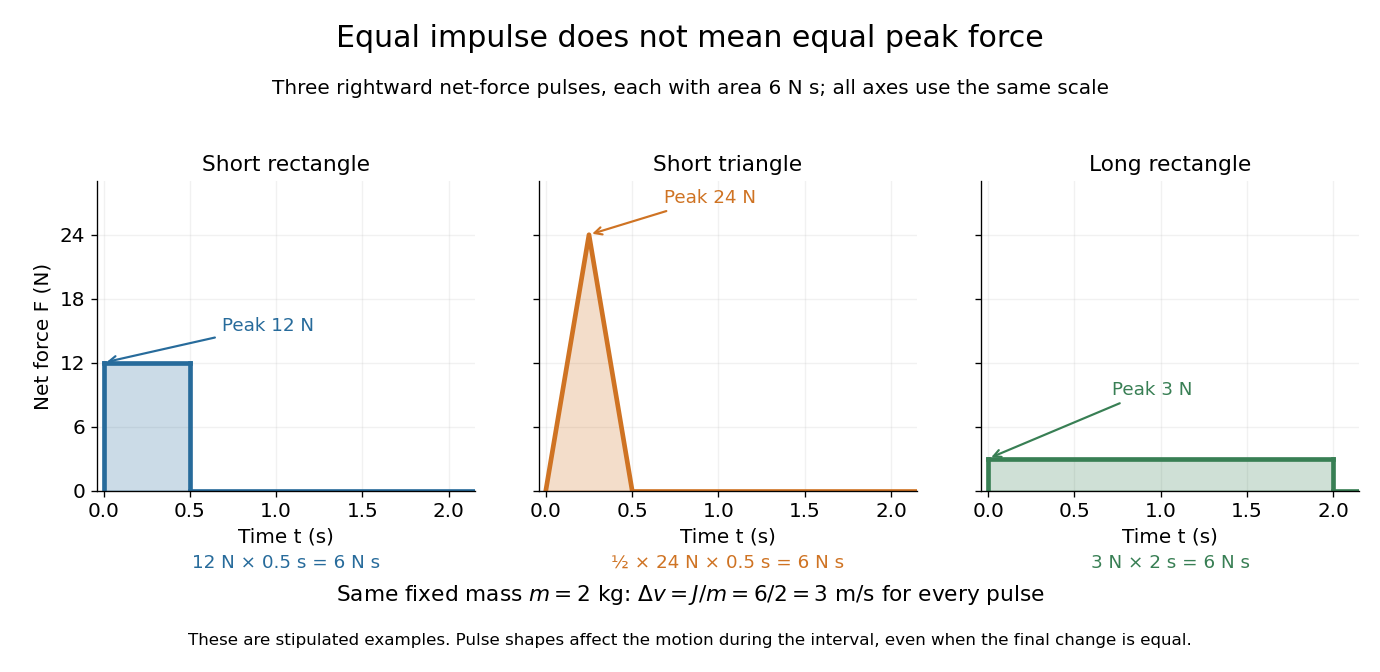
The mean net force over the chosen interval is . Extending the interval for a fixed impulse reduces this mean force. A lower peak force additionally depends on the pulse shape: the two short pulses above have the same mean but different peaks. This explains why controlling the duration and shape of a stopping impulse matters in cushioning a collision.
Oblique collision Created 2026-09-24 Updated 2026-10-05
In a frictionless oblique collision, impulse acts along the common normal and tangential velocity components remain unchanged.
Elastic collision Created 2026-09-24 Updated 2026-10-14
An elastic collision preserves total kinetic energy between the incoming and outgoing states. For isolated colliding bodies, momentum conservation also holds. The kinetic energy condition supplies information beyond momentum conservation alone. [ref]
Consider a stipulated one-dimensional example with rightward positive: , , incoming velocities and . The total momentum is and total kinetic energy is . In SI numerical values, outgoing velocities satisfySubstituting gives . The root , repeats the incoming state; the outgoing separating state is , . Its momenta add to and its kinetic energies add to . The incoming and outgoing relative velocities both have magnitude , consistent with coefficient of restitution .
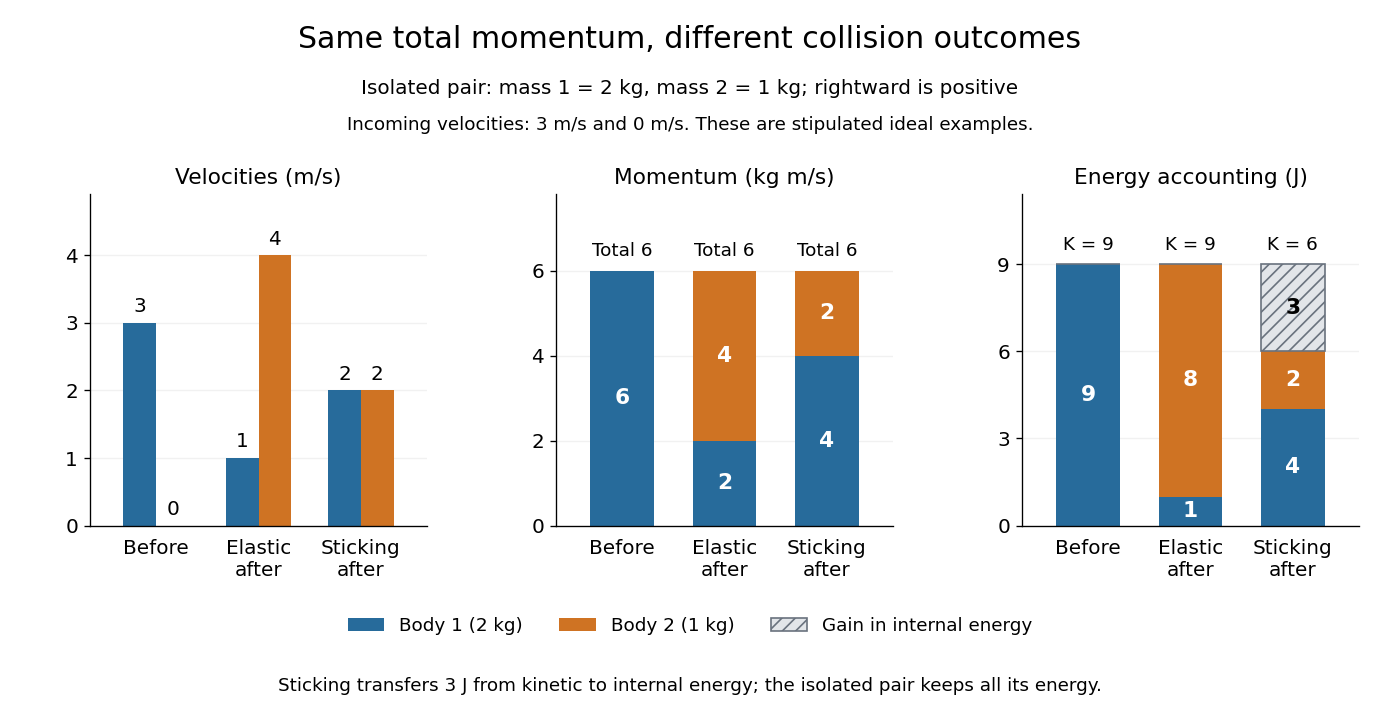


The inelastic collision example below uses exactly these incoming data. Both outcomes preserve total momentum, while only the elastic collision preserves total kinetic energy. These are ideal numerical examples, not experimental measurements.
Künneth theorem Created 2026-09-24 Updated 2026-10-14
For chain complexes of free modules over a principal ideal domain , the Künneth theorem gives a natural split short exact sequencealthough the splitting is not natural. Over a field the Tor term vanishes, and the cohomological cross product gives as graded rings under standard finiteness hypotheses.
Cup product Created 2026-09-24 Updated 2026-09-24
Cap product Created 2026-09-24 Updated 2026-09-24
Compactly supported cohomology Created 2026-09-24 Updated 2026-09-28
Compactly supported cohomology is the cohomology of cochains vanishing outside a compact subset. Equivalently,
Universal coefficient theorem for cohomology Created 2026-09-24 Updated 2026-10-14
This is the cohomological form of the universal coefficient theorem, with Ext and Hom terms rather than the homological tensor and Tor terms.
Limit point Created 2026-09-24 Updated 2026-10-14
A limit point of a subset of a topological space is a point whose every neighbourhood meets . Thus is a limit point of in the real line, even though . In contrast, an isolated point of belongs to its closure but is not a limit point of . This distinction separates limit points from the more inclusive notion of an adherent point.
Critical closed radiation--cosmological-constant solution Created 2026-09-24 Updated 2026-09-24
Supercritical closed radiation--cosmological-constant recollapse Created 2026-09-24 Updated 2026-09-24
For , the turning polynomial has two positive roots and its smaller root lies below . A universe expanding from reaches that root with and , then contracts to a finite-time Big Crunch.
Closed-graph criterion with compact codomain Created 2026-09-24 Updated 2026-09-24
If are metric spaces, is compact, and the graph of is closed, then is continuous. Any failure of sequential continuity gives a subsequence whose images stay away from the proposed limit; compactness produces a convergent image subsequence, and closedness of the graph forces its limit to be the correct value.
Nonrelativistic Maxwell--Boltzmann number density Created 2026-09-24 Updated 2026-10-14
Integrating Maxwell–Boltzmann statistics over momentum for nonrelativistic particles of mass , spin-state count , and energy gives
Transitive class Created 2026-09-24 Updated 2026-10-14
Proper class Created 2026-09-24 Updated 2026-10-14
Endpoint force derivative of clamped-free beam energy Created 2026-09-24 Updated 2026-09-24
For the clamped-free beam under uniform load and endpoint force, the additional minimized internal energy isIts derivative is the endpoint displacement caused by the endpoint force:
There are unlisted articles, also show them or only show them.