
Minkowski metric Created 2026-09-24 Updated 2026-10-14
With the mostly-plus metric signature and coordinates , the Minkowski metric is the nondegenerate bilinear formIt is a symmetric bilinear form, but not a positive-definite bilinear form. For example, is nonzero yet , making it a null vector. This does not make the Minkowski metric degenerate: some other vectors have nonzero pairing with .
Applied to infinitesimal displacements, the Minkowski metric givesFor a timelike curve, a clock records . For a null curve, . For spacelike separation, the positive Minkowski interval measures a different kind of separation. A Lorentz transformation preserves this form, expressed in matrix notation by , although it need not preserve ordinary Euclidean distance in the four-component coordinate list.
Inverse metric Created 2026-09-24 Updated 2026-10-03
Source-free Maxwell equations in a linear medium Created 2026-09-24 Updated 2026-09-24
Covariant Maxwell equation with the minus-plus-plus-plus metric Created 2026-09-24 Updated 2026-09-24
With metric signature , , and , the field tensor satisfiesIts components are and , so these tensor equations reproduce all four Maxwell equations.
Charge conservation from Maxwell equations Created 2026-09-24 Updated 2026-09-24
Taking the divergence of the Ampère-Maxwell equation and using Gauss's law givesHence the charge in a fixed volume changes only through current crossing its boundary.
Gauss's law Created 2026-09-24 Updated 2026-10-14
Gauss's law relates the electric field on a closed surface to the net electric charge inside it. In SI units, with outward unit normal ,Here describes a volume charge density, and is the vacuum permittivity; for ideal point or surface charges, use the enclosed electric charge directly rather than an ordinary volume-density integral. The left side is electric flux: the surface integral of the outward normal component of the electric field. Field directed outward contributes positively; field directed inward contributes negatively. The equality uses net signed electric charge, so positive and negative enclosed charges can cancel. The Gaussian surface is an imagined accounting boundary, not necessarily a material object. See OpenStax, explaining Gauss's law.
Where the electric field and charge density are smooth, the local statement is . The divergence theorem connects this divergence to the surface integral. This is the satisfying connection between local sources and global accounting: a surface can register how much net electric charge it encloses without revealing where that charge is located within it. A point charge requires care with the singular field at its position; the integral formulation remains useful with a boundary that avoids the charge.
The law fixes total electric flux, rather than every value of the electric field. In an uncharged region, a uniform electric field crosses a cube of side . Its left and right faces contribute and ; the other four faces contribute zero. Thus the net electric flux is zero while the electric field is nonzero everywhere. Charges outside a Gaussian surface can change the field on it without changing its net electric flux. Conversely, fields cannot generally be reconstructed from enclosed electric charge alone. Electrostatics also requires the electric field to be the negative gradient of an electric potential, with appropriate boundary information. This distinction is emphasized in Feynman lectures II.5, application of Gauss' law.
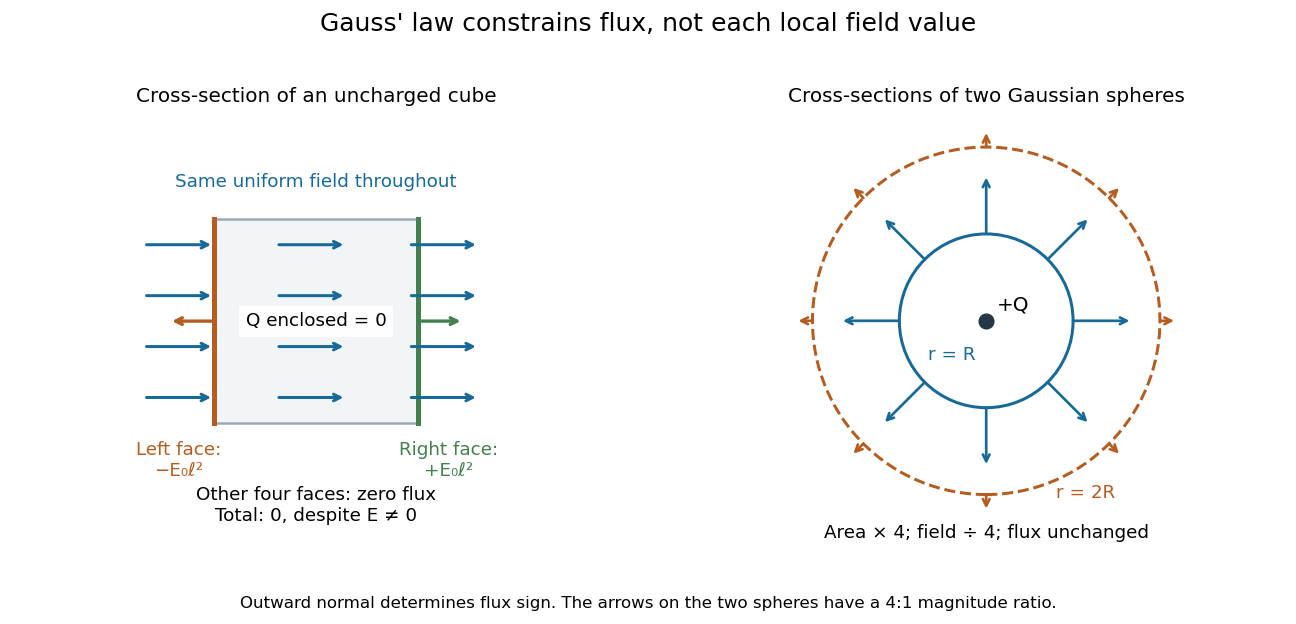
Zero net flux can coexist with a nonzero uniform field, and equal enclosed charge can give different field magnitudes on different spheres
. Details. Spherical symmetry supplies the extra information needed for a particularly simple calculation. An isolated spherically symmetric charge distribution in vacuum produces a radial electric field, constant in magnitude on each concentric sphere. Its electric flux is therefore , givingOutside the distribution, doubling quadruples the surface area and divides the radial electric field by four, while the electric flux stays . The inverse-square dependence is an area-dilution result. The electric field of a uniformly charged ball and electric field of a uniformly charged spherical shell show that the same total charge can give different interior fields. These symmetry arguments and their limits are developed in OpenStax, applying Gauss's law.
Maxwell equations in matter Created 2026-09-24 Updated 2026-10-14
In macroscopic matter with free charge density and free current density ,The electric displacement and magnetic field strength encode the material response.
These are the Maxwell equations after separating free and bound material sources.
Bell-state correlation in two real bases Created 2026-09-24 Updated 2026-09-24
Orthogonal-basis invariance of a real Bell state Created 2026-09-24 Updated 2026-10-07
Past exam of the mathematics course of the University of Cambridge Created 2026-09-24 Updated 2026-10-07
Probability-preserving bijection Created 2026-09-24 Updated 2026-09-24
A probability-preserving bijection pairs outcomes of two events without changing their masses, proving the events have equal probability.
Structural induction Created 2026-09-24 Updated 2026-09-24
Structural induction proves a property of every recursively generated object by checking the initial objects and showing that every construction rule preserves the property.
Counterexample Created 2026-09-24 Updated 2026-10-14
A counterexample is one instance satisfying a claim’s hypotheses but not its conclusion, and therefore disproves the universal claim.
First-order logic Created 2026-09-24 Updated 2026-09-24
First-order logic permits quantification over elements of a structure while its nonlogical symbols describe operations, constants, and relations.
Propositional logic Created 2026-09-24 Updated 2026-10-14
Propositional logic studies reasoning with whole propositions represented by letters such as and , and propositional formulas built from them using logical connectives. The classical two-valued, truth-functional presentation below assigns each primitive proposition either true or false: each compound value depends only on its component values. This is classical propositional logic; other systems, including Intuitionistic propositional logic, have different semantics and rules.
Starting with and , one can build by logical negation, by logical conjunction, by logical disjunction, and by logical implication, then combine these into larger propositional formulas. Parentheses specify the construction: has logical conjunction as its outermost logical connective. Primitive propositions have no internal structure in this language; a first-order formula can additionally describe objects and quantify over them. The formation rules are given in forall x: Calgary, chapter 6.
The following truth table shows the four basic logical connectives. Logical disjunction is inclusive: is true when either or both inputs are true. Classical logical implication has exactly the same values as ; its only false row has true and false. These truth conditions are specified in forall x: Calgary, chapter 9.
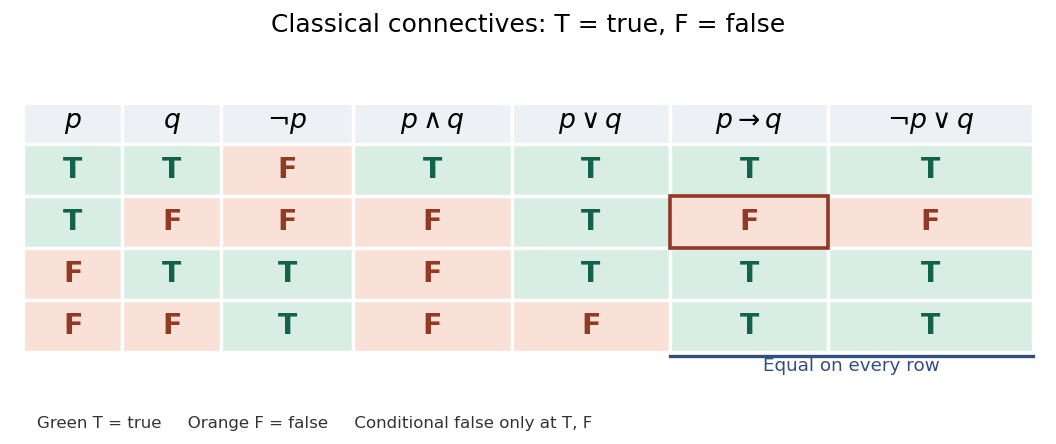
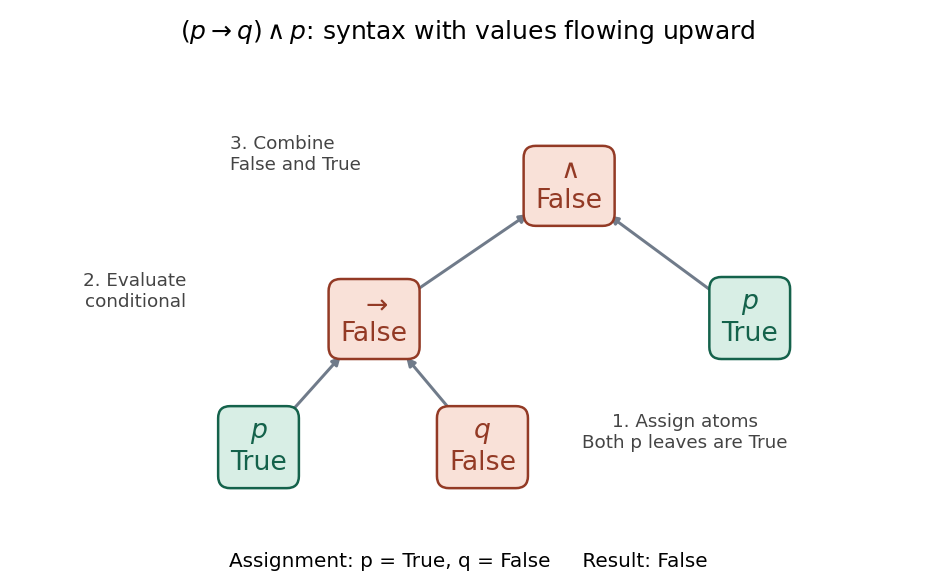
Evaluate from the inside out: first the logical implication, then the outer logical conjunction. The final column also tests the logical implication expressing the modus ponens rule:At , the logical implication is false, so the logical conjunction is false. The abstract syntax tree below separates the construction of the propositional formula from the values propagated through it. Both occurrences of receive the same value from the Boolean valuation. With the opposite assignment , the logical implication is true but the logical conjunction is still false because its second input is false. Recursive evaluation and exhaustive truth tables are explained in forall x: Calgary, chapter 11.


The last column is always true: is a tautology. This expresses the logical validity of the modus ponens rule: whenever both premises and are true, is true. It does not say the premises are true under every Boolean valuation; their logical conjunction is true only on the first row. For a short natural deduction proof outline, assume , extract both conjuncts, apply the implication elimination rule to obtain , then discharge the assumption by the implication introduction rule. See forall x: Calgary, sections 17.3–17.5.
Three tests answer different questions: Boolean satisfiability requires at least one true row, a tautology requires every row true, and a contradiction has every row false. Thus is a tautology, is a contradiction, and is satisfiable but not a tautology: it is true only at . See forall x: Calgary, sections 12.1–12.4.
Propositional logic is useful because an inference pattern can be checked once and reused for many choices of propositions. Its beauty is that a finite truth table completely settles classical truth-functional questions about a fixed propositional formula. But logical validity does not verify real atomic claims. If means “the switch is closed” and means “the lamp is lit”, a valid use of the modus ponens rule still requires establishing its premises about the apparatus; the truth table supplies neither an observation nor a causal explanation. See forall x: Calgary, chapter 2 and chapter 10.
Backward induction Created 2026-09-24 Updated 2026-09-24
Backward induction proves or computes a finite sequence of statements by starting at its terminal index and stepping toward the initial index.
Strong induction Created 2026-09-24 Updated 2026-10-18
Strong induction establishes a proposition for all integers . Prove ; then, for each , assume every with and prove . The induction hypothesis includes all earlier cases, so the inductive step can use whichever smaller indices it needs. It cannot use itself.[ref]
Mathematics for Computer Science by Eric Lehman and others. §5.2.1, printed p. 125: strong induction principle
This is useful when a construction breaks into smaller pieces of varying sizes. A prime factorization splits a composite number into smaller integer divisors, which need not be one less than the original integer. A recursive procedure can likewise call itself on several smaller inputs. The available cases should match those dependencies. Strong induction lets the mathematical proof follow the construction rather than forcing every step through the immediately preceding size.
American option Created 2026-09-24 Updated 2026-10-14
An American option may be exercised at any time up to maturity. Its value is the Snell envelope of its discounted exercise payoff.
Black-Scholes model Created 2026-09-24 Updated 2026-10-03
In the Black-Scholes model with constant interest rate and volatility , a risky asset satisfiesunder the risk-neutral measure.
Fundamental theorem of asset pricing Created 2026-09-24 Updated 2026-10-03
In a finite market, absence of arbitrage is equivalent to the existence of an equivalent martingale measure. If that measure is unique, every contingent claim has a unique no-arbitrage price given by its discounted expectation.
There are unlisted articles, also show them or only show them.