
Carmichael number Created 2026-09-24 Updated 2026-10-18
A Carmichael number is a composite number for whichEvery unit modulo satisfies the same modular congruence supplied by Fermat's little theorem for a prime number. The name refers to Robert Daniel Carmichael. The coprime qualification is essential: a nonunit can expose a prime factor through a greatest common divisor calculation. A Carmichael number is therefore a Fermat pseudoprime to every coprime base, rather than to every nonzero residue class.[ref]
Carmichael Numbers and Korselt's Criterion by Keith Conrad. Definition 1, printed p. 1: composite input and coprime bases
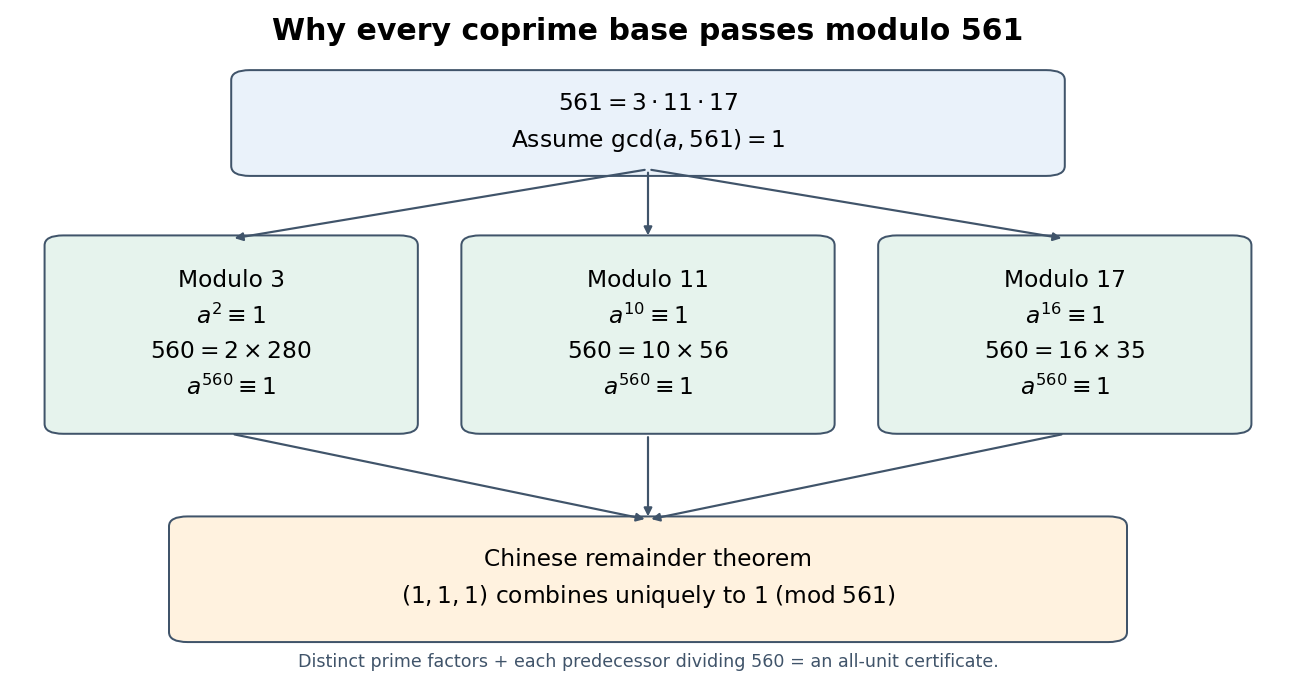
For example,The factors are distinct prime numbers. Their predecessor numbers all divide , so Korselt criterion applies. More explicitly, for any integer coprime to , Fermat's little theorem givesThe Chinese remainder theorem combines these into . This proves all coprime bases pass from three short divisibility checks, rather than from a long table of sampled bases.
Equivalently, a composite is a Carmichael number exactly when for every integer , including nonunits. The equivalence follows from Korselt criterion: modulo each prime factor, either is zero or its nonzero power returns to one, and squarefreeness combines those congruences. This does not say a nonunit satisfies . For instance gives , while ; the greatest common divisor already supplies the factor three.[ref]
The Carmichael function supplies another compact description: a composite is Carmichael exactly when . For , and . In contrast, Euler's totient function gives , which does not divide . The least common return exponent, rather than the number of units, controls this test.
The obstruction is useful to know when interpreting a Fermat primality test: even checking every coprime base cannot certify primality. The passing-base fraction for the Fermat test makes this failure quantitative. Stronger primality tests require additional structure, such as the squaring conditions in a Miller-Rabin primality test.
The historical record predates the name. Václav Šimerka's 1885 paper lists on printed page 224, together with factorizations. This is an early published list of examples, independently of their later name.[ref]
Zbytky z arithmetické posloupnosti by Václav Šimerka. Zbytky z arithmetické posloupnosti, printed p. 224, §9: list beginning with 561 and 1105; archive title sheet identifies Václav Šimerka and 1885
Quadratic reciprocity Created 2026-09-24 Updated 2026-10-13
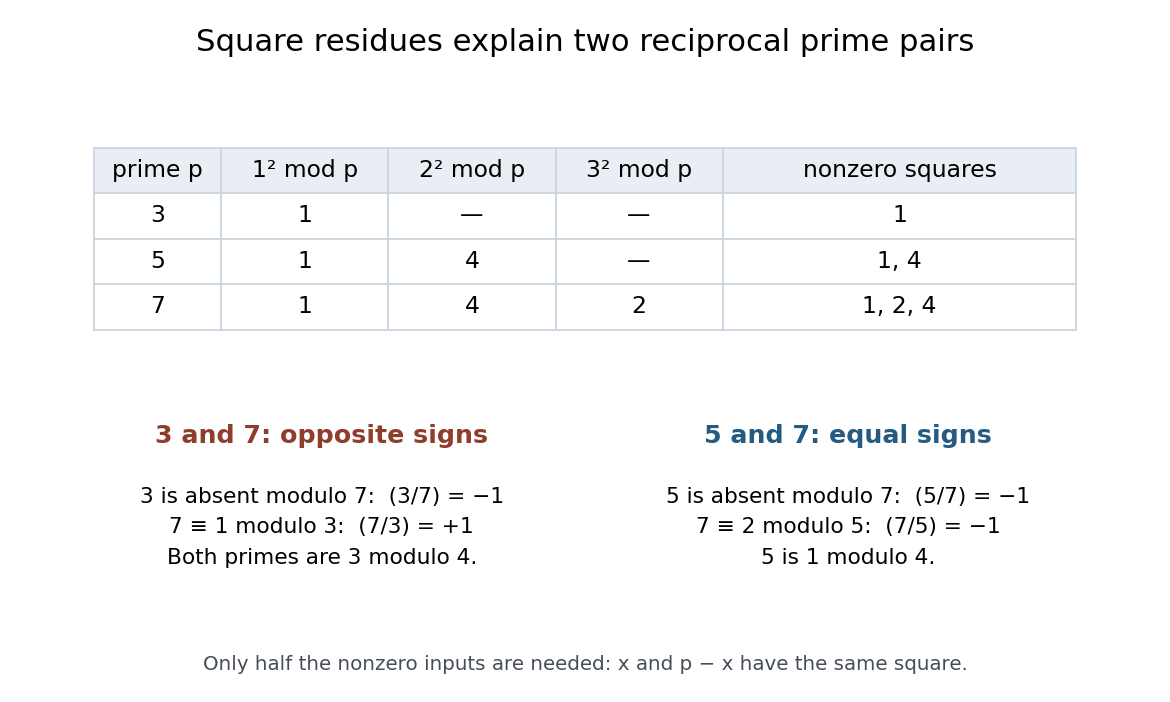
Quadratic reciprocity compares two questions: is the prime number a quadratic residue modulo , and is a quadratic residue modulo ? Let be distinct odd primes. In terms of the Legendre symbol,The two Legendre symbols have opposite signs exactly when both primes are modulo ; otherwise they are equal. Their values are nonzero because the primes are distinct. Equal signs can mean two quadratic residues or two quadratic nonresidues: reciprocity compares the answers rather than declaring either answer positive.[ref]
NIST Digital Library of Mathematical Functions. T. M. Apostol, Chapter 27, §27.9, equation 27.9.3: distinct odd prime hypotheses and reciprocity law
For a direct computation, the nonzero quadratic residues modulo are respectively , , and . Squaring just suffices because and have the same square modulo an odd prime .The pair has a sign flip, whereas has two negative signs. These small quadratic residue tables make the distinction tangible.
The first supplementary law for quadratic reciprocity handles numerator , and the second supplementary law for quadratic reciprocity handles numerator :For an odd prime , is a quadratic residue exactly when , while is a quadratic residue exactly when . The remaining odd congruence classes modulo , namely , make a quadratic nonresidue. These laws fill the cases excluded from swapping distinct odd primes.[ref]
Jacobi symbol Created 2026-09-24 Updated 2026-09-24
Primitive-root lifting criterion Created 2026-09-24 Updated 2026-09-24
Quadratic residue Created 2026-09-24 Updated 2026-10-18
For an odd prime , a nonzero congruence class is a quadratic residue when for some integer . Here "quadratic residue" excludes zero: zero is a square of a number, but is neither a quadratic residue nor a quadratic nonresidue under this convention. Some treatments include zero among quadratic residues; the distinction matters when counting them or discussing their subgroup.[ref]
Quadratic Residue Patterns Modulo a Prime by Keith Conrad. Keith Conrad, Quadratic Residue Patterns Modulo a Prime, §1, p. 1: nonzero convention and equal counts
Modulo seven, squaring the six nonzero congruence classes givesThus the set of quadratic residues is , and the quadratic nonresidues are . In particular, has exactly the two solutions : and . Modulo eleven the quadratic residues are instead . Two is therefore a quadratic residue modulo seven and a quadratic nonresidue modulo eleven: being a quadratic residue depends on the modulus.
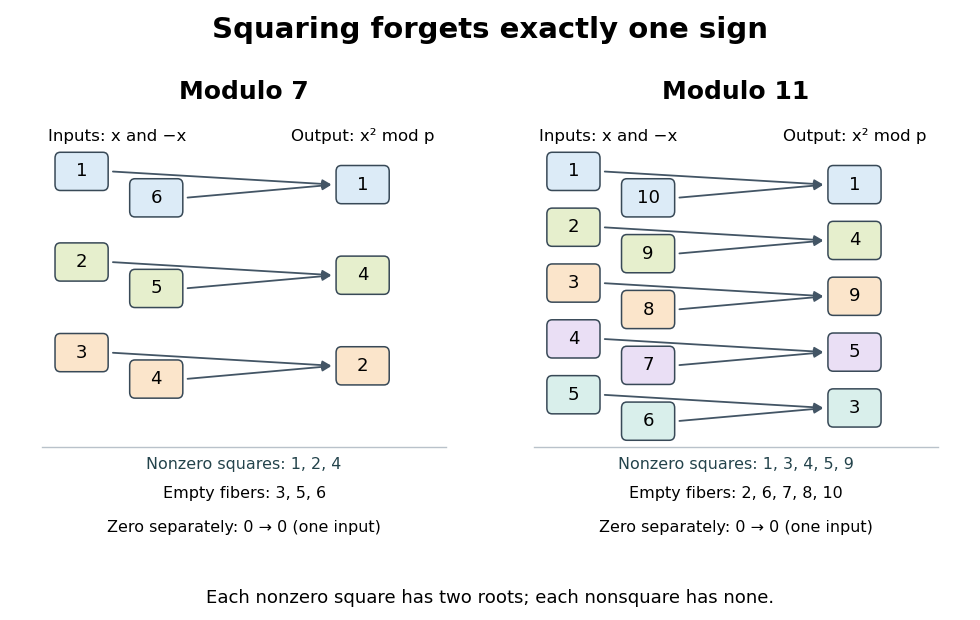
Why do the square roots come in pairs? If , the prime number divides , so it divides one factor: or . For nonzero these are distinct, because is an odd prime. Every nonempty nonzero fiber of a function of therefore contains exactly two inputs. Pairing the nonzero congruence classes gives exactly quadratic residues and quadratic nonresidues. Including zero gives different squares, with one rather than two square roots for zero.
The quadratic residues form a subgroup of the multiplicative group of a finite field , with index of a subgroup two. Indeed, one is a square, , and ; the inverses exist because the inputs are nonzero in the prime field. Equivalently, the squaring group homomorphism has kernel of a group homomorphism and image of a function . The apparent loss of a sign in squaring becomes a precise division of the nonzero arithmetic into two equal parts.
This structure turns a search for square roots into a yes-or-no test: Euler's criterion detects quadratic residues through modular exponentiation, and the Legendre symbol records the result as a sign. For a general integer modulus, the modular congruence still makes sense, but the two-root count and the prime field argument need not survive. For example, has four solutions ; the Chinese remainder theorem separates the sign choices modulo three and five.
Prime-counting function Created 2026-09-24 Updated 2026-10-13
Decisive number Created 2026-09-24 Updated 2026-09-24
A positive integer is decisive when every integer satisfying and is a prime number. There are only finitely many decisive numbers: every prime must divide a decisive , so the Chebyshev theta function gives , which eventually contradicts the linear lower bound for .
Primorial Created 2026-09-24 Updated 2026-09-24
P-adic valuation Created 2026-09-24 Updated 2026-10-13
For a prime number and a nonzero integer , the P-adic valuation counts the exponent of in its prime factorization:For , it gives , , and . The sign of a nonzero integer does not change these prime exponents. Relative to an ordered factor base, the valuations supply the coordinates of its exponent vector.
The P-adic valuation extends to nonzero rational numbers by . For example, records a factor in the denominator instead of the numerator. Multiplication adds valuations, ; this is the arithmetic reason why adding exponent vectors can make a product a square. In particular, a positive integer is a square of a number precisely when all its prime exponents are even integers, the criterion used by a factor base.
Euler pseudoprime Created 2026-09-24 Updated 2026-09-24
An odd composite number is an Euler pseudoprime to a coprime base whenwhere the right side is the Jacobi symbol.
Fermat pseudoprime Created 2026-09-24 Updated 2026-10-18
A Fermat pseudoprime is relative to its base. For example, passes base , but base yields , a Fermat witness. A Carmichael number has the stronger all-coprime-base property. This explains why finding one deceptive base and proving universal deception require different arguments.
Composite number Created 2026-09-24 Updated 2026-10-20
A composite number is an integer greater than one that is not a prime number. Equivalently, it has a factorization with integers . Thus , , and are composite numbers; one is neither a composite number nor a prime number.
Every composite number has a prime factor at most its square root. In , seven is the smaller factor and lies below ; in , equality occurs. This square-root bound makes trial division finite and lets the sieve of Eratosthenes stop marking with prime numbers beyond when listing prime numbers up to .
Prime number Created 2026-09-24 Updated 2026-10-13
A prime number is a positive integer whose only positive divisors are and . The first ten prime numbers are . In contrast, is a composite number because it has a positive divisor strictly between one and itself. The integer one is neither a prime number nor a composite number: the lower bound is part of the definition. Equivalently, the divisor function satisfies for a prime number, whereas and for every composite number .
Prime numbers are the building blocks of positive integers under multiplication. The fundamental theorem of arithmetic says that every integer greater than one is a product of prime numbers, with a unique collection of factors when their order is ignored. For example, and . Their common factors reveal the greatest common divisor , and the combined maximum powers reveal the least common multiple . A complicated divisibility question becomes a comparison of prime exponents.
There is also a useful finite test. If a composite number equals with , then . Therefore some prime factor is at most , and trial division only needs to check prime numbers up to that square root. For , checking suffices; none divides , so it is a prime number. For , the same test finds , giving . To find many prime numbers together, the sieve of Eratosthenes reuses the work by marking multiples.
The division with remainder calculations for make the test explicit:Since , these are all the prime numbers at most its square root, and every remainder is nonzero. Thus the calculation certifies a prime number, without testing the integers individually. In contrast, gives a prime factor and proves that is a composite number.
The definition has a long history. Book VII of Euclid's Elements distinguishes prime numbers from composite numbers through their possible measures; Book IX, Proposition 20 establishes that no finite list exhausts the prime numbers. The modern argument under Euclid's theorem needs only divisibility, so it proves an infinite conclusion without estimating how frequently prime numbers occur. [ref]
https://mathcs.clarku.edu/~djoyce/elements/bookVII/defVII11.html. Euclid, Elements, Book VII, definitions 11–14, David Joyce's edition
[ref]https://mathcs.clarku.edu/~djoyce/elements/bookIX/propIX20.html. Euclid, Elements, Book IX, Proposition 20
. Modular congruence Created 2026-09-24 Updated 2026-10-14
For integers and a positive integer modulus , modular congruence meansThus for some integer : the two integers differ by complete cycles of length . For example, because , and because . A modular congruence need not be an equality of integers.
On a twelve-position clock labelled , adding five to nine follows . Hence : the final position remembers the remainder while forgetting a complete revolution.
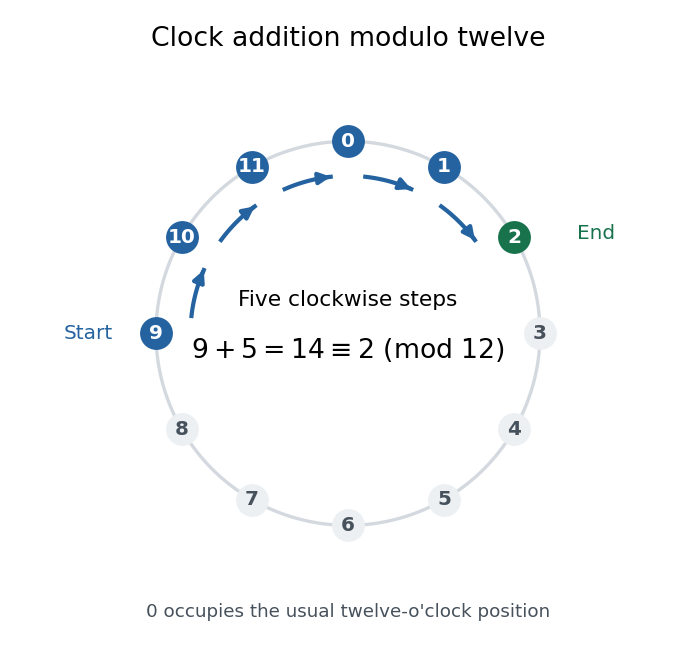


The same idea tracks any count repeating every steps. It also lets us compute sums and products with small residue classes, reducing intermediate results without changing the final class. The justification comes from addition and multiplication being well-defined on residue classes.
In Disquisitiones arithmeticae (1801), Carl Friedrich Gauss defines modular congruence by divisibility in article 1; article 2 describes the integers and adopts . These passages document his presentation and notation, without claiming that repeating remainders began in 1801. [ref]
https://la.wikisource.org/wiki/Disquisitiones_arithmeticae/Sectio_prima. Gauss, Disquisitiones arithmeticae, section I, articles 1–2; original text in the 1870 collected edition
Divisibility Created 2026-09-24 Updated 2026-10-18
For integers , divides when multiplication by some integer takes to :Then is a divisor of , and is an integer multiple of . The notation means that no such integer exists. For , this is equivalent to saying that the quotient is an integer, or that Euclidean division by leaves remainder zero.
For example, because , whereas because . Signs do not change divisibility: because , and because . In general, changing the sign of either input preserves the relation.
The definition here permits zero as either input. Every integer divides zero, since . In particular, ; however, whenever , since is always zero. This is a statement about multiplication, and assigns no meaning to division by zero: remains undefined.
Two useful properties come directly from the defining multiplication. Divisibility is a reflexive relation, since , and a transitive relation: if and , then . Moreover, a shared divisor divides every integer linear combination:Indeed, writing and gives . For example, and imply . This small observation explains why the Euclidean algorithm preserves common divisors, and why Bézout's identity can certify a greatest common divisor.
On the positive integers, divisibility is a partial order: if and , then . The restriction matters, since and although . The prime factorization viewpoint makes this order concrete: exactly when every prime valuation of is at most the corresponding prime valuation of . Thus one relation connects equal grouping, prime factorization, and modular arithmetic.
Book VII, definitions 3 and 5 of Euclid's Elements describe the corresponding positive-number relation through one number measuring another and through integer multiples. The sign and zero conventions above belong to the present integer formulation, rather than to those ancient definitions. [ref]
https://geometor.github.io/euclid/heath/VII/index.html. Euclid, Elements VII, definitions 3 and 5, T. L. Heath translation
Integer Created 2026-09-24 Updated 2026-10-18
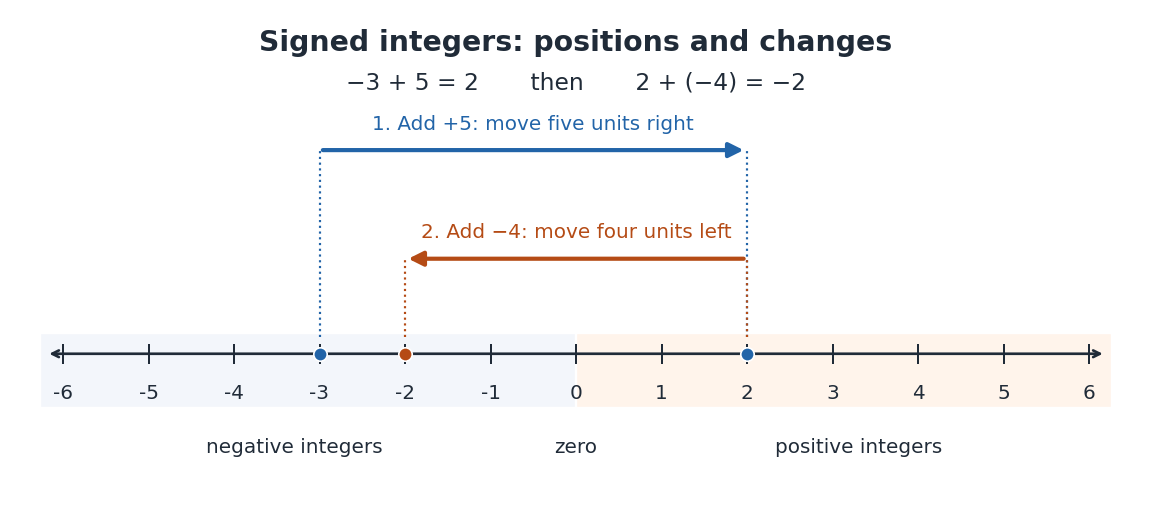
An integer is a whole number, positive, negative, or zero. The set of all integers isThe positive integers are ; the negative integers are their opposites . Zero is neither positive nor negative. The nonnegative integers include zero and all the positive integers. On a number line, consecutive integers are one unit apart, negative integers lie to the left of zero, and positive integers lie to its right. [ref]
3.1 Introduction to Integers. Prealgebra 2e, §3.1: Locate Positive and Negative Numbers on the Number Line; Opposite Notation; Integers
The integers let counting describe changes in both directions. If a counter starts at and increases by five, it reaches : . Decreasing that result by four gives . In addition on the number line, the sign of the added integer chooses the direction and its absolute value gives the distance. The additive inverse reverses the change made by .

The integers have closure under a binary operation for addition, subtraction and multiplication: whenever , the results , and are still integers. Together these operations give the integers their ring structure.[ref]
A Computational Introduction to Number Theory and Algebra by Victor Shoup. §7.1, p. 166, Definition 7.1; p. 167, Example 7.1: the integers with their usual addition and multiplication
For instance, , , and . General division has no such closure: is a rational number but not an integer. Some divisions are exact, such as ; division by zero is undefined. Euclidean division instead produces an integer quotient and a remainder, so retains the information that ordinary division puts into the fraction .An integer is the value, whereas its written numeral is an encoding. The decimal representation and the binary representation name the same integer. Changing positional notation changes how that value is displayed and how calculations are organized; it does not change the value itself.
Analytic number theory Created 2026-09-24 Updated 2026-10-14
Analytic number theory studies integers, prime numbers, and arithmetic functions using tools from real analysis and complex analysis, especially Dirichlet series and their singularities.
Arithmetic function Created 2026-09-24 Updated 2026-10-14
An arithmetic function is a function whose domain of a function is the positive integers, usually taking values in the complex numbers. Thus are its values; is outside this domain of a function. Examples include the divisor function, with , and the sum-of-divisors function, with . Studying an arithmetic function packages a question about each positive integer into one object whose values can be combined using Dirichlet convolution. [ref]
https://darijgrinberg.gitlab.io/floor.pdf. Darij Grinberg, MIT 18.781 lecture notes, Section 2.1: arithmetic functions
Positive-definite quadratic optimization Created 2026-09-24 Updated 2026-09-24
Mathematical finance Created 2026-09-24 Updated 2026-10-18
Mathematical finance uses probability theory, linear algebra and mathematical optimization to study financial markets, portfolio decisions and contingent claim prices. One question asks which portfolio best serves a specified objective; another asks what price a contingent claim must have to exclude arbitrage. The latter can have an exact answer even when future stock prices are uncertain.
The central idea is claim replication: construct a self-financing portfolio delivering the same financial payoff as a contract in every possible state. The law of one price then identifies the contract's price with the portfolio's initial cost. The binomial market makes this beautiful connection between uncertainty and linear algebra visible using just two equations. Risk-neutral pricing expresses the same cost as a discounted expectation.
The one-step example below fixes today's stock price at 100, terminal prices at 120 or 80, and the bank account's gross growth factor at 1.05. A European call option with strike price 100 pays 20 or zero. Its replicating portfolio in a binomial market costs , independently of the physical up probability, provided both states remain possible. These are conclusions within the specified financial market model.
There are unlisted articles, also show them or only show them.