Past exam of the general relativity and cosmology course of the University of Oxford 2018 4 c Solution by  Codex 0 2026-10-25
For zero chemical potential, each species contributes . ThusEntropy density scales as at fixed relativistic particle content; total entropy also includes the changing proper volume. An isolated adiabatically expanding comoving gas has conserved total entropy and constant, rather than its total entropy falling as .
At equal temperature, single electrons and photons each have two spin/polarization states. In the ultrarelativistic approximation,Positrons are a separate species with the same contribution, so . This distinction is needed for the heating count in part d. At the exact supplied temperature the electron rest mass gives corrections to the ideal ratio; it is the limiting relativistic value requested by the problem.
There is also a sign convention issue in the introductory entropy formula. With the chemical-potential convention used in the supplied distribution, the Euler relation is , so . Its chemical-potential term has the opposite sign to the printed one. For a concrete counterexample, a dilute monatomic ideal gas with one internal state and , where is the thermal de Broglie wavelength, has , and . Its entropy is ; the printed plus sign would instead give . All chemical potentials have been neglected here, so this source error does not change any of the above results.
Past exam of the general relativity and cosmology course of the University of Oxford 2018 4 b Solution by Codex 0 2026-10-25
Codex 0 2026-10-25Let be proper volume, let count the populated internal states, and take and . Spherical integration in momentum space givesUsing the fermion-to-boson thermal integral ratio, the minus-denominator boson integral is and the plus-denominator fermion integral is . HenceThe energy integral has one extra factor :The supplied distribution identity gives the fermion integral as . ThereforeFor an isotropic ultrarelativistic gas, momentum flux gives . Since and ,Photons have , electrons and Positrons each have , and each neutrino or antineutrino species has one populated helicity in the standard thermal bath.
Past exam of the general relativity and cosmology course of the University of Oxford 2018 4 a Solution by Codex 0 2026-10-25
Codex 0 2026-10-25For a photon gas in thermal and chemical equilibrium, photon number is not a conserved thermodynamic charge. Number-changing processes can create and absorb photons without a corresponding conserved-number constraint, so the equilibrium photon chemical potential is zero.
At , . The other light species are electrons, Positrons, three neutrino species and their antiparticles. Neutrinos are ultrarelativistic; electrons and Positrons are only moderately relativistic at this particular temperature because . The later simple counting formulas use the intended ultrarelativistic approximation for them. Baryons, muons and heavier particles are not an abundant relativistic bath at this temperature.
Pair equilibrium implies . Approximate charge symmetry, with the net electron excess tied to the much smaller baryon asymmetry, then makes both electron and Positron chemical potentials small compared with . For neutrinos one additionally assumes negligible lepton asymmetry. Their near-zero chemical potentials are not implied merely by their statistics. After neutrino decoupling, a distribution initially having negligible chemical potential retains a redshifted Fermi-Dirac distribution, with its own temperature.
Past exam of the general relativity and cosmology course of the University of Oxford 2018 3 e Solution by Codex 0 2026-10-25
Codex 0 2026-10-25Spatial flatness constrains the total density, not matter alone. A flat model can havewith a substantial dark energy component. A positive cosmological constant has pressure and does not dilute like matter; it can produce the observed accelerated expansion.
If positive persists, becomes exponential and the future conformal time intervalis finite. For two comoving civilisations separated by , each one-way signal consumes . Thus a message completing legs at finite time requiresOnly finitely many legs, and hence finitely many full exchanges, can then occur. A reply to even the first new message requires , the cosmological round-trip communication horizon condition. Depending on the density parameters, the initial outward message might arrive while its reply can never reach us, as in the right-hand panel of part d.
The source gives no matter and dark-energy fractions, so it does not specify an exact count for the pair in the real Universe. Flatness and lack of matter dominance alone do not prove a finite horizon: a radiation-dominated flat universe, for example, has divergent future conformal time if that power-law expansion persists. The finite-message conclusion uses persistent accelerated expansion such as positive constant .
Past exam of the general relativity and cosmology course of the University of Oxford 2018 3 d Solution by Codex 0 2026-10-25
Codex 0 2026-10-25In an Einstein-de Sitter universe, take and . The galaxy seen today at emitted the light now reaching us when , so . Its fixed comoving radial distance isPut . A new message sent now reaches the galaxy at , whereAssume an immediate reply and negligible local handling delays. The return consumes the same additional conformal time, giving the Einstein-de Sitter round-trip message timeFor the numerical value supplied later in the paper, and the waiting time is about . The age here belongs to the stipulated matter-only model, not a claim about the actual measured cosmic age.
After one-way legs, . Since , every finite number of messages is possible and there is no finite fundamental upper count. The exchange takes arbitrarily long, with successively longer intervals; infinitely many messages are not completed in finite cosmic time.
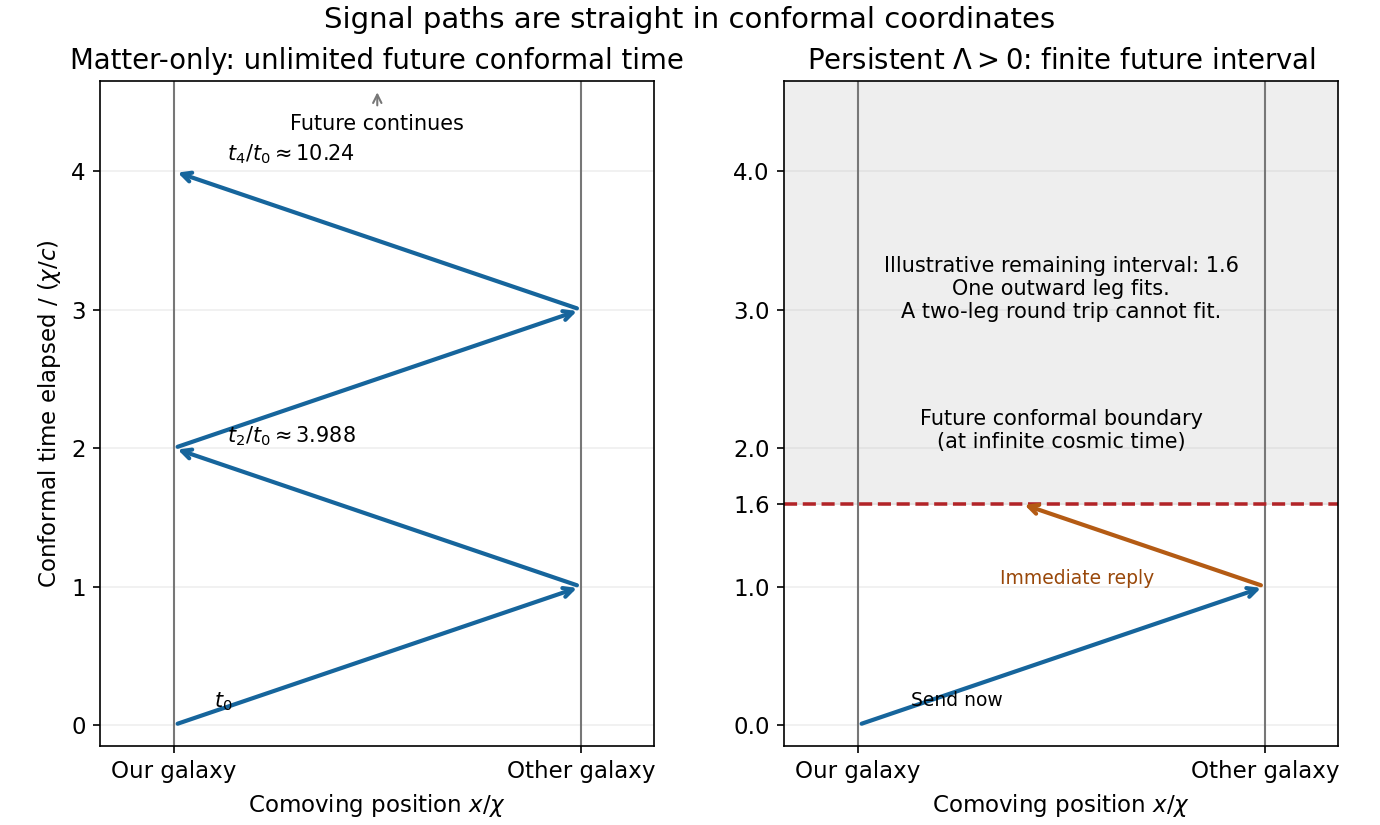
Message exchange depends on the remaining conformal time, not just the present expansion rate
. The left conformal spacetime diagram shows repeated light-signal legs between two comoving galaxies in an Einstein-de Sitter model. The right diagram illustrates a finite future conformal interval: one outward leg fits but a complete round trip does not. The right interval is a schematic example, not a parameter estimate for our Universe. Details.
Past exam of the general relativity and cosmology course of the University of Oxford 2018 3 c Solution by Codex 0 2026-10-25
Codex 0 2026-10-25Use standardized Type Ia supernovae as distance indicators and measure their redshifts. The curvature of the luminosity-distance relation constrains the deceleration parameter:Fainter supernovae at a given redshift imply larger distances, and comparison with the predicted curve tests accelerated expansion. In practice one fits the full expansion history over the observed redshift range and controls luminosity evolution, extinction and calibration, rather than relying only on a short low- series.
The cosmological fate from local expansion data is conditional on a matter model. For the spatially flat model of part b, if the only relevant components are pressureless matter and a constant , put . The two Friedmann equations giveHere follows the sign of the supplied Friedmann equations, where positive contributes positive acceleration. These fix the parameters governing subsequent evolution. Positive yields eternal late-time accelerated expansion; zero gives the flat matter solution; negative leads to eventual recollapse in this dust model. If instead one assumes dust and zero while allowing curvature, determines whether the matter universe is closed and recollapsing or expands indefinitely.
Without a fixed equation of state and its future evolution, two present derivatives do not uniquely fix the future. For a concrete counterexample in units with , the positive scale factors and have the same now. The former expands forever; the latter turns around and later reaches zero. Different time-dependent matter stresses can support their different flat expansion histories. Thus the printed sufficiency statement needs the cosmological-model assumption.
Past exam of the general relativity and cosmology course of the University of Oxford 2018 3 b Solution by Codex 0 2026-10-25
Codex 0 2026-10-25Normalize the scale factor to , with . Along a radial null geodesic, . Two successive wave crests sent by the same comoving emitter and received by the same comoving observer traverse the same comoving distance, soTo first order, . Frequencies are inverse proper periods for the comoving observers, giving the cosmological redshiftExpansion stretches wavelengths, so a spectral line of known rest wavelength gives .
At small , the light travel time is short compared with the expansion time. Expanding gives and , henceCombine independently calibrated luminosity distances with galaxy spectral redshifts and fit the slope. Nearby peculiar velocities must be allowed for, while high-redshift data require the full distance-redshift relation rather than the linear approximation.
Past exam of the general relativity and cosmology course of the University of Oxford 2018 3 a Solution by Codex 0 2026-10-25
Codex 0 2026-10-25The cosmic distance ladder starts by calibrating a physical baseline. Radar echoes from planets or spacecraft give a round-trip light time and hence a distance , after accounting for orbital motion and propagation delays. Combining this with orbital geometry fixes the Earth-Sun orbital scale; directly timing a reflected pulse from the solar surface is not required.
That baseline supplies annual stellar parallax: for small parallax angle , , or in parsecs equals when is in arcseconds and is one astronomical unit. Nearby parallax distances calibrate stellar absolute magnitudes. Main-sequence fitting extends the scale to star clusters, and the calibrated Cepheid period-luminosity relation gives luminosities for Cepheids visible in nearby galaxies.
Cepheid-host galaxies then calibrate Type Ia supernovae. After light-curve and colour standardization, their high luminosities permit distances to much more remote galaxies. For a source of calibrated luminosity and observed bolometric flux ,with consistent bandpass definitions and corrections. Interstellar extinction, composition, stellar-population differences and calibration uncertainty must be propagated through the steps. Redshift can subsequently provide a distance within a fitted cosmological model; using it alone cannot independently calibrate the Hubble constant.
Past exam of the general relativity and cosmology course of the University of Oxford 2018 2 c Solution by Codex 0 2026-10-25
Codex 0 2026-10-25Outside the core, and the metric is locally flat: set . Static test particles have no Newtonian-like attraction because is constant and . Local trajectories are straight lines in locally unwrapped coordinates, so a very thin dark core is hard to identify through ordinary orbital accelerations or local tidal forces.
The global angular range is nevertheless rather than . The missing angle can give gravitational lensing with two nearly identical, essentially undistorted images of a background galaxy, and multiple such pairs aligned along the projected object. For a small deficit, a straight string and favourable geometry, their angular separation is of order , with an additional inclination factor for a tilted string. The matching spectra and common line of image pairs distinguish this from an ordinary compact lens.
A moving cosmic string can also induce a step in the cosmic microwave background temperature across its path. That signature needs motion in addition to the static geometry supplied here. These are consequences of the exterior conical geometry; interpreting the inferred deficit as a positive mass per length requires the regular-axis/core assumptions distinguished in part b.
Past exam of the general relativity and cosmology course of the University of Oxford 2018 2 b Solution by Codex 0 2026-10-25
Codex 0 2026-10-25Assume has period , in the regular bulk, and consider a unit proper length in . The proper transverse area element is , while the mass density is . The axial boundary term in the mass of a cylindrical spacetime is thereforeChoose the usual deficit branch , so . Continuity of the induced metric requires . If there is no distributional thin shell at , continuity of the extrinsic curvature also requires . A jump in would add a surface-layer stress and cannot simply be discarded.
Using the printed inner condition , these assumptions yieldThis is the literal smooth-bulk answer. It is negative for the ordinary deficit range, so it must not be silently replaced by the usual positive cosmic-string mass formula.
For comparison, a regular axis with proper radial coordinate and angular period requires and , since the circumference-to-radius ratio must approach . Under that different regular-axis condition the same integral givesThe original PDF really prints the derivative limit zero. It describes either a nonregular axis or an inner geometry different from an ordinary smooth string core; any additional singular-axis matter is not included in the bulk integral above and would need its own stress specification. Standard regular-core matching can also require an offset in the exterior radial origin. Thus the regular-axis formula is a qualified physical interpretation, not a derivation from the printed zero. For a general exterior branch replace by in the boundary derivative.
Past exam of the general relativity and cosmology course of the University of Oxford 2018 2 a Solution by Codex 0 2026-10-25
Codex 0 2026-10-25In coordinates the diagonal metric tensor is , and only depends on position. Substitution into the connection formula giveswith all other Christoffel symbols zero away from singular axes.
Use the explicit Ricci tensor formula and the Einstein equation sign printed on the source formula sheet. They giveFor example, in the two terms proportional to cancel. For the derivative of contributes , the product terms contribute , and the determinant term contributes .
Formula-sheet qualification. Directly contracting the separately printed Riemann curvature tensor as instructed on that sheet instead gives , the opposite sign. For the concrete example , that contraction gives , whereas the explicit Ricci tensor formula gives . The two source formulas cannot both hold with the stated contraction. The calculation here uses the explicit Ricci tensor formula, whose pairing with the negative Einstein equation coupling yields the requested stress-energy tensor.
The desired matter tensor assumes ; otherwise the cosmological-constant contribution must also be included. With that assumption,and raising both indices givesThe static observer measures energy density and equal-magnitude negative axial pressure when that energy is positive. The axial stress is a tension. Keeping the source's curvature sign and its negative Einstein-equation coupling together is essential to this result.
Past exam of the general relativity and cosmology course of the University of Oxford 2018 1 e Solution by Codex 0 2026-10-25
Codex 0 2026-10-25For radial motion outside the Schwarzschild event horizon, the equations needed to determine the acceleration components areThey are respectively the four-velocity norm, velocity-acceleration orthogonality, and the maximum proper acceleration norm. Together with part d they give the stated thrust equation; no integration of the trajectory is required. The positive radial sign corresponds to outward thrust.
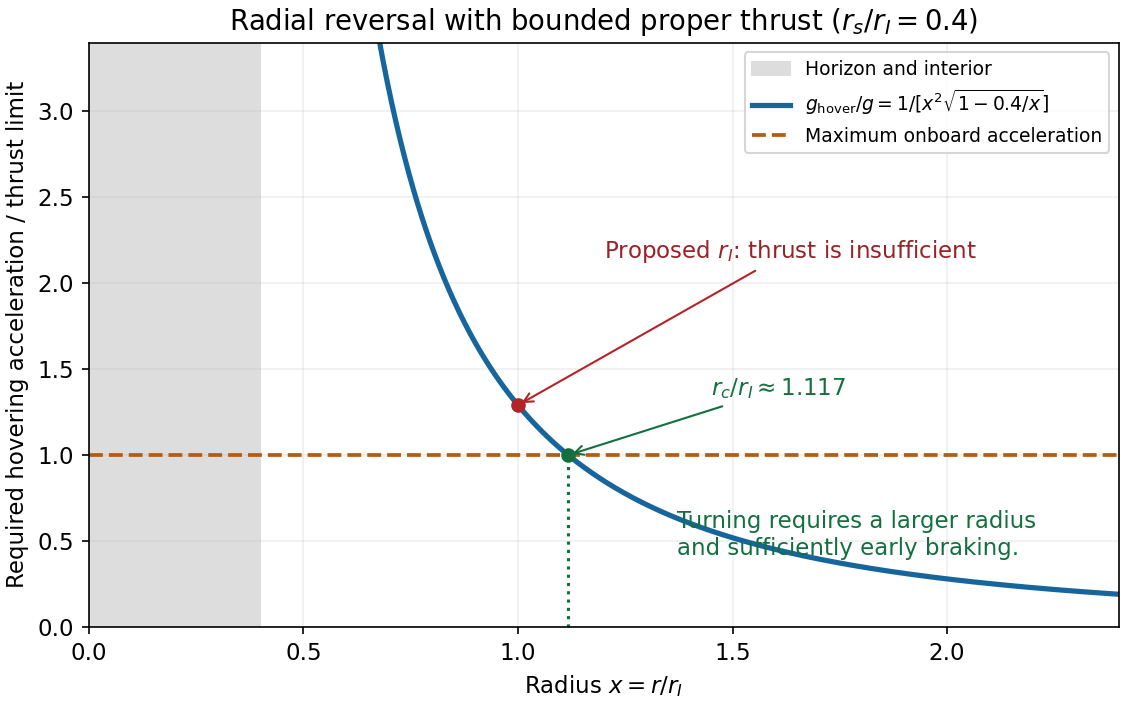
Let . A first transition from inward to outward motion requires at a minimum radius and there. The largest possible radial derivative at such an event isAt , this isThus the ship cannot reverse its inward motion there. It cannot reverse at any smaller exterior radius either: grows while decreases. If it first reaches while falling inward, it cannot return home using the stipulated bounded radial thrust. If , it would instead have reached the black-hole horizon before that radius, which already prevents escape.
The minimum radius for radial turnaround with bounded proper acceleration lies strictly outside the proposed radius. Define byThe right side is the proper acceleration required to hover, decreases monotonically from infinity to zero, and exceeds . A genuine turnaround needs ; equality gives no positive initial outward acceleration at rest. A sufficiently early burn is also needed to remove the pre-existing inward velocity. The failure at follows from the turning-point condition, not from treating the moving ship as static throughout its fall.

Past exam of the general relativity and cosmology course of the University of Oxford 2018 1 d Solution by Codex 0 2026-10-25
Codex 0 2026-10-25Put and . For radial motion . The given Christoffel symbols implyandThe four-velocity normalization of part c isIts bracketed combination is therefore exactly , independently of the instantaneous velocity or the thrust history. ConsequentlyThe derivative here is with respect to proper time. This expression does not say that the ship measures a gravitational acceleration during free fall; setting gives its radial proper-time equation of motion in Schwarzschild spacetime.
Past exam of the general relativity and cosmology course of the University of Oxford 2018 1 c Solution by Codex 0 2026-10-25
Codex 0 2026-10-25Use metric signature and . At an event in the ship's instantaneous rest local inertial frame, . Since its squared norm is a scalar,in every coordinate system. Equivalently it follows directly from and .
Metric compatibility lets us differentiate this identity covariantly:In the instantaneous rest local inertial frame, the last equation gives . The spatial components are the acceleration recorded by an onboard accelerometer, , whose magnitude is . ThereforeThis proper acceleration is zero in ideal free fall, even when the coordinate position has a nonzero second derivative. A coordinate acceleration and an accelerometer reading are different quantities.
Past exam of the general relativity and cosmology course of the University of Oxford 2018 1 b Solution by Codex 0 2026-10-25
Codex 0 2026-10-25In general coordinates the basis changes along the world line. Differentiating only the components of a vector omits that basis change, and does not transform as a vector under a position-dependent coordinate transformation. The appropriate rate is the covariant derivative along a curve:For the metric-compatible torsion-free connection, the Christoffel symbols are determined by the metric tensor and its first derivatives:Thus the ship's four-acceleration isIn Cartesian coordinates of an inertial frame in flat spacetime, the connection coefficients vanish and the ordinary component derivative happens to suffice. In curved spacetime it suffices at a chosen event in a local inertial frame, but not generally along an extended trajectory.
Past exam of the general relativity and cosmology course of the University of Oxford 2018 1 a Solution by Codex 0 2026-10-25
Codex 0 2026-10-25The strong equivalence principle extends universality of free fall to bodies with appreciable gravitational self-energy, and states that the outcome of any local experiment, including a gravitational experiment, in a freely falling laboratory is independent of its location and velocity. In a sufficiently small freely falling laboratory the external gravitational influence can be removed to first order by choosing a local inertial frame.
This does not remove tidal forces or the Riemann curvature tensor. The laboratory must be small compared with the length scale over which the external gravitational field varies. These qualifications distinguish a local equivalence statement from the incorrect assertion that gravity can be transformed away throughout an extended curved region.
Past exam of the general relativity and cosmology course of the University of Oxford 2017 4 d Solution by Codex 0 2026-10-25
Codex 0 2026-10-25As the temperature falls, electrons and protons form neutral hydrogen through cosmological recombination. The free electron fraction drops sharply, and so does the scattering rate . When this rate becomes comparable to or smaller than the Hubble parameter, the plasma becomes transparent and photon decoupling occurs. The Thomson scattering cross-section itself does not abruptly vanish. The rapid change is in the abundance of free targets.
The Hydrogen binding energy is , but recombination occurs at a much smaller thermal energy, of order , or a few thousand kelvin. There are roughly a billion photons per baryon, so the high-energy tail can keep hydrogen ionized long after drops below the binding energy. The falling exponential ionizing tail then makes the transition comparatively sharp. Last scattering follows when sufficiently few electrons remain free.[ref]
Cosmology by David Tong. Section 2, recombination and photon decoupling: small baryon-to-photon ratio, thermal tail, and the distinction between recombination and last scattering
To estimate a horizon, specify an expansion model as well as the redshift. The proper particle horizon at emission isAs a transparent analytic estimate, approximate a spatially flat matter-dominated universe by throughout. ThenTaking the illustrative present value , this model has . At ,This is a proper horizon radius at emission; its corresponding present comoving length is about .
For the same model the comoving distance to the Cosmic microwave background last-scattering surface and its angular diameter distance areTherefore the angular extent associated with one radial horizon length isThis is an order-one-degree estimate. Including the earlier radiation domination and late dark energy changes the coefficient; it does not make the horizon span the sky. A horizon patch diameter has twice this angle, whereas the acoustic scale uses a sound horizon and differs again. The redshift by itself, without an expansion model or normalization, is insufficient for a unique horizon distance.
The horizon problem is that the observed cosmic microwave background has nearly the same mean temperature across angular separations vastly greater than this scale. In the purely decelerating Hot Big Bang model, sufficiently separated last-scattering regions had neither time to exchange signals nor a common post-Big-Bang causal region that could establish their observed thermal uniformity. The puzzle concerns the missing causal explanation of those initial correlations; it is not an inconsistency of specifying uniform initial conditions mathematically. An earlier period of cosmic inflation can enlarge a formerly causally connected region beyond the later observable horizon.
Past exam of the general relativity and cosmology course of the University of Oxford 2017 4 c Solution by Codex 0 2026-10-25
Codex 0 2026-10-25A photon travels at , so its typical scattering interval isabout four minutes. The supplied universe age isThusA photon scatters extremely frequently compared with the expansion timescale, of order the cosmic age. The plasma is opaque and its photons are tightly coupled to the electrons rather than freely streaming over a cosmological distance. In rate language , where is the Hubble parameter.[ref]
Cosmology by David Tong. Section 2, photon decoupling: scattering rate and its comparison with the expansion rate
This is a statement about transport and momentum coupling. Elastic Thomson scattering alone does not create or destroy photons and hence is not, by itself, proof that an arbitrary photon spectrum reaches complete blackbody thermal equilibrium. The interaction interval calculated here is the interval experienced by a photon; the interval per electron differs because there are many more photons than electrons. Even replacing the inconsistent supplied age by the standard age of order a year at this scale factor would leave scattering much faster than expansion.
Past exam of the general relativity and cosmology course of the University of Oxford 2017 4 b Solution by Codex 0 2026-10-25
Codex 0 2026-10-25For statistically independent Thomson scattering events, the probability of no scattering over a proper distance is . The photon mean free path in an ionized universe is thereforeThis is about half an astronomical unit. It is a proper distance at that epoch, not a present-day comoving distance. The Thomson scattering approximation is appropriate because the electrons are nonrelativistic and typical photon energies are much smaller than . The source's spelling of the process is a typographical error; the physical process is Thomson scattering.
Past exam of the general relativity and cosmology course of the University of Oxford 2017 4 a Solution by Codex 0 2026-10-25
Codex 0 2026-10-25Normalize the present scale factor to . Conservation of the number of electrons associated with the baryons makes their physical number density scale as . At this early epoch they are free rather than bound in neutral atoms, soHere the specified present density is interpreted as the conserved total electron abundance, including electrons that might be bound today. A present free-electron density would require an ionization-fraction correction.
Density alone does not determine whether a gas is relativistic; its random kinetic energy must be compared with the rest energy. In the usual thermal Hot Big Bang model, use the measured cosmic microwave background temperature and the temperature scaling of thermal photon number and energy densities, . Tight coupling then givesSince ,Their thermal speed is of order . The gas is fully ionized because its temperature is far above the recombination temperature, but ionization does not imply relativistic electrons. Thermal electron-positron pairs are exponentially suppressed at this temperature.[ref]
Cosmology by David Tong. Section 2, thermal history and recombination: present photon temperature, electron mass scale, and temperature-redshift scaling
The given age and scale-factor ratio should be treated as independent supplied estimates in the following rate comparison. They do not describe the same epoch in standard radiation-era expansion: normally corresponds to an age of order a year, not years. The density and temperature estimates above depend on the scale-factor ratio, not on assigning it the stated age.
There are unlisted articles, also show them or only show them.