Past exam of the geometry of surfaces course of the University of Oxford 2023 3 a Solution by  Codex 0 2026-10-25
For a regular parametric surface , its tangent vectors are linearly independent. The first fundamental form is the induced inner product on the tangent plane, writtenIt measures squared lengths and angles; its determinant satisfies . Choose the unit normalThe second fundamental form, with shape operator , isThe subscript distinguishes the coefficient from a genus or a Riemannian metric. In these coordinates the shape operator has matrix , so the Gaussian curvature, the product of its two principal curvatures, isReversing reverses and both principal curvatures, leaving the Gaussian curvature unchanged.
Past exam of the geometry of surfaces course of the University of Oxford 2023 2 e Solution by Codex 0 2026-10-25
Codex 0 2026-10-25The dihedral group here has order . Substituting into part (d) givesIn particular, requires genus seven. A geometric construction is to start with a round solid torus about the vertical axis, then drill thin radial tunnels through its tube in the horizontal midplane, equally spaced at azimuths , . The tunnels run from the central opening to the exterior; their directions are horizontal and radial. Round all their rims in the same way, preserving the dihedral symmetry, and let be the boundary of the resulting solid.
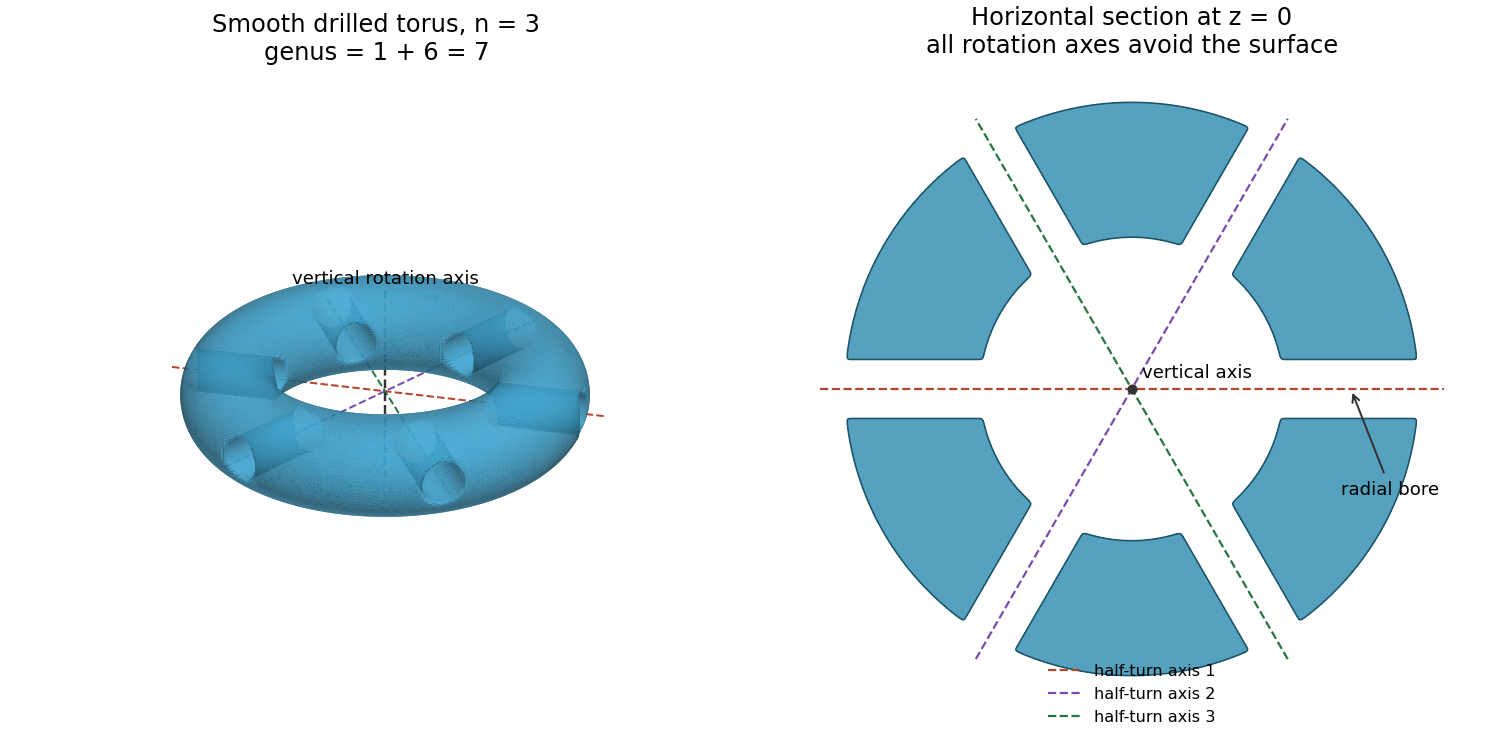
A genus-seven surface with a free dihedral action: six radial bores contain the horizontal rotation axes
. Details. 
Here is why the construction has exactly the required properties. Every nonidentity power of is a rotation in three dimensions fixing the vertical axis, which lies in the central opening and is disjoint from . Each element is a half-turn about a horizontal line at azimuth , modulo . The such lines meet the original solid torus in short radial segments. Each segment lies strictly inside one drilled tunnel, so these axes are also disjoint from . A nonidentity rotation in three dimensions fixes only its axis. Thus no nonidentity element fixes a point of , proving a free action of a group.
Rotation by permutes the tunnels, while preserves their arrangement and the original solid torus. Hence is preserved by the two generators and therefore by . The tunnels can be chosen sufficiently thin to be pairwise disjoint, and the rounding can be made group-invariant in small disjoint neighbourhoods of their rims. It neither changes the genus nor introduces an intersection with any axis.
Each tunnel removes two discs from the existing boundary and inserts the cylindrical wall of the bore. Its contribution to Euler characteristic is : the two removed discs contribute , and the inserted annulus and its boundary circles have zero Euler characteristic. The boundary remains connected and orientable, so each tunnel increases genus by one. Starting from a torus and drilling tunnels therefore gives . The construction also supplies a Riemann surface: use the complex structure associated with the induced oriented Riemannian metric. The ambient generators are isometries preserving the solid and ambient orientation of a vector space, so they preserve the induced boundary orientation and act by biholomorphisms. Part (d) then confirms that the quotient space has genus two. This is a free dihedral action on a drilled torus.
Past exam of the geometry of surfaces course of the University of Oxford 2023 2 d Solution by Codex 0 2026-10-25
Codex 0 2026-10-25For a free action of a group, every stabilizer subgroup is trivial. Hence every ramification index of a holomorphic map is one, and the projection is an unramified covering map of degree of a holomorphic map . The Riemann-Hurwitz formula reduces toThis is also the multiplicativity of Euler characteristic under a finite covering.
Past exam of the geometry of surfaces course of the University of Oxford 2023 2 c Solution by Codex 0 2026-10-25
Codex 0 2026-10-25In a cyclic group of prime order , a stabilizer subgroup has order either one or . The latter case consists exactly of points fixed by all of . Thus the fixed points each have ramification index of a holomorphic map , and every other point has index one. Applying the Riemann-Hurwitz formula with degree of a holomorphic map givesEquivalently,The count concerns fixed points upstairs. Each is its own group orbit, so their images are also distinct branch values of a holomorphic map.
Past exam of the geometry of surfaces course of the University of Oxford 2023 2 b Solution by Codex 0 2026-10-25
Codex 0 2026-10-25Every nonidentity biholomorphism in the finite group has only finitely many fixed points, by the identity theorem on a Riemann surface and compactness. Because the group action is a faithful group action, the union of these finite sets does not exhaust . A point outside this union has trivial stabilizer subgroup, so its group orbit has points by the orbit-stabilizer theorem. The generic fiber of a function of the projection is such an group orbit, givingMore precisely, put and . Differentiation at gives a group homomorphism . It is injective: if a nonidentity finite-order germ had the form with and , then its th iterate would begin , so no positive iterate could be the identity. A germ equal to the identity gives the identity on by the identity theorem on a Riemann surface. Thus is a cyclic group, with derivative image the th roots of unity.
For completeness, an explicit local coordinate linearizing isIt has , and reindexing the sum gives . Therefore a coordinate on the local quotient space is . Other translates of a sufficiently small neighbourhood of are disjoint unless their translating element lies in , so this local quotient space is also a chart for . The local cyclic quotient of a Riemann surface consequently gives
Past exam of the geometry of surfaces course of the University of Oxford 2023 2 a Solution by Codex 0 2026-10-25
Codex 0 2026-10-25Let and choose holomorphic coordinate charts centred at and . A nonconstant holomorphic map has a local expansion , where and . Taking a local holomorphic th root of the nonvanishing factor and changing the source coordinate gives the exact local form . The integeris the ramification index of a holomorphic map. A ramification point of a holomorphic map is a source point with , equivalently where its derivative vanishes; a branch value of a holomorphic map, also called a branch point here, is the image of such a point in . These are different sets, one in the source and one in the target.
Every fiber of a function is finite: locally it is the zero set of a nonzero holomorphic function, so its points are isolated, and compactness prevents infinitely many such zeros without an accumulation point. The same argument applied to the local derivatives makes the set of ramification points of a holomorphic map finite. The open mapping theorem and compactness show that is both open and closed in the connected target , hence is surjective.
For any , the degree of a holomorphic map isTo see independence of , choose disjoint small coordinate charts about its finitely many preimages. The local form shows that nearby values have preimages counted with multiplicity in the corresponding chart. Compactness excludes additional preimages outside these charts for sufficiently nearby values: a sequence of such preimages would have a limit in . The displayed sum is therefore locally constant, hence constant on connected . Away from branch values of a holomorphic map it is the ordinary number of preimages, and is a -sheeted covering map there.
The Riemann-Hurwitz formula isor, in terms of the two genera,For its proof, choose a triangulation of a surface on containing every branch value of a holomorphic map among its vertices. Every open edge and open face has lifts, since its interior avoids branch values of a holomorphic map. The lifted cells give a finite CW complex structure on . If are the target counts and , the source counts areIndeed, at a target vertex the deficit from distinct preimages is precisely , and all nonzero contributions occur over vertices. Taking the alternating sum gives , as required. This is the Triangulation proof of the Riemann-Hurwitz formula.
Past exam of the geometry of surfaces course of the University of Oxford 2023 1 e Solution by Codex 0 2026-10-25
Codex 0 2026-10-25Take a hexagonal polygonal schema with boundary wordIdentify equally labelled polygon edges in the indicated directions. The two consecutive occurrences of identify the first three vertices; the two edges extend this class to the next two vertices, and the edges include the remaining vertex. Thus all six polygon vertices become one, while the six edges become three and the interior is one face. Its Euler characteristic isThis is the usual polygonal schema for the connected sum of surfaces of three real projective planes. The same-sign edge pairs force a nonorientable surface, consistently with . A closed orientable surface cannot have odd Euler characteristic.
Past exam of the geometry of surfaces course of the University of Oxford 2023 1 d Solution by Codex 0 2026-10-25
Codex 0 2026-10-25The uniformization theorem says that every simply connected Riemann surface is biholomorphic to the Riemann sphere, the complex plane, or the unit disc. Its consequence for a compact Riemann surface of genus at least two is that the universal cover is the unit disc, equivalently the hyperbolic plane.
To explain the restriction, a spherical universal cover would make the fundamental group finite. Since a finite covering map multiplies Euler characteristic, is impossible for . If the universal cover were the complex plane, its deck transformations would be biholomorphisms . A nonidentity such map with has a fixed point, impossible for a deck transformation. Thus the deck transformation group would consist of translations. A discrete subgroup of translations with compact quotient space is a rank-two Euclidean lattice, whose quotient space is a torus, again incompatible with .
On the unit disc, the Poincare metric on a Riemann surfacehas Gaussian curvature and is invariant under every biholomorphism of the unit disc. It therefore descends through the deck transformation group to a hyperbolic metric on . Its local expression is a positive multiple of in every holomorphic coordinate chart, so it is compatible with the given complex structure. In fact, this hyperbolic metric is unique within that conformal class.
Past exam of the geometry of surfaces course of the University of Oxford 2023 1 c Solution by Codex 0 2026-10-25
Codex 0 2026-10-25Write for the internal angle at , using the numbering in part (b), and use the hyperbolic plane with Gaussian curvature . The necessary and sufficient conditions are equal lengths for each pair of equally labelled polygon sides, and total angle at each vertex equivalence class. Explicitly, the two angle conditions areNecessity follows because the identification must preserve arc length along each seam, and a smooth interior point of a Riemannian surface has total angle . For sufficiency, equally long hyperbolic geodesic segments can be identified by isometries. Across their interiors, two half-disc neighbourhoods join to a hyperbolic disc. At an identified vertex, the incident sectors form a cyclic disc with total angle , so no cone singularity of a surface metric remains. These local isometries therefore extend the Riemannian metric smoothly everywhere. This is the smooth hyperbolic polygon gluing criterion.
The ten internal angles sum to . The area of a hyperbolic geodesic polygon consequently givesEquivalently, the Gauss-Bonnet theorem gives .
Past exam of the geometry of surfaces course of the University of Oxford 2023 1 b Solution by Codex 0 2026-10-25
Codex 0 2026-10-25Number the polygon vertices in the order of the given polygonal schema, with its th polygon edge going from to , and subscripts interpreted modulo ten. Equal labels identify equal arrow endpoints. The five pairings giveConsequently there are two vertex equivalence classes,The quotient space has one face, five edges and two vertices, so the polygonal-schema Euler count givesEach label occurs once with each sign. Hence every pairing reverses the direction induced by traversing the boundary of the polygon, so an orientation of a surface on its interior extends consistently across every glued edge. Thus is orientable. The classification of compact surfaces now gives , or a closed orientable surface of genus two, equivalently the connected sum of surfaces of two tori.
Past exam of the geometry of surfaces course of the University of Oxford 2023 1 a Solution by Codex 0 2026-10-25
Codex 0 2026-10-25The classification of compact surfaces says that every compact, connected topological surface without boundary is homeomorphic to exactly one of the following: the sphere ; a connected sum of surfaces consisting of tori; or a connected sum of surfaces consisting of real projective planes. The first two cases are orientable; the last case is a nonorientable surface. Their Euler characteristics areHere has genus , and has crosscaps; is the real projective plane and the Klein bottle. Thus orientability together with the Euler characteristic determines the closed surface up to homeomorphism.
If the convention permits a surface with boundary, also remove the interiors of disjoint closed discs from one of these closed surfaces. The Euler characteristic decreases by , giving in the orientable case and in the nonorientable surface case. The number of boundary components is then an additional invariant.
Past exam of the general relativity II course of the University of Oxford 2021 3 c Solution by Codex 0 2026-10-25
Codex 0 2026-10-25First use the original null coordinates , . They obey , and the radial metric tensor becomesApply the given substitutions and . The identitiesgive the analytic extension of a spacetimeThe poles of the individual tangent and cotangent substitutions are now ordinary coordinate lines wherever . Set and . Allowing these coordinate functions to continue across every such line givesThis is the universal cover of two-dimensional anti-de Sitter spacetime of radius , times a two-sphere of radius : the simply connected Bertotti-Robinson spacetime. In defining this maximal analytic extension, ranges over the whole real line without periodic identification. A periodic identification would instead create closed timelike curves and would be an additional global choice.
For clarity, the original patch is embedded by the branches and . The inequality is equivalent on these branches to , so the original patch occupiesThe first spacetime extension in part (a) occupies the larger band , with . Its finite- Killing horizon is the interior line . The edges of that band are further regular Poincaré horizons; continuing through them produces the full conformal strip of two-dimensional anti-de Sitter spacetime.
The original coordinate has a smooth continuation throughout the strip:Consequently the complete set of zero-level Killing horizons isThese are two alternating families of parallel null lines; different families meet only at the excluded conformal boundaries, never inside the spacetime. The continuation of the original Killing vector field isThe field never vanishes in the interior, including on the Killing horizons.
To obtain the Penrose diagram, suppress the two-sphere and multiply by the conformal factor . The resulting radial metric tensor is , so the diagram is an infinitely tall strip of width , with null lines at 45 degrees and timelike edges . Generically,At the special edge points where the two families of Killing horizons end, the displayed formula is a limit and has no unique limiting value. Thus the infinity labels on the diagram refer to the open edge segments, not those vertices. Each interior point of the diagram represents a two-sphere of fixed radius ; neither edge is a centre where that two-sphere shrinks.
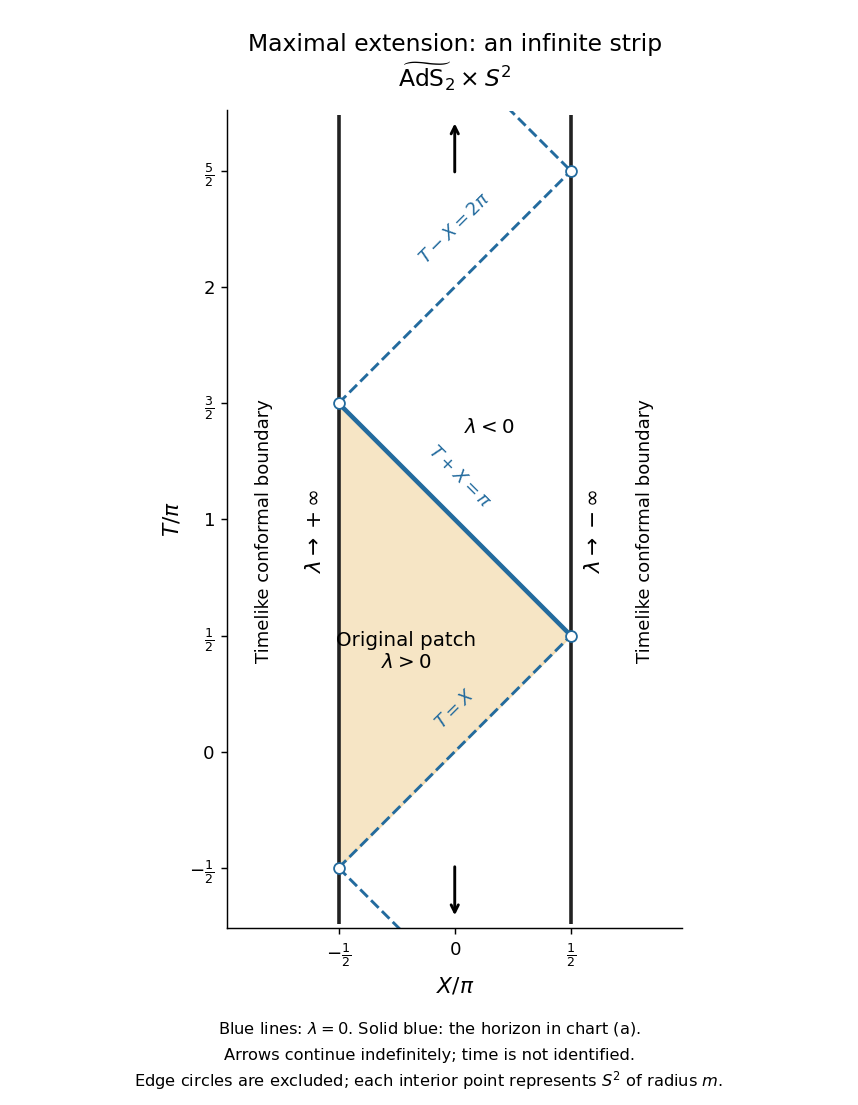
Penrose diagram of the maximal Bertotti-Robinson spacetime extension, with the original patch and all zero-level Killing horizons
. Details. 
Finally, these timelike edges are conformal boundaries, not omitted regular points of a further spacetime extension. One way to establish maximality is geodesic completeness. The two-dimensional anti-de Sitter spacetime factor embeds locally as in a flat space with metric signature . Along an affinely parametrized geodesic with constant , the ambient equation isIts oscillatory, linear or hyperbolic solutions for negative, zero or positive exist for all real affine parameters and lift to the universal cover. The two-sphere is also geodesically complete, and geodesics of the product split into geodesics of its factors. Hence is geodesically complete. A proper regular spacetime extension would furnish a geodesic reaching its boundary in finite affine parameter, contradicting that completeness. This proves that the displayed simply connected analytic spacetime is maximal.
Past exam of the general relativity II course of the University of Oxford 2021 3 b Solution by Codex 0 2026-10-25
Codex 0 2026-10-25The inverse of the metric tensor block isThe normal covector has squared norm . ThereforeMore explicitly, the induced metric tensor is ; at zero its sole zero direction is . The coefficients are independent of , so is a Killing vector field. On ,Hence is both tangent and normal to this null hypersurface, proving it is a Killing horizon. The definition of surface gravity is on the Killing horizon, or equivalently . Since vanishes there while ,Thus this is a degenerate Killing horizon, and is an affine parameter on each of its null geodesics.
For a concrete horizon frequency comparison, fix the same angular position for a narrow high-frequency light beam and two freely falling radial observers. Work in geometric optics, with the beam's affinely transported wavevector tangent to the Killing horizon, . Here is constant because . Choose the observers as translates of one timelike geodesic by the isometry generated by , crossing at and . Give them the same positive Killing energy per unit rest mass, . At their crossings their normalized four-velocities havewhich satisfy . They can be realized by local geodesics with precisely these initial data. The measured angular frequency isTo connect this measurement to surface gravity, if with constant , affine transport of would give . For observers related by the same Killing vector field translation, agrees at the crossings, giving . Here there is no accumulated redshift along the Killing horizon for these equally prepared observers. Arbitrary observers with different four-velocities can still measure different frequencies through their different Killing energies.
Past exam of the general relativity II course of the University of Oxford 2021 3 a Solution by Codex 0 2026-10-25
Codex 0 2026-10-25Put , the standard metric tensor on the unit sphere. From one has . The apparently divergent terms cancel:The metric tensor block has determinant , independently of . Its coefficients are real analytic, so this formula defines a regular Lorentzian metric onThe polar-coordinate degeneracies at the poles are handled by ordinary two-sphere charts. Thus is a coordinate singularity of the original chart and is crossed by this spacetime extension.
Past exam of the general relativity II course of the University of Oxford 2021 2 d Solution by Codex 0 2026-10-25
Codex 0 2026-10-25Continue with the active sign convention for the linearized coordinate gauge transformation. Choose local functions of by integration so thatFor example, for any fixed one may takeA generator, specified as a covector with components in the null coordinates , isIndeed, with , the mixed components cancel:All components without a index vanish as well, andSince , only the component needs changing. ThusYes, satisfies both equations (3). Its trace is zero, gives zero divergence, and the harmonic quadratic plane-wave profile givesThe two surviving functions encode the two gravitational wave polarizations; constant and linear transverse terms have been removed by the explicit linearized coordinate gauge transformation.
Past exam of the general relativity II course of the University of Oxford 2021 2 c Solution by Codex 0 2026-10-25
Codex 0 2026-10-25With and , the Minkowski metric and the specified null vector becomeThe Minkowski wave operator in null coordinates is . All components of the original metric perturbation still depend only on , since this coordinate change is linear. The result of part (a), differentiated once, readsIt follows that and . Taking the trace givesExpanding the scalar in these null coordinates therefore yieldswhere the coefficients are explicitlyThe quadratic transverse term is a harmonic quadratic plane-wave profile. In particular , and , consistently reproducing the failure of wave gauge in part (b).
Past exam of the general relativity II course of the University of Oxford 2021 2 b Solution by Codex 0 2026-10-25
Codex 0 2026-10-25Use the active sign convention for the linearized coordinate gauge transformation, . The paper's prescribed generator has precisely this sign; using the passive convention would require its negative. Direct partial differentiation givesThe middle terms cancel when the indices are symmetrized. ThereforeTo test both equations (3), put , the trace of the original metric perturbation. Since is a null vector, and its trace-reversed metric perturbation equals . Differentiating the result of part (a) givesIn the second identity, the term with is zero. ThusIn general does not satisfy (3). On an open interval of , both equations hold exactly when there: the first equation forces this for , and smoothness gives it at as well. A linearized coordinate gauge transformation preserves the linearized vacuum Einstein equations, but only a residual gauge symmetry of linearized gravity preserves the imposed Lorenz gauge in linearized gravity.
For an explicit failure, use the null coordinates of part (c) and take only nonzero. Then , the original field obeys (3), but gives and .
Past exam of the general relativity II course of the University of Oxford 2021 2 a Solution by Codex 0 2026-10-25
Codex 0 2026-10-25For the plane gravitational wave in linearized gravity, the chain rule gives . The Lorenz gauge in linearized gravity, called wave gauge in the paper, imposes zero divergence of the trace-reversed metric perturbation. HenceThe wave equation itself holds for any smooth profile of , because for the constant null vector .
There are unlisted articles, also show them or only show them.