Past exam of the general relativity course of the University of Oxford 2021 3 d Solution by  Codex 0 2026-10-25
The geodetic precession per orbit isThe orbital position and four-velocity repeat after a full orbit, so the direction to distant Earth in the instantaneous rest frame repeats. The freely transported gyroscope does not: its beam axis has turned through relative to the original aiming direction. This applies to any initial in-plane spin direction by linearity of parallel transport, not only the radial initial condition used in part (b). The beam's angular diameter is , giving a half-angle of . Thus Earth lies outside the beam after one orbit; comparing the offset with the diameter would already show a miss, but the correct acceptance angle is the half-angle.
The initial radial ray must be outward from the black hole for a direct path to Earth. A precisely inward radial null geodesic falls into the black hole and cannot provide the assumed initial communication. For outgoing near-radial Schwarzschild light deflection, the angular correction is especially small. If a static observer at measures a small emission angle from the outward radial direction, its impact parameter is . The outgoing null geodesic givesRelative to flat propagation, curvature changes the small pointing angle and beam radius by the fraction . At an offset of this is only about ; the beam's radius changes by about . The exactly radial central ray has zero angular deflection. This is not the geometry of the usual scattering formula, which assumes a ray coming from infinity, passing the black hole, and returning to infinity.
Relativistic aberration also distinguishes a coordinate-radial light ray from a beam aimed radially in the moving crew's frame. Here . Successful initial aiming includes that fixed correction; the same correction applies at the repeated orbital position. More precisely, an outgoing static-radial ray initially has crew-frame angle from the radial axis. The local small-angle aberration factor about that aim is ; including the outgoing propagation factor gives . Thus the asymptotic miss is about and the beam half-angle about , with the same conclusion. The small distortion of the outward beam cannot correct the much larger accumulated geodetic precession.
Past exam of the general relativity course of the University of Oxford 2021 3 c Solution by Codex 0 2026-10-25
Codex 0 2026-10-25For a timelike circular Schwarzschild geodesic, the coordinate orbital period and onboard proper time per orbit areUsing and , the Schwarzschild radius and orbital areal radius are and . ThereforeThe crew accumulates about fewer seconds, or fewer minutes, per orbit. Both gravitational time dilation and kinematic time dilation contribute: a static clock at has , while the orbiting clock additionally has , where . A distant observer measures the coordinate period; comparing arrivals emitted at the same orbital phase also removes the repeated light propagation delay.
Past exam of the general relativity course of the University of Oxford 2021 3 b Solution by Codex 0 2026-10-25
Codex 0 2026-10-25Let , , , and choose . A torque-free test gyroscope moving on a geodesic has a spin four-vector obeying parallel transport,The orthogonality condition says the temporal spin component vanishes in the body's rest frame, not necessarily in Schwarzschild coordinates. Here it givesIn addition to the radial Christoffel symbols in part (a), use and . On the equator the parallel transport equations becomeThe radial equation follows by substituting into . Eliminating gives .
Let be the invariant spin magnitude. Initially radial spin means and . The complete solution isTo interpret the orientation, convert coordinate components into the orbiting orthonormal frame. The Lorentz factor relative to a Schwarzschild static observer is , so the body's measured radial and tangential spin components areTheir squared sum is , and their angle relative to the outward radial direction decreases uniformly at rateThe differing coordinate amplitudes in must not be interpreted as a nonuniform physical spin rotation. After one orbital period the radial basis has turned by while the spin has turned by relative to it. The residual geodetic precession is in the orbital direction.
Past exam of the general relativity course of the University of Oxford 2021 3 a Solution by Codex 0 2026-10-25
Codex 0 2026-10-25The intended orbit is a freely falling timelike circular Schwarzschild geodesic. Use the Schwarzschild metric with rather than as the zeroth coordinate, and put the orbit at . Thus , , , with . The radial geodesic equation at constant isConsequently . The four-velocity normalization givesand henceHere is Schwarzschild time, the orbiting clock's proper time, the gravitational constant, the central mass, the constant areal radius, and the speed of light. The dimensionless follows the question's time-valued zeroth-coordinate convention; with the zeroth four-velocity component would be .
The condition is for a massive circular geodesic; radial stability further requires , with equality marginal. The phrase “any circular orbit” is false without free fall: a powered circular trajectory has with independently chosen . For example, at choose ; this valid accelerated circular trajectory has , instead of the displayed .
Past exam of the general relativity course of the University of Oxford 2021 2 c Solution by Codex 0 2026-10-25
Codex 0 2026-10-25Displacement must be specified relative to an observer. In transverse-traceless gauge the free particles can have fixed coordinates, while their measured proper lengths oscillate. In a local, freely falling orthonormal frame, the geodesic deviation equation for an initial separation is, to first order in ,Its general solution with physical displacement and initial physical velocity isThe source has been running indefinitely, so there is no wave-free initial state. Its initial conditions for an eternal monochromatic gravitational wave need more than positions to fix . The usual bounded, periodic response selects ; if the particles instead start at physical rest at , set and retain the linear term. Both solve the same linear geodesic deviation problem. The distinction between fixed TT coordinates and measured separation is explained in [ref].
Choose so the wave phase at the detector is . For the bounded response the four initial placements then giveThese are displacements from the specified positions at ; positions are . Equivalently, relative to mean positions the usual oscillatory displacement is to first order. The response repeats after .
Both plus polarization and cross polarization occur with equal amplitude and a quarter-cycle phase difference. Their superposition is circular gravitational-wave polarization, with handedness reversed when the viewing direction or source rotation is reversed. The principal stretching axis turns through half the wave phase. There is no leading longitudinal motion.
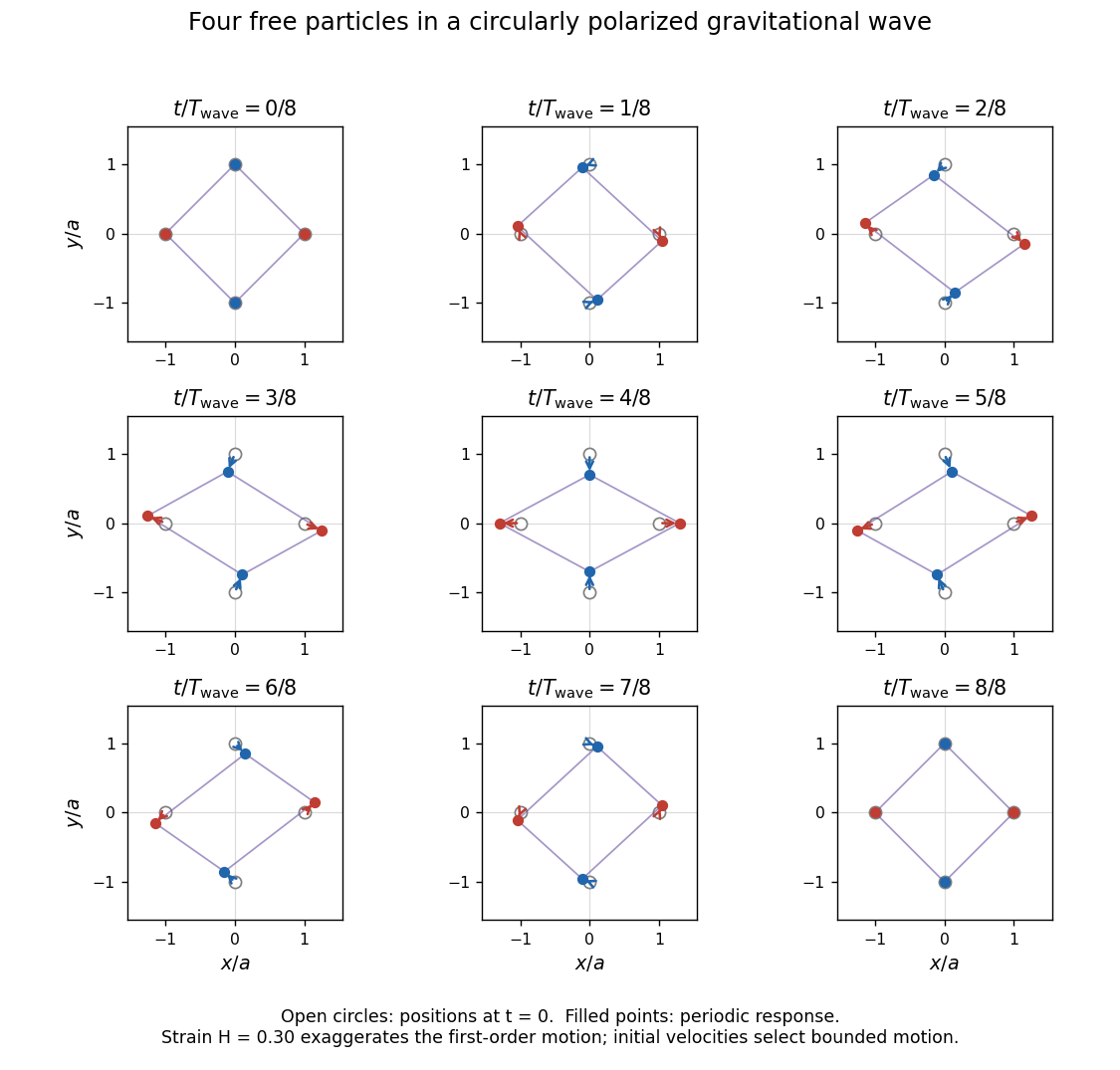
One full circularly polarized gravitational-wave cycle, with the four particles at their specified initial positions at phase zero
. Details. 
Past exam of the general relativity course of the University of Oxford 2021 2 b Solution by Codex 0 2026-10-25
Codex 0 2026-10-25Use metric signature and transverse-traceless gauge, . To resolve the source's origin ambiguity, put the detector centre at and the source centre at , so the gravitational wave travels in the positive direction. Reversing that direction replaces by . Work in the weak-field approximation, with , , and detector size . The radiation reaction is neglected, so the rod maintains the prescribed steady motion.
At the retarded source time , take the source positions as . The arbitrary constant specifies the initial source phase. The second mass moment tensor obeysThe quadrupole formula projects away the transverse trace, which is already constant here. Differentiating twice therefore givesAll time and longitudinal metric perturbation components vanish in transverse-traceless gauge. The gravitational-wave frequency is in angular units; is each source mass, not their sum, and the detector mass does not enter the strain. The plane wave approximation holds the amplitude fixed at ; retaining spherical spreading replaces its denominator by near the axis. The retarded quadrupole formula and the distinction between source and wave frequency are derived in [ref].
Past exam of the general relativity course of the University of Oxford 2021 1 d Solution by Codex 0 2026-10-25
Codex 0 2026-10-25The time-translation Killing vector field of the Schwarzschild metric gives a conserved Killing energy per unit rest mass,For unit rest mass, this is the total energy relative to infinity, including rest energy. At release , so the four-velocity normalization gives andSubstitution into the radial four-velocity normalization yieldsChoosing the inward square root and evaluating at the ground provesThis identity is exact within the assumed Schwarzschild metric, despite its familiar Newtonian mechanics form. The quantity is not exactly the locally measured speed. A Schwarzschild static observer measures . Thus the distinction disappears in the stated weak-field approximation, giving for .
Past exam of the general relativity course of the University of Oxford 2021 1 c Solution by Codex 0 2026-10-25
Codex 0 2026-10-25Write and . The Christoffel symbols follow fromThe relevant time and radial entries, using , areFor the angular geodesic equations, , , and . Thus, with primes on coordinates here denoting proper time derivatives,Initial conditions are preserved by these ordinary differential equations. The motion is therefore radial, with constant angular coordinates. Choose the polar axis so the apple is away from the angular coordinate singularities.
The exact remaining radial geodesic equation and four-velocity normalization areEliminating gives the particularly simple exact result . The supported observer's proper time differs from the apple's proper time by relative corrections of order and . Consequently, to leading order in the weak-field approximation and , , with and zero initial radial velocity. HenceThe proper height measured along a static radial ruler is at this accuracy. The use of means the ground clock's elapsed time, with propagation delays corrected; raw visual arrival times include the changing light travel time.
If variation of over the fall is retained but relativistic corrections are neglected, a useful parametric solution isIts small- expansion gives the same constant- result. For an exact check on the choice of clock, the initial coordinate acceleration measured using is , which reduces to the displayed approximation.
Past exam of the general relativity course of the University of Oxford 2021 1 b Solution by Codex 0 2026-10-25
Codex 0 2026-10-25Approximate Earth by an isolated, nonrotating, spherically symmetric body. By Birkhoff's theorem, the exterior vacuum metric tensor is the Schwarzschild metric. With it isHere is the areal radius, and are spherical angles, is Schwarzschild time normalized to the proper time of a static observer at infinity, is Earth's mass, the gravitational constant, and the speed of light. The nonzero diagonal metric tensor components are , , , .
The apple is a test particle; neglect its effect on the metric tensor, air resistance, Earth's rotation and nonspherical structure, and external tidal forces. Near Earth's surface, , , and the falling speed remains much smaller than . Thus the Newtonian limit of this metric tensor is appropriate, while the exact radial geodesic is available as a check. A static observer under the tree has proper time , up to an additive constant. Such an observer is supported by the ground and has nonzero proper acceleration; the released apple instead has zero proper acceleration.
Past exam of the general relativity course of the University of Oxford 2021 1 a Solution by Codex 0 2026-10-25
Codex 0 2026-10-25The apple's proper time is the time read by a clock carried with it, with for metric signature . At any event choose a local inertial frame with coordinates , in which free motion satisfies at that event. The chain rule givesMultiplying by the inverse coordinate Jacobian matrix yields the exact geodesic equationHere are the observer's coordinates, is the apple's four-velocity, and the Christoffel symbols describe the Levi-Civita connection. The last expression applies when the coordinates are locally inertial at the event considered; one such chart need not remain inertial throughout a finite region.
Choose , so . In the weak-field approximation and at small spatial speed compared with , the leading spatial geodesic equation isIt is exact at the release event when all spatial vanish, and is the intended approximation to the displayed expression in the source. Terms and cannot generally be dropped; the time component must also be retained to find changing . For a concrete counterexample to the unrestricted expression, a straight free trajectory , in flat spacetime has polar radius and , although . The missing angular term supplies that radial coordinate acceleration.
Past exam of the general relativity and cosmology course of the University of Oxford 2018 4 e Solution by Codex 0 2026-10-25
Codex 0 2026-10-25Use the observed present photon temperature . This is an additional observational input, consistent with [ref]
The Temperature of the Cosmic Microwave Background by Dale J. Fixsen. abstract: combined CMB-temperature determination
. Standard neutrino decoupling and electron-positron entropy transfer giveFor nonrelativistic relic neutrinos this is the temperature parameter of the redshifted momentum distribution, not the temperature of a newly thermalized gas of massive particles.The photon number density from part b isOne neutrino mass eigenstate and its antineutrino have two populated helicity states. ThusThe total over three species is about , including antineutrinos. Comoving number conservation preserves these abundances after the particles become nonrelativistic.
For the supplied ,Assuming nonnegative other energy components, relic neutrino rest-mass density cannot exceed the near-critical total density. With the common per-species abundance ,Using the total would instead bound the mean mass, not the sum. This critical-density bound on the sum of relic neutrino masses is deliberately conservative: baryons, dark matter and dark energy leave less density available. It assumes the standard thermal abundance, negligible chemical potentials, no later dilution or extra populated states, and the idealized decoupling count. Small non-instantaneous-decoupling corrections do not matter for this estimate.
Past exam of the general relativity and cosmology course of the University of Oxford 2018 4 d Solution by Codex 0 2026-10-25
Codex 0 2026-10-25As the plasma cools through electron-positron annihilation, the pairs transfer their entropy to the coupled photons. Neutrinos have largely decoupled and do not share that heating in the instantaneous-decoupling approximation. Before annihilation the electromagnetic entropy count iswhile after it . Conservation of electromagnetic comoving entropy, , gives the relative photon heating factorEquivalently afterward. The exact count compares an asymptotic relativistic pair bath with the pair-free bath; at the supplied temperature some finite-electron-mass entropy loss has already begun.
The word “rises” requires care. The photons become hotter than an otherwise freely redshifting bath at the same scale factor; their absolute temperature need not rise during the expansion. In the smooth equilibrium process,since the pair contribution grows with temperature. This monotonic photon cooling during pair annihilation is slower than while increases. The factor compares the photon temperature with the freely redshifting neutrino bath, not two consecutive absolute temperatures along the expanding history.
There are unlisted articles, also show them or only show them.