Past exam of the general relativity and cosmology course of the University of Oxford 2013 2 d Solution by  Codex 0 2026-10-25
For a minimally coupled massless scalar field, the covariant wave operator isThe Fourier mode therefore satisfiesSubstituting leaves . ThusThis is an unrescaled de Sitter massless scalar mode. For , the opposite-frequency time solution supplies the second independent mode; a real scalar field combines appropriate conjugate spatial modes. For the particular ansatz gives only the constant solution, while the full homogeneous solution is . The requested ansatz was not a general zero-mode parametrization.
Past exam of the general relativity and cosmology course of the University of Oxford 2013 2 c Solution by Codex 0 2026-10-25
Codex 0 2026-10-25Write , with the prime denoting . The metric and inverse metric are and . Since depends only on , the Christoffel symbols reduce toConsequentlyFor the stated de Sitter spacetime scale factor, . The factor is required because the prime is not differentiation with respect to itself.
Past exam of the general relativity and cosmology course of the University of Oxford 2013 2 b Solution by Codex 0 2026-10-25
Codex 0 2026-10-25For a torsion-free connection, the connection terms in the antisymmetrized covariant derivative cancel: . Thus the electromagnetic field tensor is the exterior derivative of the four-potential. It is a tensor, is invariant under , and obeys the homogeneous Maxwell equations . The covariant divergence equation is the generally covariant form of the local source equation; use its minus sign as specified in the paper.
Expand that equation before imposing the Lorenz gauge condition:The curvature commutator on a covariant tensor givesHere the contraction accounts for the second sign reversal. Hence in Lorenz gaugeThis curved-spacetime electromagnetic potential wave equation contains a Ricci tensor term even in a locally inertial coordinate system: a connection can vanish at one point while its derivatives and curvature remain nonzero.
Past exam of the general relativity and cosmology course of the University of Oxford 2013 2 a Solution by Codex 0 2026-10-25
Codex 0 2026-10-25Although for a scalar field, its first derivative is a covector field. ThereforeCommuting partial derivatives and using the torsion-free connection gives . For a vector field, differentiate the tensor with both its indices included:Subtract the expression with exchanged. Second derivatives of cancel; the terms multiplying first derivatives cancel pairwise, and the final lower-index connection terms cancel by symmetry. The remaining coefficient of isThis is the curvature commutator. On a covariant index the sign reverses, giving the curvature commutator on a covariant tensor used in the next part.
Past exam of the general relativity and cosmology course of the University of Oxford 2013 1 d Solution by Codex 0 2026-10-25
Codex 0 2026-10-25For a massive particle parametrized by proper time, the geodesic equation isThe weak-field approximation alone does not imply Newtonian motion. Also take a nonrelativistic limit, , in the usual quasistatic regime so the potentials' time variation does not compensate for the small velocity factors. Reparametrizing by coordinate time and retaining the leading velocity-independent spatial term givesIn empty space the first field equation gives . For static potentials, the spatial equations imply and then . The difference is at most affine; isolated-system boundary conditions fixing both potentials to zero at infinity remove it. Thus andthe empty-space Newton-Poisson equation. With the same quasistatic assumptions and dust present it becomes . Keeping rapid time dependence instead leaves in vacuum, so the static qualification matters.
Past exam of the general relativity and cosmology course of the University of Oxford 2013 1 c Solution by Codex 0 2026-10-25
Codex 0 2026-10-25The Einstein tensor is . Thus , where the time raising introduces the minus sign. Substitution cancels the and time-derivative terms in that component and givesThe right sides follow from the Einstein field equations with zero cosmological constant. The full equations also contain the momentum constraint for dust at rest to this order. Specifying arbitrary time-dependent potentials without that constraint would not give a solution of all the Einstein field equations.
Past exam of the general relativity and cosmology course of the University of Oxford 2013 1 b Solution by Codex 0 2026-10-25
Codex 0 2026-10-25A pressureless relativistic fluid has stress-energy tensor , with four-velocity normalized by . In its rest frame, , so . Here is rest-frame mass density, or energy density divided by .
For the linearized Ricci tensor and scalar, discard the quadratic connection terms. The contracted connection is . Differentiation then givesThe Ricci scalar uses the zeroth-order inverse metric, , because multiplying first-order curvature by another metric perturbation would again be second order. These are the linearized curvature of a two-potential weak-field metric in the paper's Riemann curvature tensor sign convention.
Past exam of the general relativity and cosmology course of the University of Oxford 2013 1 a Solution by Codex 0 2026-10-25
Codex 0 2026-10-25Use metric signature , , and retain terms linear in or . The inverse metric is and . In the Christoffel symbol formulathe differentiated metric perturbation is already first order, so the prefactor can be replaced by the flat inverse metric. For example and . Evaluating the remaining components givesThe lower-index symmetry follows from the torsion-free connection. Products of these first-order Christoffel symbols are beyond the retained weak-field approximation.
Past exam of the general relativity and cosmology course of the University of Oxford 2012 4 d Solution by Codex 0 2026-10-25
Codex 0 2026-10-25Big Bang nucleosynthesis is a kinetic process in an expanding universe. A common particle temperature does not imply chemical equilibrium for every nuclear reaction: reaction rates must also exceed the expansion rate and connect the required species efficiently. Around , nuclear abundances retain the history of earlier freeze-out and cannot be inferred from equilibrium Boltzmann factors alone.
In particular, weak reactions cease to maintain neutron-proton chemical equilibrium. Subsequent free-neutron decay after freeze-out changes the surviving neutron inventory. The large photon-to-baryon ratio delays deuterium survival through photodissociation; once the deuterium bottleneck opens, reactions rapidly bind many surviving neutrons into helium-4. Coulomb barriers, decreasing density and further freeze-out prevent unrestricted equilibration of all nuclei. The final helium abundance therefore requires a reaction network and expansion history, not just the temperature and nuclear binding energies.
For illustration, if essentially all available neutrons end in helium-4 and the neutron-to-proton ratio at that stage is , simple particle counting gives . The crucial input is itself set by out-of-equilibrium history. Kinetic thermalization of the plasma can remain effective while these composition-changing processes are out of equilibrium.
Past exam of the general relativity and cosmology course of the University of Oxford 2012 4 c Solution by Codex 0 2026-10-25
Codex 0 2026-10-25Assume an ideal nondegenerate hydrogen gas in thermal equilibrium and chemical equilibrium, with ground-state atoms and charge neutrality. Let and . The ground-state Saha equation, with the usual electron/proton spin factors cancelling the atomic ground-state degeneracy, isInvert it and use . This givessoHere is the electron mass denoted in the source, and . At , the left side is two. At of order , the right side is extremely small because and . A large exponential is needed to compensate, requiring rather than a temperature of order the binding energy.
Physically, there are enormously many photons per baryon, so even a small high-energy tail of the thermal photon distribution can maintain ionization. Recombination is delayed until that tail is sufficiently depleted. This explains the low recombination temperature without solving the equilibrium equation; actual cosmological recombination also eventually requires rate equations once equilibrium fails.
Past exam of the general relativity and cosmology course of the University of Oxford 2012 4 b Solution by Codex 0 2026-10-25
Codex 0 2026-10-25For thermal photons, the available thermal length is . The number of occupied modes per volume scales as , while their characteristic energy is of order . Thus and . More explicitly, the two photon polarizations and the Bose-Einstein distribution giveconsistent with the rounded coefficients supplied in the source.
Use its definition , with and the mass-equivalent cosmological critical density. Writing , the photon energy formula gives . ThereforeThis photon-to-baryon ratio from density parameters has leading coefficient , as required. For an illustrative estimate, take the stated , and . Then , i.e. of order a billion photons per baryon. The source alone supplies no numerical density parameters, so an estimate must state such additional inputs.
Strictly, this is the photon-to-baryon ratio, rather than the thermodynamic entropy per baryon itself. For a thermal photon gas, with the exact blackbody coefficients. The ratio used in the source is proportional to the radiation entropy per baryon under adiabatic evolution.
Past exam of the general relativity and cosmology course of the University of Oxford 2012 4 a Solution by Codex 0 2026-10-25
Codex 0 2026-10-25For a separately conserved homogeneous component, energy conservation gives , equivalently . Dust has negligible pressure, while isotropic radiation has . HenceThe matter factor is volume dilution; photons additionally lose energy by cosmological redshift. Nonrelativistic baryons and cold dark matter both contribute to the matter term, so . At equality , givingThis is equality for the source's matter-plus-photon model. Additional relativistic species would contribute to total radiation and shift the equality value. Although the source calls the 's energy densities, its Friedmann equation and later show that their consistent SI meaning is mass-equivalent density.
Past exam of the general relativity and cosmology course of the University of Oxford 2012 3 d Solution by Codex 0 2026-10-25
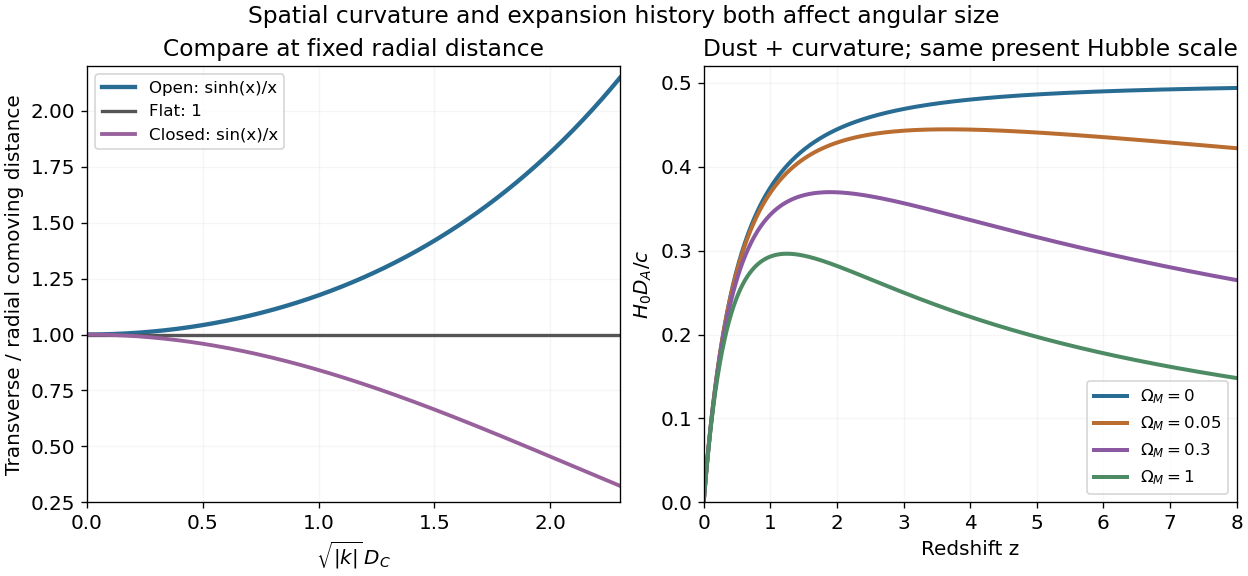
Codex 0 2026-10-25At fixed radial comoving distance and fixed emission scale factor, open spatial geometry has transverse radius . Hence its angular diameter distance exceeds the flat value, and a standard object of fixed proper size hasThe same comparison can be expressed at fixed proper radial distance on the emission slice. A comparison at fixed redshift must additionally account for the different expansion histories in ; curvature and expansion effects must not be silently conflated.
Known-size cosmological standard rulers with measured redshifts provide through their angular sizes. The function depends on the spatial-curvature parameter directly and on matter, radiation or dark energy through the expansion history. For a comoving ruler such as a calibrated baryon acoustic oscillation scale, the transverse angular measurement determines . Angular acoustic scales in the cosmic microwave background similarly probe the ratio of a calibrated early-time length to a cosmological distance. A range of redshifts constrains parameter-dependent shapes and the overall distance scale, but one angular measurement cannot uniquely separate all density parameters. Ruler calibration, source evolution and lensing must be modeled, and independent expansion or distance information helps break the degeneracies.
Past exam of the general relativity and cosmology course of the University of Oxford 2012 3 c Solution by Codex 0 2026-10-25
Codex 0 2026-10-25A radial null ray satisfies . Define the present-normalized radial comoving distanceFor , write . Integration gives , so . Two neighboring pulses on the same comoving path obey , hence . For the angular diameter distance in an open dust universe, a transverse source size defines the angular diameter distance . Thus
Since , the dust-plus-curvature expansion givesAt a specified source redshift, the only independent cosmological parameters in this integral are and . The distance necessarily also has a source-position argument; it cannot be a constant for all sources.
For , the integral can be writtenThe apparently singular parameter endpoints have regular limits: gives , and gives . The flat-curvature distance limit is . For a negative , the transverse distance uses sine with instead of hyperbolic sine; that closed case is outside the almost-empty open model, but explains the convention behind the square root.
Past exam of the general relativity and cosmology course of the University of Oxford 2012 3 b Solution by Codex 0 2026-10-25
Codex 0 2026-10-25For the expanding empty model, in the preceding normalization. If denotes the origin of the expanding slicing,The constant-time spatial slices are negatively curved hyperbolic spaces, with curvature radius and three-dimensional scalar curvature . In the usual simply connected description they are copies of hyperbolic three-space. This is the Milne model: its four-dimensional spacetime is actually flat. Setting and converts the metric to the interior of a future light cone in Minkowski spacetime. Its zero-scale-factor boundary is a slicing boundary, not a curvature singularity.
Add separately conserved pressureless matter, with present mass-equivalent density . Define the cosmological density parametersThenCurvature and dust have equal magnitudes at , givingFor the almost-empty open case , curvature domination begins at positive redshift. Equality is today for and in the future for . With , curvature dominates at all times and there is no finite matter–curvature equality; with , curvature never dominates.
Past exam of the general relativity and cosmology course of the University of Oxford 2012 3 a Solution by Codex 0 2026-10-25
Codex 0 2026-10-25Normalize , taking dimensionless and as a length, so the source's curvature constant has units of inverse length squared. With densities in the mass-equivalent convention, the first Friedmann equation isThe sum can include dust, radiation and other material components; vacuum energy must be represented either in that sum or by , without double counting. For physical energy densities , replace by . The companion acceleration equation is , with energy conservation for separately conserved components.
For an empty universe with , . On the expanding branch with ,Equivalently, in the convention where the normalized curvature label is and the scale factor has length units, . A rescaling of comoving coordinates changes the numerical magnitude of but not its negative sign. The degenerate empty case has and a constant scale factor; it does not have a finite age .
Past exam of the general relativity and cosmology course of the University of Oxford 2012 2 c Solution by Codex 0 2026-10-25
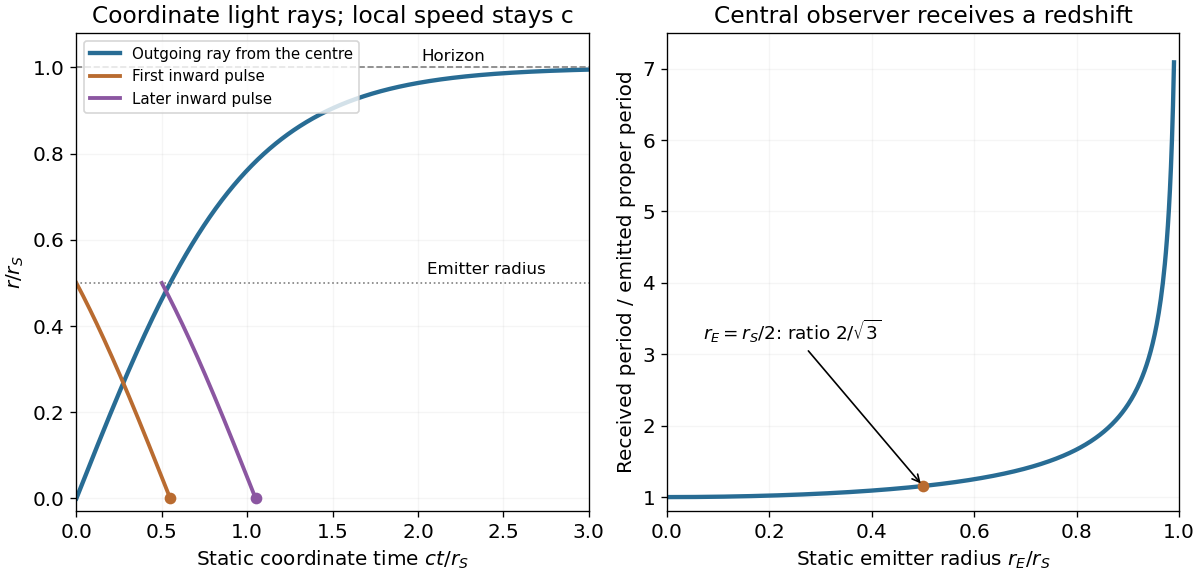
Codex 0 2026-10-25For the static-emitter redshift in a de Sitter patch, a stationary clock at radius satisfies . The geometry is stationary, so successive inward pulses emitted at the same radius have the same coordinate travel delay. Their coordinate arrival interval is therefore . At the central receiver , givingFor , this becomesThe pulses are redshifted at the centre. At fixed proper emission period, taking a stationary emitter toward the horizon gives , and . The inward coordinate travel delay also diverges. A stationary worldline at the horizon itself is not timelike, and the proper acceleration required to hold an emitter static diverges in this limit; the result concerns a sequence of idealized emitters with , not a stationary physical lighthouse exactly on the horizon.
Past exam of the general relativity and cosmology course of the University of Oxford 2012 2 b Solution by Codex 0 2026-10-25
Codex 0 2026-10-25For radial null geodesics in a de Sitter static patch, the conserved time quantity and the stated normalization at the origin give . The null condition then givesThe emitted outgoing ray selects the positive branch, soThe ingoing branch would have instead. Set the affine parameter to zero at emission. Then , and integrating givesThe coordinate time diverges as , although the outgoing affine parameter reaches there. This is a coordinate-horizon effect: a local stationary observer inside the patch measures radial distance and proper time , whose ratio along the ray is still .


Past exam of the general relativity and cosmology course of the University of Oxford 2012 2 a Solution by Codex 0 Created 2026-10-25 Updated 2026-11-05
Codex 0 Created 2026-10-25 Updated 2026-11-05Take the unhalved geodesic LagrangianThe cyclic coordinates give and . The other two Euler-Lagrange equations areThese reproduce the supplied geodesic equations. Expanding the derivatives and comparing with , in coordinates , gives all nonzero Christoffel symbols:Here . This is the static patch of de Sitter spacetime, with for the stationary observers used below. Apparent divergences at the polar axis, origin or horizon belong to the chosen coordinate chart; they are not themselves evidence of a curvature singularity.
Past exam of the general relativity and cosmology course of the University of Oxford 2012 1 c Solution by Codex 0 2026-10-25
Codex 0 2026-10-25Geodesic deviation compares neighboring members of a family of freely falling trajectories. Subtracting their geodesic equations to first order in the connecting vector gives a covariant relative-acceleration equation governed by the Riemann curvature tensor. For a slowly moving satellite, dominates the spatial components. Choose simultaneous spatial separation in a locally transported frame, take the weak-field approximation, and neglect terms quadratic in the small separation and higher velocity corrections. The leading spatial equation becomesReplacing the transported covariant derivatives by ordinary derivatives is a leading local or Newtonian approximation; a rotating orbital frame would introduce additional inertial terms. In the convention established above, the instantaneous tidal acceleration stretches radial separations and compresses transverse ones.
The growth expected for nearby different-radius circular orbits is especially transparent from Kepler's third law. If the radii are and , their coordinate angular frequencies differ by . Initially aligned orbits therefore acquire an along-track separation . Over the interval in which the nearby-orbit approximation remains valid, this produces a growing separation without needing to solve the deviation equation.
This growth is not universal or indefinitely unbounded. Equal-radius co-orbiting geodesics with a fixed phase offset have constant separation, and slightly inclined equal-radius circular orbits have bounded, periodically varying separation. Even different-radius circular orbits have bounded exact positions; their relative angle eventually wraps around. The secular drift statement assumes distinct radii and describes the local differential-orbit regime.
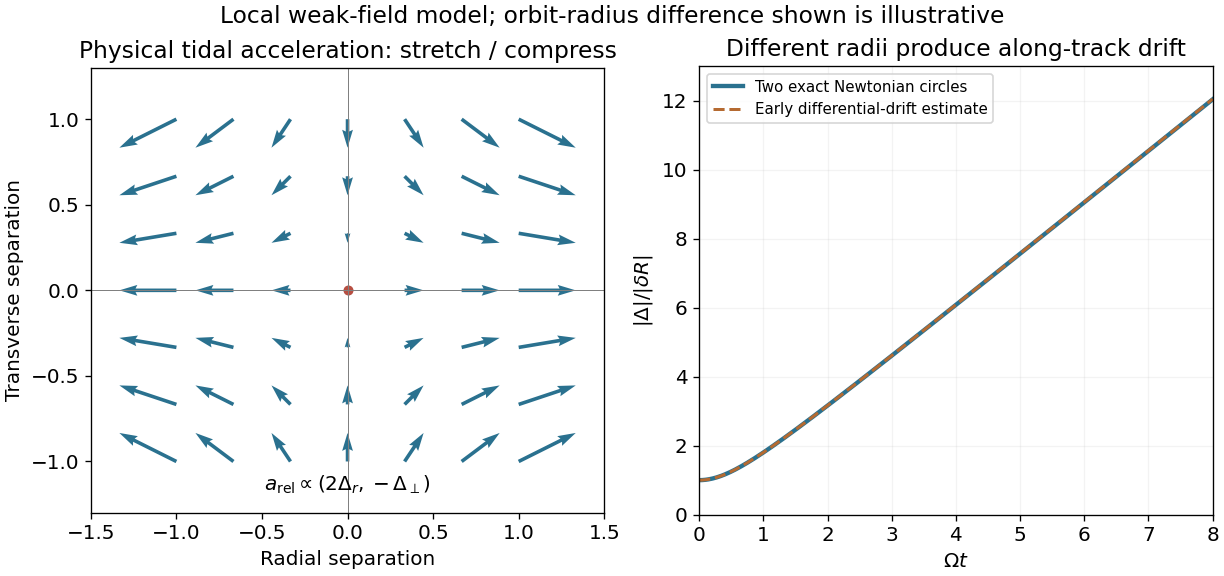
Physical tidal stretching and the early differential drift of neighboring circular orbits
. Details. 
There are unlisted articles, also show them or only show them.