Past exam of the condensed matter physics course of the University of Oxford 2021 2 b Solution by  Codex 0 2026-10-25
Given independent primitive lattice translation vectors , defineThen . The reciprocal lattice consists ofequivalently all wavevectors for which for every direct lattice vector .
For the face-centered cubic lattice, chooseTheir scalar triple product is , and direct evaluation of the cross products givesEvery integer combination has coordinates with all even or all odd. Conversely, for such coordinates the coefficients are integers, so every such point occurs. The even-coordinate points are the corners of cubes of edge , and the odd-coordinate points are their body centres. ThereforeThis is a property of the Bravais lattice; the two-atom atomic basis changes structure factors rather than these reciprocal lattice translation vectors.
Past exam of the condensed matter physics course of the University of Oxford 2021 2 a Solution by Codex 0 2026-10-25
Codex 0 2026-10-25The Bravais lattice is a face-centered cubic lattice. Four inequivalent representatives of its lattice points in the conventional cubic unit cell, in fractional crystal coordinates, areBoundary copies in the drawing do not constitute additional independent lattice points. Attach the two-atom atomic basisto each lattice point. The resulting aluminium phosphide crystal structure is the zinc blende structure. For example, the four phosphorus positions reduced into the conventional unit cell are , , , and , reproducing the heights in the source drawing. There are four aluminium and four phosphorus chemical atoms per conventional unit cell, but only two chemical atoms per primitive unit cell.
Past exam of the condensed matter physics course of the University of Oxford 2021 1 e Solution by Codex 0 2026-10-25
Codex 0 2026-10-25A consistent mechanism is a transition to G-type antiferromagnetism at the Néel temperature. On the manganese primitive cubic lattice, take the magnetic moments to beEvery nearest neighbour has the opposite magnetic moment. The nuclear crystal structure can retain its original lattice constant, while the magnetic order introduces the propagation wavevectorSumming the scattering amplitude from the magnetic moments over sites gives peaks at , where is a nuclear reciprocal lattice vector. Thus all three components of the new Miller indices, expressed relative to the original unit cell, are half-integers. The two smallest squared magnitudes in units of areThe first predicts , agreeing with the new ring. The next squared magnitude is , outside the measured angular range. Taking the observed first magnetic ring as the calibration, Bragg's law predictsUsing the independently fitted lattice constant gives , within the input rounding. One ring alone does not uniquely determine a magnetic order; this proposed nearest-neighbour antiferromagnetic pattern explains both the observed ring and the count of two new rings in the specified interval.
Past exam of the condensed matter physics course of the University of Oxford 2021 1 d Solution by Codex 0 2026-10-25
Codex 0 2026-10-25An applied magnetic field changes the alignment of the manganese magnetic moments. The component of their magnetic structure factor perpendicular to the scattering vector contributes to magnetic neutron diffraction. A field-induced uniform magnetization has the same translational periodicity as the nuclear crystal structure, so its scattering amplitude can occur at the existing reciprocal lattice vectors. The diffraction wave intensities can therefore change without moving the peaks. Their angular positions still measure the same interplanar spacings. This mechanism does not require a measurable change of the lattice constant.
Past exam of the condensed matter physics course of the University of Oxford 2021 1 c Solution by Codex 0 2026-10-25
Codex 0 2026-10-25For the cubic crystal system, the Miller indices satisfyThe inverse squared interplanar spacings have ratios approximately . With the lattice constant close to , the appropriate squared-index sums are . Thus the four powder diffraction rings areThe braces collect all symmetry-related lattice planes with the same interplanar spacing. In particular, is forbidden for both a body-centered cubic lattice and a face-centered cubic lattice, but occurs for a primitive cubic lattice. These observations identify the Bravais lattice as primitive cubic lattice, with a multi-atom atomic basis, consistent with a perovskite structure.
Past exam of the condensed matter physics course of the University of Oxford 2021 1 b Solution by Codex 0 2026-10-25
Codex 0 2026-10-25The neutron is nonrelativistic at this kinetic energy. Its de Broglie wavelength isIn elastic scattering, Bragg's law gives . The measured total deflection is , so it must be halved before taking the sine. The reflection order is absorbed into the Miller indices of the diffracting lattice planes. In the order of the four measured rings, the interplanar spacings areThe last digits give the numerical calculation, rather than accuracy beyond the supplied angular precision.
Past exam of the condensed matter physics course of the University of Oxford 2021 1 a Solution by Codex 0 2026-10-25
Codex 0 2026-10-25Determining antiferromagnetic magnetic order is a good reason to use neutron scattering. The neutron has a magnetic dipole moment, so its scattering amplitude includes the spatial arrangement of electronic magnetic moments. Alternating magnetic moments can produce magnetic neutron diffraction peaks even when there is no change of the nuclear crystal structure. Ordinary nonresonant X-ray diffraction primarily measures the electron density, and is much less sensitive to this magnetic order.
Past exam of the condensed matter physics course of the University of Oxford 2019 4 e Solution by Codex 0 2026-10-25
Codex 0 2026-10-25Let be uniform, with dimensionless spin operators . The factor in the source Hamiltonian removes double counting of pairs. Decoupling about a uniform polarization gives the one-site mean-field theory HamiltonianA body-centred-cubic site has eight nearest neighbors and six next-nearest neighbors, soFor a spin one half in this effective field, the mean-field self-consistency equation isLinearizing at the continuous onset gives , henceEquivalently, the general spin- result is . The antiferromagnetic next-nearest-neighbor exchange reduces the uniform ordering scale rather than contributing its absolute magnitude. The negative nuclear g-factor does not change this exchange instability; aligning the spins also aligns their moments with one another.
For these particular competing couplings, the uniform mode is indeed the largest exchange eigenvalue. Writing , and giveswith equality at modulo reciprocal lattice vectors. To see the bound, replace a negative by its absolute value for an upper bound, let , and use . The expression is at most , whose maximum on is five. Thus another modulation does not preempt the stated ferromagnetic onset at this level of mean-field theory. Fluctuations can change the actual transition temperature.
Past exam of the condensed matter physics course of the University of Oxford 2019 4 d Solution by Codex 0 2026-10-25
Codex 0 2026-10-25Add the electronic diamagnetism of each helium atom to the nuclear magnetic susceptibility, using the same for both contributions in the helium-3 sample:The density cancels when the two terms balance. The sign-change temperature in the independent-atom approximation is thereforeNo numerical atomic radius was supplied, so the exact numerical value remains conditional on that electronic length scale. Taking , where is the Bohr radius, gives . A slightly more explicit estimate uses the helium variational effective charge , for which a hydrogenic orbital has , givingAbove this scale the electronic contribution is negative and dominates; below it the positive nuclear contribution dominates within the independent-moment approximation. The estimate is not a precision prediction of a real interacting helium phase.
Past exam of the condensed matter physics course of the University of Oxford 2019 4 c Solution by Codex 0 2026-10-25
Codex 0 2026-10-25Let be the magnitude of the saturated nuclear moment of helium-3, with . A spin-one-half nucleus has the two Zeeman energies . For independent nuclei the one-site partition function and magnetization density areIn the weak-field limit , expand the hyperbolic tangent:The nuclear moment's negative sign means that its moment points oppositely to its spin; it does not make the thermal magnetic susceptibility negative. The response is paramagnetism governed by Curie's law.
There is no extra factor here: the stated is the moment of a fully polarized spin-one-half state. Equivalently, writing the moment operator as requires , and . The formula presumes independent localized nuclear moments; exchange correlations invalidate it close to the much lower ordering scale discussed in part (e).
Past exam of the condensed matter physics course of the University of Oxford 2019 4 b Solution by Codex 0 2026-10-25
Codex 0 2026-10-25The helium atom has a closed electronic shell with total electronic spin and orbital angular momentum zero. The nucleus of helium-4 also has spin zero. At low temperature there is no Curie response from permanent atomic or nuclear moments; the leading atomic response is diamagnetism.
Let denote the number of atoms per volume and let be the mean squared radius of one electron. Use the symmetric magnetic vector potential . Expanding the electron kinetic Hamiltonian gives the quadratic field termwhere isotropy gives . The term linear in orbital angular momentum vanishes in the spherical electronic ground state. ThusFor weak susceptibility, , so the Langevin diamagnetic susceptibility isIf the supplied density is a mass density , use , with the atomic mass unit. The result is approximately temperature independent at fixed density. The factor two for the two electrons is already included; has not been defined as their summed radius.
Past exam of the condensed matter physics course of the University of Oxford 2019 4 a Solution by Codex 0 2026-10-25
Codex 0 2026-10-25A material showing paramagnetism has an induced magnetization in the direction of a weak applied field, giving positive magnetic susceptibility, and no spontaneous magnetization once the field is removed in the paramagnetic phase. Alignment of permanent atomic or nuclear moments is one mechanism.
A material showing diamagnetism develops an induced moment opposing the applied field, giving negative magnetic susceptibility. Closed electronic shells supply a familiar orbital contribution; the response need not require permanent moments.
A ferromagnet has a phase with a spontaneous ordered magnetization below its Curie temperature, produced by cooperative alignment of moments. Its magnetic domains can cancel in a macroscopic zero-field sample, so a measured zero net moment alone does not show that the material lacks ferromagnetism.
Past exam of the condensed matter physics course of the University of Oxford 2019 3 e Solution by Codex 0 2026-10-25
Codex 0 2026-10-25With equal constant electron mobility and hole mobility , the sheet electrical conductivity is . In the intrinsic regime, , soIt decreases steeply with increasing on the high-temperature side. There is a small logarithmic curvature rather than a perfectly straight activation line.
In the fully ionized extrinsic regime, charge neutrality and the semiconductor mass-action law give , , henceThis gives a nearly horizontal region passing through . At lower temperatures semiconductor carrier freeze-out decreases the ionized donor density and bends the curve downward again.
To locate that bend realistically, include donor charge-state degeneracy. For a neutral donor with two spin states and an empty donor with one state, the ionized density isSolve for the mobile density. In the asymptotic freeze-out regime, where is negligible and ,Its activation scale is much smaller than the intrinsic scale .
Within the specified interval the low-temperature downturn is modest: , and the partial-ionization equation gives . The sample is not yet deep in the asymptotic freeze-out limit at 30 K. Calibrating the mobility to the stated 200 K value gives representative valuesThe donor statistical weights were not explicitly supplied, so they are a stated assumption for these illustrative curve details; a one-state donor approximation changes the low-temperature rounding but not the three physical regimes or their activation scales.
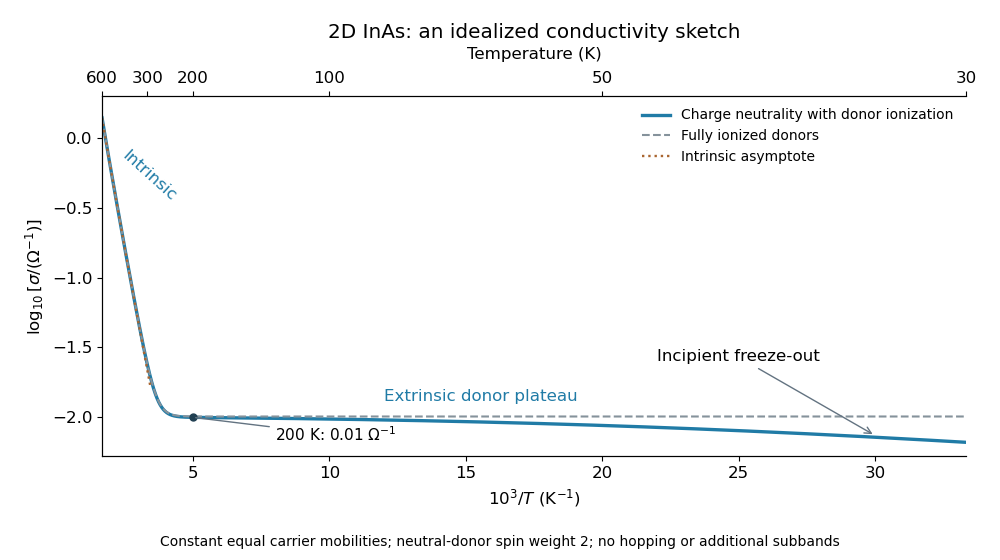
Two-dimensional InAs conductivity from intrinsic carriers to incipient donor freeze-out
. Original ideal-model calculation using the supplied gap, masses and donor density, the derived 2D donor binding energy, twofold neutral-donor spin weight and equal temperature-independent carrier mobilities. The vertical scale is normalized to the stated 200 K conductivity. The plotted range is 30 to 600 K; donor freeze-out is only beginning at its cold end. The dashed line is the fully ionized extrinsic approximation. Details.
Past exam of the condensed matter physics course of the University of Oxford 2019 3 d Solution by Codex 0 2026-10-25
Codex 0 2026-10-25Take the screened Coulomb potential of a singly ionized donor as , with and . The electron's motion is two-dimensional, but its electrostatic interaction is the ordinary three-dimensional interaction restricted to the layer; it is not a logarithmic two-dimensional electrostatic potential.
For the rotationally symmetric bound state, the two-dimensional radial Schrödinger equation isFor , the radial Laplacian is . Cancel the term to obtainThus the positive two-dimensional hydrogenic donor binding energy is four times the three-dimensional effective Rydberg:The decay length is . Normalization, if desired, follows from , giving up to a constant phase. This ideal result neglects finite well thickness, dielectric mismatch at the interfaces and short-range impurity corrections.
Past exam of the condensed matter physics course of the University of Oxford 2019 3 c Solution by Codex 0 2026-10-25
Codex 0 2026-10-25At , the two-dimensional effective density of states values areUsing and givesFor the doped sample, estimate the intrinsic-to-extrinsic crossover by . With the masses and gap held fixed, , whereSolving givesIt is a smooth carrier crossover, not a thermodynamic phase transition. Donors are essentially ionized near this temperature because their binding energy, calculated next, is much smaller than . At substantially higher temperatures intrinsic pairs dominate; below the crossover and above appreciable donor freeze-out, the majority density approaches .
Past exam of the condensed matter physics course of the University of Oxford 2019 3 b Solution by Codex 0 2026-10-25
Codex 0 2026-10-25Near a parabolic valence band maximum , the missing-electron effective mass is . The same two-dimensional state counting givesMultiplication eliminates the chemical potential, giving the semiconductor mass-action lawFor an intrinsic semiconductor, charge neutrality imposes , soThe intrinsic chemical potential is not exactly midgap when the two effective masses differ: . The exponential suppression still justifies the assumed nondegenerate regime here.
Past exam of the condensed matter physics course of the University of Oxford 2019 3 a Solution by Codex 0 2026-10-25
Codex 0 2026-10-25The Boltzmann carrier density of a two-dimensional parabolic band can be derived directly. Use one isotropic parabolic conduction band, , with two spin states per wave vector. In the nondegenerate limit the Fermi-Dirac distribution reduces to its Boltzmann factor. The number per area is thereforeThe integral uses . ThusEquivalently, the two-dimensional density of states is constant, , and with . These expressions include twofold spin degeneracy and one valley. With a general total band degeneracy , replace the factor by ; extra valleys or occupied confinement subbands would change the coefficient.
Past exam of the condensed matter physics course of the University of Oxford 2019 2 f Solution by Codex 0 2026-10-25
Codex 0 2026-10-25Square the stated Lindemann melting criterion and insert the high-temperature displacement:Thus, with ,Here , so the use of the high-temperature approximation is only moderately justified. It is an estimate, not a controlled limit. Retaining the exact Einstein mean-square displacement in the same heuristic criterion gives about , indicating the size of that particular correction. The empirical threshold and the independent-oscillator model introduce additional uncertainty.
There are unlisted articles, also show them or only show them.