Past exam of the condensed matter physics course of the University of Oxford 2019 2 e Solution by  Codex 0 2026-10-25
For one Cartesian displacement, the harmonic potential is . At , the equipartition theorem assigns to this quadratic potential term. HenceThis is a one-coordinate mean squared displacement, not the total three-dimensional displacement variance, which is three times larger in the isotropic model.
For comparison, the exact Einstein mean-square displacement isUsing recovers the requested high-temperature result. Its nonzero zero-temperature limit is the displacement contribution of the zero-point energy.
Past exam of the condensed matter physics course of the University of Oxford 2019 2 d Solution by Codex 0 2026-10-25
Codex 0 2026-10-25The leading coefficient fixes the atom count:With molar mass , the sample mass isOne atom belongs to each primitive unit cell of monatomic argon on a face-centered cubic lattice, but the conventional cube contains four atoms. If its side is , , and nearest neighbors lie across half a face diagonal. Thereforeusing . The corresponding conventional lattice constant is . Treating the source's one-atom cell as the conventional cube would omit the factor four and give a wrong nearest-neighbor distance.
Past exam of the condensed matter physics course of the University of Oxford 2019 2 c Solution by Codex 0 2026-10-25
Codex 0 2026-10-25Use the ratio of the two measured coefficients so that the sample size cancels:HenceThe units of the coefficient are , so that its division by has the same heat capacity units as the leading term.
Past exam of the condensed matter physics course of the University of Oxford 2019 2 b Solution by Codex 0 2026-10-25
Codex 0 2026-10-25Apply the given small- expansion with to the internal energy, including its zero-point energy:The temperature-independent terms cancel. Taking the derivative gives the Einstein high-temperature heat-capacity expansionThusThere is no correction to the heat capacity even though the internal energy has a correction.
Past exam of the condensed matter physics course of the University of Oxford 2019 2 a Solution by Codex 0 2026-10-25
Codex 0 2026-10-25The Einstein model of a solid replaces the vibrations of identical atoms by independent quantum harmonic oscillators with a common frequency . Each atom has three displacement directions; the restoring force is harmonic, coupling between different atoms is replaced by a fixed local restoring potential, and anharmonicity and frequency dispersion are neglected. The crystal volume and are held fixed when calculating the vibrational heat capacity at constant volume.
The one-oscillator partition function isConsequently, with ,Differentiating at fixed volume givesThe zero-point energy does not contribute to this derivative. The result tends to the Dulong-Petit law at high temperature and vanishes exponentially at low temperature; the latter is a limitation of the single-frequency model for a real acoustic spectrum.
Past exam of the condensed matter physics course of the University of Oxford 2019 1 e Solution by Codex 0 2026-10-25
Codex 0 2026-10-25In cubic coordinates write . The face-centred cubic selection rule allows integer triples only when are all even or all odd. One way to derive it is to sum the four conventional-cell lattice positions:This vanishes for mixed parity and equals four otherwise. The two-atom diamond atomic basis adds the factorFor all-odd indices this is nonzero. For all-even indices it vanishes when and survives when the sum is divisible by four: this is diamond-basis diffraction extinction.
Exclude the forward beam and order the remaining families by . The first is , with squared length three. The candidate , with squared length four, is extinguished by the diamond atomic basis. The next allowed family is , with squared length eight. ThusFor fixed incident wavelength, increases with scattering angle, so these are the two lowest-angle powder rings. The two atoms are counted per primitive cell; a conventional silicon cube contains four lattice points and eight atoms.
Past exam of the condensed matter physics course of the University of Oxford 2019 1 d Solution by Codex 0 2026-10-25
Codex 0 2026-10-25Separate the entire-system atom index into a cell translation and an index within a single primitive unit cell. The potential becomesThe same is used in every translated cell because the atomic basis repeats. Normalize plane waves in volume by . For , substitution and giveFor a real static scalar potential, define the atomic scattering factor in the positive-exponent convention of the question byThe second bracket in the matrix element is . At a reciprocal lattice vector every term of the first bracket is one, giving the number of cells . Therefore the stated transition-rate rule, equivalently the first Born approximation and Fermi's golden rule up to the final-state kinematic factors, yieldsThe harmless complex conjugation records the distinction between the source's positive-exponent Fourier transform and the usual positive-exponent incoming plane wave. Reversing every Fourier sign gives the equivalent amplitude convention. Only the cell-translation sum ranges over the full crystal; the crystal basis structure factor contains the atoms of one cell.
Past exam of the condensed matter physics course of the University of Oxford 2019 1 c Solution by Codex 0 2026-10-25
Codex 0 2026-10-25Translate the integration variable by an arbitrary lattice vector and use the periodicity of :Thus for every . A nonzero coefficient requires for every lattice translation, which is precisely the defining condition for .
For an infinite crystal the integral is a Fourier transform of a periodic distribution, rather than an ordinary convergent integral. More explicitly, the Fourier seriesgivesThis is the precise meaning of zero away from the reciprocal lattice. A finite specimen instead has broadened reciprocal-lattice peaks of a finite crystal; exact delta-function support is an infinite-periodicity idealization.
Past exam of the condensed matter physics course of the University of Oxford 2019 1 b Solution by Codex 0 2026-10-25
Codex 0 2026-10-25Put . DefineThe scalar triple product gives . Consequently every integer combination satisfiesThis proves that the proposed vectors generate points in the reciprocal lattice, but primitiveness also requires the converse. Let satisfy the exponential condition for every lattice vector, and in particular for . ThenSince the form a basis of three-dimensional space, the vector has the same dot products with each as . Their difference is orthogonal to three independent vectors and is zero. Henceand no additional reciprocal lattice vectors lie outside that integer span. Thus the are primitive, not merely three possible reciprocal translations.
Past exam of the condensed matter physics course of the University of Oxford 2019 1 a Solution by Codex 0 2026-10-25
Codex 0 2026-10-25A Bravais lattice is the set of pointswhere the primitive lattice translation vectors are linearly independent. Every lattice point has the same translational environment.
An atomic basis is the motif of atoms attached to each point of the Bravais lattice, specified by positions and atomic species. The full crystal consists of atoms at , with . The Bravais lattice describes translations; the atomic basis describes what is repeated. A primitive cell contains one lattice point but can contain several atoms.
Past exam of the condensed matter physics course of the University of Oxford 2018 4 e Solution by Codex 0 2026-10-25
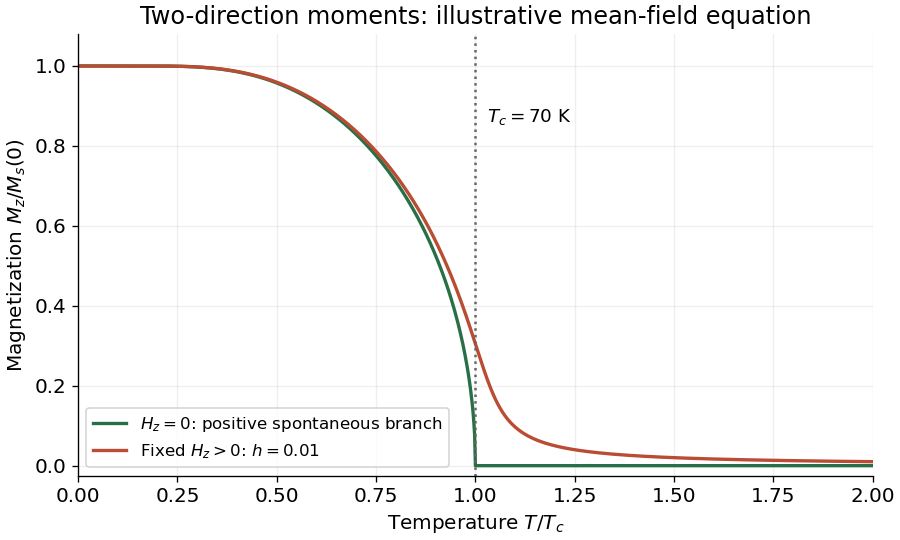
Codex 0 2026-10-25Choose the positive spontaneous branch for . Its magnetization starts at , decreases with temperature, and reaches zero continuously at . It remains zero for . There is an equally valid negative branch below ; domain averaging can instead give zero net moment.
A fixed small positive magnetic field intensity selects the positive branch. At zero temperature it still saturates at ; at intermediate temperature it increases the magnetization relative to the zero-field branch. It rounds the zero-field transition and leaves a positive magnetization above , tending in the linear-response region to . The magnetization therefore does not vanish at in the nonzero-field curve.
For a concrete labelled sketch, the figure uses the illustrative mean-field theory equationIt shows and a fixed small . The curve is an illustrative equilibrium equation of state, not a determination of the precise critical exponents of GdN. At no symmetry-breaking transition remains along this temperature sweep.
Past exam of the condensed matter physics course of the University of Oxford 2018 4 d Solution by Codex 0 2026-10-25
Codex 0 2026-10-25Ferromagnetic interactions enhance the response above the ordering transition. The Curie–Weiss law improves the independent-spin approximation:with positive Weiss temperature and the same high-temperature coefficient . In a simple mean-field theory, take . More generally is fitted and need not equal , and the simple pole does not give exact critical behaviour arbitrarily close to the transition.
At zero temperature, a selected ferromagnetic orientation has all magnetic moments aligned. Its saturation magnetization isEquivalently, there are per conventional cell. The moment points along either allowed easy-axis direction at zero magnetic field. This is the local or single-domain spontaneous magnetization; a macroscopic multidomain sample can have smaller, even zero, net magnetization in the absence of a selecting field.
Past exam of the condensed matter physics course of the University of Oxford 2018 4 c Solution by Codex 0 2026-10-25
Codex 0 2026-10-25The specified two-direction constraint permits magnetic moments , withwhere is the Bohr magneton. There are four magnetic gadolinium ions per conventional face-centered cubic lattice cell; the closed-shell nitrogen ions add no local spin moment. Hence the magnetic-ion number density isAt high temperature, neglect interactions and use . The one-ion partition function and mean magnetic dipole moment areIn the weak-magnetic field limit, , so . Thus the dimensionless SI magnetic susceptibility is , withThe coefficient has units of kelvin. The unrestricted-spin expression proportional to is inappropriate here: the source explicitly retains only the two orientations with . In this two-state Curie law, the squared axial moment is .
Past exam of the condensed matter physics course of the University of Oxford 2018 4 b Solution by Codex 0 2026-10-25
Codex 0 2026-10-25An shell has orbital quantum number and seven orbital states with . The first of Hund's rules maximizes total spin subject to the Pauli exclusion principle. Seven electrons occupy the seven orbitals singly with parallel spins, givingTheir orbital projections sum to zero, so the half-filled shell also has total orbital angular momentum , total , and Landé g-factor . These further values identify the magnetic moment used below.
Past exam of the condensed matter physics course of the University of Oxford 2018 4 a Solution by Codex 0 2026-10-25
Codex 0 2026-10-25A material with paramagnetism develops a magnetization parallel to a weak applied magnetic field intensity, with positive magnetic susceptibility and no spontaneous magnetization in its paramagnetic phase. Molecular oxygen is an example; it has unpaired electron spins.
A material with diamagnetism develops an induced magnetization opposing the applied magnetic field, with negative magnetic susceptibility. A closed-shell atom such as helium is an example; its orbital response is diamagnetic.
A ferromagnet has a spontaneously ordered magnetization below its Curie temperature, even in the limit of vanishing applied magnetic field. Iron below its Curie temperature is an example. Different magnetic domains can cancel the net moment of an unmagnetized bulk sample, despite nonzero local spontaneous magnetization.
Past exam of the condensed matter physics course of the University of Oxford 2018 3 d Solution by Codex 0 2026-10-25
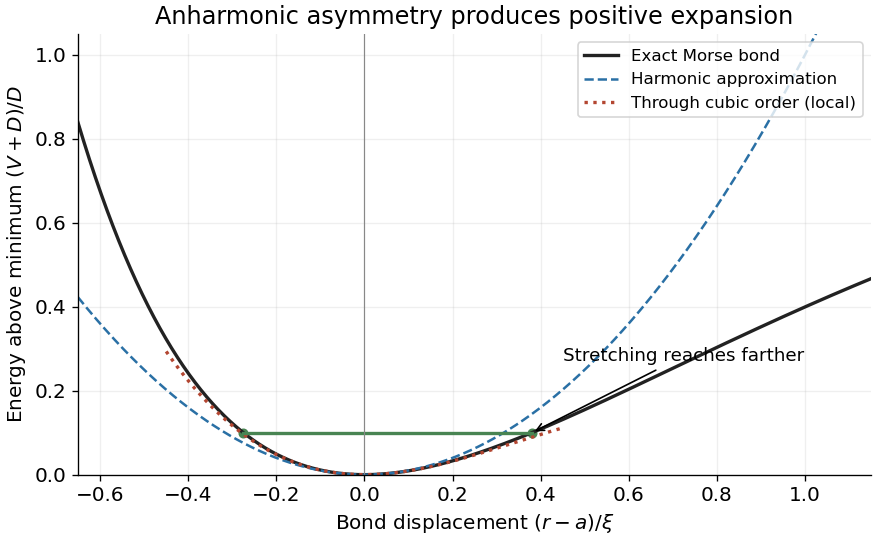
Codex 0 2026-10-25Write the Morse potential relative to its minimum as . Expanding one order beyond the harmonic term givesThe negative cubic coefficient means that stretching is softer than compression. Thermal motion therefore has positive mean displacement even though the most probable minimum is at .
For thermal expansion of a weakly anharmonic bond, classical equipartition gives . Vanishing mean restoring force, to first anharmonic order, requiresFor a bond free to expand under negligible applied tension, . Its linear thermal expansion coefficient is thereforeKeeping the leading perturbative numerical factor gives . The question only requires the scale, not that factor. The thermal expansion is positive; a purely harmonic approximation would give zero mean displacement and zero thermal expansion. The local Taylor expansion describes a bound bond and is not a globally stable cubic potential.


Past exam of the condensed matter physics course of the University of Oxford 2018 3 c Solution by Codex 0 2026-10-25
Codex 0 2026-10-25The mass per lead atom isLet be its longitudinal displacement. Newton's second law gives the harmonic chain equationInsert the normal mode to obtainAt long wavelength, . The sound speed is the corresponding low-frequency group velocity:The relevant inertia in this chain equation is one atomic mass. The reduced mass belongs to the relative vibration of an isolated pair and should not be substituted for in the chain's dispersion relation.
Past exam of the condensed matter physics course of the University of Oxford 2018 3 b Solution by Codex 0 2026-10-25
Codex 0 2026-10-25Put . Differentiating the Morse potential givesThe finite-separation minimum has . ThusThe positive bond-dissociation energy is , measured relative to the separated-atom value . This distinguishes the well's negative potential energy from the positive energy required to break the bond.
For the displacement , the Taylor expansion isConsequentlyThe restoring force is to leading order, identifying the bond's Hooke's law spring constant.
There are unlisted articles, also show them or only show them.