Past exam of the condensed matter physics course of the University of Oxford 2016 2 b Solution by  Codex 0 2026-10-25
Use periodic boundaries in a box of side and include two spin states for each wavevector. One orbital state occupies in wavevector space. Let be the volume of the unit ball in dimension , namely . Filling the ball of radius givesSince ,The density means number per length, area or volume as appropriate; it is not assigned three-dimensional units in every case.
For the same spin-summed states, the cumulative number per -dimensional volume below energy is . Differentiating yields . Evaluating at the filling energy,In one, two and three dimensions the density of states varies respectively as , a constant and . The normalization counts both signs of momentum and both spin states exactly once. A single-spin density of states or extra valley degeneracy would require a different counting convention, not an extra unexplained factor in these constants.
Past exam of the condensed matter physics course of the University of Oxford 2016 2 a Solution by Codex 0 2026-10-25
Codex 0 2026-10-25In the free electron model, conduction electrons occupy independent plane-wave states with energy in a uniform mean background. Crystal-periodic band structure and explicit electron–electron correlations are omitted. Electrons still obey the Pauli exclusion principle and Fermi–Dirac statistics; free does not mean distinguishable classical particles. A scattering time can be added phenomenologically to describe transport.
The Fermi energy is the highest occupied single-particle energy at zero temperature, measured here from the bottom of the parabolic band. The Fermi temperature is the corresponding scale , not the actual thermal temperature of the sample. Metallic electron densities are large, so filling all distinct states up to the required momentum gives Fermi energies of several electronvolts, equivalent to tens of thousands of kelvin or more. At ordinary temperatures, only a narrow region around the Fermi surface has appreciably changing occupations.
A room-temperature metal and its lattice are nevertheless at room temperature, not at . High occupied kinetic energies are present even in the zero-temperature ground state and cannot all be liberated as heat without violating the allowed occupancy structure. A metal below skin temperature often feels cold because it transfers heat rapidly out of the skin; its thermal conductivity and thermal effusivity matter, not the value of its Fermi temperature. At the same actual temperature, a poorly conducting material can therefore feel warmer while neither material is thermodynamically hotter.
Past exam of the condensed matter physics course of the University of Oxford 2016 1 c Solution by Codex 0 2026-10-25
Codex 0 2026-10-25The isothermal volume compressibility is . For isotropic cubic compression and , soDifferentiate Bragg's law at fixed incident wavelength and fixed reflection:This derivative uses radians. It remains locally valid with a pressure-dependent compressibility, provided the cubic isotropic phase is retained. For a constant stipulated , integration givesThus is only the first-order approximation, not the exact consequence of a constant logarithmic compressibility. The finite-pressure calculation also assumes that the reflection still exists, the crystal remains in the same structure and . These limitations matter for a large extrapolation.
Past exam of the condensed matter physics course of the University of Oxford 2016 1 b Solution by Codex 0 2026-10-25
Codex 0 2026-10-25The two sites give phases one and . ThusFor real nonresonant form factors, even gives the square of the sum and odd the square of the difference. The factor represents the remaining experimental corrections, not another basis-interference term. Since the two ions differ, a half-body-diagonal translation does not preserve the decorated crystal. Its Bravais lattice is therefore simple cubic, with a two-ion basis; CsCl is not a monatomic body-centered cubic Bravais lattice.
Replacing both sites by identical Fe atoms changes the amplitude toNow the body-centering translation does preserve the structure. It is a body-centered cubic lattice with one Fe atom per primitive cell, or two per conventional cubic cell.
For 111 the parity is odd: CsCl generally has a nonzero amplitude , whereas the identical-Fe 111 reflection is systematically absent. A numerical absolute CsCl intensity requires the angle-dependent form factors and experimental normalization; no such values are supplied. Forward electron counts, 54 for Cs+ and 18 for Cl-, explain why their amplitudes are substantially unequal, but are not substituted for the actual finite-angle factors without an additional approximation.
Past exam of the condensed matter physics course of the University of Oxford 2016 1 a Solution by Codex 0 2026-10-25
Codex 0 2026-10-25Take as fractional coordinates in the chosen unit cell. In the kinematic approximation the crystal basis structure factor isEquivalently, in Cartesian coordinates the phase is . Reversing every phase sign complex-conjugates the nonabsorbing amplitude and leaves its intensity unchanged. The atomic scattering factor is the Fourier transform of the atom's electron density, in electron scattering units:At zero scattering angle the normal form factor counts electrons: for a neutral atom, modified by the ionic charge for an ion. At increasing , different parts of the electron cloud scatter with different phases, reducing the coherent amplitude. Typical nonresonant atomic curves fall from their forward value toward small values at large angle. A localized cloud falls more slowly in reciprocal space. Anomalous scattering near an absorption edge adds energy-dependent complex terms and is excluded from this simple sketch.
For a fixed reflection and fixed instrumental and geometric corrections,The full amplitude also contains the lattice sum. At its reciprocal-lattice peak, coherently illuminated identical cells give a peak amplitude ; peak height and integrated peak intensity have different size dependences because the peak narrows with crystal size. Powder multiplicity, polarization, absorption, thermal motion and measurement geometry also affect observed intensities. The basis factor determines relative interference, not every experimental prefactor.
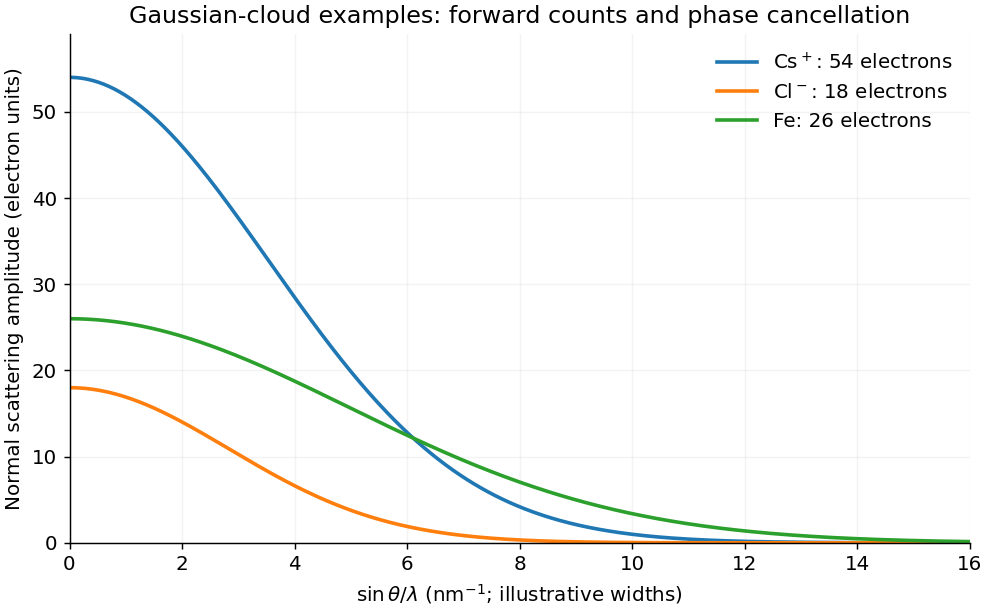
Forward electron counts and decreasing atomic scattering amplitudes
. Original Gaussian-cloud illustrations for Cs+, Cl- and Fe, with their correct electron counts at zero transfer. Cloud widths are illustrative rather than tabulated atomic form-factor fits; the horizontal variable increases with scattering angle at fixed wavelength. Details. Past exam of the condensed matter physics course of the University of Oxford 2015 4 d Solution by Codex 0 2026-10-25
Codex 0 2026-10-25The sign must become positive, so use p-type acceptor impurities, such as boron substituting for tetravalent silicon. Assume uncompensated, fully ionized acceptors of density , nondegenerate carriers and equilibrium throughout the interval. Charge neutrality and mass action giveFor a nearly constant hole-dominated Hall coefficient, the dopant plateau must persist up to the highest temperature. Its necessary concentration scale is thereforeThe order-of-magnitude onset is , but equality is not a flat plateau: at , , changing the hole-only Hall coefficient by about 38 percent. The word approximately does not define a unique sharp minimum without a tolerance.
For , , so the hole-only varies by a fraction of order . An illustrative one-percent tolerance in that approximation is obtained with . This gives and less than one percent hole-density-induced variation. It is an explicit plateau criterion, not an exact minimum deduced from the unspecified word approximately.
At 300 K the minority electron concentration isThus the onset-scale estimate gives about , whereas the explicit ten-times-larger plateau choice gives .
The acceptor density for a stable Hall sign can be more restrictive if both carriers matter. With mobility ratio , positive Hall sign requires , or . In the strongly extrinsic limit the full two-carrier Hall correction scales as , not just . Hence a true measured-Hall tolerance can require a larger dopant density than the hole-only illustration. Mobilities and their temperature dependence are not supplied, so they cannot be used to manufacture a unique sharper minimum.
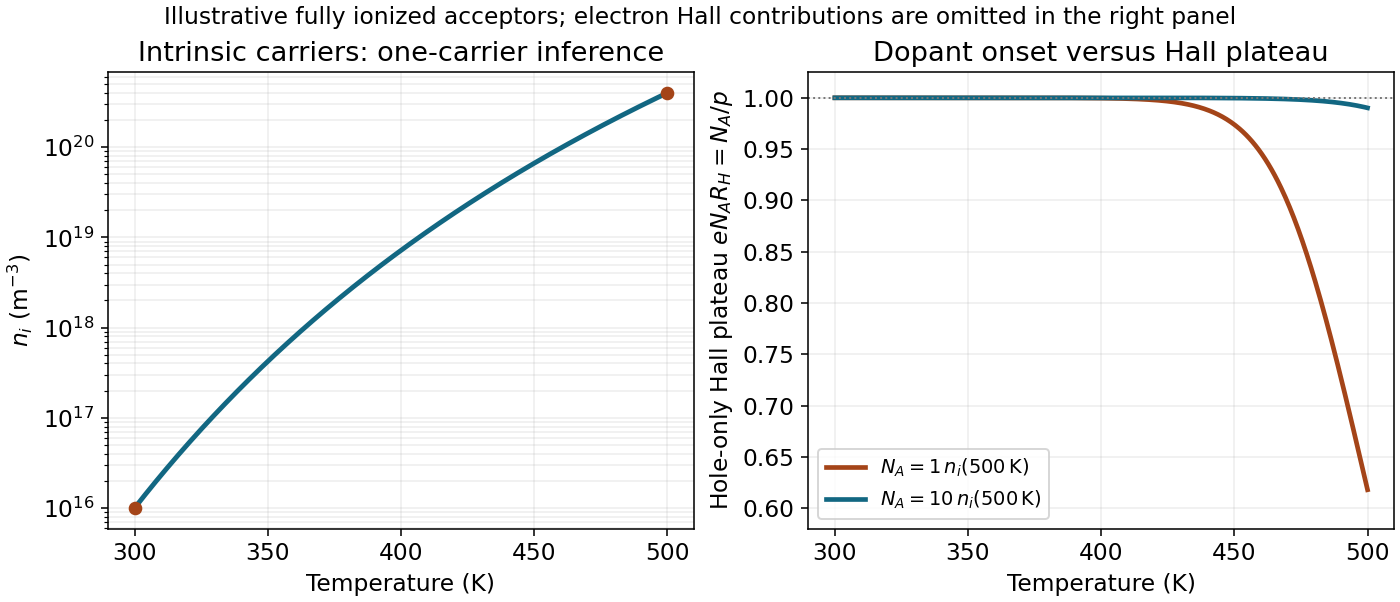
Intrinsic carrier activation and the hole-only Hall plateau for two explicitly chosen acceptor densities; concentrations are model estimates, not extra measurements
. Details. Past exam of the condensed matter physics course of the University of Oxford 2015 4 c Solution by Codex 0 2026-10-25
Codex 0 2026-10-25Choose longitudinal current along , magnetic field along , and define the oriented Hall coefficient by . For one carrier type with signed charge , a stationary transverse force balance is . Since , this gives . Using ,This is the weak-field isotropic one-carrier approximation with Hall scattering factor one, not a general multiband identity.
Under the stipulated electron-dominated approximation, the given Hall magnitudes implyTake the ratio of the intrinsic activation law:Solving gives the model's activation-gap estimateThis result uses the supplied Hall-temperature ratio and the fixed-gap, fixed-prefactor assumptions. A temperature-dependent gap or changing Hall factors would modify its interpretation.
The source's description of electrons as intrinsic silicon's majority carriers needs qualification. Intrinsic neutrality gives equal electron and hole concentrations, not an electron density majority. Electrons can nevertheless dominate conductivity and the Hall response because their mobility is larger. For two weak-field carriers,At this becomes . Thus explains the negative sign, while the one-electron formula is quantitatively accurate only if the hole contribution can be neglected. Equality itself is a concrete counterexample to a literal electron-number-majority claim. The numerical deductions above retain the approximation explicitly requested by the source.
Past exam of the condensed matter physics course of the University of Oxford 2015 4 b Solution by Codex 0 2026-10-25
Codex 0 2026-10-25Assume nondegenerate three-dimensional parabolic band edges, a fixed gap and approximately temperature-independent density-of-states effective masses. Let be the chemical potential, and the band edges, and their effective density of states. Boltzmann occupation givesFor one spin-degenerate spherical conduction extremum, direct integration of givesand similarly for the valence band with its appropriate density-of-states mass. Valley and additional band degeneracies can be included in these prefactors. The factor follows from the integral .
Multiplication removes the chemical potential:The semiconductor mass-action law combined with intrinsic charge neutrality, , therefore givesThe intrinsic chemical potential is not necessarily exactly midgap: . Equal effective masses are unnecessary for the displayed carrier-density law. A changing gap, effective mass or degeneracy would make the prefactor or activation law temperature dependent.
Past exam of the condensed matter physics course of the University of Oxford 2015 4 a Solution by Codex 0 2026-10-25
Codex 0 2026-10-25An intrinsic semiconductor has thermally generated conduction electrons and valence holes, with at equilibrium in the ideal undoped neutral material. Their abundance is controlled by its band gap, temperature and band density of states.
An extrinsic semiconductor has its mobile carrier populations substantially modified by electrically active impurities. A donor impurity can supply electrons, producing n-type material; an acceptor impurity can capture a valence electron and leave a mobile electron hole, producing p-type material. Compensation and incomplete ionization can modify these simple counts. At low temperature dopant freeze-out can occur; at sufficiently high temperature intrinsic pair production can overwhelm a fixed dopant density. Doping and the dominant transport regime are related but are not interchangeable descriptions at every temperature.
Past exam of the condensed matter physics course of the University of Oxford 2015 3 c Solution by Codex 0 2026-10-25
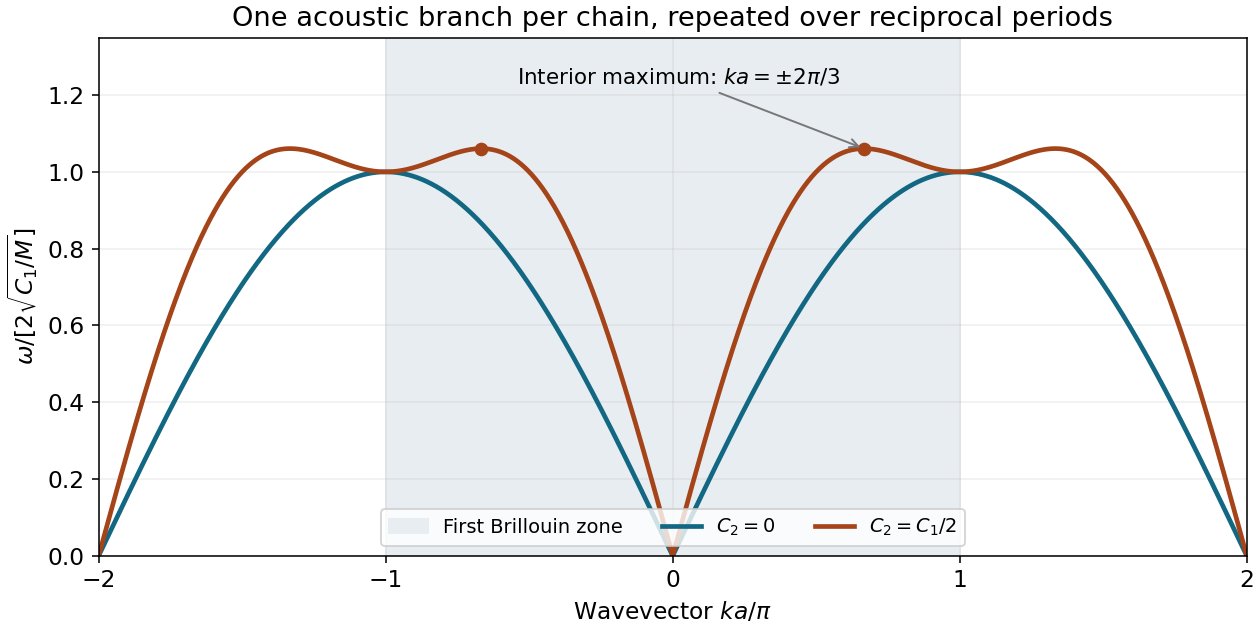
Codex 0 2026-10-25Write and use as the frequency unit. The nearest-neighbour chain and its next-nearest-neighbour extension haveThese are each a single acoustic branch, repeated over reciprocal-lattice periods. There is no added optical branch merely because a longer-range spring is introduced. The cutoff for specifies the first chain as nearest-neighbour despite the source's repeated word in its description.
For small , and . ThusThe maximum is not necessarily at the zone edge. Put , so . The second squared dimensionless frequency isIt reaches its maximum at , or in the first zone. The first chain peaks at . ThereforeAt both chains have the same frequency, but the second chain has already passed its interior maximum. The next-nearest-neighbour monatomic-chain frequency maximum is therefore crucial to a correct sketch. Periodic repetition gives the requested curves for all wavevectors.


Past exam of the condensed matter physics course of the University of Oxford 2015 3 b Solution by Codex 0 2026-10-25
Codex 0 2026-10-25Let be the longitudinal displacement of atom . Translational invariance and a symmetric harmonic pair force give the long-range harmonic-chain dispersion equationsUse a traveling normal mode . Dividing by its nonzero amplitude givesHencePositive pair constants give a nonnegative squared frequency and a uniform-translation zero mode. More general signed force constants require checking stability of the entire sum. The frequency is even in and periodic with , reflecting reciprocal-lattice equivalence. The force sum must converge in the model. A finite ordinary acoustic slope additionally requires convergence of , in which case . Both finite-range examples below satisfy this condition.
Past exam of the condensed matter physics course of the University of Oxford 2015 3 a Solution by Codex 0 2026-10-25
Codex 0 2026-10-25A phonon is one quantum of a collective harmonic normal mode of a crystal. A mode labelled by wavevector and branch has energies , with bosonic occupation statistics. The crystal momentum is defined modulo a reciprocal lattice vector; it is not generally the mechanical momentum of one atom. The phonon dispersion relation assigns its frequency and polarization to the wavevector and branch.
Inelastic neutron scattering can measure this relation in a single crystal. Determine the incident neutron energy and wavevector, scatter at a chosen angle, and analyze the outgoing energy by time of flight or a spectrometer analyzer. Energy and crystal-momentum conservation giveThe signs distinguish phonon creation and annihilation with consistent momentum convention. Repeating measurements at different momentum transfers maps peaks in the dynamic scattering response into phonon branches. The measured intensity depends on occupation, scattering factors and the projection of the mode polarization along the momentum transfer; a weak or missing peak need not mean that the corresponding mode does not exist.
Past exam of the condensed matter physics course of the University of Oxford 2015 2 c Solution by Codex 0 2026-10-25
Codex 0 2026-10-25Replacing X-rays by neutrons of the same wavelength keeps the geometric Bragg positions, but replaces electron-density amplitudes by nuclear coherent scattering lengths. For Al all sites still carry the same nonzero amplitude, so its six reflections remain. For Si the identical two-site basis still has the same destructive-interference conditions, so its four reflections remain. Isotopic randomness can add diffuse/incoherent scattering but does not create a new periodic basis with different systematic Bragg absences.
K and Cl, however, have different nuclear amplitudes despite their isoelectronic ionic electron clouds. For natural isotopic composition, fm and fm. The all-odd/all-even basis-intensity ratio becomeswhich is no longer the strong X-ray cancellation. The two odd rings should therefore be observable with suitable sensitivity, givingThe numerical contrast uses the NIST bound coherent lengths.[ref]
Neutron scattering lengths and cross sections by NIST. Complete table, natural-element K and Cl rows: coherent b in femtometres; also Al and Si rows
Counts here mean allowed and reasonably observable rings in the specified range, assuming sufficient angular coverage and resolution; no theory alone fixes an instrument's intensity threshold. These nonmagnetic examples use nuclear elastic scattering, not magnetic scattering. Past exam of the condensed matter physics course of the University of Oxford 2015 2 b Solution by Codex 0 2026-10-25
Codex 0 2026-10-25For the four conventional face-centered cubic lattice sites , , and , their centering factor isThis is the face-centred cubic selection rule. Enumerating the nonzero representatives with givesSymmetry-related permutations and signs belong to the same powder ring, not additional rings. For Al, the basis contains one atom, . ThusFor the stated KCl basis,The all-even reflections add the two atomic factors; all-odd reflections subtract them. Ionic and each have 18 electrons, giving similar X-ray amplitudes. Their difference is much smaller than their sum, so the 111 and 311 rings are weak. Consequently the four strong rings areThis is an accidental diffraction extinction from equal atomic scattering factors in the equal-factor limit, not an extra exact fcc selection rule. Isoelectronic ions can have different radial electron distributions, so real odd reflections need not vanish exactly. Even the cruder neutral-atom estimate , makes the odd/even basis-intensity ratio only , before other ring-intensity factors.
For Si's displaced identical basis atoms,For all-odd indices, the bracket is , with squared magnitude 2. For all-even indices it vanishes when , and has squared magnitude 4 when the sum is a multiple of four. Thus 200 and 222 vanish, whereas 111, 220, 311 and 400 survive:These are the basis extinctions of the ideal diamond cubic structure. Intensity strengths within each surviving set can still differ because of atomic factors, multiplicity and geometry.
Past exam of the condensed matter physics course of the University of Oxford 2015 2 a Solution by Codex 0 2026-10-25
Codex 0 2026-10-25The structure factor is the coherent scattering amplitude of the contents of a unit cell at a specified momentum transfer. Contributions from its atoms add with phases fixed by their positions. At a reciprocal lattice vector indexed by Miller indices, the crystal basis structure factor isChanging every phase sign conjugates the amplitude for real scattering factors and leaves the intensity unchanged. The positions here are fractions of the chosen cell edges. An atomic basis of a crystal should not be confused with a set of primitive translation vectors.
In kinematic elastic scattering the diffraction intensity of a Bragg reflection is proportional to , after including geometrical, polarization, thermal-displacement and experimental factors. Powder integrated intensities also include multiplicity. The many-cell interference factor selects reciprocal-lattice vectors satisfying the diffraction geometry; the unit-cell factor determines their relative amplitudes and additional extinctions. Ring positions determine spacings through Bragg's law, while intensity patterns and systematic absences constrain lattice centering and atomic arrangements. Intensity loses the overall complex phase, so structure determination is not a direct measurement of every individual atomic phase.
X-rays scatter from electron density, giving an atomic factor that changes with momentum transfer and chemical charge distribution. Neutrons scatter coherently from nuclei with bound coherent scattering lengths, which need not track atomic number; magnetic neutron scattering is an additional channel in magnetic materials. Their different elemental/isotopic contrasts make the two probes complementary.
Past exam of the condensed matter physics course of the University of Oxford 2015 1 d Solution by Codex 0 2026-10-25
Codex 0 2026-10-25The conventional face-centered cubic lattice cell contains four atoms, soThe preceding free-electron and Debye expressions giveAt low temperature the electronic and lattice heat-capacity crossover in a monovalent metal is found fromThus the electronic term dominates for K within the normal-metal model. Both low-temperature approximations are well controlled at that crossover. At exactly zero temperature both heat capacities vanish; below sufficiently small finite-size energy scales a continuum model also needs revision.
Room temperature is not : using the cubic formula at 300 K would incorrectly predict , far above the harmonic high-temperature limit . Instead use the Dulong-Petit law as an estimate:Keeping the finite cutoff in the Debye heat capacity givesAt 300 K this is , whereas , giving . Either appropriate room-temperature estimate shows that the lattice contribution dominates. The electronic approximation remains excellent because .
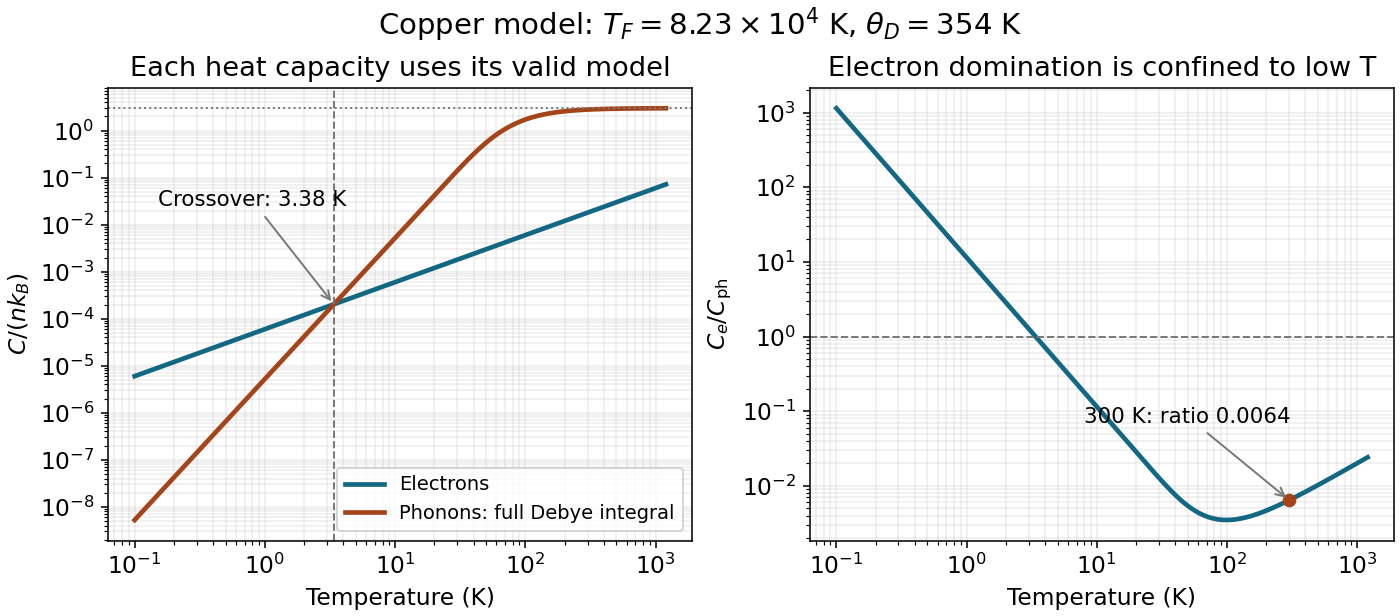
Electronic and full Debye lattice heat capacities of the stated copper model, with the low-temperature crossover and room temperature marked
. Details. 
There are unlisted articles, also show them or only show them.