Past exam of the condensed matter physics course of the University of Oxford 2017 2 d Solution by  Codex 0 2026-10-25
In the one-band electron Hall effect model, , with . The measured Hall coefficient therefore givesA monovalent body-centered cubic lattice has two conduction electrons per conventional unit cell. Thus , andCounting two spin states within the Fermi sphere gives . Using the specified effective mass in the dispersion,There is one mole of conduction electrons per mole of sodium. Its molar density of states at is , givingUsing the volume density of states in c givesThe effective mass changes the dispersion and density of states; the electron Bohr magneton used for the spin coupling retains the bare electron mass. Replacing it by would be an additional, unjustified magnetic-moment assumption. A Hall factor or a multiband metal would also invalidate the simple density inference; the stated calculation uses the requested one-band approximation.
Past exam of the condensed matter physics course of the University of Oxford 2017 2 c Solution by Codex 0 2026-10-25
Codex 0 2026-10-25Let denote the spin-summed density of states per volume. An electron moment with magnitude the Bohr magneton has Zeeman energies . At low temperature, the two spin populations areThe common chemical potential changes only at order , so it does not affect this linear imbalance. The magnetization is . Define SI volume magnetic susceptibility by and take the weak applied field as . Then Pauli paramagnetism givesThe last equality uses the three-dimensional parabolic free electron model, . This susceptibility is nearly independent of temperature for , unlike the Curie law for localized independent moments. The displayed result excludes orbital diamagnetism and interaction enhancements. If susceptibility instead denotes , omit ; confusing that convention with changes the units.
Past exam of the condensed matter physics course of the University of Oxford 2017 2 b Solution by Codex 0 2026-10-25
Codex 0 2026-10-25At fixed volume and particle number, reversible heating obeys . Integrating the electronic heat capacity from zero temperature givesWith no extensive residual ground-state degeneracy, the third law of thermodynamics sets the electronic . ThereforeThe entropy normalization follows that of : total, per volume or per mole. Lattice contributions are additional and are not part of this electronic result.
Past exam of the condensed matter physics course of the University of Oxford 2017 2 a Solution by Codex 0 2026-10-25
Codex 0 2026-10-25The density of states counts one-electron states per energy interval, including both electron spin orientations. It may be a total or a per-volume quantity; must have the matching normalization. The Fermi-Dirac distributionis the occupation probability of such a state. In the fixed-volume free electron model, the integration variable and the density of states do not depend on . The occupation depends explicitly on and implicitly through the chemical potential needed to preserve electron number. Thermal expansion or a changing electronic band structure would require additional effects outside this model.
At , only states within order of the Fermi energy change their occupation. There are order such states, each carrying an excitation energy of order . Thus and the electronic heat capacity is proportional to . Using the supplied coefficient,The shell argument fixes the scaling, not the numerical coefficient; the controlled Sommerfeld expansion fixes that coefficient at fixed electron number. Filled states far below cannot accept arbitrary thermal excitations because of the Pauli exclusion principle.
Past exam of the condensed matter physics course of the University of Oxford 2017 1 e Solution by Codex 0 2026-10-25
Codex 0 2026-10-25The sixth allowed family is . For the two lattice constants, use :ConsequentlyThe larger lattice constant shifts the AlAs reflection to lower scattering angle. As a differential check, in radians.
If the angular displacement is unresolved, use the intensity contrast. With the same model, a difference reflection has basis amplitude for AlAs, versus for GaAs. Its squared amplitude is therefore one hundred times greater before overall sample normalization. More robustly, compare a weak and a strong reflection within each specimen. Neglecting their almost identical angular corrections,The contrast in this internal ratio is about a factor . Element-specific X-ray fluorescence, for example testing for a Ga characteristic line with a suitably energetic incident beam, or an X-ray absorption spectroscopy scan through an element-specific absorption edge, also distinguishes composition. Such scans can change incident energy; one must not assume every core shell can be excited by the original beam.
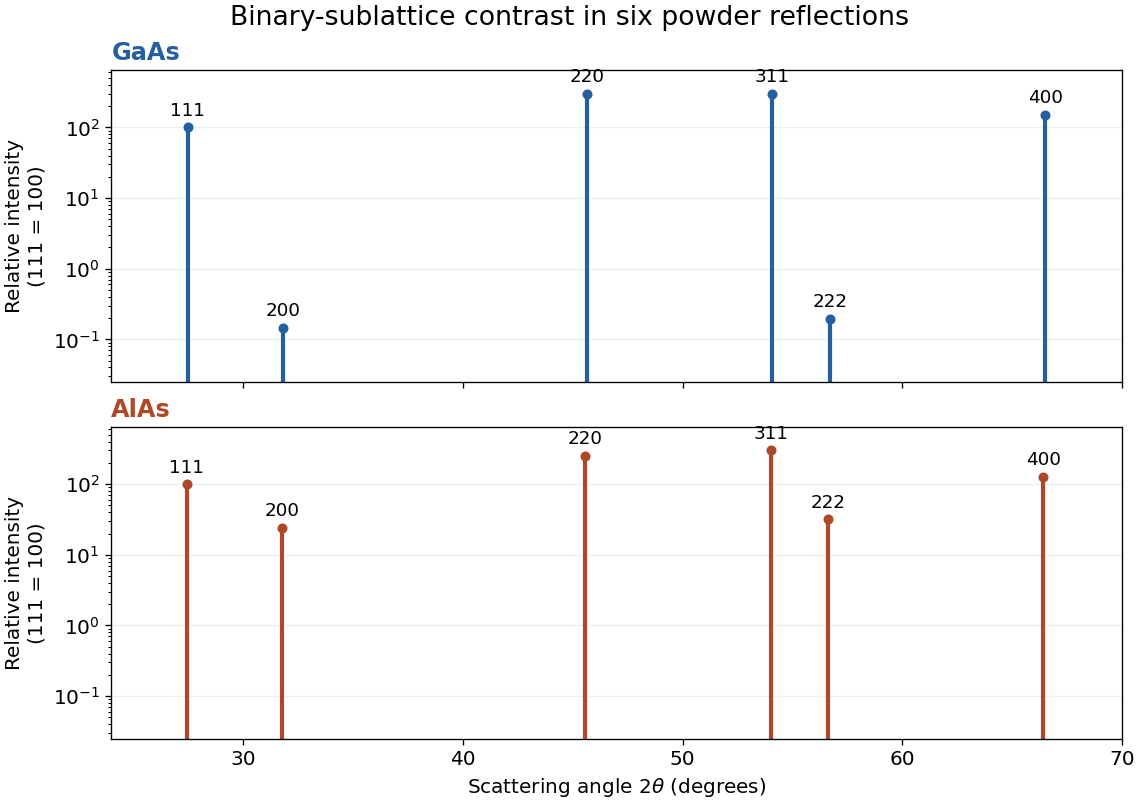
Approximate powder-reflection contrast for GaAs and AlAs
. Original stick patterns use the six derived angles, , and multiplicity times squared structure amplitude. Each compound is normalized to its own reflection. A logarithmic intensity scale reveals the nearly cancelled and GaAs reflections. Geometry and form-factor corrections are omitted deliberately. Details.
Past exam of the condensed matter physics course of the University of Oxford 2017 1 d Solution by Codex 0 2026-10-25
Codex 0 2026-10-25The X-ray wavelength is . Write the amplitude of one conventional unit cell as the face-centred cubic selection rule times the two-atom atomic basis amplitude:The first bracket is four when the indices have equal parity and zero otherwise. Among the allowed Bragg reflections, the zinc blende structure factor therefore givesHere the atomic scattering factors are taken as real. For the requested rough estimate set and . The weak difference reflections remain allowed: unequal species do not have the extra exact extinction of the equal-species diamond limit.
The first six allowed values of are . Bragg's law gives the measured scattering angle . For powder diffraction, multiply the squared amplitude by the powder diffraction multiplicity . The last two columns use :The first intensity column is the geometry-independent multiplicity-and-structure estimate. The second additionally assumes an unpolarized beam and a common symmetric powder-diffractometer geometry, with Lorentz-polarization factorAn overall constant cancels in either normalization. A particular measured intensity set is not fixed by the atomic numbers alone: actual atomic scattering factors decrease with momentum transfer, anomalous scattering and absorption can matter, and the instrument geometry and polarization determine angular corrections. The two columns state the approximation rather than asserting identical peak heights for all instruments.[ref]
Past exam of the condensed matter physics course of the University of Oxford 2017 1 b Solution by Codex 0 2026-10-25
Codex 0 2026-10-25The cubic Miller indices give an interplanar spacing . Equivalently, the reciprocal lattice vector normal to these lattice planes has length . HenceThe eight reciprocal lattice vectors are the nearest nonzero reciprocal points. Their perpendicular bisectors form the eight hexagonal faces of the first Brillouin zone, a truncated octahedron. For the positive direction, that Bragg plane is , or . It is parallel to the direct lattice planes. The six remaining square zone faces correspond to the reciprocal points. The zone boundary is halfway to a reciprocal point, not the point itself.
Past exam of the condensed matter physics course of the University of Oxford 2017 1 a Solution by Codex 0 2026-10-25
Codex 0 2026-10-25With the convention , the reciprocal lattice of a face-centered cubic lattice is a body-centered cubic lattice. The reciprocal conventional cube is parallel to the direct conventional cube and has side . In direct-cubic coordinates its points areThe even triples supply the corners of that reciprocal cube and the odd triples its body centres. The atomic basis can change diffraction intensities through its structure factor; it does not change the reciprocal lattice determined by the translation lattice.
Past exam of the condensed matter physics course of the University of Oxford 2016 4 b Solution by Codex 0 2026-10-25
Codex 0 2026-10-25The right spring changes length by and pulls atom to the right with force . The left spring contributes . Adding these restoring forces and applying Newton's second law givesUniform displacement makes both spring extensions vanish, as translational invariance requires. Search for a normal mode . Substitution yieldsOne representative first Brillouin zone is . This is one positive-frequency acoustic branch: near zero wavevector, , so the sound speed is . Opposite signs of label opposite propagation directions, not a second polarization branch.
The model assumes small displacements, harmonic nearest-neighbor forces, one scalar displacement per atom and uniform equilibrium spacing. It excludes damping, anharmonic expansion and transverse polarizations. In a three-dimensional monatomic crystal there would normally be three acoustic polarizations; that counting cannot be imported into this explicitly one-dimensional scalar model.
Past exam of the condensed matter physics course of the University of Oxford 2016 4 a Solution by Codex 0 2026-10-25
Codex 0 2026-10-25Inelastic neutron scattering measures both momentum and energy exchanged with the crystal. Comparing incident and outgoing neutron wavevectors gives , while their energy difference gives a created or annihilated phonon energy . Crystal momentum conservation identifies the reduced phonon wavevector modulo a reciprocal-lattice vector. Varying scattering geometry maps dispersion curves and polarization-dependent intensities across a substantial part of the Brillouin zone.
Inelastic X-ray scattering provides a complementary energy- and momentum-resolved probe, particularly when small samples or high-pressure environments favor photon beams. Raman and infrared spectroscopy measure optical-frequency resonances subject to different symmetry selection rules. Photon momentum at these frequencies is usually small on the Brillouin-zone scale, so these methods mostly sample near the zone center rather than an arbitrary phonon wavevector. Brillouin scattering and ultrasonic measurements probe low-frequency acoustic motion and infer sound velocities or elastic constants.
Heat-capacity measurements constrain the thermally weighted vibrational density of states and its low-frequency behavior, but do not by themselves reconstruct a unique wavevector-resolved dispersion. Elastic diffraction and temperature-dependent displacement factors also constrain mean-square motion, while energy-resolved inelastic measurements distinguish individual excitations directly. A monatomic scalar chain has only the acoustic branch derived below; it should not be assigned an optical branch merely because Raman spectroscopy exists for more complicated crystals.
Past exam of the condensed matter physics course of the University of Oxford 2016 3 b Solution by Codex 0 2026-10-25
Codex 0 2026-10-25A shell has one hole in the otherwise filled shell. Hund's rules give , , and, for a more-than-half-filled shell, : the free-ion term is . Its Landé factor isDistinguish the Curie effective moment from a saturated projection:The question then explicitly asks us to use orbital quenching in the crystal. Ligand fields split and mix orbital states, suppressing their freely orientable angular momentum. The spin-only approximation has , , so but the two field-axis projections are . The latter, not , belong in the tanh argument and saturation magnetization.
The sulfate and water environment supplies mainly closed-shell, weakly magnetic surroundings, stabilizes localized Cu2+ sites and separates their moments so that exchange can be weak on the temperature scale considered. Paramagnetism here is an approximation of weakly interacting local spins, not a claim that dilution guarantees no magnetic ordering at any temperature. Elemental copper has a filled band and itinerant conduction electrons rather than one localized Cu2+ spin per atom. Pauli spin response and orbital/core contributions then replace a local-spin Curie law; ordinary pure copper has a weak net diamagnetic response.[ref]
https://www.sciencedirect.com/science/article/pii/S1090780715000774. 2015 primary measurement, abstract: negative volume susceptibility of high-purity copper wire
There is one Cu2+ per formula unit, hence m. The spin-only weak-field SI volume susceptibility isThese neglect exchange, anisotropic factors and background diamagnetism. At high field and low temperature, saturation requires the nonlinear response in a; a field-independent Curie value then describes only the zero-field slope.
Past exam of the condensed matter physics course of the University of Oxford 2016 3 a Solution by Codex 0 2026-10-25
Codex 0 2026-10-25Write the two allowed moment projections as , where for spin one-half. Their Zeeman energies in the prescribed flux density are . The single-particle partition function and the mean moment along the field areFor noninteracting moments, magnetization is moment per volume:For electron-like spin-only moments , these become and .
Differentiate with respect to the specified to obtainThis derivative is not a dimensionless SI volume susceptibility. In the weak-feedback approximation , the usual dimensionless differential susceptibility is . The small-field limit gives Curie's law . At finite bias a secant response differs from the differential slope . For an internal retained self-consistently, the exact local conversion is ; demagnetizing geometry can further affect an applied-field measurement. Stating the field convention avoids a hidden factor of or confusion between a slope and a ratio.
There are unlisted articles, also show them or only show them.