Past exam of the condensed matter physics course of the University of Oxford 2018 3 a Solution by  Codex 0 2026-10-25
A phonon is a quantum of a normal mode of Bravais lattice vibration. A harmonic mode of angular frequency has energy , and adding one phonon increases its energy by . The phonon carries crystal momentum , defined modulo a reciprocal lattice vector.
The first Brillouin zone is the Wigner-Seitz cell of the reciprocal lattice about the origin: the set of wavevectors at least as close to the origin as to any other reciprocal lattice point. Its boundaries are reciprocal-space perpendicular bisectors. It gives one representative of each wavevector modulo reciprocal lattice translations.
Past exam of the condensed matter physics course of the University of Oxford 2018 2 e Solution by Codex 0 2026-10-25
Codex 0 2026-10-25The reciprocal primitive vectors are and , so the first Brillouin zone isIt is wider in the direction because .
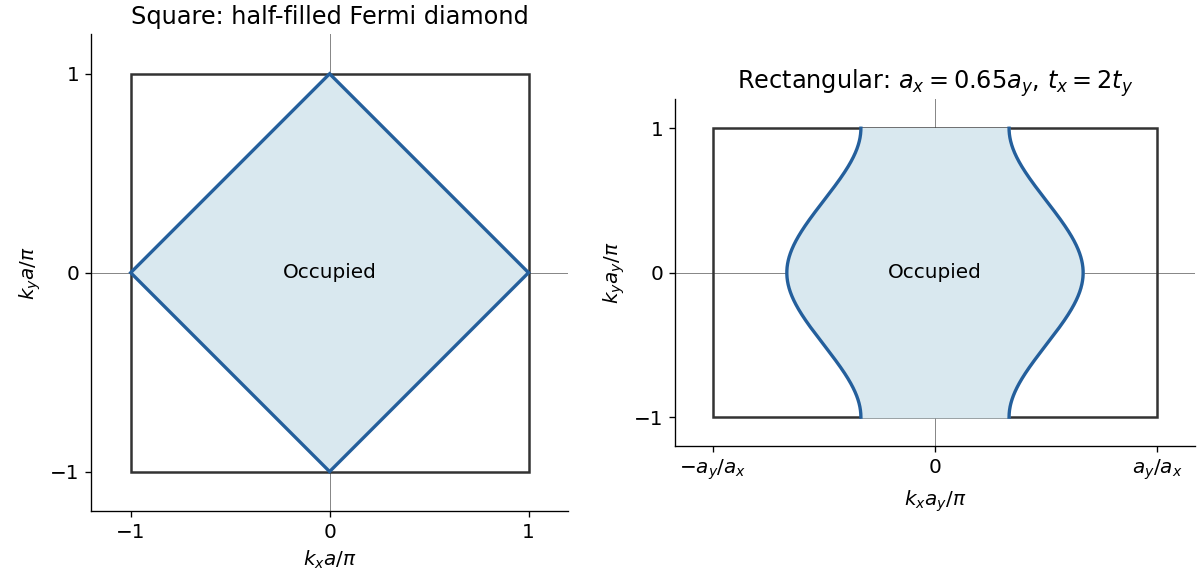
The geometry alone does not fix the hopping amplitudes or a unique Fermi surface. One consistent tight-binding model isrepresenting larger hopping between the closer atoms. It remains a nearest-neighbour bipartite band at half filling, so its chemical potential is . Its Fermi surface consists of the two sheetsThese meet the top and bottom zone edges and continue periodically into the neighbouring zones. The right panel of the figure gives an explicit example with and . The central region between the sheets is occupied and has half the zone area. If the hopping amplitudes instead remained equal, a geometrically stretched diamond would also satisfy the stated information. The metric inequality alone does not determine which of these shapes occurs.
Past exam of the condensed matter physics course of the University of Oxford 2018 2 d Solution by Codex 0 2026-10-25
Codex 0 2026-10-25The first Brillouin zone is the squareAt half filling, translation of the wavevector by exchanges the two band energies:Thus the same energy-pair argument as in part c givesAt zero temperature, the Fermi surface satisfies . Within the square Brillouin zone this is the diamondwhose vertices are and . The occupied region is the diamond's interior, containing the band minimum at the zone centre. It has half the Brillouin zone area, consistent with one electron per atom and two spin states per wavevector.
Past exam of the condensed matter physics course of the University of Oxford 2018 2 c Solution by Codex 0 2026-10-25
Codex 0 2026-10-25Monovalency gives one electron per atom, so the two-spin-state band is half filled. At zero temperature, occupying gives . HenceRelative to the band minimum, the Fermi energy is .
The density of states obeys . At , the Fermi-Dirac distribution satisfiesPairing the energies above and below the band centre therefore leaves exactly half of the two available states per atom occupied, at every positive temperature. Increasing strictly increases the mean particle number, so this solution at fixed half filling is unique. ConsequentlyThis particle-hole symmetry of a half-filled bipartite band argument uses the symmetric tight binding band and fixed half filling; it is not a general temperature-independence property of chemical potential in metals with additional bands or an asymmetric density of states.
Past exam of the condensed matter physics course of the University of Oxford 2018 2 b Solution by Codex 0 2026-10-25
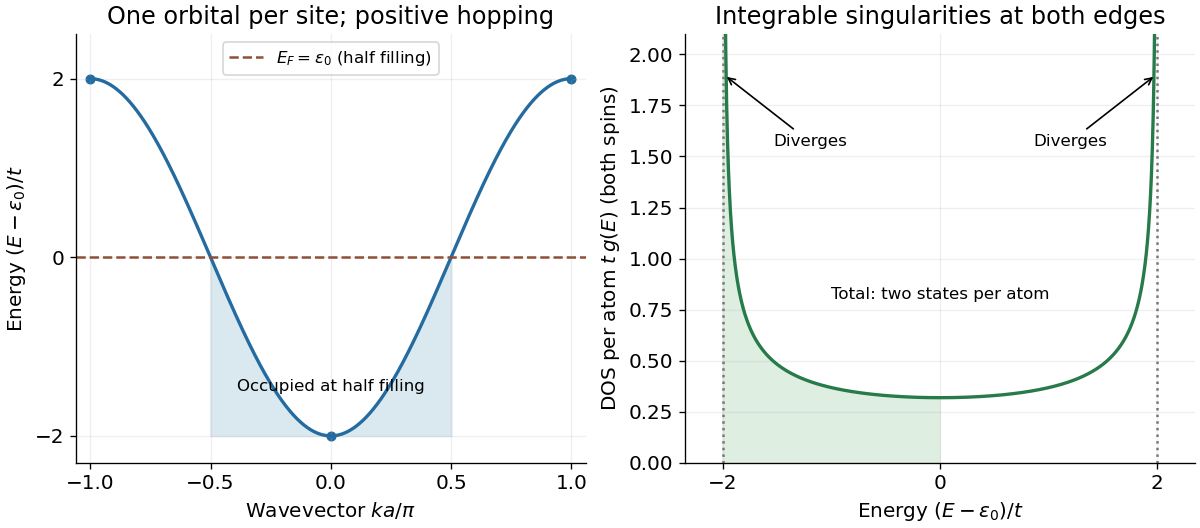
Codex 0 2026-10-25Expand a single-electron wavefunction as . Project the Schrödinger equation onto to obtainTranslation symmetry suggests the Bloch state on a periodic chain of sites. Substitution givesTake the conventional positive hopping . The first Brillouin zone is ; the band has minimum at and maximum at the zone edges. Its width is . A negative hopping interchanges the extrema but does not change the density of states after replacing by .
There are allowed wavevectors and two spin states per wavevector. For the total spin-summed density of states , each interior band energy has two roots, . Using the spacing givesThus the density of states per atom isIt is symmetric about and has integrable inverse-square-root Van Hove singularities at both band edges. Its integral over the band is two states per atom. The plot labels the dispersion extrema and both singular edges.


Past exam of the condensed matter physics course of the University of Oxford 2018 2 a Solution by Codex 0 2026-10-25
Codex 0 2026-10-25The chemical potential is the change in Helmholtz free energy when particles are added at fixed temperature and volume:Equivalently, identifies it as the derivative of internal energy at fixed entropy and volume. In equilibrium, systems that exchange particles have equal chemical potentials.
The Fermi energy is the zero-temperature chemical potential, or, for independent electrons, the highest occupied single-particle energy in the zero-temperature limit. Its numerical value depends on the chosen energy reference; the Fermi energy need not be measured from the bottom of a band unless that convention is specified.
Past exam of the condensed matter physics course of the University of Oxford 2018 1 e Solution by Codex 0 2026-10-25
Codex 0 2026-10-25The two body-centre/origin sites and the other six sites have different local environments. Their effective atomic scattering factors therefore need not be identical even in an elemental, chemically pure crystal. Write them as and , respectively. The crystal basis structure factor becomesFor the low-angle families this givesThus can produce a weak extra powder diffraction ring below . This is an accidental diffraction extinction from equal atomic scattering factors: its cancellation in part d is exact only in the identical-atom-scattering approximation. Small differences in the bonding electron density, or site-dependent Debye–Waller factors, can leave a small nonzero amplitude. For instance, taking and gives while ; the corresponding intensity suppression is quadratic in . No impurity is required. The and cancellations remain for arbitrary scalar in this two-site-class model.
Past exam of the condensed matter physics course of the University of Oxford 2018 1 d Solution by Codex 0 2026-10-25
Codex 0 2026-10-25Initially approximate every tungsten atom by the same atomic scattering factor . Pairing the quarter-coordinate sites in the crystal basis structure factor givesFor cubic powder diffraction, increasing deflection corresponds to increasing , since . The first possibilities are
| Family | | \ | | | \ | | | \ | | | \ | | | \ | | | |
|---|
Hence the first two strong rings have Miller indicesThe powder diffraction multiplicity is six for , from three choices of nonzero axis and two signs. For it is , from six permutations and four sign choices. If the atomic scattering factors and angular corrections are taken as approximately equal for these nearby rings, their integrated diffraction intensity obeyThis is a multiplicity-based estimate. An exact measured ratio also depends on the momentum-transfer dependence of the atomic scattering factor, the Lorentz-polarization factor, the Debye–Waller factor, absorption and instrument geometry. In particular, the source does not provide the beta-phase lattice constant or instrument corrections needed to calculate those angular factors. Peak heights additionally depend on peak widths; the estimate refers to integrated ring intensities.
Past exam of the condensed matter physics course of the University of Oxford 2018 1 c Solution by Codex 0 2026-10-25
Codex 0 2026-10-25The beta phase has a primitive cubic lattice with an eight-atom atomic basis of a crystal, rather than a body-centred cubic lattice. A lattice translation must map the entire atomic arrangement onto itself. For example, the putative body-centering vector maps to modulo integer coordinates, where the given atomic basis of a crystal has no atom. None of the seven nonzero basis positions generates a translation that preserves all eight sites. ThereforeThe presence of atoms at both the origin and the body centre alone is insufficient to establish body-centering of the full crystal structure.
Past exam of the condensed matter physics course of the University of Oxford 2018 1 b Solution by Codex 0 2026-10-25
Codex 0 2026-10-25For the conventional body-centred cubic lattice, the crystal basis structure factor of identical atoms isIt vanishes for odd and equals for even . Thus the first powder diffraction ring is the family, with interplanar spacing .
The measured deflection is the angle between incident and scattered rays, , so the Bragg angle is . Using first-order Bragg diffraction, , givesThe mass density follows from two atoms per conventional unit cell, with molar mass and Avogadro constant :Using as the Bragg angle would confuse with and give an incorrect lattice constant and mass density.
Past exam of the condensed matter physics course of the University of Oxford 2018 1 a Solution by Codex 0 2026-10-25
Codex 0 2026-10-25A Bravais lattice is a set of points generated by integer translations along three independent primitive lattice translation vectors:Every lattice point has the same environment under lattice translations. A crystal structure consists of this Bravais lattice with an atomic basis of a crystal repeated at every lattice point; the set of atomic positions need not itself be a Bravais lattice.
Past exam of the condensed matter physics course of the University of Oxford 2017 4 c Solution by Codex 0 2026-10-25
Codex 0 2026-10-25A substitutional phosphorus atom supplies one more valence electron than the silicon atom it replaces. In the shallow hydrogenic donor state model, the remaining positive impurity attracts that extra electron through the screened Coulomb potentialRescaling the hydrogen atom binding energy by the effective mass and dielectric screening gives the ionization energyThe donor level lies at ; its binding magnitude is positive. The associated effective Bohr radius of a hydrogenic donor is , consistent with a shallow state extended over several lattice spacings.
At , , approximately times this binding energy. Dilute donors are consequently expected to be largely ionized, rather than frozen out. The actual ionized fraction also depends on the chemical potential, available conduction states and donor charge-state degeneracy; comparing to the binding energy alone is not a normalized ionization probability. At sufficiently high temperature, intrinsic electron-hole production can dominate the total carriers even though donors are ionized. Band anisotropy and short-range impurity corrections limit the numerical hydrogenic estimate.
Past exam of the condensed matter physics course of the University of Oxford 2017 4 b Solution by Codex 0 2026-10-25
Codex 0 2026-10-25For an undoped neutral intrinsic semiconductor, . Equating the two expressions from a and taking logarithms givesand hence the intrinsic-semiconductor chemical potentialTherefore . The logarithm is temperature-independent for fixed parabolic effective masses. The chemical potential is exactly at midgap only if the two effective density of states values coincide; for it moves above midgap. Additional valley multiplicities would add their logarithmic contribution.
Past exam of the condensed matter physics course of the University of Oxford 2017 4 a Solution by Codex 0 2026-10-25
Codex 0 2026-10-25Assume thermal equilibrium, a three-dimensional nondegenerate semiconductor, one parabolic conduction extremum and one parabolic valence extremum, with two spin states in each. Use the supplied effective masses as scalar density-of-states parameters. With conduction energy , state counting gives the per-volume density of statesSince , replace the Fermi-Dirac distribution by its Boltzmann factor. Using and the supplied integral,The electron hole occupation is in the valence band. Applying the same integration below givesTheir product cancels the chemical potential, giving the semiconductor mass-action lawThus, for masses expressed in ordinary mass units,The labels in this last box are exponents, unrelated to the magnetic field or Curie constant above. Valley degeneracy or multiple valence bands must be included in the effective density of states, or absorbed into suitable density-of-states effective masses, not counted twice. Real silicon has anisotropic multiple valleys, so its conductivity mass is not automatically its density-of-states mass; the numerical answers below implement the paper's supplied scalar-mass model.[ref]
ECE 340 Lecture 6 by John Dallesasse. Slide 26, A Few Cautions: carrier counting uses the density-of-states effective mass, while silicon conductivity and cyclotron masses differ
The formula is not an identity for arbitrarily degenerate carriers. For a concrete counterexample, take while holes remain dilute. Fermi occupation gives , whereas the Boltzmann replacement would give ; the predicted product then differs by about three orders of magnitude. Separate electron and hole quasi-Fermi levels out of equilibrium would also prevent the cancellation used above.
Past exam of the condensed matter physics course of the University of Oxford 2017 3 d Solution by Codex 0 2026-10-25
Codex 0 2026-10-25A macroscopic nickel specimen can split into magnetic domains, each with nonzero local spontaneous magnetization but with different orientations. Their vector contributions can cancel, giving an almost zero measured net magnetization below the Curie temperature. This reduces the external stray-field energy, at the expense of magnetic domain wall energy; the balance favours a multidomain state in many ordinary specimens.
An applied magnetic field can move magnetic domain walls and rotate the domain moments, revealing a large response and eventually saturation magnetization. Thus a zero average does not mean that each local moment has become thermally disordered or that the material is above its Curie temperature. Preparation, shape and domain-wall pinning influence remanence.
Past exam of the condensed matter physics course of the University of Oxford 2017 3 c Solution by Codex 0 2026-10-25
Codex 0 2026-10-25Within the stipulated localized, one-moment-per-atom spin model, the number density follows directly from mass density and molar mass:The face-centered cubic lattice is consistent with four atoms per conventional unit cell; no additional factor four is needed once has been obtained from the density. The Curie constant is . Identifying the model's with the specified Curie temperature givesAt very low temperature, a fully ordered single domain has . Its Weiss molecular field isThe cancellation of in the middle expression provides a useful check. The ordinary magnetostatic scale is only , smaller by the factor . Thus is not a plausible ordinary self-generated dipolar magnetic field of the nickel moments. It represents the exchange interaction energy in field units, not an additional Maxwell field of that magnitude. This does not assert that such large externally generated fields are forbidden. Nickel is an itinerant ferromagnet; the imposed one--per-atom model is an estimate rather than its measured microscopic moment.
Past exam of the condensed matter physics course of the University of Oxford 2017 3 b Solution by Codex 0 2026-10-25
Codex 0 2026-10-25In the Weiss molecular field approximation, the local response obeysLinearize around in the stable phase of paramagnetism. Substitution of a givesHence the Curie–Weiss law and Weiss temperature areFor positive , is the mean-field theory Curie temperature: the zero-magnetization solution becomes unstable there, and below it a spontaneous solution appears. For negative coupling, a negative fitted Weiss temperature indicates predominantly opposing interactions, but this one-uniform-magnetization treatment does not determine an antiferromagnetic ordering pattern or its transition temperature. More generally the fitted Weiss temperature need not equal the observed ordering temperature.
For , the paramagnetic curve is positive for , diverges as , and tends to at high temperature; its inverse is the straight line . The expression is not the stable susceptibility below . For example substituting would predict a negative response around the unstable branch. The nonlinear self-consistency equation must instead be expanded about the appropriate spontaneous magnetization.
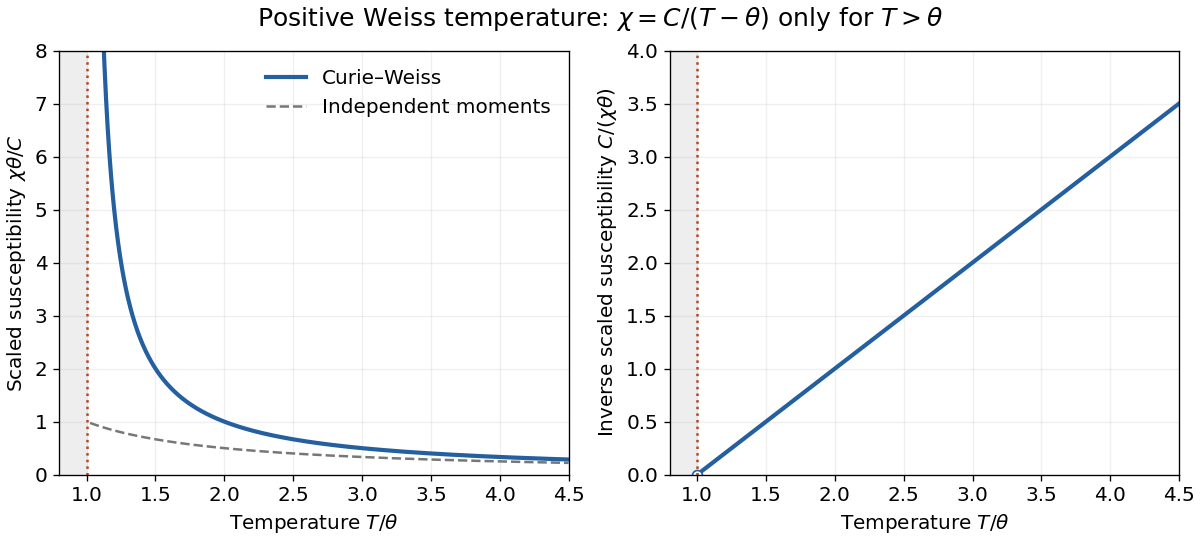
Paramagnetic Curie-Weiss susceptibility and its inverse
. The positive-Weiss-temperature mean-field law is shown only in its stable paramagnetic range . Its inverse extrapolates to zero at . The curve below the transition is not obtained by continuing the displayed rational expression. Details.
Past exam of the condensed matter physics course of the University of Oxford 2017 3 a Solution by Codex 0 2026-10-25
Codex 0 2026-10-25Take two localized spin orientations with moments along the applied magnetic field. This assumes an electron-like spin factor of two. Their energies are , so the one-moment partition function is , with . The thermal mean moment is , and the spin-one-half paramagnetic magnetization isFor , . With the same SI convention and ,This Curie law is a zero-field or weak-field susceptibility. At arbitrary field the differential response is , and saturates at ; extending the linear law to unlimited field would contradict that finite saturation magnetization.
There are unlisted articles, also show them or only show them.