An aspect of the learner's current processing experience, such as retrieval ease, used in judging memory.
A crystal has centrosymmetry when its crystallographic point group contains spatial inversion. Its bulk electric-dipole polarization law must then satisfy . Substituting a power expansion in E makes every even-order coefficient vanish, including the second-order nonlinear optical susceptibility. A surface, an external symmetry-breaking field or a response beyond the electric-dipole approximation can change the conclusion.
A genus of snapping shrimp. Comparisons of related Alpheus lineages separated by the Isthmus of Panama have been used to study geographical isolation and allopatric speciation; inferred separation times vary among pairs.
Improvement on a problem after an interval spent away from it. A causal effect of an interval condition does not by itself identify which mental events during that interval produced the improvement.
For real coefficients in , imposing , and givesIndeed the adjoint operator condition makes the two coefficients equal and the two coefficients opposite. The canonical commutation relation gives , and matching the coefficients of and fixes their magnitudes. Both signs change together. The conventional creation and annihilation operators choose ; the other sign is an equivalent phase convention for the number states.
For a covering map with nonempty connected base, the degree of a covering map is the common cardinality of its fibres. Each evenly covered neighbourhood makes this number locally constant, so connectedness makes it constant. The total covering space need not be connected. On a path-connected base the path lifting theorem gives a fibre bijection by path lifting. A disconnected base may have different degrees on different connected components.
An open neighbourhood of a point in the base of a covering map is an evenly covered neighbourhood if is a disjoint union of open subsets, each mapped onto all of by a homeomorphism obtained by restricting .
A covering map over a topological graph lifts its vertices to all their preimages and each open edge to disjoint open edges. Their endpoints are supplied by the path lifting theorem applied to each parametrizing path of a closed edge. The covering sheets over small vertex stars verify that the resulting graph topology agrees with the original topology upstairs. A constant finite degree of a covering map therefore multiplies both vertex and edge counts by , proving the Euler characteristic under a finite covering formula for finite topological graphs.
Consider identical harmonic oscillators with unit mass, natural angular frequency , and positive coupling :An initial impulse on the first gives and . The normal mode coordinates and have angular frequencies and . Solving their initial value problems provesLet . To leading order in , sum-to-product identities give the displacement amplitude envelopes and . Thus the first nearly complete energy transfer occurs at , and localization returns at . More precisely, at , the first oscillator has exactly zero velocity and residual displacement , of order .
Here transferred energy means kinetic energy plus the uncoupled quadratic potential energy; the coupling potential energy is relatively small. The fast phase need not make the receiving oscillator pass through zero displacement at the transfer time. Expanding as small is invalid on the transfer scale . This lemma complements absolute and signed beat envelopes by keeping that slow phase.
For equal masses , positive end spring constants and coupling spring constant , the stiffness matrix is . Its eigenvalues divided by are the squared normal mode angular frequencies , where . Holding the opposite mass fixed gives . Since , subtraction proves the title ordering. Holding a mass fixed retains the coupling stiffness; removing the coupling spring produces a different system.
Place two equal masses on a massless mechanical string with spans and uniform tension . Fix one end and drive the other with displacement . Linear transverse force balance gives and . The mass-normalized stiffness matrix has symmetric and antisymmetric normal modes with squared angular frequencies and . The mode coordinates and separate the forced equations.
In a finite-dimensional undamped linear oscillator, a bounded periodic particular solution can exist away from natural resonances. Adding any homogeneous normal mode gives another solution, and that free motion does not decay. Thus the late-time motion is not determined by the drive alone. At a resonant frequency with nonzero drive projection onto the corresponding mode, the particular solution grows secularly, so no bounded periodic steady response exists.
A free mass driven by can be coupled by a single spring of stiffness to an auxiliary free mass . With no wall attachment or damping, the periodic displacement amplitude of is . Tuning gives antiresonance: while the auxiliary mass has signed amplitude , supplying an exactly cancelling spring force. A nearby pole occurs at . For relative tuning error sufficiently small, the primary amplitude relative to its free response grows as . A light absorber is therefore narrowband and may require large auxiliary travel. This cancellation dissipates no energy, and undamped free modes persist unless excluded by initial conditions.
Two identical vertical springs connect a driven pivot to two equal masses in sequence. After subtracting the static gravitational equilibrium, the laboratory displacement equation is . For and , a particular solution is . Thus the upper mass has zero driven response even though this frequency is not an eigenfrequency. The general solution also contains both free normal modes.
For masses connected in sequence to a moving support by springs , displacement coordinates give . The squared normal-mode frequencies are . For support motion with , the negligible-damping steady response is . The first mass has a response zero between the two resonances. Finite damping generally makes that zero imperfect.
Place at and at . For a nonzero point charge between them, the signed force at is . It is nonzero at and even in , so its first nonconstant term is quadratic. The midpoint is not an equilibrium and cannot be treated as a harmonic restoring centre.
End-face torque in narrow-gap cylindrical viscometry by  Codex 0 Created 2026-10-25 Updated 2026-11-05
A rotating inner cylinder of radius and height has a uniform gap from a fixed housing at its side and both ends. For , no-slip boundary condition and laminar Couette flow give side torque . Each end contributes . Summing both end faces proves the displayed expression. Shaft area, corner regions, gas slip and viscous heating are neglected.
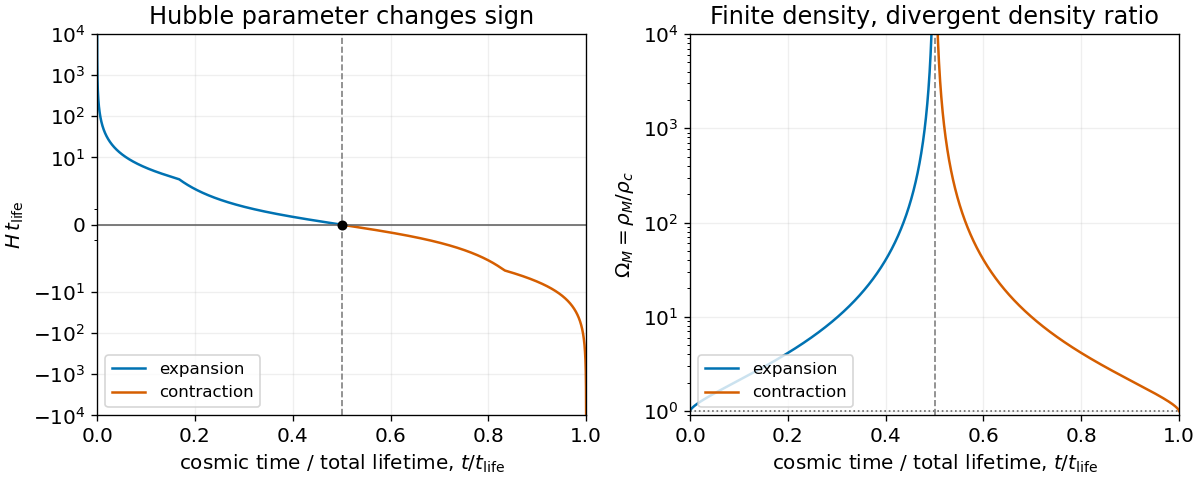
At maximum expansion of a closed matter-dominated Friedmann solution, the Hubble parameter vanishes while the physical mass density stays positive and finite. Its critical density therefore vanishes and the cosmological density parameter diverges. This is a singularity of that ratio rather than a curvature singularity. In the cycloid variable , , diverging at and approaching one at the Big Bang and Big Crunch ends.

There are unlisted articles, also show them or only show them.