Past exam of the quantum Condensed Matter Field Theory course of the University of Cambridge 2014 Paper 1 3 b Solution by  Codex 0 2026-10-20
A coherent state is an eigenstate of an annihilation operator. Bosonic unnormalized states have exponential overlap and the Gaussian resolution of identity used above; their overcompleteness supplies a phase-space integration measure, not an orthonormal state count. For a normal-ordered many-body Hamiltonian, coherent-state insertion gives the bosonic coherent-state path integralConstants in must be retained. The exact time-sliced prescription places creation and annihilation symbols on adjacent slices; discarding that prescription can change ordering corrections, as the oscillator example demonstrates. The derivative term is first order because the fields describe phase space.
Fermionic coherent states instead use Grassmann variables. Their Gaussian identity is , whereas complex bosons give . Anticommutation in the trace produces antiperiodic fields. Accordingly bosons have , fermions , in these inverse-energy time units.
For one mode of grand-canonical energy , the products give and ; convergence requires for the bosonic Gaussian. Correlation functions follow by source differentiation. Quartic interactions can be treated perturbatively or decoupled with a Hubbard–Stratonovich transformation; a saddle then describes an order parameter and quadratic fluctuations its collective modes. Such saddles require stability and an appropriate control parameter; the functional notation alone is not an exact solution of an interacting problem.
Past exam of the quantum Condensed Matter Field Theory course of the University of Cambridge 2014 Paper 1 3 a Solution by Codex 0 2026-10-20
Codex 0 2026-10-20The real-time path integral sums over paths. In a classically forbidden region, the dominant semiclassical contribution is clearer after Wick rotation: the weight becomes and stationary paths obey , equivalent to motion in the inverted potential. A finite-action path joining degenerate minima is an instanton.
For , , zero Euclidean mechanical energy gives . ThusThe reversed trajectory is an anti-instanton.[ref] Expanding produces the fluctuation operator . Its translation zero mode is handled by integrating the collective centre , not by dividing by a zero determinant. The remaining determinant and Jacobian form an attempt-frequency prefactor .
When , well-separated events form a dilute gas with rate scale . Paths returning to the same well have an even number of events, while paths ending in the other well have an odd number. The sums yield and , givingThe ground state is the lower symmetric combination of localized well states: tunnelling lifts the apparent classical degeneracy. This splitting is nonperturbative in , beyond a power series about either minimum. In a metastable well a bounce, with a negative fluctuation mode, describes decay rather than the stable doublet splitting. Finite temperature, overlapping events or a low barrier require improvements beyond the dilute approximation.
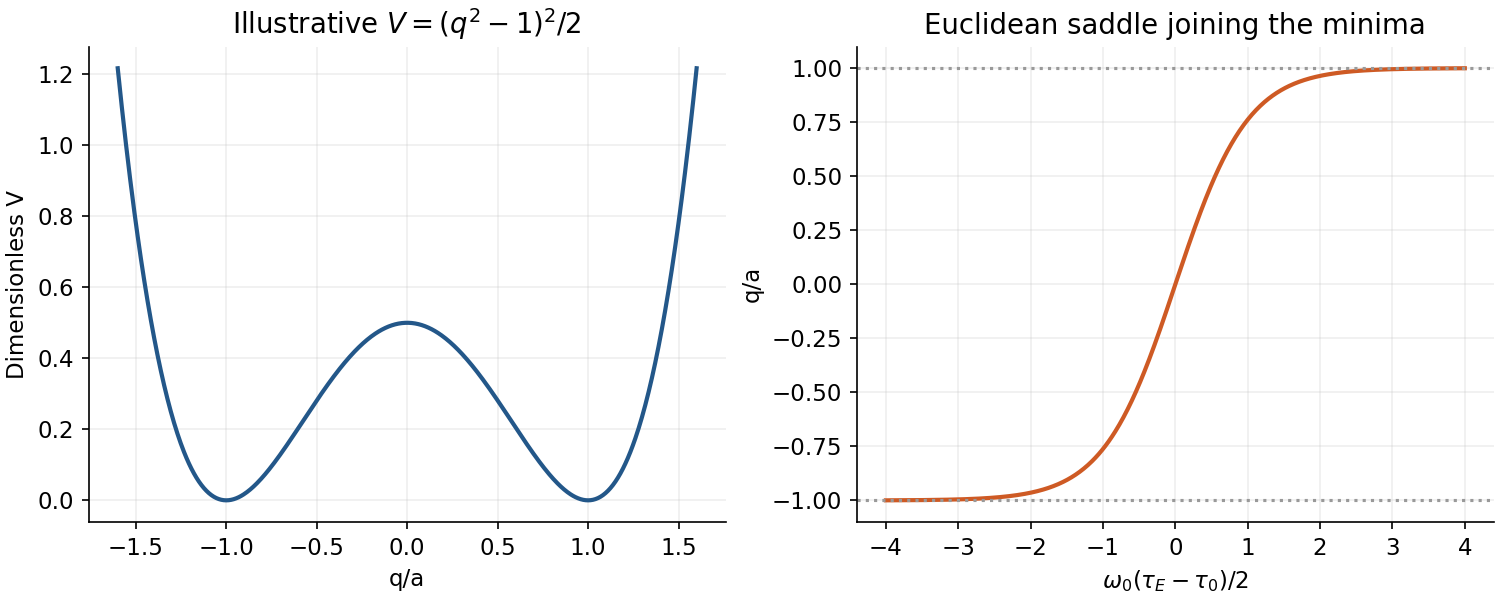
An original quartic double well and its Euclidean instanton trajectory
. Source. Details. Past exam of the quantum Condensed Matter Field Theory course of the University of Cambridge 2014 Paper 1 2 d Solution by Codex 0 2026-10-20
Codex 0 2026-10-20Let , use time slices and . The exact normal-ordered coherent Gaussian has cyclic matrix , where shifts one slice. Its eigenvalues are andRestoring the constant energy givesconsistent with the coordinate path integral. Alternatively, pairing positive and negative Matsubara frequencies symmetrically yields a determinant proportional to . This symmetric prescription already incorporates the zero-point convention and must not receive the vacuum factor twice. A naive unregulated frequency product can hide this difference.
Past exam of the quantum Condensed Matter Field Theory course of the University of Cambridge 2014 Paper 1 2 c Solution by Codex 0 2026-10-20
Codex 0 2026-10-20For unnormalized coherent states, , and . Insert this identity between short imaginary-time evolutions. The overlaps generate , while the normal-ordered symbol of givesHere runs from zero to ; the exponent is dimensionless. The bosonic trace makes the complex fields periodic, not antiperiodic.
The printed expression omits the explicit vacuum factor. It represents the full oscillator only if a symmetric/Weyl determinant prescription implicitly includes that factor. With the ordinary normal-ordered time-sliced coherent-state measure, it instead represents . The continuum formula alone does not specify the energy-zero convention.
Past exam of the quantum Condensed Matter Field Theory course of the University of Cambridge 2014 Paper 1 2 b Solution by Codex 0 2026-10-20
Codex 0 2026-10-20The endpoint integral is a Gaussian with coefficient . ThereforeIt agrees with , tends to at high temperature, and to at low temperature. The last limit retains the oscillator zero-point energy.
Past exam of the quantum Condensed Matter Field Theory course of the University of Cambridge 2014 Paper 1 2 a Solution by Codex 0 2026-10-20
Codex 0 2026-10-20Put and . With equal endpoints , the Euclidean classical path and its action areWrite , where . Sine modes have fluctuation eigenvalues . Relative to the free-particle determinant, their Gaussian integral contributesMultiplying the free prefactor gives the Euclidean oscillator diagonal kernelIntegrating this over the common endpoint is precisely the trace. All fluctuations here are Dirichlet fluctuations about a fixed-endpoint path; periodicity is imposed on the full trace after endpoint integration.
Past exam of the quantum Condensed Matter Field Theory course of the University of Cambridge 2014 Paper 1 1 e Solution by Codex 0 2026-10-20
Codex 0 2026-10-20Choose the reference staggered direction so its classical moment is positive. The Bogoliubov vacuum has , henceNear each soft point the integrand is proportional to , so the one-dimensional thermodynamic integral diverges logarithmically. The ordered-reference expansion fails; it does not predict a physical negative magnetization. Long-range Néel order is destroyed in this isotropic one-dimensional setting. The exact finite symmetric ground state also has zero staggered expectation without selecting a direction.
For linearly dispersing modes in dimensions, zero-temperature depletion behaves as and is infrared finite for , allowing order in suitable two- and three-dimensional antiferromagnets. Finite depletion is not a guarantee for every frustrated quantum magnet. At nonzero temperature, the extra Bose occupation changes the singularity to : short-range isotropic systems cannot sustain continuous-symmetry long-range order for . This thermal conclusion is distinct from the one-dimensional zero-point argument.
Past exam of the quantum Condensed Matter Field Theory course of the University of Cambridge 2014 Paper 1 1 d Solution by Codex 0 2026-10-20
Codex 0 2026-10-20The inverse transformation has negative off-diagonal entries. Choosing removes anomalous terms and givesThere are gapless points at and the zone boundary; near zero, , a linear antiferromagnetic spin wave with velocity in the stated units. The zero modes are collective rotations: their divergent squeezing cannot be treated as ordinary normalized independent oscillator vacua. A finite-size cutoff or infinitesimal symmetry-breaking field regulates them.
As a constant-term check, the continuum spin-wave vacuum energy per site is . This is a spin-wave prediction, not an exact spectrum for every finite- one-dimensional chain.
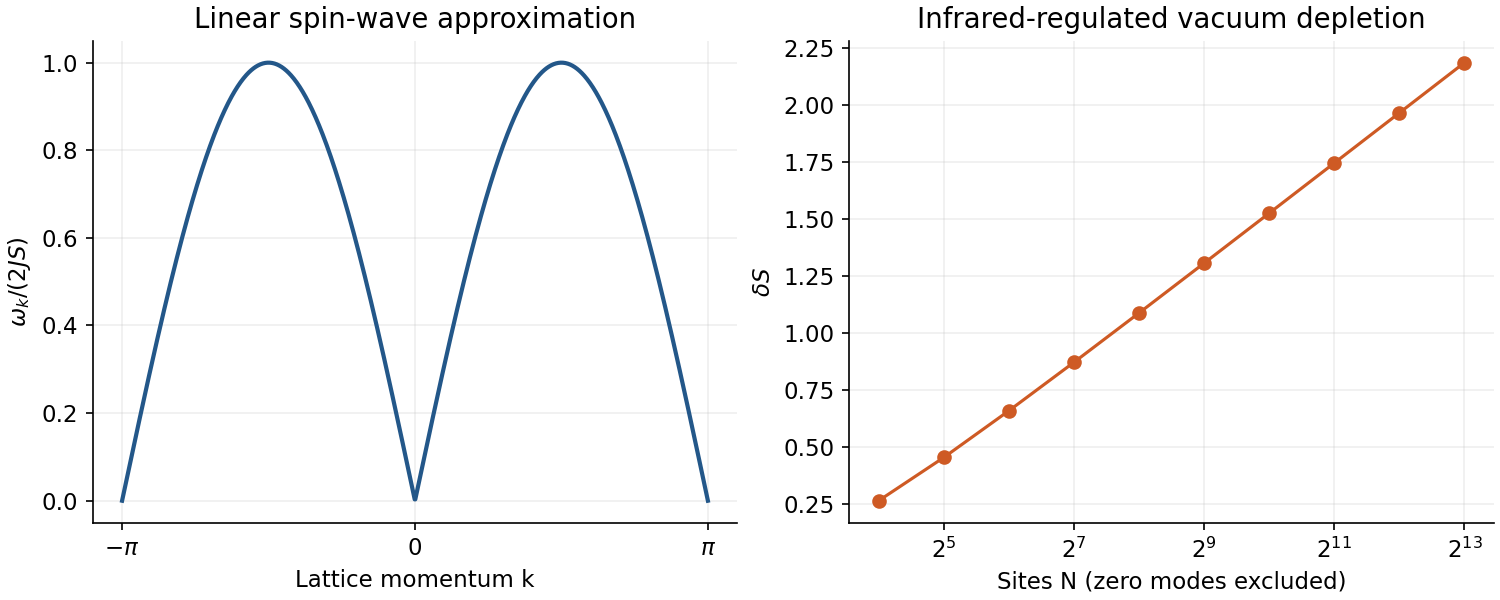
Linear antiferromagnetic spin-wave dispersion and logarithmically growing one-dimensional vacuum depletion
. Source. Details. Past exam of the quantum Condensed Matter Field Theory course of the University of Cambridge 2014 Paper 1 1 c Solution by Codex 0 2026-10-20
Codex 0 2026-10-20For real even , the Bogoliubov transformation givesEquivalently, its Nambu matrix obeys . The bosonic canonical metric is preserved; need not be unitary in the ordinary positive-definite metric.
Past exam of the quantum Condensed Matter Field Theory course of the University of Cambridge 2014 Paper 1 1 b Solution by Codex 0 2026-10-20
Codex 0 2026-10-20Rotate alternate sites by about a transverse axis so all local reference spins point up. Choosing the transverse axes to give positive anomalous coupling, the linear spin-wave approximation yieldsUse lattice spacing one and , with all momenta , , in . Then andReordering gives the requested Nambu form with constant . Its extra restores before diagonalization. This full-zone convention has no additional sublattice or half-zone factor.
Past exam of the quantum Condensed Matter Field Theory course of the University of Cambridge 2014 Paper 1 1 a Solution by Codex 0 2026-10-20
Codex 0 2026-10-20For the even periodic chain, every classical Néel state has energy , with arbitrary unit vector . Thus there is a continuous sphere of classical orientations, not merely two Ising-like states. Opposite staggered directions are connected by a global spin rotation.
A quantum Néel product is not an eigenstate: transverse exchange flips opposite neighbouring spins. The ground state therefore contains quantum superpositions and zero-point spin waves, reducing the classical staggered moment. A finite isotropic balanced chain has a symmetry-invariant ground state; a symmetry-broken reference is an approximation for analysing fluctuations, not its exact finite-system eigenstate.
Past exam of the quantum Condensed Matter Field Theory course of the University of Cambridge 2013 Paper 1 3 f Solution by Codex 0 2026-10-20
Codex 0 2026-10-20The constant term in the spin sum cancels. Linearizing the saddle point equation givesThe paramagnetic auxiliary-field curvature isConsequently the Stoner criterion for the loss of local paramagnetic stability isThe printed uses energy measured from the Fermi level. For a smooth density of states, becomes a narrow unit-area peak at ; a singular density of states or appreciable temperature requires the integral form. The curvature establishes local instability, not the order or location of every possible thermodynamic transition.
With exact spin-rotation symmetry, itinerant ferromagnetism selects a magnetization direction. The two broken transverse generators form one quadratic type-B Goldstone boson, a long-wave ferromagnetic magnon with . Longitudinal amplitude motion is not symmetry-protected to be gapless. In a metallic ordered state, particle-hole excitations remain near each surviving exchange-split Fermi surface; these are distinct from the collective magnon. The itinerant spin-flip particle-hole continuum starts at exchange scale at in this simple mean-field spectrum, while its finite- boundaries differ. Spin anisotropy, spin-orbit coupling or an external field can gap the transverse mode; none is present in the stated model.
Past exam of the quantum Condensed Matter Field Theory course of the University of Cambridge 2013 Paper 1 3 e Solution by Codex 0 2026-10-20
Codex 0 2026-10-20Differentiate the uniform effective action:To reproduce the printed coefficient, define the spin-summed density of states per site byThe saddle-point approximation then givesThe uniform spin field and magnetization obey for occupations per site. If a one-spin density of states were used instead, the factor would be absent. The spin field is an energy, rather than directly a magnetic moment.
Past exam of the quantum Condensed Matter Field Theory course of the University of Cambridge 2013 Paper 1 3 d Solution by Codex 0 2026-10-20
Codex 0 2026-10-20For the uniform mean-field approximation field , the inverse fermion propagator is diagonal in momentum, frequency and spin: . The Grassmann Gaussian integral therefore givesHere denotes the residual uniform-field measure; integration over its orientation only affects a nonextensive prefactor. HenceThe exchange field separates the two spin bands by . Integrating out the fermions is exact for a specified auxiliary field; restricting that field to be constant is the mean-field approximation.
Past exam of the quantum Condensed Matter Field Theory course of the University of Cambridge 2013 Paper 1 3 c Solution by Codex 0 2026-10-20
Codex 0 2026-10-20Define the Grassmann spin density . The Pauli matrices and Grassmann reordering giveFor example ; each of the other two components gives the same result. For , complete the square independently at each site and time slice:This normalized spin-vector Hubbard–Stratonovich decoupling yieldsThe auxiliary bosonic quantum field is real and periodic, while the fermionic fields remain antiperiodic. All three vector components are required to reproduce the original interaction; replacing this exact transformation by a single-component identity would change its coefficient.
Past exam of the quantum Condensed Matter Field Theory course of the University of Cambridge 2013 Paper 1 3 b Solution by Codex 0 2026-10-20
Codex 0 2026-10-20Expand the Grassmann fields in fermionic Matsubara frequencies . For , the Grassmann Gaussian integral factorizes into thermal fermionic one-level thermal determinants:Each factor counts the empty and occupied states of one spin orbital. Equivalently, the regularized Matsubara sum gives the logarithm of that factor; the raw infinite determinant requires thermal normalization of a fermion determinant. ThereforeThe printed is the grand potential , because the trace contains . The Helmholtz free energy at fixed mean particle number is .
Past exam of the quantum Condensed Matter Field Theory course of the University of Cambridge 2013 Paper 1 3 a Solution by Codex 0 2026-10-20
Codex 0 2026-10-20Use and dimensionless spin operators. At one site, the canonical anticommutation relations imply the on-site spin-square normal-ordering identityIndeed the empty and doubly occupied states have spin zero, while either singly occupied state has . Thus the interaction in normal-ordered form is . There is no residual chemical-potential shift: that contraction has cancelled.
Insert fermionic coherent state resolutions between imaginary-time evolution factors. With and , the grand-canonical coherent-state action isThe independent barred and unbarred Grassmann variables satisfy antiperiodic boundary conditions at . Adjacent time-slice labels in the normal-ordered symbol fix the continuum prescription and thermal normalization. The interaction coefficient is , not the of a differently normalized Hubbard model.
Past exam of the quantum Condensed Matter Field Theory course of the University of Cambridge 2013 Paper 1 2 c Solution by Codex 0 2026-10-20
Codex 0 2026-10-20For conventional superconductivity, an attractive interaction pairs opposite-spin fermions. A complex pairing Hubbard–Stratonovich transformation introduces a Cooper pair field . The fermionic fields then appear quadratically, giving the pair-field effective action of a superconductorThe trace convention counts each independent spin-pair block once. The uniform saddle is the BCS gap equation; the fermionic excitations have in the fully gapped case. A slow-field expansion near the transition yields Ginzburg-Landau theory of superconductivity. Normalize its pair field so is an effective pair density, with pair mass and signed charge :For , the uniform minimum has , with arbitrary constant phase. Writing separates the amplitude mode from the phase. The local potential has curvature term and coherence scale . A neutral condensate has a gapless phase Goldstone mode when suitable dynamics is included.
The charged theory is invariant underThe gauge-invariant condensate momentum is . Only and enter physical phase dynamics. At nearly constant amplitude, varying givesFor a smooth phase, taking the curl and using Ampère's law gives : the Meissner effect screens a static bulk magnetic field over the London penetration depth . In a gauge with , the phase stiffness is a quadratic term in , the superconducting version of the Higgs mechanism.
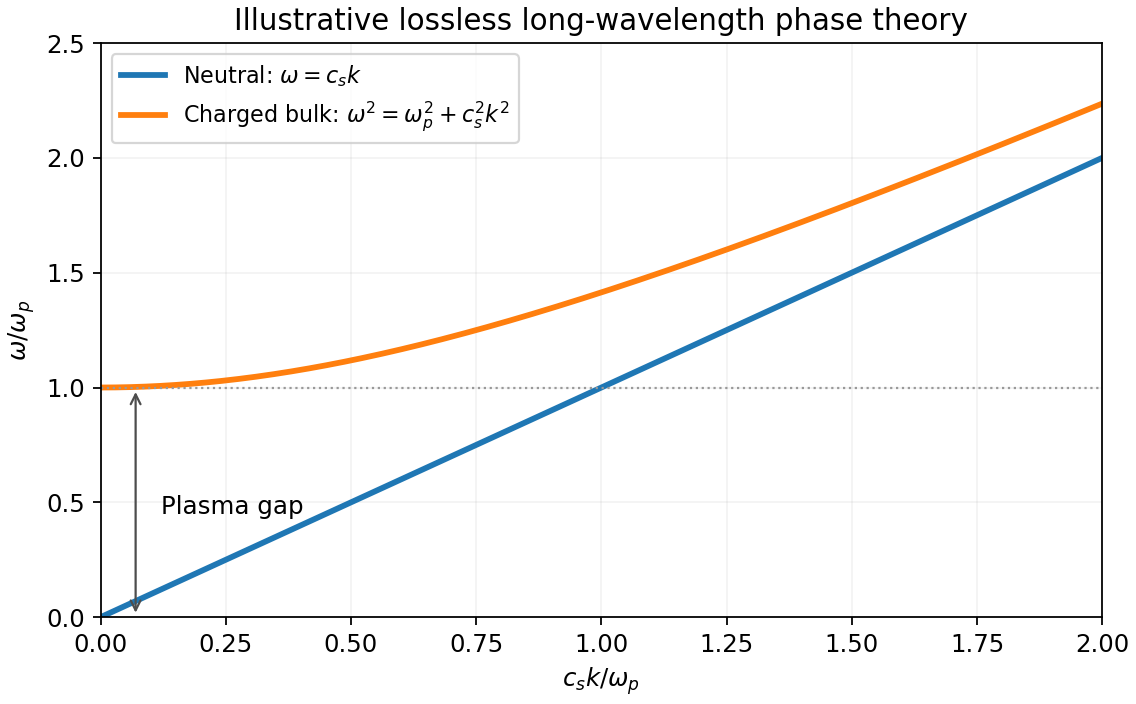
To identify the dynamical mode, a simple lossless long-wave superconducting phase-density action isHere is the pair compressibility coefficient. Eliminating the longitudinal electric potential givesThus the neutral sound mode becomes a gapped longitudinal plasma oscillation; transverse electromagnetic waves acquire in this simple bulk model. This redistribution of the phase degree of freedom into electromagnetic collective modes is the Anderson-Higgs mechanism in a superconductor. Local gauge symmetry is a redundancy, not an independently observable symmetry whose breaking creates another massless particle. [ref]
Physics 215C: Quantum Field Theory, Part 3 by John McGreevy. §2.3, superconductors, superfluids and gauged phase dynamics
The static functional alone does not determine a frequency or damping rate. The displayed mode dispersions require the added dynamical assumptions; real screening, normal carriers, boundaries and dissipation modify them. The amplitude fluctuation is distinct from the phase mode and is not removed by the gauge choice.
Past exam of the quantum Condensed Matter Field Theory course of the University of Cambridge 2013 Paper 1 2 b Solution by Codex 0 2026-10-20
Codex 0 2026-10-20For , divide elapsed time into slices and apply the Trotter product formula. Inserting complete position and momentum bases gives the regulated phase-space path integralThe endpoint values are , . Each Gaussian momentum integration in a phase-space path integral can be performed explicitly, leaving the configuration-space path integralIts measure is the time-sliced limit of , with the usual infinitesimal convergence prescription. The integral sums amplitudes, not positive classical probabilities. Operator ordering remains part of the time-slice definition. Expanding a short-time kernel recovers the Schrödinger equation; composing kernels reproduces the time-evolution operator.
In the classical limit, rapid phase cancellation suppresses paths away from stationary action. Varying with fixed endpoints gives . The semiclassical result sums the classical-path phases multiplied by fluctuation functional determinants; for a quadratic Hamiltonian the fluctuation integral is Gaussian and this expansion is exact.
For quantum statistical mechanics, continue by a Wick rotation. The Euclidean action and thermal trace giveThe trace closes position-space paths. In a many-particle trace one also sums over endpoint permutations with the appropriate exchange signs. In a coherent state field formulation, bosonic fields are periodic and fermionic coherent states instead give antiperiodic Grassmann fields, hence bosonic and fermionic Matsubara frequencies and . [ref]
Physics 215C: Quantum Field Theory, Part 3 by John McGreevy. §§3.1–3.2, coherent-state time slicing and trace boundary conditions
The quantum-to-classical imaginary-time mapping views a local -dimensional quantum problem as a classical-looking field theory in dimensions, with imaginary-time extent . A genuine classical probability interpretation additionally requires a nonnegative weight; fermion signs and Berry terms can obstruct it.
For a smooth potential in the high-temperature or small- limit, imaginary-time paths fluctuate only over the thermal de Broglie wavelength . If this is short compared with the potential's variation scale, the diagonal free kernel givesThis classical phase-space limit of the thermal kernel is the classical phase space partition function for one degree of freedom. A dilute identical-particle gas also needs its factor; when exchange is appreciable, classical statistics fails. As a check, a single quantum harmonic oscillator gives , precisely the classical phase-space integral.
Past exam of the quantum Condensed Matter Field Theory course of the University of Cambridge 2013 Paper 1 2 a Solution by Codex 0 2026-10-20
Codex 0 2026-10-20A periodic harmonic chain with masses , spacing and nearest-neighbour spring constant hasHamilton's equations give . The discrete Fourier transform , , with in one Brillouin zone, diagonalizes the quadratic form:The harmonic-chain normal-mode reality condition means , not that and are independent real coordinates. For canonical quantization, impose , equivalently . For setThen the quantum harmonic chain is a set of independent phonon oscillators:The centre-of-mass zero mode of a harmonic chain is the free coordinate , with ; it cannot be normalized by dividing by . Retaining it giveswith the corresponding momentum expansion and uniform term . The nonzero modes alone give the site commutator ; the uniform term supplies the missing . Each oscillator occupation is a nonnegative integer, and adding one phonon costs and crystal momentum modulo a reciprocal-lattice vector. [ref]
Applications of Quantum Mechanics by David Tong. §4.1.1, printed pp.103–105, monatomic-chain normal modes and quantization
In the continuum limit of a harmonic chain, , andThe wave equation and linear low- dispersion relation follow. The lattice gives an ultraviolet cutoff; the acoustic approximation does not reproduce the zone-edge flattening.
With the centre of mass fixed, the oscillator partition function and Bose-Einstein distribution areFor a long chain, above its finite-size level spacing and below the zone-edge scale, integrating the two acoustic propagation directions gives . At high temperature each retained oscillator instead contributes to the heat capacity.
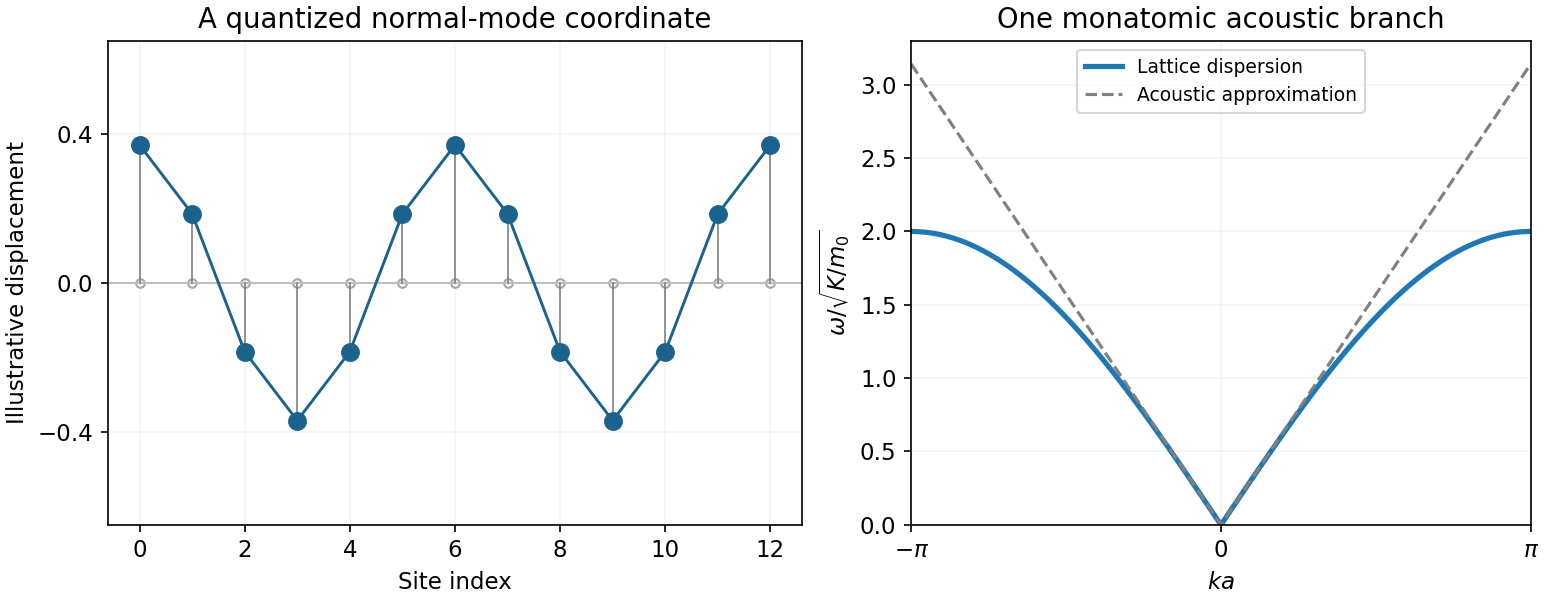


There are unlisted articles, also show them or only show them.