Past exam of the quantum information course of the University of Cambridge 2014 Paper 1 3 a Solution by  Codex 0 2026-10-20
Consistent histories assigns probabilities to suitably compatible sequences of quantum alternatives without making an external measuring apparatus fundamental. At successive times choose complete orthogonal sets of projection operators. In the Heisenberg picture, a history has class operator . For an initial density operator , its decoherence functional isA common sufficient consistency condition is for . Then is nonnegative and coarse-grained alternatives have additive probabilities: the interference cross-terms vanish. The weaker requirement on real cross-terms can suffice for individual probability sum rules. Predictions must stay within one compatible framework; mutually incompatible history families cannot simply be combined into one classical account.
The many-worlds interpretation instead treats unitary quantum evolution as universally valid and interprets the correlated outcome branches as components of one global state. A measurement interaction givesWhen the environment records become nearly orthogonal, quantum decoherence suppresses observable interference between stable apparatus records. Each relative state contains an observer correlated with a definite record; no additional physical collapse is postulated. Branch structure is an emergent approximation, rather than a unique literal splitting at every arbitrary choice of basis.
Both approaches use the ordinary unitary formalism and decoherence, but their interpretations of histories and branches differ. Decoherence alone does not prove that one unique branch is selected, nor does the unitary equation by itself settle every assumption needed to justify Born rule probabilities. Neither interpretation predicts ordinary interference experiments incorrectly merely by interpreting the same state differently.
Past exam of the quantum information course of the University of Cambridge 2013 Paper 1 3 c Solution by Codex 0 2026-10-20
Codex 0 2026-10-20Quantum cryptography includes quantum key distribution, which uses quantum transmissions and authenticated public discussion to establish a secret random key. In BB84, the sender independently chooses a random bit and either the computational or Hadamard basis, sending one of . A receiver independently chooses one of those two bases. They announce bases after receipt, retain matching-basis positions and reveal a random sample of those bits to estimate noise or eavesdropping. Ideal uniform independent basis choices retain about half of the detected signals before testing and further processing.[ref]
Quantum cryptography: Public key distribution and coin tossing by Charles H. Bennett and Gilles Brassard. 1984 key-distribution protocol; original proceedings pp. 175–179
The no-cloning theorem prevents an adversary from copying arbitrary unknown nonorthogonal signal states perfectly. In a simple intercept–resend attack, the adversary chooses a random protocol basis. On half of the sifted positions it is the wrong basis, and the resent state then yields an erroneous receiver bit with probability one half. Thus the BB84 intercept-resend error rate isif every signal is intercepted, or when an independently selected fraction is attacked this way. This is an illustrative attack calculation, not a security proof against all possible quantum attacks.
After parameter estimation, classical error reconciliation aligns the remaining keys; privacy amplification compresses them to remove the adversary's bounded information, including information leaked during public reconciliation. The classical channel requires message authentication, otherwise an attacker could impersonate each party to the other. Real sources, losses, multiphoton pulses and detector behavior must fit the security model. A low observed error rate alone is insufficient to certify arbitrary hardware. Finally the protocol distributes a key; encrypting a later message is a separate step.
Past exam of the quantum information course of the University of Cambridge 2013 Paper 1 3 b Solution by Codex 0 2026-10-20
Codex 0 2026-10-20Quantum decoherence arises when different system alternatives correlate with distinguishable environmental states. For an initially uncorrelated state, a measurement-like unitary time evolution can produceTaking the environmental partial trace givesThe environmental overlap suppresses locally observable quantum coherence. Scattered photons, surrounding gas and uncontrolled apparatus variables can carry away such records. The interaction often singles out robust states forming a pointer basis. Decoherence can be much faster than thermal energy relaxation because recording a macroscopic distinction need not transfer much energy.
The overall state can remain pure and evolve unitarily even when the system alone looks like a classical mixture. Discarding environmental information is therefore not, by itself, a proof of fundamental wavefunction collapse or a solution to the definite-outcome measurement problem. A small controlled environment can return coherence, as in the single-qubit environment dephasing model; practical irreversibility arises when recovering the many dispersed records becomes inaccessible. In an interferometer, varying gas pressure or an independently controllable path marker tests the dependence of fringe contrast on this environmental coupling. Quantum computation must suppress or correct such unwanted system–environment entanglement to preserve the intended interference.
Past exam of the quantum information course of the University of Cambridge 2013 Paper 1 3 a Solution by Codex 0 2026-10-20
Codex 0 2026-10-20Quantum complementarity concerns experimental arrangements or observables that cannot be combined into one sharp classical description. For a qubit, the Pauli operators and have incompatible eigenbases: a definite value gives equal probabilities for the two outcomes. One can measure either observable sharply on a given preparation, but a joint measurement cannot reproduce both sharp projective measurements on every state. Complementarity is not merely ignorance of two simultaneously definite quantum properties.
In a balanced two-path interferometer, which-path information reduces the interference available when the paths recombine. If the path becomes entangled with detector states,the path reduced density matrix has off-diagonal magnitude . Its interference visibility is . For equally likely pure marker states, optimal path distinguishability is , giving in this ideal model. Identical marker states preserve full interference; orthogonal ones permit perfect path discrimination and erase the unconditional fringes.
A concrete optical realization puts different polarizations on the two arms of a Mach-Zehnder interferometer. A detector that ignores polarization sees reduced interference because polarization records the path. Projecting the outgoing light onto a common polarization erases that information in the selected subensemble and can recover conditional fringes; summing all outcomes again removes them. This is a physical change in which alternatives remain distinguishable, not a retrospective alteration of earlier detections.
Past exam of the quantum information course of the University of Cambridge 2013 Paper 1 1 d Solution by Codex 0 2026-10-20
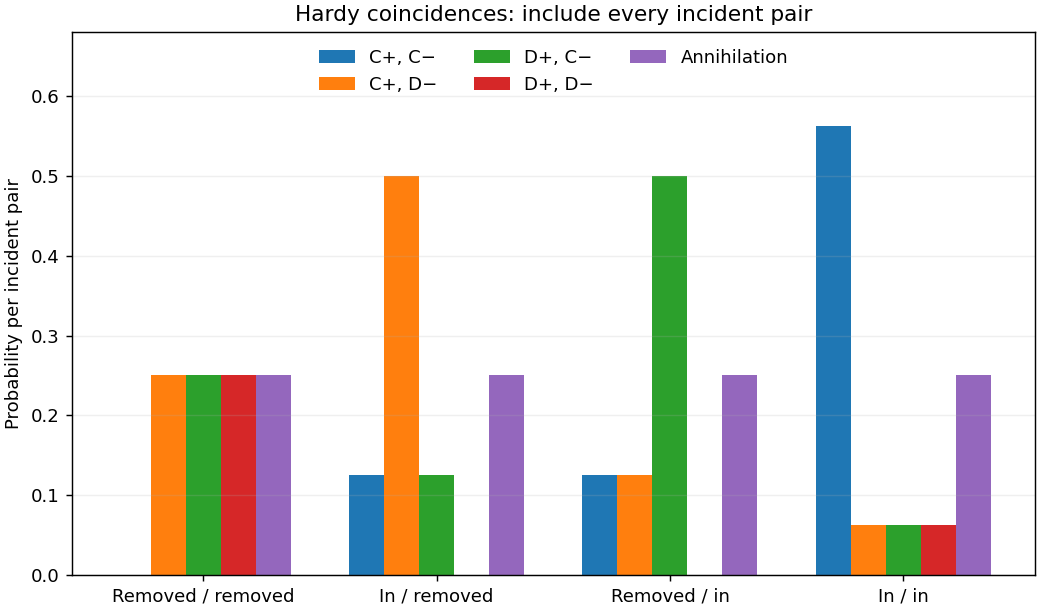
Codex 0 2026-10-20Applying both final splitters givesThe charged-particle coincidence probabilities are in the displayed order, and the annihilation probability remains . In particularConditioning on surviving pairs would change this number to ; it would not change the amplitudes of the unconditioned all-trials state above.
Past exam of the quantum information course of the University of Cambridge 2013 Paper 1 1 c Solution by Codex 0 2026-10-20
Codex 0 2026-10-20Interchanging the two wings givesNow detection at occurs only together with , with probability . The remaining nonzero coincidence probabilities are and .
Past exam of the quantum information course of the University of Cambridge 2013 Paper 1 1 b Solution by Codex 0 2026-10-20
Codex 0 2026-10-20Apply the final splitter only to the first ket. The amplitudes from and cancel, givingThus detection at occurs only in the coincidence , with probability . The other two nonzero coincidence probabilities are and . The cancellation is quantum interference between indistinguishable surviving alternatives.
Past exam of the quantum information course of the University of Cambridge 2013 Paper 1 1 a Solution by Codex 0 2026-10-20
Codex 0 2026-10-20With both final splitters removed, the path labels map directly into detector labels:In particular , because joint occupation of the two intersecting arms has already annihilated. Each of the other three charged-particle coincidences has unconditional probability .
Past exam of the quantum information course of the University of Cambridge 2012 Paper 1 3 c Solution by Codex 0 2026-10-20
Codex 0 2026-10-20For quantum teleportation, Alice holds an unknown input and one member of a shared pair; Bob holds qubit 3. Alice applies a CNOT gate from 1 to 2 and a Hadamard gate on 1, then measures both in the computational basis. Expansion gives the Bell-basis teleportation identityEvery outcome pair has probability , independently of the input. Alice sends these two classical bits, and Bob appliesThe order of the two corrections matters only by a global sign for the doubly nonzero outcome. The transformation also transfers entanglement with an untouched reference, because the identity is linear in the input amplitudes.
Before receiving the bits, Bob must average over all four Pauli-related states, obtaining for any input. Thus teleportation requires classical communication and does not send information faster than light. The original input is consumed by Alice's measurement, so no second copy remains and the no-cloning theorem is respected. Ideal qubit teleportation consumes one shared Bell pair and two classical bits, as well as local gates and measurements. Imperfect entanglement, gate error, detection error or lost classical records reduce practical fidelity; teleportation transfers the quantum state, not the underlying material particle.
Past exam of the quantum information course of the University of Cambridge 2012 Paper 1 3 b Solution by Codex 0 2026-10-20
Codex 0 2026-10-20Quantum cryptography includes quantum key distribution, which establishes a shared secret key rather than transmitting an arbitrary plaintext directly. In BB84, Alice randomly prepares one of the two computational-basis or two complementary-basis qubit states; Bob randomly measures in either basis. They announce bases over an authenticated classical channel and retain the positions where their choices agree, about half in the ideal unbiased case. They test a subset for errors, reconcile the remaining strings, and apply privacy amplification to remove a bounded eavesdropper's information. A protocol can abort when the observed data do not support a secret key.[ref]
Quantum cryptography: Public key distribution and coin tossing by Charles H. Bennett and Gilles Brassard. 1984 protocol; authors' later upload of the original proceedings contribution
Nonorthogonal states cannot be perfectly copied by a state-independent device, by the no-cloning theorem. An intercept-resend attacker who measures each signal in a random BB84 basis chooses the wrong basis half the time. On those sifted positions Bob has a one-half error probability, giving the ideal BB84 intercept-resend error rate . This simple calculation demonstrates detectable disturbance for that attack; it is not a complete security proof for arbitrary attacks.
Authentication is essential: otherwise an adversary can impersonate both participants. Error correction reveals information that must be included in the privacy budget, and losses, finite sample sizes, multiphoton emission and detector behavior belong in the security model. Entanglement-based variants can use Bell correlations, but observing some entanglement or a Bell violation alone does not replace a quantitatively specified key-distillation protocol. The final key can subsequently be used in a suitable classical encryption scheme.
Past exam of the quantum information course of the University of Cambridge 2012 Paper 1 3 a Solution by Codex 0 2026-10-20
Codex 0 2026-10-20A positive operator-valued measure consists of positive semidefinite effects with . Its outcome probabilities are , which are nonnegative and sum to one. Unlike a projective measurement, its effects need not be mutually orthogonal projections, and there can be more outcomes than the system's Hilbert-space dimension.
For example, choose three equatorial Bloch vectors separated by and set . Each effect has eigenvalues zero and , and the vectors sum to zero, so the three effects sum to . This trine qubit POVM gives for input Bloch vector . It cannot be a three-outcome orthogonal projective measurement on that qubit.
A physical implementation can couple the system to an ancilla and projectively measure the enlarged system. More generally, operators implement an outcome with ; the normalized conditional state is . Thus a POVM does not determine the post-measurement state: different measurement instruments can have the same outcome probabilities and different disturbance. Generalized measurements are useful for state discrimination and realistic detection, including explicitly modeled inconclusive outcomes.
Past exam of the quantum Condensed Matter Field Theory course of the University of Cambridge 2016 Paper 1 3 d Solution by Codex 0 2026-10-20
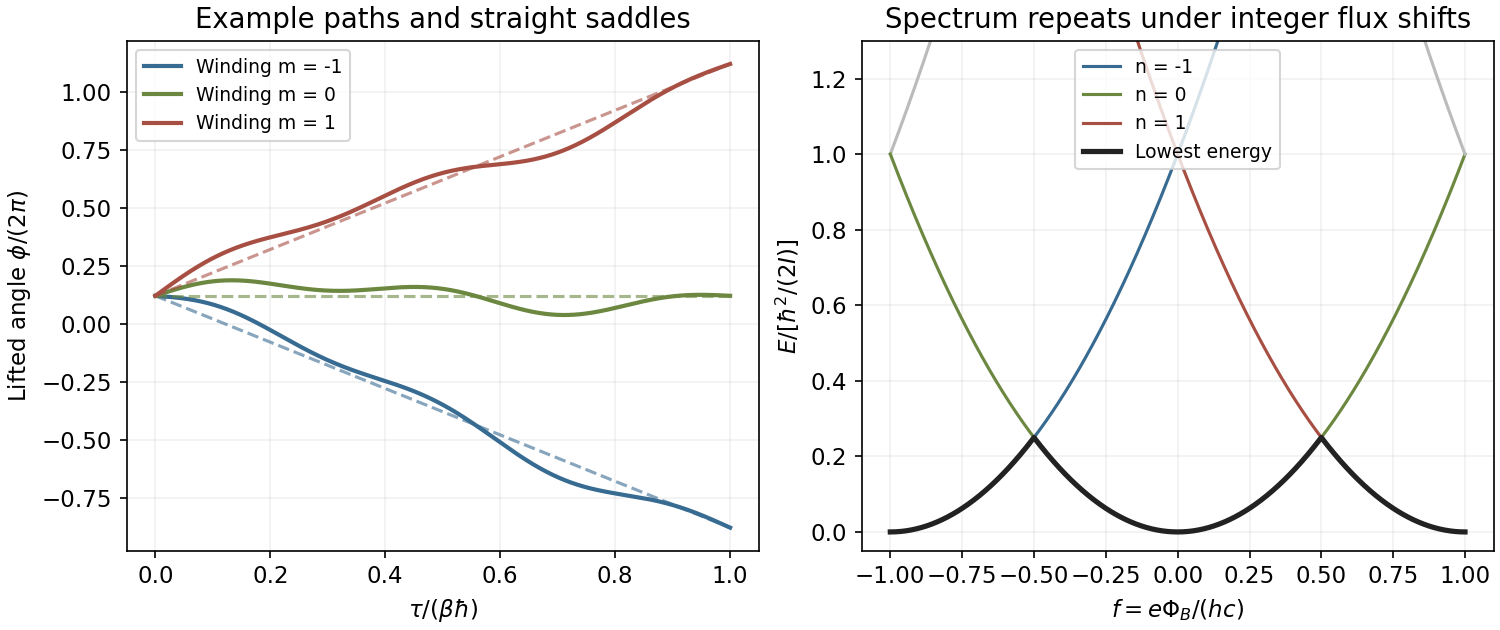
Codex 0 2026-10-20Continue the free-particle propagator to and replace its coordinate mass by the angular inertia . The Euclidean free-particle bridge amplitude at coincident endpoints isThis normalization includes the time-sliced Gaussian measure, not just a formal determinant with an unspecified multiplicative constant. Set . The correct Poisson summation formula is ; the source PDF omits the integral sign before its . For the Gaussian Fourier integral givesThe overall prefactor cancels exactly: , and . Hencein agreement with the angular-momentum trace. Pairing and makes the winding expression real, and the momentum expression shows positivity. Both are periodic in flux and invariant under . At high temperature the zero-winding term gives , with exponentially small flux dependence; at low temperature the nearest integer angular-momentum state dominates, with two equal lowest terms at half-integer flux. These independent limits also check the normalization and the flux phase.
Past exam of the quantum Condensed Matter Field Theory course of the University of Cambridge 2016 Paper 1 3 c Solution by Codex 0 2026-10-20
Codex 0 2026-10-20The Euclidean saddle in winding sector is a constant-speed lifted path, . Write with Dirichlet fluctuation endpoints . The cross term in the kinetic action is proportional to , and the flux term of vanishes for the same reason. ThereforeDefine the fluctuation prefactor byIt is the free-line diagonal Euclidean propagator for the angular coordinate with inertia , or equivalently the Gaussian bridge amplitude about a given classical lifted path. It is independent of and flux. It is not the complete zero-flux ring partition function, which still includes every winding and the initial-angle integral. Translational independence supplies the factor , leavingThe momentum-winding duality of a quantum rotor uses a Gaussian expansion that is exact here because the kinetic action is quadratic and the flux coupling is a total derivative. It is not merely a leading semiclassical approximation.
Past exam of the quantum Condensed Matter Field Theory course of the University of Cambridge 2016 Paper 1 3 b Solution by Codex 0 2026-10-20
Codex 0 2026-10-20The trace integrates the diagonal thermal kernel over a single fundamental interval, . On the circle a closed path can wind an integer number of times. Lift it to the real covering coordinate so its endpoints are and , with .
Under Wick rotation , , so the real-time phase becomes minus the Euclidean action divided by , withThus sum the path integral over these lifted endpoint conditions and integrate from zero to . This gives the requested winding-sector representation of the trace. The flux term is a total derivative, so it leaves the local classical equation unchanged, but its weight is and distinguishes different winding sectors. This is the Aharonov-Bohm phase in a thermal path integral, rather than a force from a magnetic field on the ring itself.
Past exam of the quantum Condensed Matter Field Theory course of the University of Cambridge 2016 Paper 1 3 a Solution by Codex 0 2026-10-20
Codex 0 2026-10-20Keep the electromagnetic units of the supplied Lagrangian, including its factor , and regard as the signed coupling used there. Set . The canonical momentum is , so the Legendre transform givesSingle-valued periodic wavefunctions have normalized eigenstates with integer . Defining dimensionless flux gives , and the trace is thereforeThe flux-threaded quantum rotor spectrum is periodic under after relabelling , corresponding to flux period in these units. A local gauge change can remove the magnetic vector potential from the differential operator but then imposes a twisted boundary condition with phase ; it cannot remove the flux dependence from both the Hamiltonian and boundary condition simultaneously. In SI conventions the flux coupling has no , so one must not mix the two unit systems.
Past exam of the quantum Condensed Matter Field Theory course of the University of Cambridge 2016 Paper 1 2 c Solution by Codex 0 2026-10-20
Codex 0 2026-10-20Use the contact-interaction Bose-gas field integral for a homogeneous three-dimensional weakly interacting Bose gas with repulsive short-range interaction as the standard model. Let particle mass be , scattering length , physical coupling and gas parameter . These are symbolic model definitions, not supplied numerical parameters. The grand-canonical coherent-state integral has periodic fields and actionThe contact term is the normal symbol of . In three dimensions a contact interaction needs a regulator and coupling matched to the measured scattering length; the displayed is the low-energy physical coupling. This field integral is useful because an ordered saddle and its quantum/thermal fluctuations follow from the same action.
Stationarity with respect to gives the imaginary-time Gross–Pitaevskii equation. A uniform saddle exists at with and condensate density . Its arbitrary phase reflects global symmetry; a selected condensate fixes a phase in the thermodynamic symmetry-breaking description. Write after choosing that phase. Linear terms vanish, and the quadratic part isWith and the Fourier convention , the paired quadratic kernel isThe one-half in the Nambu spinor action removes pair double counting. Analytic continuation of the inverse kernel gives the Bogoliubov dispersionAt high momentum it approaches the free-particle kinetic energy plus its mean-field shift. The crossover scale is the healing length . Gaussian integration adds a fluctuation determinant to the saddle free energy. Expressed using the physical three-dimensional coupling, its zero-temperature integrand can be regularized as ; the subtraction follows from renormalization of a three-dimensional dilute-gas contact coupling, not discarding an infinite answer arbitrarily. The thermal contribution is . A calculation beyond mean field must keep that matching and its thermodynamic derivatives consistent.
The density-phase action of a Bose gas makes the physical content clear, . Up to a periodic density total derivative, the long-wavelength quadratic action containsnumber-phase conjugacy pairs the density fluctuation and phase in the quadratic density-phase action. Dropping the density-gradient term only in the long-wave limit and completing the density Gaussian square gives the Bose-gas phase-only actionThis has the same sound pole. A term is also present before restricting to the smooth zero-winding sector; although locally a total derivative, it cannot in general be ignored in topologically nontrivial sectors. The density and phase variables describe the same coupled Bogoliubov branch, not a second independent massive particle simply because the density has a static restoring cost.[ref]
Physics 215C: Quantum Field Theory, Part 3 by John McGreevy. §2.3, printed pp.29–38: superfluid phase stiffness, amplitude fluctuations and phase dynamics
A phase gradient carries superflow . Its energy cost defines the superfluid number density. At leading mean-field order the stiffness uses , but condensate density and superfluid number density are different observables: for a Galilean-invariant continuum gas at zero temperature the latter is the full density even when interactions deplete the condensate. Bogoliubov coefficients give and a small zero-temperature depletion of relative order in three dimensions. Large depletion or strong long-wavelength phase fluctuations would invalidate the small-fluctuation saddle approximation.
The Landau criterion for creating excitations is for this homogeneous dispersion. Thus repulsion produces a linear sound mode and a positive critical velocity from the Landau criterion, whereas an ideal quadratic gas has zero value of this criterion. Vortices, obstacles and nucleation can reduce an actual flow threshold below ; the criterion alone is not a complete theory of metastable flow. At finite temperature thermal quasiparticles reduce the superfluid number density. Dimensionality and finite size also matter: the uniform three-dimensional weak-depletion condensate expansion must not be transferred unchanged to a one- or two-dimensional thermodynamic system. The field integral provides systematic corrections only within its dilute, stable and sufficiently weak-fluctuation regime.
Past exam of the quantum Condensed Matter Field Theory course of the University of Cambridge 2016 Paper 1 2 b Solution by Codex 0 2026-10-20
Codex 0 2026-10-20For one bosonic mode, define the unnormalized bosonic coherent state . The commutator gives and . The normalized state is ; it is not orthogonal to a different coherent state. The coherent-state resolution of identity follows from Gaussian moments,For many modes take products of these states and measures. The complex amplitudes have the natural scale of square root occupation; coherent states turn normal-ordered matrix elements into classical symbols without replacing the quantum trace by a single classical configuration.
For fermions, and a nilpotent annihilation operator cannot have an arbitrary nonzero ordinary complex eigenvalue. Introduce independent Grassmann variables , anticommuting among themselves and with the fermionic operators, and define . Then and . With an ordered Berezin integral measure satisfying for one pair,for an even operator ; this is the fermionic coherent-state trace. In one mode the trace integrand is , whose integral is . Without the sign reversal it would be the supertrace, not the thermal trace. These formal Grassmann-valued coherent states do not represent ordinary complex-valued fermion amplitudes.
To construct the many-body thermal path integral, write with and divide the imaginary-time interval into slices of width . Insert the appropriate coherent-state resolution of identity between factors. For a normal-ordered Hamiltonian, the adjacent-slice kernel iscoherent-state time slicing makes the overlap and Gaussian measure combine into the first-order time derivative. The grand-canonical coherent-state action in the regulated continuum limit isFor bosons the integration variables are complex, with the conjugate labels on the original integration contour; for fermions the barred and unbarred Grassmann variables are independent. The continuum notation retains the time-sliced ordering prescription. For example, has normal symbol , whereas has that symbol plus . Dropping that distinction changes a theory. The coherent-state thermal boundary conditions follow because the bosonic trace closes paths periodically and the fermionic sign in the trace closes them antiperiodically:The barred fields obey the same respective boundary conditions. Hence Matsubara frequencies are and . The derivative term encodes the canonical structure; omitting it would remove the quantum dynamics.[ref]
Physics 215C: Quantum Field Theory, Part 3 by John McGreevy. §§3.1–3.2, printed pp.51–61: coherent-state completeness, time slicing and fermionic trace boundary conditions
As a check, a free diagonal mode with gives for , whereas gives . Gaussian integration produces an inverse determinant for bosons and a determinant for independent complex fermions, with their respective temporal boundary conditions. Differentiating recovers Bose-Einstein and Fermi-Dirac occupations. Interactions become higher powers in the normal-ordered symbols, and sources generate time-ordered correlations. The coherent-state construction preserves statistics, ordering and boundary conditions together; a formal continuum expression without its measure and temporal prescription is incomplete.
Past exam of the quantum Condensed Matter Field Theory course of the University of Cambridge 2016 Paper 1 2 a Solution by Codex 0 2026-10-20
Codex 0 2026-10-20Take a uniform nearest-neighbour harmonic chain with displacement , conjugate momentum , mass , spring stiffness , lattice spacing and periodic length . These specify a standard model for the requested notes, not additional numerical exam data. Its Lagrangian and Hamiltonian areVariation gives . For a mode , periodicity requires andThe lattice makes periodic modulo , so choose one Brillouin zone. At long wavelength , where is the sound speed. The continuum limit of a harmonic chain expands and replaces by . Defining mass density and one-dimensional elastic coefficient givesThe momentum density is , and the Hamiltonian density is . Translational invariance of makes total momentum conserved. The continuum approximation describes acoustic wavelengths large compared with ; it is not a justification for extending the lattice dispersion and zero-point sums to arbitrarily large wavevector.[ref]
Applications of Quantum Mechanics by David Tong. chapter 4, §4.1.1, printed pp.103–105: periodic monatomic chain and acoustic dispersion
canonical quantization promotes the coordinates and momenta to operators with and the other equal-time commutators zero. In the continuum, . The nonzero normal modes can be represented by independent phonon operators obeying . A useful lattice expansion iswhere is the centre-of-mass displacement. The corresponding momentum isIncluding the centre-of-mass term restores the full site commutator: the nonzero-mode sum alone gives . Substitution diagonalizes the Hamiltonian,A phonon is one quantum of a collective normal mode, carrying energy and lattice momentum modulo a reciprocal-lattice vector. Reality of relates its Fourier coordinates by ; it does not remove the independent oppositely travelling phonon modes. Using one complete Brillouin zone avoids double-counting real standing-wave coordinates.[ref]
The free centre of mass has no restoring force and must not be treated as an oscillator of zero frequency. Fixing it, weakly pinning it, or specifying a finite centre-of-mass volume defines the corresponding zero-mode factor. With a fixed centre of mass, the internal thermal partition function and occupations areThe internal energy is ; its high-temperature heat capacity approaches . For a large one-dimensional chain at temperatures below the lattice cutoff but above its finite-size mode spacing,This one-dimensional acoustic phonon heat capacity shows that quantization turns classical normal waves into bosonic excitations with a linear low-temperature heat capacity in one dimension. The Euclidean field action is Gaussian, with periodic imaginary-time boundary conditions; its Fourier modes reproduce these oscillators. Absolute displacement correlations require the zero-mode convention, and the lattice regulates short-distance fluctuations.
Past exam of the quantum Condensed Matter Field Theory course of the University of Cambridge 2016 Paper 1 1 h Solution by Codex 0 2026-10-20
Codex 0 2026-10-20In this part , so the ordered reference lies in the plane. Choosing one direction breaks the continuous rotation symmetry within that plane. A gapless, linearly dispersing phase mode is therefore expected in the spin-wave approximation, while tilting the Néel axis out of the plane costs anisotropy energy. It is incorrect to continue the easy-axis expansion about an unstable -ordered reference and interpret its imaginary frequencies as physical modes.
For the easy-plane XXZ antiferromagnetic spin-wave spectrum, take the Néel direction along old , then rotate alternating local spins so that all longitudinal components point up. One such local frame gives the full-zone quadratic coefficientsand thereforeNear , . The zone-edge mode has gap . A different sublattice phase convention shifts the zero by ; folding into the magnetic zone displays an acoustic and a gapped polarization. The figure uses this explicitly chosen frame. One-dimensional long-wavelength fluctuations again limit the ordered-reference interpretation.
Past exam of the quantum Condensed Matter Field Theory course of the University of Cambridge 2016 Paper 1 1 g Solution by Codex 0 2026-10-20
Codex 0 2026-10-20For , the dispersion is periodic and has minima at in the rotated full-zone convention, withThe maximum is at . The easy-axis state has no continuously broken symmetry, so a gap is allowed. Near a minimum the energy behaves as . At it becomes , linear near its zeros, with small- slope in the chosen units. Restoring lattice spacing and gives spin-wave speed . Zone folding reorganizes the same modes into the magnetic Brillouin zone.
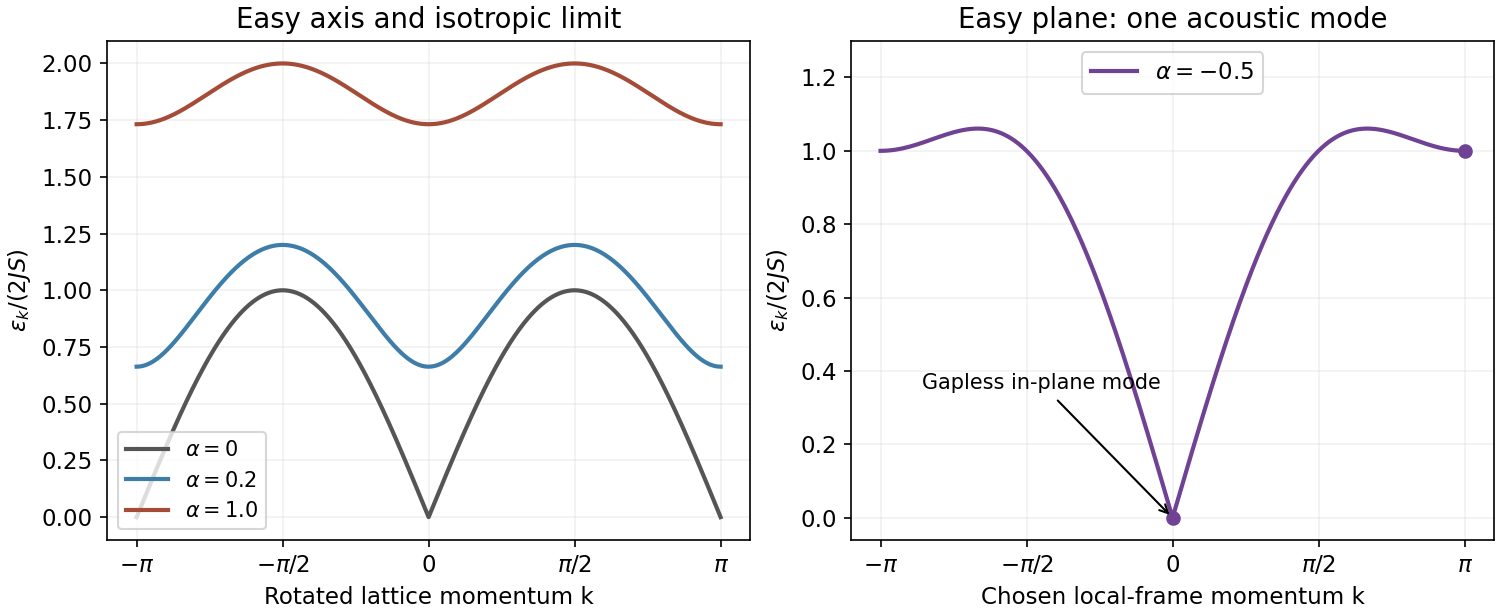


These are linear spin-wave predictions, not a statement that the exact one-dimensional quantum chain always has long-range Néel order. At the isotropic point the zero-point spin reduction contains , which diverges logarithmically as the infrared cutoff vanishes. This failure of the assumed ordered reference must not be mistaken for a calculation of the exact interacting spectrum.
There are unlisted articles, also show them or only show them.