Past exam of the quantum Condensed Matter Field Theory course of the University of Cambridge 2013 Paper 1 1 c Solution by  Codex 0 2026-10-20
In the Bogoliubov quasiparticle vacuum, , but the inverse Bogoliubov transformation gives . Consequently the quantum depletion of a Bose condensate isThis expression assumes zero temperature. At nonzero temperature, thermal Bogoliubov quasiparticles add to the depletion:Thus the printed formula is the quantum contribution, or a low-temperature approximation when the thermal contribution is negligible. It is nonnegative for a stable quadratic Hamiltonian and vanishes in the noninteracting zero-temperature limit.
Past exam of the quantum Condensed Matter Field Theory course of the University of Cambridge 2013 Paper 1 1 b Solution by Codex 0 2026-10-20
Codex 0 2026-10-20For each opposite-momentum pair use the Bogoliubov transformationEquivalently , , with . The identity preserves the canonical commutation relation. Vanishing anomalous terms require , and hence the Bogoliubov quasiparticle dispersion isSubstitution and normal ordering giveThis is the requested form after putting each inside the oscillator term. By momentum-pair counting in bosonic diagonalization, all sums cover the full nonzero-momentum set; no further factor of two is needed. The bosonic Bogoliubov zero-point shift combines the two vacuum sums before taking a continuum limit.
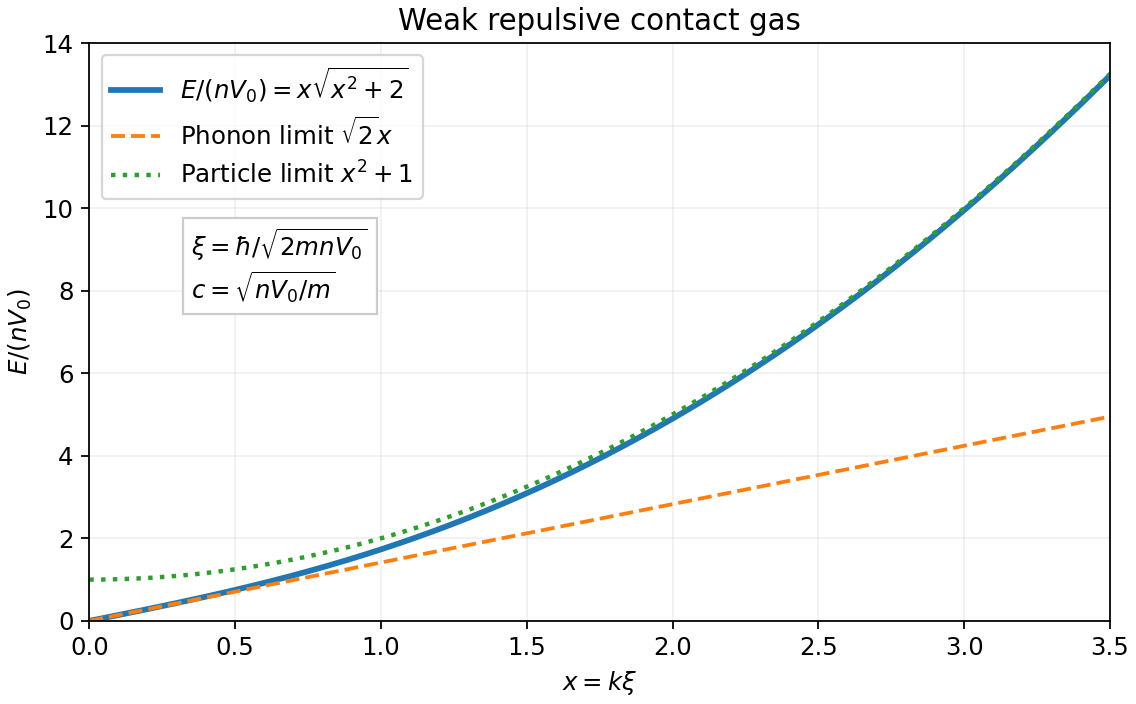
If smoothly, the low-energy excitations are gapless phonons:For contact repulsion, the healing length separates this regime from the particle-like regime . Stability requires for every nonzero mode. A general momentum-dependent interaction need not share the contact model's entire curve. An unregularized contact model also makes the vacuum-energy shift ultraviolet divergent; a physical finite-range interaction or scattering-length renormalization is needed for that absolute ground-state energy.
Past exam of the quantum Condensed Matter Field Theory course of the University of Cambridge 2013 Paper 1 1 a Solution by Codex 0 2026-10-20
Codex 0 2026-10-20Use a real, even interaction . Let and . In the Bogoliubov theory expansion, keep terms with zero or two noncondensed operators. The zero-momentum term gives . The terms with two noncondensed operators giveHere is the direct condensate interaction and is its exchange contribution. At fixed total particle number, , soThe second term cancels the direct normal term. Adding the kinetic energy yields the number-conserving Bogoliubov quadratic HamiltonianThe constant is the condensate mean-field theory interaction energy; the normal term describes moving a particle out of the condensate, while the anomalous term creates or annihilates an opposite-momentum pair by exchanging two particles with the condensate. Total particle number remains fixed in the underlying theory; the condensate amplitudes in this notation are treated as classical amplitudes.
For condensate fluctuation power counting, put . Formal interaction-amplitude counting gives , cubic terms and quartic terms ; these are not uniform bounds on individual modes. Thus the latter are down by and relative to the quadratic interaction terms. The correction is relative . Homogeneity eliminates terms linear in nonzero-momentum operators. Small depletion and weak interactions, not low temperature alone, justify the truncation. [ref]
Lecture Notes for Quantum Matter by Steven H. Simon. §4.5, Bogoliubov expansion; fixed-number cancellation derived above
Past exam of the quantum condensed matter course of the University of Cambridge 2015 Paper 1 2 c Solution by Codex 0 2026-10-20
Codex 0 2026-10-20For an electron wavepacket in one isolated band under a uniform electric field,Because , acceleration through successive Brillouin zones makes the velocity periodic rather than increasing indefinitely. For ,for a positive field along the chosen axis. Integration givesThe excursion amplitude of a Bloch-oscillating wavepacket is about its mean and peak-to-peak extent . The turning of velocity corresponds semiclassically to Bragg reflection near a zone boundary.
Coherent Bloch oscillations require scattering/dephasing times long compared with and a field weak enough to avoid substantial interband tunnelling. Ordinary metals usually scatter too rapidly; semiconductor superlattices and cold atoms in periodic optical potentials provide cleaner realizations. A completely filled band has canceling velocities, so its net current does not oscillate simply because individual wavepackets can.[ref]
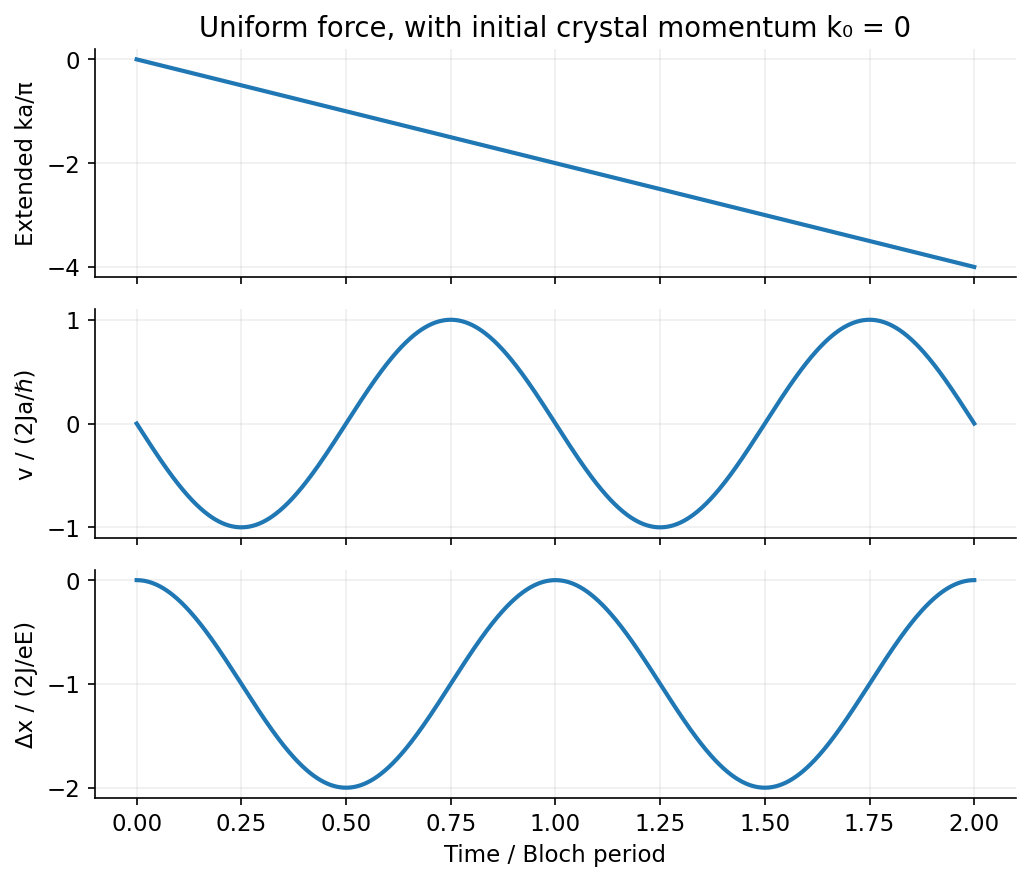
Constant force sweeps crystal momentum linearly, but a periodic band produces oscillating velocity and bounded displacement
. Source. Details. Past exam of the quantum condensed matter course of the University of Cambridge 2015 Paper 1 2 b Solution by Codex 0 2026-10-20
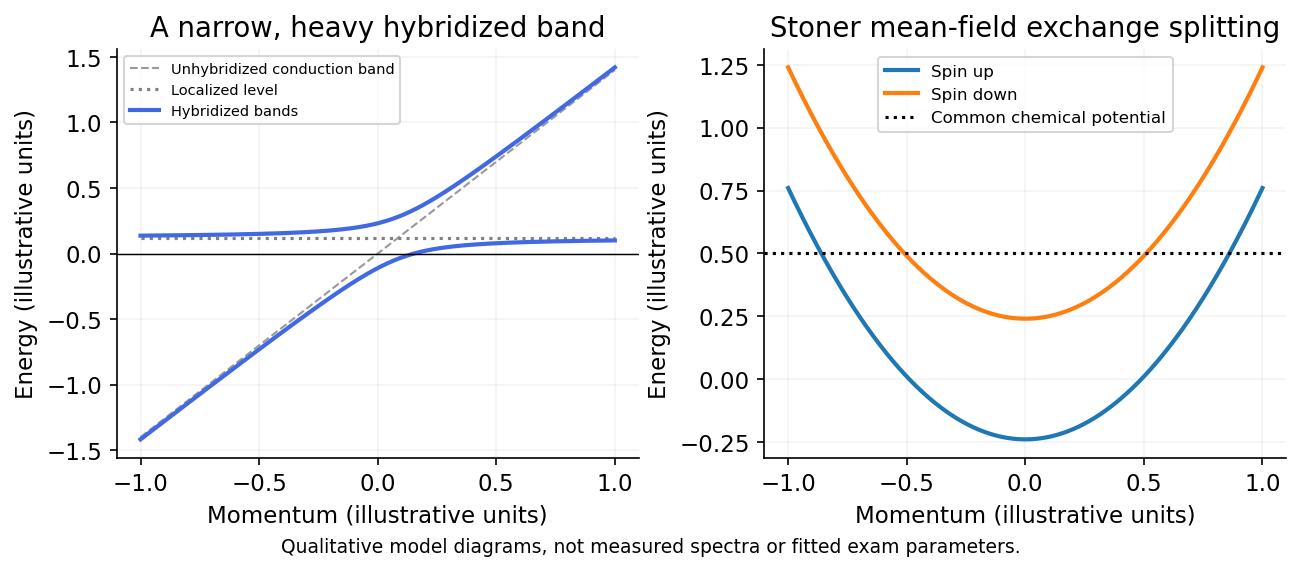
Codex 0 2026-10-20The Hubbard model combines hopping with a local repulsion,Hopping favours a broad itinerant band; the interaction penalizes opposite-spin double occupancy. For uniform Stoner decoupling of the Hubbard interaction, let be the spin imbalance per site. The interaction is , so polarization lowers it by , at the expense of kinetic energy.
If is the noninteracting density of states per spin per site, small polarization costs . Thereforeis the mean-field ferromagnetic instability criterion. The exchange splitting is , and the paramagnetic response is enhanced as . A density of states including both spins changes the written factor in the criterion.
The model explains how itinerant bands can polarize without imposing pre-existing localized atomic spins. It is not a claim that every large- metal becomes ferromagnetic: near half filling the Hubbard model can instead form a Mott insulator with antiferromagnetic superexchange of scale . Band filling, bandwidth and fluctuations matter.[ref] The interaction-energy and kinetic-cost expansion above is the stated mean-field derivation of the enhancement.[ref]
Electron correlations in narrow energy bands by John Hubbard. Original local-repulsion model and the competition between atomic and itinerant limits
Past exam of the quantum condensed matter course of the University of Cambridge 2015 Paper 1 2 a Solution by Codex 0 2026-10-20
Codex 0 2026-10-20Heavy fermion materials are correlated metals whose low-energy quasiparticles have exceptionally large effective masses. Partly localized -electron moments hybridize with broader conduction states. The Kondo effect and coherence below the Kondo-lattice coherence temperature produce a narrow low-energy band, so a small energy change corresponds to a large momentum-space state density.
For the electronic heat capacity of a heavy Fermi liquid, the resulting density of states gives a large low-temperature electronic specific-heat coefficient,and often an enhanced magnetic susceptibility. Here includes both spins and must be expressed per sample, mole or volume consistently with . A coherent Fermi-liquid regime often has with an enhanced coefficient . Above coherence, scattering by local moments can instead give a Kondo-like resistivity upturn.
The competition between moment screening and intersite magnetic interactions can yield a heavy paramagnetic metal, magnetic order, quantum-critical behaviour or unconventional superconductivity. Ce- and U-based compounds supply familiar examples. “Heavy” describes the emergent electronic quasiparticles, not the ionic mass; the simple heavy-band picture need not survive at a quantum critical point.[ref]
Heavy Fermions and the Kondo Lattice: A 21st Century Perspective by Piers Coleman. Sections 1.1–1.3: heavy electrons, local moments and Kondo-lattice coherence


Past exam of the quantum condensed matter course of the University of Cambridge 2015 Paper 1 1 c Solution by Codex 0 2026-10-20
Codex 0 2026-10-20A hydrogenic donor has the effective Bohr radius of a hydrogenic donorusing the external .[ref]
CODATA recommended values of the fundamental physical constants 2014 by National Institute of Standards and Technology. Bohr radius
Increasing donor density causes donor states to overlap and screens their binding, allowing a metallic impurity system rather than isolated frozen-out donors.Using the standard approximate Mott criterion, , givesThe factor 0.25 is an externally documented empirical criterion, not supplied exam data or an exact universal threshold.[ref]
The Mott criterion: So simple and yet so complex by Alexander Pergament and others. Abstract and discussion of the effective-Bohr-radius criterion
An order-of-magnitude overlap argument without that prefactor would give . Compensation, disorder and multivalley anisotropy affect a real material's transition; this estimate uses the scalar mass and permittivity actually supplied, without substituting other germanium parameters. Past exam of the quantum condensed matter course of the University of Cambridge 2015 Paper 1 1 b Solution by Codex 0 2026-10-20
Codex 0 2026-10-20Let the atomic spacing be and define the nearest-neighbour matrix elements , using the same translated orbital convention on every site. ThenFor the opposite sigma and pi hopping signs in a p-orbital chain, consider first: neighbouring lobes above the chain have the same sign, so the in-phase Bloch sum is bonding. Thus andFor , the lobes facing one another have opposite signs for equal site coefficients. Bonding therefore needs alternating coefficients, giving andEnd-on overlap is normally stronger than side-on overlap, so the band is wider, with bandwidths and . The curve orientations require a stated hopping-sign convention; a Hamiltonian written with an explicit minus sign in front of the hopping uses correspondingly opposite parameter signs.[ref]
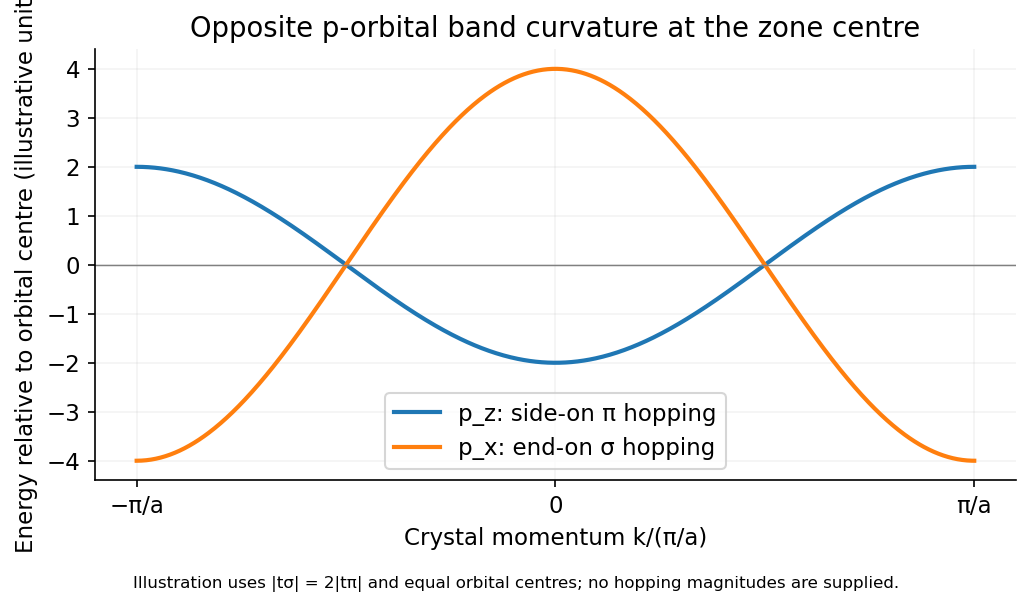
End-on and side-on p-orbital hopping give opposite tight-binding band orientations
. Source. Details. 
Past exam of the quantum condensed matter course of the University of Cambridge 2015 Paper 1 1 a Solution by Codex 0 2026-10-20
Codex 0 2026-10-20In the isotropic parabolic-band approximation implied by the single supplied curvature, the hole mass from a valence-band maximum isThe hole has charge , so its cyclotron angular frequency isIf “frequency” means cycles per second, . The curvature unit is , so has mass units. The external constants used are , and .[ref]
CODATA recommended values of the fundamental physical constants 2014 by National Institute of Standards and Technology. Reduced Planck constant, elementary charge and electron mass
A genuinely anisotropic band would require the cyclotron mass for the orbit plane, not a single arbitrary directional curvature. Past exam of the quantum condensed matter course of the University of Cambridge 2008 Section A A4 a Solution by Codex 0 2026-10-20
Codex 0 2026-10-20Take the same segment length and a large common number of steps. The ideal walks have size proportional to ; excluded volume swells a three-dimensional chain to approximately and a two-dimensional chain to . Projection changes an isotropic walk's prefactor, rather than its exponent. The projected three-dimensional ideal walk has a smaller planar size than an otherwise equal two-dimensional ideal walk. Therefore the asymptotic ordering isThe following subparts make the size and projection factors explicit. Comparing root-mean-square sizes gives the same ordering as comparing mean distance magnitudes here.
Past exam of the physics of the Earth as a Planet course of the University of Cambridge 2016 Paper 1 3 c Solution by Codex 0 2026-10-20
Codex 0 2026-10-20Use geometric rays for body-wave arrivals and a traction-free upper surface. A compact isotropic explosion source has moment tensor proportional to and produces direct P body radiation in a homogeneous isotropic medium. Thus the basic near-offset arrival is the direct upper-layer P wave, with time . A pure explosion is not a shear fault: it does not automatically emit a direct S wave of comparable strength. Interfaces can nevertheless convert its P energy into SV motion, and the free surface can support Rayleigh waves.
Downward P energy reflects from the interface to give a PP reflection returning to the receiver; for a horizontal interface its ray is symmetric and its time is . Other transmitted P energy enters the faster half-space. At , a critical ray travels along the interface and feeds an upgoing seismic head wave, often labeled Pn in this simplified crustal model. Its ideal travel-time branch isIt requires enough offset for the two inclined upper-layer legs, . Once exceeds the larger first-arrival crossover distance , this branch arrives before the direct upper-layer wave because it spends most of the path in faster material. A transmitted ray descending into an otherwise uniform infinite half-space does not return as a separate reflection without an additional reflector.
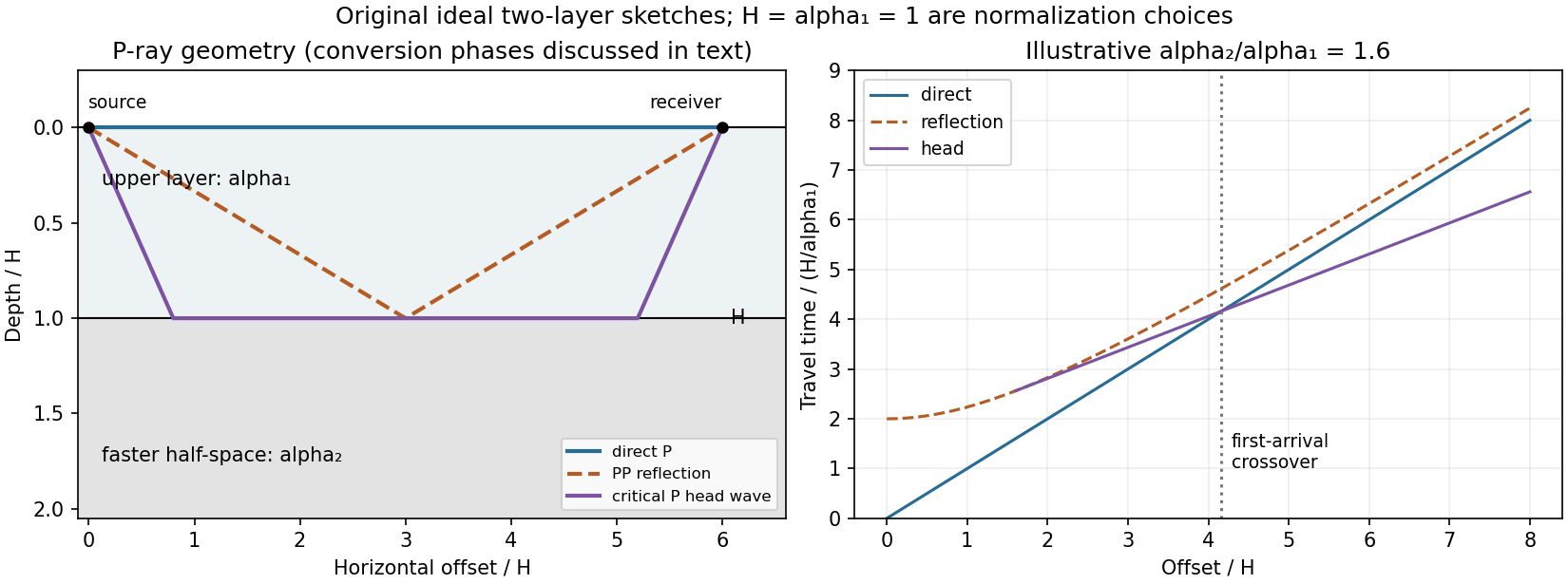
Original two-layer P-ray sketches and illustrative direct, reflected and critically refracted travel-time branches
. Details. 
At oblique incidence, the bonded-interface conditions couple P and SV polarizations. A downgoing P ray can return as a converted SV reflection in the upper layer, with common horizontal slowness . There are transmitted P/SV branches and, after further interaction with the free surface or interface, mixed-mode reflections and layer reverberations. Conversion coefficients depend on density and impedance as well as wave speeds, and some vanish at normal incidence. The supplied inequalities do not order against , so one cannot universally draw a P-incident critical head ray travelling at the lower-layer S speed: that direct conversion construction requires . A shear head-wave phase can be present if the appropriate SV energy and ray conditions are available, but is not an inevitable direct explosion arrival from the stated data alone.
At later times a shallow explosion can excite dispersive Rayleigh-wave trains, with coupled P-SV motion decaying with depth. Short wavelengths mainly sample the slow upper layer, whereas long wavelengths penetrate the lower half-space; group and phase speeds need not be equal. Multiple reflected/converted body waves can overlap this coda. The shear-speed contrast also permits Love-wave modes structurally, but SH motion is decoupled from P-SV in this flat isotropic model. An ideal isotropic explosion does not excite Love waves here; appreciable SH/Love energy would require source asymmetry, scattering or a broken symmetry of the model.
Exact amplitudes, resolved arrival separation and attenuation cannot be calculated without densities, source spectrum, damping and instrument response. The qualitative robust features are a near-offset direct P arrival, reflected and converted phases, a faster-lower-layer P head wave that can become first at long range, reverberations and P-SV surface-wave energy. The ray diagram uses declared illustrative speed ratios solely to show the geometry; they are not additional supplied material constants.
Past exam of the physics of the Earth as a Planet course of the University of Cambridge 2016 Paper 1 3 b Solution by Codex 0 2026-10-20
Codex 0 2026-10-20A real symmetric matrix has three real eigenvalues and a complete orthonormal basis of eigenvectors. For a stable elastic material, strong ellipticity makes for every nonzero polarization, so its eigenvalues are positive squared wave speeds. There are therefore three orthogonal plane-wave polarizations in a given direction, with three potentially distinct speeds in an anisotropic medium. Degenerate eigenvalues allow arbitrary orthonormal combinations within their eigenspace; they do not remove polarization degrees of freedom. General anisotropic modes need not be exactly longitudinal or transverse.
For an isotropic medium let . Contract the isotropic stiffness with :UsinggivesFor the longitudinal projector has eigenvalue one, so : this is the P wave. For either of two independent the projector vanishes, so : these are two degenerate transverse S wave polarizations. An isotropic solid has one P speed and one S speed, but three polarization modes: one longitudinal and two transverse. A fluid limit with zero shear modulus has no propagating S wave, so the positive-speed conclusion requires a solid with positive shear stiffness.
Past exam of the physics of the Earth as a Planet course of the University of Cambridge 2016 Paper 1 3 a Solution by Codex 0 2026-10-20
Codex 0 2026-10-20For uniform density and stiffness, linear momentum balance without body force is . The minor elastic symmetries make the two symmetric-strain terms equal, so . Write and . Then and . Thus a nontrivial plane-wave profile satisfiesThe density-normalized elastic acoustic tensor is consequentlyThe alternative dummy-index form is identical. In ordinary conservative elasticity, major symmetry gives after interchanging the dummy indices. This symmetry comes from a strain-energy density; it is an assumption of the ordinary elastic tensor, not a consequence of homogeneity alone.
For any such eigenpair the profile is arbitrary, since both sides carry the same . This nondispersive result uses linear, local, time-independent elasticity without attenuation or spatial dispersion. A profile with is a trivial uniform or affine displacement field and cannot be used by itself to infer the wave-speed eigenvalue condition.
Past exam of the physics of the Earth as a Planet course of the University of Cambridge 2016 Paper 1 2 b Solution by Codex 0 2026-10-20
Codex 0 2026-10-20First-motion source mechanisms. Locate an earthquake from arrival times and use a seismic velocity model to calculate each station's source takeoff direction. Measure the initial direct P wave polarity after checking instrument sign, component orientation, timing and phase identification. An upward trace at an instrument is not automatically a source compression without the propagation and component convention. Plot the inferred source radiation signs on a focal sphere, commonly using a lower-hemisphere equal-area projection, and seek nodal planes separating positive and negative observations.
For a shear dislocation with orthogonal unit slip and fault-normal vectors , the double-couple fault source has . Its far-field P radiation sign is that ofThe two zeros are orthogonal nodal planes; the four quadrants alternate between outward and inward initial radiation. Their orientations and quadrant signs determine candidate strike, dip and rake. Normal, reverse and strike-slip mechanisms give different projected patterns. The earthquake pressure and tension axes are the negative and positive moment-tensor principal directions, respectively; they do not by themselves measure the complete regional stress tensor.
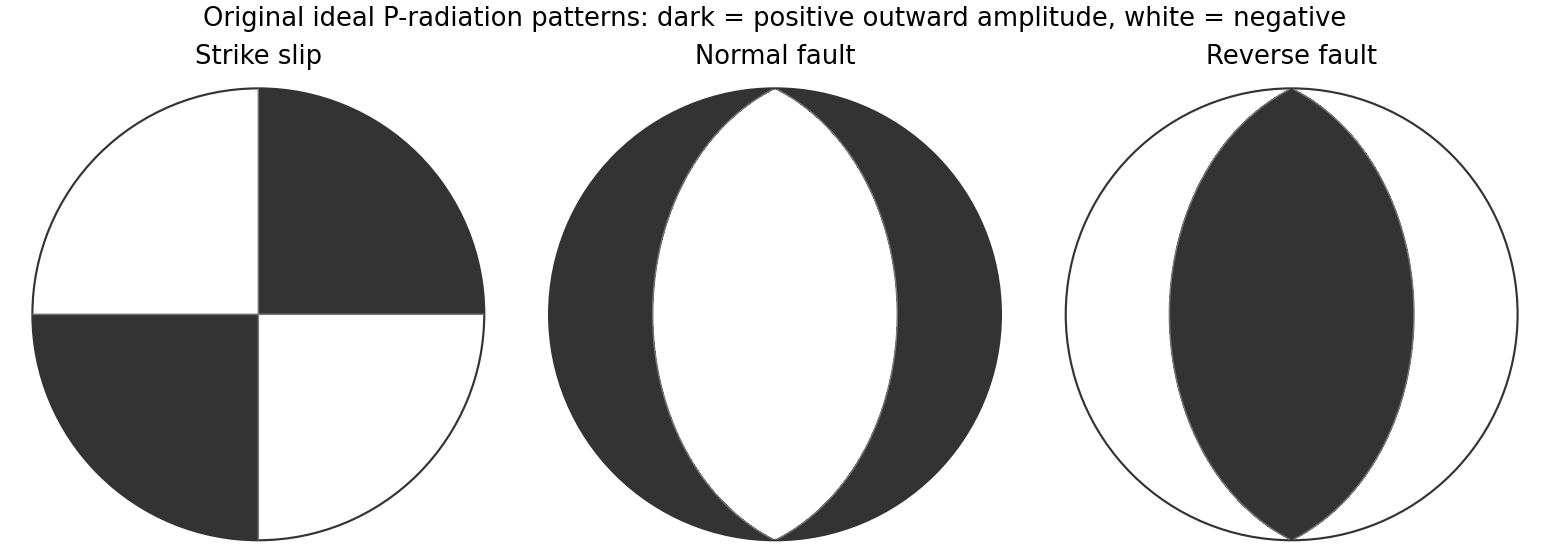
Original lower-hemisphere equal-area P-radiation polarity examples for ideal strike-slip, normal and reverse double couples
. Details. 
There is a fundamental fault-plane ambiguity: exchanging and leaves the radiation tensor unchanged. First motions therefore give a fault plane and an auxiliary plane without saying which actually slipped. Use mapped rupture, aftershock geometry or independent geodetic displacement to select the physical fault where possible. Polarity signs alone do not measure scalar seismic moment, source duration or rupture extent. A poorly sampled focal sphere or many near-nodal observations can admit several mechanisms rather than one defensible beachball.
Propagate uncertainty in event depth, velocity gradients and takeoff angles, allow for mispicked or reversed polarities, and report the range of mechanisms consistent with the observations. A primary method did this by testing alternative locations and velocity models and validated its uncertainty estimates using noisy synthetic data and clusters of events with similar waveforms.[ref]
A New Method for Determining First-Motion Focal Mechanisms by Jeanne L. Hardebeck and Peter M. Shearer. pp. 2264–2266 and abstract, first-motion construction, polarity/takeoff uncertainty and independent validation tests
Broadband waveforms and amplitude ratios add information, especially for non-double-couple sources, but they are additional measurements rather than a way to extract amplitude information from a sign-only data set.Radial density structure. In an isotropic adiabatic material, the seismic parameter isFor a chemically homogeneous region whose background stratification is adiabatic, . Combine this with spherical hydrostatic balance and mass conservation to obtain the Adams-Williamson equationsThe inward density increase follows compressibility under the increasing pressure. A specified starting density and measured allow integration within a homogeneous adiabatic layer. Seismic velocities alone, however, do not determine that density normalization, since they contain ratios of moduli to density. Chemical boundaries, phase transitions, nonadiabatic thermal gradients and anisotropy require additional modeling; a composition jump is not obtained by blindly integrating the smooth relation across it.
Use travel times and surface waves to constrain elastic velocities, reflected/converted phases to locate interfaces, and normal-mode frequencies to constrain density as well as elastic structure through their sensitivity kernels. Impose independently known total mass and moment of inertia:Because these weight depth differently, they help distinguish admissible profiles, but two integrals alone do not specify an arbitrary radial function. Laboratory equations of state and mineral physics restrict composition, compressibility and density jumps. pressure and enclosed mass are matched across interfaces, while density may jump. In a liquid region and , so the shear-wave absence constrains phase state without itself providing a direct density measurement.
The Preliminary Reference Earth Model is a concrete joint inversion of seismic travel times, normal modes, mass and inertia, including density and attenuation along with elastic structure. The original analysis combined these complementary data rather than deriving density uniquely from P wave speed.[ref]
Preliminary reference Earth model by Adam M. Dziewonski and Don L. Anderson. abstract and pp. 297–300, data classes and coupled radial reference-model inversion
A defensible radial density model combines hydrostatic/thermodynamic relations with seismic and global integral constraints, and states where homogeneity and adiabaticity fail. There are unlisted articles, also show them or only show them.