Past exam of the relativity course of the University of Cambridge 2015 Paper 1 2 c Solution by  Codex 0 2026-10-20
Ordinary component differences at neighboring points depend on how the local bases vary. The covariant derivative corrects for that variation:Each upper tensor index adds a connection term and each lower index subtracts one. A scalar has , while the derivative of a tensor transforms as a tensor with one additional covariant index. The Christoffel symbols themselves are not tensor components; their inhomogeneous transformation cancels that of the ordinary derivative.
For the Levi-Civita connection,These express metric compatibility and zero torsion. Along , parallel transport is the initial value problemIt preserves inner products for the Levi-Civita connection. Parallel transport of the tangent itself gives the affinely parametrized geodesic equation, .
Transport generally depends on the path. On a round sphere, transport a tangent vector around the triangle bounded by two meridians degrees apart and the intervening equatorial arc. All three sides are geodesics; the enclosed spherical area is . The returning vector is rotated by degrees, with sign set by traversal orientation. Locally this holonomy is controlled by curvature, even though the connection can be made zero at a single point. A vector can therefore have changing coordinate components while remaining parallel, and constant components do not generally mean parallel transport.
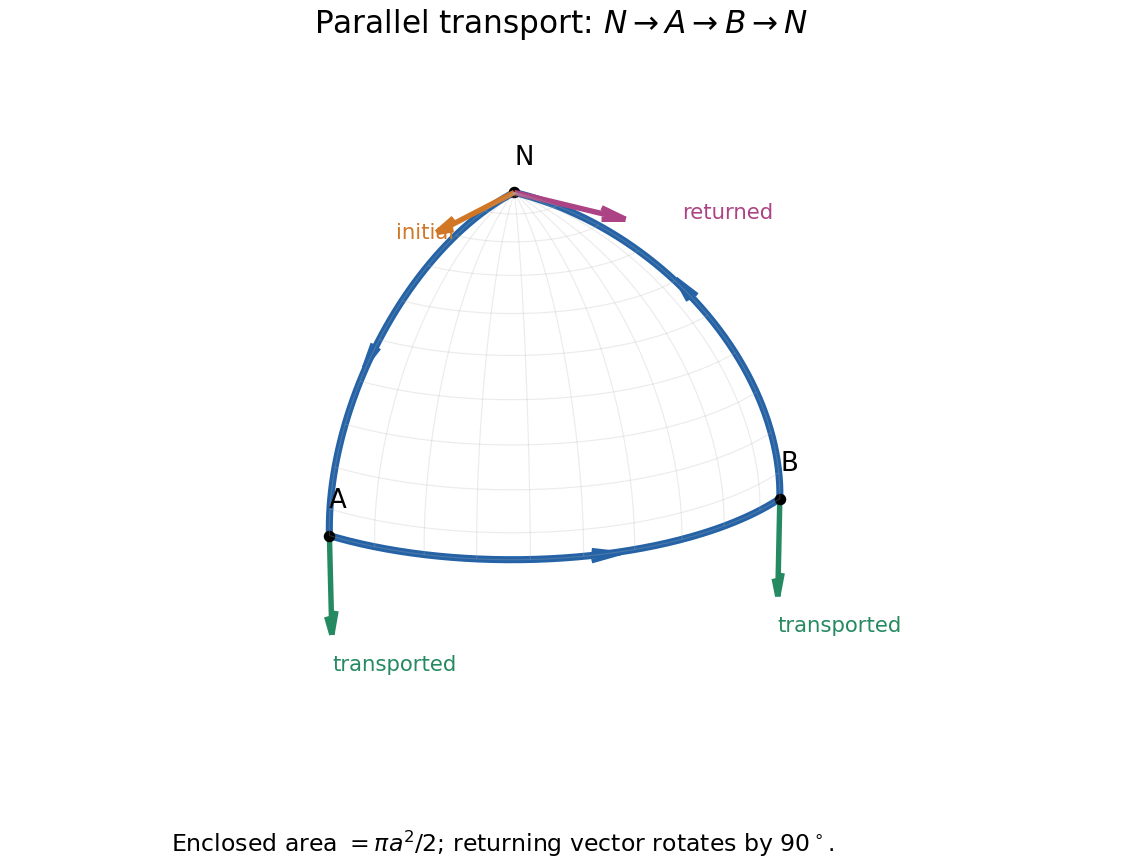
Original spherical-triangle transport: a tangent initially pointing along the first meridian returns rotated by ninety degrees
. Details. 
Past exam of the relativity course of the University of Cambridge 2015 Paper 1 2 b Solution by Codex 0 2026-10-20
Codex 0 2026-10-20The cosmological principle idealizes spatial slices as homogeneous and isotropic. The corresponding Friedmann-Lemaître-Robertson-Walker metric can be writtenHere is cosmic time, has dimensions of length in this convention, and is a dimensionless comoving coordinate. The sign of gives positive, zero or negative spatial curvature. It does not alone determine global topology. A comoving pair at fixed radial coordinates has proper separation scaling with , so the Hubble parameter is , and cosmological redshift satisfies .
For a perfect fluid of mass-equivalent energy density and pressure , Einstein's equations giveThe last equation is local energy conservation for constant , with vacuum energy kept separate from . A component with has : pressureless matter dilutes as and radiation as , the additional radiation factor being photon redshift. With , matter domination gives and radiation domination gives . Positive vacuum energy alone gives exponential expansion, with .
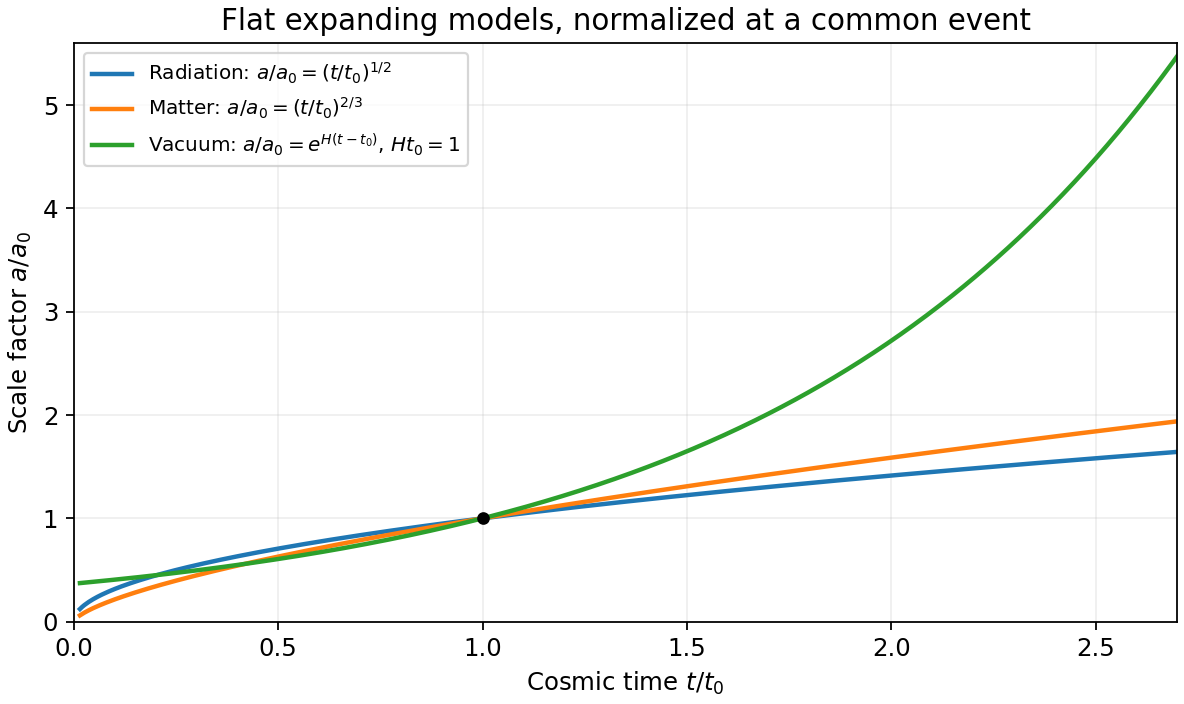
Original comparison of normalized scale factors in flat radiation, matter and positive-vacuum models; the vacuum model has no finite-time big-bang origin in this chart
. Details. 
Geometry, contents and initial conditions together determine the expansion history. A closed matter-only model recollapses; an open matter-only model expands indefinitely. With a cosmological constant, positive spatial curvature no longer by itself implies recollapse. Present critical density is and the density parameters obey , where . These models describe the large-scale background, while local structure and inhomogeneities require perturbations or more general metrics.
Past exam of the relativity course of the University of Cambridge 2015 Paper 1 2 a Solution by Codex 0 2026-10-20
Codex 0 2026-10-20A tidal force is a difference of gravitational acceleration across an extended region. In Newtonian gravity, . Two neighboring freely falling particles separated by have, to first order,For a point mass, . In a local orthonormal radial/transverse frame,A small freely falling cloud stretches radially and compresses transversely. Outside the source the three eigenvalues sum to zero, consistently with ; within matter the trace is . These are accelerations of separations, not the much larger common acceleration of the cloud's centre.
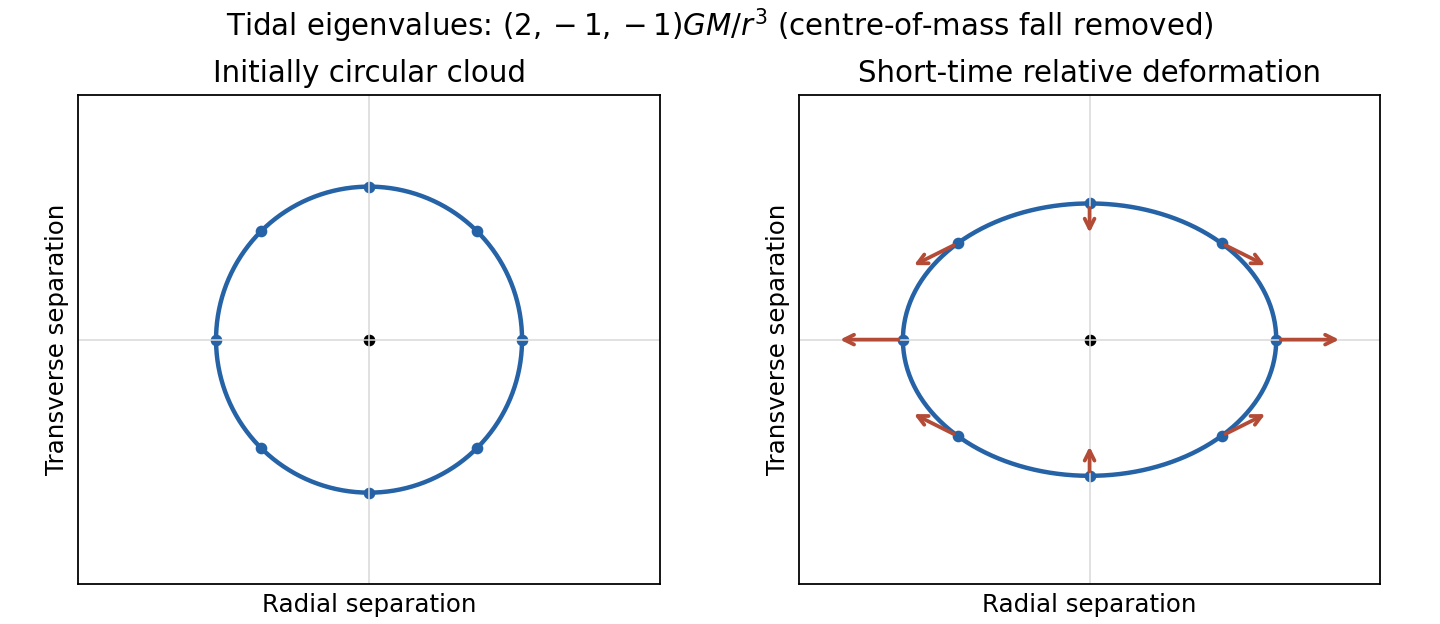
Original local tidal map: a freely falling cloud stretches along the radial direction and contracts in both transverse directions
. Details. 
In general relativity, freely falling test particles follow timelike geodesics. A freely falling frame can eliminate the connection at one event, but not the Riemann curvature tensor throughout a finite laboratory. Let be the geodesic tangent and a connecting vector for neighboring geodesics with . In the explicitly chosen curvature conventionthe geodesic deviation equation isIt follows by commuting , using and zero torsion. In a parallel-propagated orthonormal frame, its spatial components directly describe measured relative acceleration. The weak-field, slow-motion limit recovers the Newtonian Hessian above. Reversing the curvature sign convention reverses the displayed curvature side, without changing the physical stretching. The equivalence principle removes locally uniform gravity, while geodesic deviation measures the residual tidal field. The connection between parallel transport, curvature and neighboring geodesics is developed systematically in the standard geometric construction.[ref]
Lecture Notes on General Relativity by Sean M. Carroll. Section 3, Curvature: parallel transport and geodesic deviation; translate the chosen curvature sign consistently
Past exam of the relativity course of the University of Cambridge 2015 Paper 1 1 c Solution by Codex 0 2026-10-20
Codex 0 2026-10-20Use metric signature and four-velocities , with . Their Lorentz invariant inner product isIn the rest frame of either particle this same scalar is the relative Lorentz factor . HenceLet . The numerator after combining terms isUse to obtainThe two rest frames agree on the relative speed, although their velocity vectors are expressed in different spatial frames. Checks include equal velocities giving zero, collinear velocities giving , and low speeds reducing to the Galilean relative speed. For timelike particles the four-velocity inner product also ensures .
Past exam of the relativity course of the University of Cambridge 2015 Paper 1 1 b Solution by Codex 0 2026-10-20
Codex 0 2026-10-20Assume an emitter at rest on the stellar surface and a static observer at infinity. Write . The time-translation Killing energy of a photon is conserved, while the locally measured photon energy is proportional to . ConsequentlyUsing , , and ,The Schwarzschild radius is approximately , below the given surface radius. The positive shift is therefore a gravitational redshift of an escaping photon, with received wavelength about times the emitted wavelength. A moving emitter would introduce an additional Doppler factor; that is outside this static-surface model. The weak-field estimate is insufficient at this compactness. These stated constants are numerical conventions, not a claim about an unavailable historical handbook's last digits.
Past exam of the relativity course of the University of Cambridge 2015 Paper 1 1 a Solution by Codex 0 2026-10-20
Codex 0 2026-10-20Use arc length as the affine parameter, and put a dot over derivatives with respect to . The geodesic Lagrangian on the sphere isThe cyclic coordinate gives . With the constant normalized as in the paper,Here has units of inverse length, because is physical arc length. Unit-speed normalization givesFor , division by yields the spherical-geodesic first integralThe turning latitudes satisfy . In the usual polar-coordinate range ,The maximum departure from the equator, often the geometric quantity intended by an angular amplitude, is insteadThus polar angle and signed latitude must not be interchanged. At the geodesic is the equator. At it is a meridian through the poles; cannot serve as a global parameter and the divided equation is inapplicable. The limiting polar range is then .
The original PDF prints an ambiguous derivative with the square on rather than a conventional derivative notation. If the intended equation was second order, differentiating the first integral, or eliminating from the Euler-Lagrange equation, gives the equally useful formIt has the same normalized geodesics and the same turning angles. Giving both forms resolves the typographical ambiguity without pretending that a second derivative is the square of a first derivative. Geometrically these trajectories are great circles, with inclination to the equator.
Past exam of the relativity course of the University of Cambridge 2014 Paper 1 2 c Solution by Codex 0 2026-10-20
Codex 0 2026-10-20The strongest pre-2014 evidence combines large gravitating mass with extreme compactness. In an X-ray binary, companion-star radial velocities determine a binary mass function; orbital inclination, donor properties and distance complete the mass inference. An unseen component above conventional neutron-star masses is a black-hole candidate. For example, a 2011 Cygnus X-1 analysis combined optical photometry, spectroscopy and distance information to infer a compact-object mass about , with model and observational uncertainties.[ref]
Near Sagittarius A*, infrared stellar astrometry and radial velocities trace nearly Keplerian orbits around a dark compact mass. The concentration of several million solar masses in a small volume strongly challenges an extended cluster of ordinary remnants; source confusion, reference-frame errors, distance and possible extended mass must be fitted.[ref]
Measuring Distance and Properties of the Milky Way's Central Supermassive Black Hole with Stellar Orbits by Andrea M. Ghez and others. Abstract and orbital-fit/systematic-error discussion
Gas and maser dynamics provide related compact-mass tests in other nuclei.accretion explains luminous X-rays, rapid variability and broad relativistic disk features. These constrain size and the strong-field environment, but emission alone is not unique to an event horizon. Lack of surface-like signatures is supporting, model-dependent evidence. Mass, compactness and consistent accretion phenomenology together support the black-hole interpretation; large-radius mass measurements alone do not directly demonstrate a horizon.
Past exam of the relativity course of the University of Cambridge 2014 Paper 1 2 b Solution by Codex 0 2026-10-20
Codex 0 2026-10-20Use coordinates , signature , and the convention , . The antisymmetric electromagnetic field tensor combines six field components:It transforms as . Lowering indices changes the time–space signs: , while . The covariant tensor instead uses the inverse coordinate Jacobian on each lower index.
For a frame moving with velocity relative to the original one,Electric and magnetic fields therefore mix under a boost; they are frame-dependent parts of one tensor. For example, a purely transverse electric field acquires a magnetic field in a boosted frame. The electromagnetic field invariants and restrict which fields can be eliminated by a frame change. The covariant force law guarantees consistent particle dynamics in all inertial frames.
Past exam of the relativity course of the University of Cambridge 2014 Paper 1 2 a Solution by Codex 0 2026-10-20
Codex 0 2026-10-20inertial mass sets the response to force, . Passive gravitational mass sets the response to a given gravitational potential, ; active gravitational mass describes a body's gravitational sourcing. Universality of the passive-to-inertial mass ratio makes freely falling trajectories independent of composition. torsion balance comparisons and differential free-fall experiments test this weak equivalence principle by searching for composition-dependent acceleration, with environmental forces and instrumental asymmetries controlled.
The Einstein equivalence principle further says that local nongravitational experiments in a freely falling laboratory obey special relativity, independent of the laboratory's location and velocity. A local inertial coordinate system can remove Christoffel symbols at one event, but cannot remove a nonzero Riemann tensor throughout a finite region. Relative acceleration of separated freely falling particles reveals tidal gravity. Thus a uniformly accelerating laboratory in flat spacetime can mimic a local gravitational field, while extended tidal measurements distinguish genuine curvature. Equality of the measured mass responses does not make every gravitational field globally equivalent to acceleration.
Past exam of the relativity course of the University of Cambridge 2014 Paper 1 1 c Solution by Codex 0 2026-10-20
Codex 0 2026-10-20Use the largest Newtonian tidal-tensor eigenvalue, the radial gravity gradient . Imposing the supplied gradient threshold givesThis is about from the centre, or above the stated surface. The tangential eigenvalues have half the radial magnitude. Since , the Newtonian tidal estimate is adequate; this calculation uses the given threshold without inferring any additional material-response model.
Past exam of the relativity course of the University of Cambridge 2014 Paper 1 1 b Solution by Codex 0 2026-10-20
Codex 0 2026-10-20On a coordinate patch with , , and the only nonzero metric tensor derivative is . ThusAll remaining Christoffel symbols vanish. In the supplied Riemann tensor convention,For example, is flat away from the polar-coordinate origin, while gives positive Gaussian curvature .
Past exam of the relativity course of the University of Cambridge 2014 Paper 1 1 a Solution by Codex 0 2026-10-20
Codex 0 2026-10-20With , four-momentum conservation gives total energy and momentum . The compound system therefore hasHere . The excess over is retained internal energy, assuming absorption without escaping radiation.
Past exam of the relativity course of the University of Cambridge 2013 Paper 1 2 c Solution by Codex 0 2026-10-20
Codex 0 2026-10-20Write , and , so . The ingoing Eddington-Finkelstein coordinates use to label ingoing radial light fronts. Substituting into the Schwarzschild metric givesThe radial block has determinant even at ; its coefficients have no horizon divergence. The apparent singularity of Schwarzschild time at the future horizon is therefore a coordinate failure. The physical curvature singularity at remains.
The radial null trajectories in ingoing Eddington-Finkelstein coordinates haveThe ingoing family crosses the future horizon smoothly. The outgoing family has zero outward radial coordinate speed at the horizon and decreasing radius inside it; both future null directions then lead toward smaller radius. These advanced coordinates cover the exterior and future black-hole horizon, rather than simultaneously regularizing the past white-hole horizon. Their null time coordinate is not a clock reading of a stationary observer.
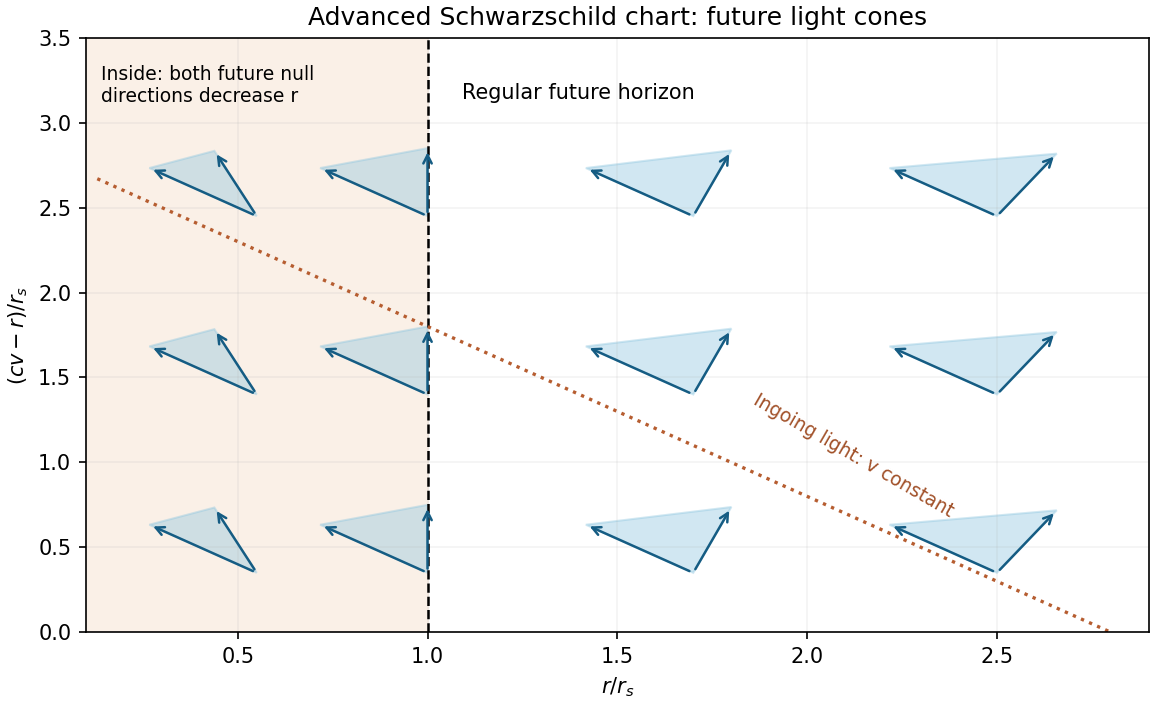
Original future light-cone schematic in regular advanced Schwarzschild coordinates, using vertical coordinate cv minus r
. Details. 
Past exam of the relativity course of the University of Cambridge 2013 Paper 1 2 b Solution by Codex 0 2026-10-20
Codex 0 2026-10-20accretion-disk tests of strong-field gravity put radiating matter in a strong gravitational field at relativistic orbital speeds. general relativity predicts an innermost stable circular orbit, for a nonrotating black hole, with a spin-dependent radius in the Kerr metric. If the radiating inner edge tracks that orbit, its fitted radius and binding-energy release probe the geometry. For a thin disk with negligible inner-edge torque, ; the Schwarzschild efficiency is .
In relativistic iron-line spectroscopy, a fluorescent iron line supplies a rest-energy reference. The relativistic Doppler effect from orbital motion, relativistic beaming, gravitational redshift and ray bending produce an asymmetric broadened profile, including a red wing from the deepest emitting radii. The ASCA observation of MCG-6-30-15 showed a broad asymmetric iron feature relative to the approximately neutral-iron energy, interpreted through relativistic disk-line models.[ref]
ASCA: MCG-6-30-15 by NASA HEASARC. Mission result description: broad iron line, low-energy asymmetry and relativistic interpretation
The observed line must be separated from the illuminating continuum, absorption and other reflection features; inclination, ionization and the radial illumination law affect the inferred radius.thermal-continuum fitting of an accretion disk provides an independent method for a geometrically thin, optically thick disk. Its spectrum and normalization constrain a characteristic inner area, provided mass, distance, inclination and atmospheric spectral hardening are controlled. A pre-2013 application selected thermal-state observations of GRS 1915+105 at relatively low disk luminosity to make the thin-disk approximation appropriate.[ref]
The Spin of the Near-Extreme Kerr Black Hole GRS 1915+105 by Jeffrey E. McClintock and others. Abstract: relativistic continuum fit, thermal-state selection, luminosity cut and inner-edge assumptions
Consistency among inner radius, line transfer and thermal emission tests the strong-field disk picture. A black-hole spin estimate obtained by assuming a Kerr metric is not by itself a model-independent verification of general relativity. Stress across the nominal inner edge, finite disk thickness, coronal geometry, calibration and competing absorption models must be constrained; a gravity test compares alternative geometries while allowing for those astrophysical uncertainties. An emitting material surface or boundary layer can further complicate disks around neutron stars.
Past exam of the relativity course of the University of Cambridge 2013 Paper 1 2 a Solution by Codex 0 2026-10-20
Codex 0 2026-10-20Universality of free fall equates the passive gravitational response to inertial mass up to a universal choice of units. The Einstein equivalence principle further states that local nongravitational experiments in a freely falling laboratory obey special relativity independently of the laboratory's location and velocity. A supported laboratory instead has proper acceleration, just as an accelerating laboratory in flat spacetime does.
Around an event, freely falling coordinates can be chosen so that and there. The first metric tensor derivatives vanish at that event, and nearby corrections begin at order curvature times squared separation. The metric tensor's second derivatives retain the Riemann tensor. Thus a local inertial frame removes Christoffel symbols at an event, while tidal gravity remains measurable over a finite region. Relative motion of separated freely falling test particles detects this curvature through geodesic deviation. Freely falling axes carried along an observer's world line extend the local construction, but do not make an extended curved region globally Minkowskian.
Past exam of the relativity course of the University of Cambridge 2013 Paper 1 1 c Solution by Codex 0 Created 2026-10-20 Updated 2026-11-05
Codex 0 Created 2026-10-20 Updated 2026-11-05The Christoffel symbols of a spatially flat FLRW metric depend on the time-coordinate convention. Here is , not . For an affine parameter , take . Its Euler-Lagrange equations areComparison with the geodesic equation givesAll others vanish because is constant and there are no spatial metric tensor derivatives. The lower-index interchange is essential: the printed list specifies one member of each symmetric mixed pair. The factor of two in the spatial geodesic equation comes from those two members.
Past exam of the relativity course of the University of Cambridge 2013 Paper 1 1 b Solution by Codex 0 2026-10-20
Codex 0 2026-10-20For geodesic motion of uncharged dust, use the pressureless stress-energy form, and . stress-energy conservation expands toContracting with kills the second term, since . Hence , and wherever ,On a flow line , so this becomes . Each relativistic dust element therefore follows a timelike geodesic with proper time as an affine parameter. pressure gradients or external nongravitational forces would add an acceleration term.
Past exam of the relativity course of the University of Cambridge 2013 Paper 1 1 a Solution by Codex 0 2026-10-20
Codex 0 2026-10-20Use the angular-diameter ratio under a collinear boost, with motion along the common sightline and small angular radius . For a boost toward the source, relativistic aberration of the incoming light gives , where is the relative rapidity. Thus the observer seeing the smaller disk has angular diameter reduced by . The ratio two implies , soThe answer is . Both observations occur at one event, so this is a relativistic aberration comparison rather than a change of geometrical distance during observation. Arbitrary transverse relative motion would require additional directional information; the stated motion toward the same distant target selects the collinear interpretation.
Past exam of the relativistic Astrophysics and Cosmology course of the University of Cambridge 2016 Paper 1 3 e Solution by Codex 0 2026-10-20
Codex 0 2026-10-20The equivalence principle connects the universality of freely falling motion to the local description of gravity. In Newtonian language a test body's response to a given field is proportional to . Equality of that ratio for different non-gravitating test bodies gives the weak equivalence principle: identical initial conditions yield identical free-fall trajectories, independent of composition. Negligible nongravitational forces and negligible disturbance of the background are part of the test-body limit.
The Einstein equivalence principle adds local Lorentz invariance and local position invariance for nongravitational experiments. A sufficiently small freely falling laboratory obeys the local laws of special relativity independently of its spacetime location and freely falling velocity. Uniform acceleration of a small laboratory can imitate the leading local effects attributed to a gravitational field. An observer held at rest in a gravitational field generally needs proper acceleration; a freely falling observer does not.
Mathematically, local inertial coordinates can set the metric to Minkowski form and the Christoffel symbols to zero at an event. The geodesic equation there has no connection term at that point:This coordinate choice does not remove curvature. With a standard curvature convention, nearby free-fall trajectories have relative accelerationThe tidal signal survives in an extended laboratory. Thus the principle is local and does not identify every gravitational field with acceleration globally. Finite-size spin and tidal couplings also qualify the ideal point-test-body statement.
The strong equivalence principle extends the universality to gravitational experiments and bodies whose gravitational self-energy is important. It is stronger than the Einstein principle and need not hold in every metric theory that satisfies local nongravitational equivalence. Comparing the Earth and Moon as they fall toward the Sun probes this distinction as well as composition effects. Lunar laser-ranging analyses test differential acceleration by fitting the lunar orbit and measured ranges; an interpretation in terms of self-energy requires separating ordinary composition-dependent violations.[ref]
Lunar Laser Ranging Tests of the Equivalence Principle by James G. Williams and others. 2012 abstract, differential Earth-Moon free fall and dependence on composition and gravitational self-energy
Redshift and clock comparisons test local position invariance; laboratory Lorentz tests and universality-of-free-fall experiments test other components. These are complementary tests, not deductions from a single numerical equality of inertial and gravitational mass. The principle motivates geometric gravity and minimal coupling, but does not by itself derive the complete Einstein field equations or determine the value of the gravitational constant.
Past exam of the relativistic Astrophysics and Cosmology course of the University of Cambridge 2016 Paper 1 3 d Solution by Codex 0 2026-10-20
Codex 0 2026-10-20Supernovae are explosive stellar events with different energy sources and progenitors; a remnant is the expanding ejecta and shocked environment left afterward. Their spectra classify the observed event, while explosion mechanisms give a related but distinct physical classification. Lack of hydrogen absorption defines TypeI spectroscopically; TypeII shows hydrogen. TypeIa typically shows silicon features, while stripped-envelope core-collapse events can be TypeIb or Ic.
In core collapse, an evolved massive star's central core loses support as nuclear processing ceases to supply stable pressure support, electron captures reduce electron pressure and photodisintegration consumes energy. Collapse can form a neutron star or black hole. A shock launched near core bounce loses energy, so a successful explosion requires additional processes, often modeled through neutrino heating aided by multidimensional flow; some collapses fail to eject a bright ordinary supernova. The compact remnant and neutrino emission distinguish this channel physically from a thermonuclear disruption.
TypeIa explosions involve thermonuclear burning of a carbon-oxygen white dwarf in a binary-related evolutionary channel. Both near-Chandrasekhar and sub-Chandrasekhar routes are studied; no single progenitor path is forced by the spectral classification alone. Radioactive nickel and cobalt decay can power much of the later optical emission. Empirical light-curve standardization makes these events useful distance indicators, but dust, population differences and calibration must be controlled; they are not intrinsically identical candles.
Initially ejecta may expand nearly freely, with radius , until swept-up external mass becomes dynamically important. The shock heats the surrounding gas and a reverse shock heats ejecta. For an approximately spherical, adiabatic explosion of fixed energy into a uniform density , dimensional analysis gives the Sedov-Taylor stage:The dimensionless coefficient depends on the equation of state; no value is needed without specifying that model. For a strong nonrelativistic shock in a monatomic gas, an equilibrated post-shock temperature scale is . Collisionless electron and ion temperatures may differ.
Later radiative losses can produce a dense cooled shell. Idealized pressure-driven and momentum-conserving snowplough models then have different expansion exponents; the environment and continuing interior pressure determine which description applies. For uniform ambient density and conserved shell momentum, gives . Real remnants can be asymmetric and encounter nonuniform winds or clouds.
Thermal X-ray emission traces shocked plasma, optical lines trace cooling gas, and radio synchrotron emission traces relativistic electrons and magnetic fields. Shocks can accelerate cosmic rays and alter the energy budget. Ejecta abundances, a surviving compact object, pulsar-powered nebulae and the remnant's dynamics help reconstruct the explosion, but present morphology alone does not uniquely identify the progenitor.
Supernovae enrich the interstellar medium, stir and heat galactic gas and can drive outflows or trigger local compression. Their feedback couples small stellar scales to galaxy evolution. Quantifying that effect requires accounting for cooling and the collective environment rather than assigning all explosion energy to a permanently retained galactic reservoir.
There are unlisted articles, also show them or only show them.