Past exam of the materials science course of the University of Cambridge 2016 Paper 1 3 b Solution by  Codex 0 2026-10-20
Take for the unresolved iron doublet. The underlying tabulated and wavelengths are approximately and .[ref]
X-ray wavelengths and X-ray atomic energy levels by J. A. Bearden. Table V, iron entries; physical PDF page17
Using the inferred , Bragg's law gives the following approximate cone angles:The exact angles inherit the lattice-parameter uncertainty. Five reflection families are kinematically possible with this longer wavelength: . The next FCC family, 400, cannot satisfy Bragg's law.
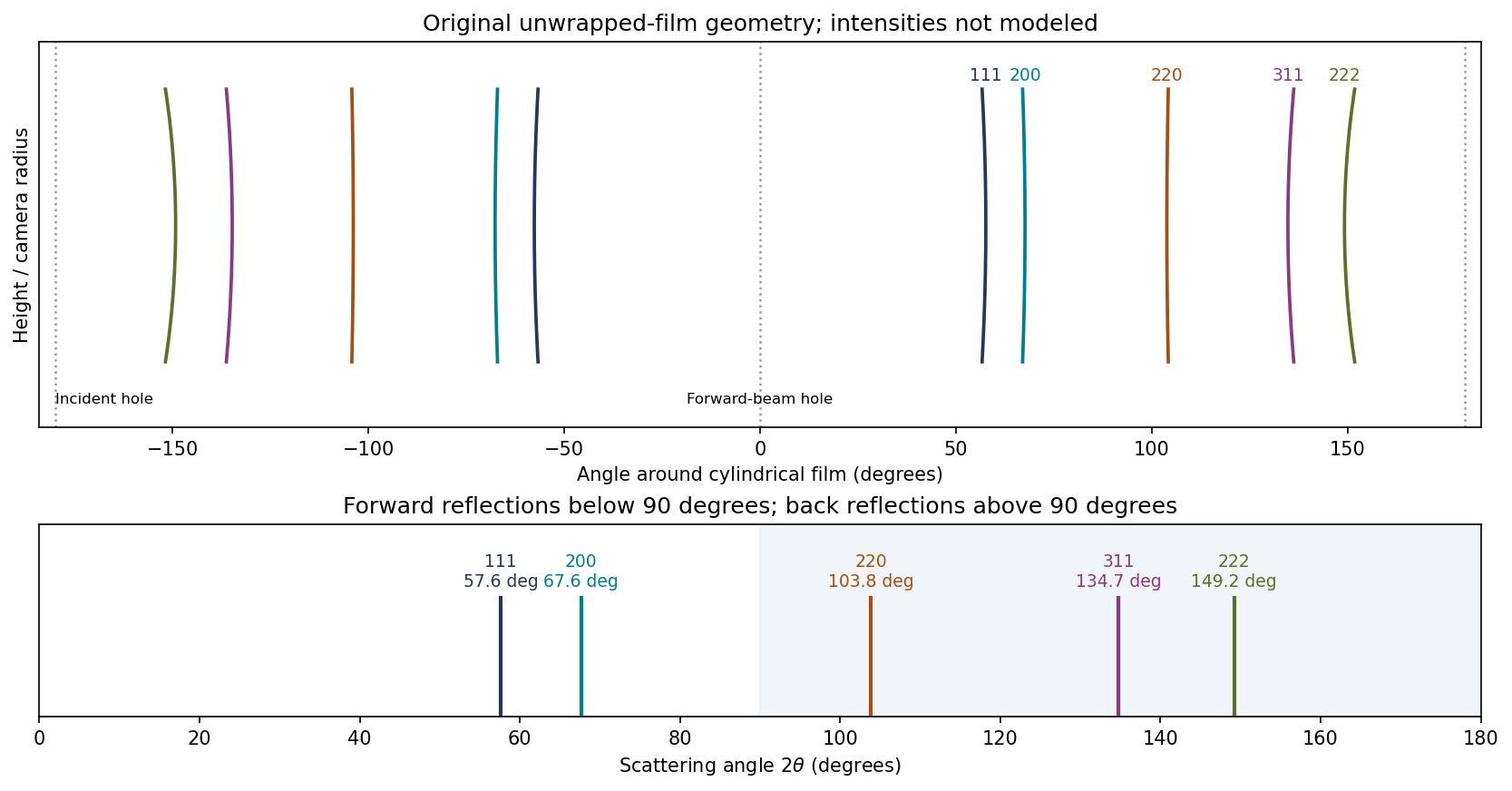
Original calculated Fe cone intersections on unwrapped cylindrical film; angular positions use the measured lattice estimate, line intensities are schematic
. Details. 
A cylindrical Debye-Scherrer camera records paired curved lines where each diffraction cone intersects the film. Both forward and backward cones can be intercepted. The last three families are back reflections here, unlike the rings recorded on the original forward flat plate. Film position is proportional to camera angle along the equatorial circumference, rather than to ; the incident and transmitted beam holes must also be distinguished from reflections. A sufficiently resolved exposure may separate the characteristic doublet, but the schematic does not claim to predict line intensities.
Past exam of the materials science course of the University of Cambridge 2016 Paper 1 3 a Solution by Codex 0 2026-10-20
Codex 0 2026-10-20Measure ring centers and radii against the printed scale, rather than comparing raw squared radii. A representative reading of the four rings is , with broad photographic lines. For a flat plate at distance ,With the ratios are approximately , givingFor identical atoms at the four conventional FCC positions,The structure factor is for indices all even or all odd, and zero for mixed parity. Thus, for example, 100, 110 and 210 are systematic absences. The allowed squared-index sums begin . Only the first four rings fit within the displayed field; 222 and later allowed reflections are not forbidden merely because they are outside the image. The central shadow and its holder are not extra diffraction peaks.
Past exam of the materials science course of the University of Cambridge 2016 Paper 1 2 d Solution by Codex 0 Created 2026-10-20 Updated 2026-10-20
Codex 0 Created 2026-10-20 Updated 2026-10-20The numerical vacancy fraction depends on what the supplied diffusivity describes. In the usual effective mobile-vacancy calculation, the carriers per cell are oxygen vacancies, each of effective charge . There are eight oxygen sites, so that convention givesThere is a real qualification: the printed description calls the measured particles oxygen carrier ions. If is their tracer diffusivity and every occupied oxygen site is counted as an uncorrelated carrier, the inversion instead gives , formally . Such an enormous oxygen deficiency is inconsistent with the ordinary lightly doped fluorite picture; it is not a credible deduction of vacancies in stabilized zirconia.
More generally the conductivity involves a collective diffusion coefficient, whereas tracer diffusion includes jump correlations. With the explicitly defined convention ,Without a carrier definition and the relevant correlation information, the literal tracer data do not uniquely establish the vacancy fraction. The consistent vacancy-carrier interpretation gives the boxed estimate. Interpreting the same measured as an oxygen-ion tracer diffusivity requires the collective/tracer conversion above; ordinary Nernst-Einstein relation arithmetic cannot identify these two carrier populations. This states the model assumption needed for the numerical result without treating the physically implausible uncorrelated oxygen-ion inversion as an established material composition.
Past exam of the materials science course of the University of Cambridge 2016 Paper 1 2 c Solution by Codex 0 2026-10-20
Codex 0 2026-10-20The conventional cubic cell has volumeConsequently the same effective carrier count isA noninteger mean is normal for a doped crystal: it describes an ensemble average, not a requirement that every cell contain the same number of defects. The fluorite structure has four cation sites and eight oxygen sites in this conventional cell.
Past exam of the materials science course of the University of Cambridge 2016 Paper 1 2 b Solution by Codex 0 2026-10-20
Codex 0 2026-10-20For an oxide ion, or an oxygen vacancy measured relative to the ideal lattice, the charge magnitude is . The independent-carrier Nernst-Einstein inversion at givesHere and must describe the same carrier convention. If the quoted diffusivity is a mobile-vacancy diffusivity, this is the vacancy density. If it is literally an oxygen-ion tracer diffusivity, it is an effective oxygen-ion density under an uncorrelated model. Vacancy density cannot be substituted for oxygen-ion density while retaining the same diffusivity. This distinction is consequential in the last part.
Past exam of the materials science course of the University of Cambridge 2016 Paper 1 2 a Solution by Codex 0 2026-10-20
Codex 0 2026-10-20Assume one temperature-independent activation energy over this interval and an unchanged dopant-controlled carrier population. Write the Arrhenius equation as . The two measurements giveUsing yieldsThe Nernst-Einstein relation includes the factor : . For fixed and a fixed correlation correction,Using conductivity proportional to alone would miss the temperature factor. Carrier association, a changing vacancy population or a changing diffusion correlation factor would invalidate this simple extrapolation.
Past exam of the materials science course of the University of Cambridge 2016 Paper 1 1 c Solution by Codex 0 2026-10-20
Codex 0 2026-10-20At fixed temperature, a phase's Gibbs free energy satisfies . For the metallic-minus-molecular difference,Increasing pressure favors the smaller-volume metallic phase. With a pressure-independent volume approximation, , so pressure can overcome an initially positive free-energy difference. The volume comparison explains the direction of stabilization; it does not by itself determine the transition pressure or the electronic origin of metallic bonding.
Past exam of the materials science course of the University of Cambridge 2016 Paper 1 1 b Solution by Codex 0 2026-10-20
Codex 0 2026-10-20Count atoms before comparing cell volumes. The molecular conventional cell has eight atoms; the metallic face-centered cubic cell has four. ThusRelative to the molecular phase,The transformation therefore produces about 22.2% contraction per atom on the stated extrapolated-volume comparison. Conversely, the molecular volume is about larger than the metallic volume; these percentages have different denominators. Compressibility would be needed to turn the extrapolated comparison into exact volumes at the transformation pressure.
Past exam of the materials science course of the University of Cambridge 2015 Paper 1 7 d Solution by Codex 0 2026-10-20
Codex 0 2026-10-20A single-domain precipitate has no internal domain wall available to move. Magnetization changes therefore require rotation, curling or reversal of a particle's magnetization, rather than ordinary wall displacement through that particle. Relative to a larger multidomain material this can increase coercivity, but the actual coercivity depends on anisotropy, shape and particle interactions. If thermal activation over the anisotropy barrier is rapid on the observation timescale, superparamagnetic behavior can instead suppress remanence. Ferromagnetic composition plus small size alone does not prove a permanent hard magnet.
For an elementary wall-energy comparison, imagine one planar wall through a sphere of radius . Its area is . If that trial two-domain state removes essentially all of the specified stray-field energy while adding wall energy , stability of the uniform state requiresWith and the supplied ,This is the requested scale under a full stray-energy-release and one-planar-wall approximation; it is a lower-bound estimate within that model.
A more exact comparison uses the actual energy reduction of the competing domain pattern, not necessarily the whole original stray energy:No domain geometry, anisotropy energy or barrier is supplied to determine or establish that the observed state is the thermodynamic ground state rather than kinetically trapped. Thus the given information alone does not establish an unconditional positive numerical lower bound independent of the competing pattern; the elementary estimate must retain its stated assumptions.
Past exam of the materials science course of the University of Cambridge 2015 Paper 1 7 c Solution by Codex 0 2026-10-20
Codex 0 2026-10-20Orowan bypass bows a dislocation around an unshearable obstacle and leaves a loop. A dislocation line-tension estimate for a segment with tension gives the limiting shear-stress scalewhere is a free obstacle gap on the slip plane. For an FCC perfect dislocation,Using and the simple gap estimate givesConverting to tensile stress requires an orientation factor. With an explicitly assumed polycrystalline FCC Taylor factor ,The graph and spacing approximations do not justify a precise last digit. A favorably oriented single crystal with Schmid factor1/2 would instead give , around110MPa.
This is a line-tension estimate. A true slip-plane obstacle distribution, line character, logarithmic elastic corrections and precipitate size distribution are not specified. If the quoted pitch is used directly as an effective free spacing, neglecting diameter, the same simplified calculation gives and . The larger gap-corrected estimate explicitly uses the size inferred above; the tensile factor and spacing convention must not be silently treated as provided measurements.
Past exam of the materials science course of the University of Cambridge 2015 Paper 1 7 b Solution by Codex 0 2026-10-20
Codex 0 2026-10-20Assume the two thermodynamic phases have similar atomic volumes, so use . Model the stated average pitch by one sphere per representative cubic volume . If the sphere diameter is ,Using the more literal lever-rule reading0.145 gives about0.65micrometres instead, within graphical uncertainty. The central estimate is therefore a diameter of roughly two-thirds of a micrometre.
A random distribution does not make a nearest-neighbor mean distance exactly equal to the cube root of inverse number density. The representative cubic spacing is an explicit geometric closure, not evidence that the precipitates actually form a cubic lattice. Unequal molar volumes or a different spacing statistic would change the inferred size.
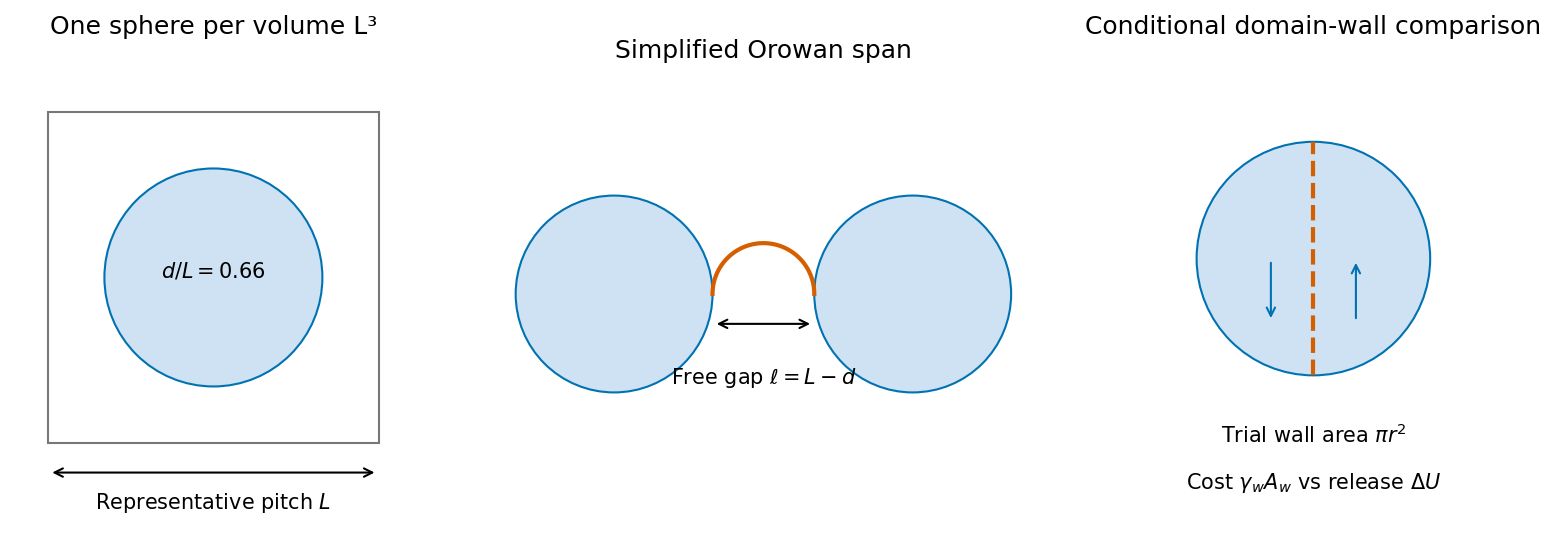
Original geometric estimates for a spherical precipitate fraction, a dislocation free gap and a trial internal domain wall
. Details. 
Past exam of the materials science course of the University of Cambridge 2015 Paper 1 7 a Solution by Codex 0 2026-10-20
Codex 0 2026-10-20At two-phase equilibrium, the endpoints of a common tangent to the two molar free-energy curves give the coexisting compositions. They are not the separate curve minima. Reading the graph gives approximately and , with a few atomic-percent graphical uncertainty.
Let be the fraction of atoms in the precipitate thermodynamic phase. Conservation of the overall B fraction givesand henceAbout85percent remains in the B-richer matrix. Smooth readings of the original curves put the result near14–15percent; the graph does not justify many significant figures. The result is an atomic or molar thermodynamic phase fraction. Its identification with a volume fraction in the next estimate requires comparable atomic volumes of the two thermodynamic phases.
Past exam of the materials science course of the University of Cambridge 2015 Paper 1 6 d Solution by Codex 0 2026-10-20
Codex 0 2026-10-20Use the same molar amount for both thermodynamic phases. A hexagonal cell built from two basal lattice vectors at120degrees has volume , not the volume of a three-times-larger full hexagonal prism. With four atoms per stated graphite cell,Diamond has eight atoms per conventional cubic cell, soFor graphite transforming to diamond,ThereforeThe positive slope reflects diamond's smaller entropy and volume. Higher temperature favors the higher-entropy graphite thermodynamic phase, requiring greater pressure to compensate in favor of the smaller-volume diamond thermodynamic phase.
This estimate treats the supplied ambient molar entropies and volumes as applicable near coexistence and neglects their changes through thermal expansion, compressibility and heat capacity. It gives an approximate gradient, not the transition pressure or a complete high-pressure thermodynamic phase boundary; an intercept would require an additional free-energy datum.
Past exam of the materials science course of the University of Cambridge 2015 Paper 1 6 c Solution by Codex 0 2026-10-20
Codex 0 2026-10-20Diamond can be metastable: its Gibbs free energy is higher than graphite's under ambient conditions, but transformation is kinetically inhibited. Conversion requires substantial rearrangement of the strong carbon-bond network and the formation and growth of a new thermodynamic phase, with an activation and nucleation barrier.
At room temperature the rate can be extremely small even though the free-energy change favors graphite. Thermodynamic stability specifies the preferred equilibrium state, not the time needed to reach it. Persistence of diamond therefore does not contradict graphite's ambient equilibrium stability.
Past exam of the materials science course of the University of Cambridge 2015 Paper 1 6 b Solution by Codex 0 2026-10-20
Codex 0 2026-10-20A multi-anvil press transmits a large external load through several hard anvils onto a confined pressure medium surrounding the sample. Reducing the loaded area raises pressure, while the surrounding medium and gasket limit lateral escape. A resistive heater within the assembly can heat the sample, with insulation and temperature sensing arranged around it. It provides relatively large sample volumes and useful bulk, high-temperature experimental conditions, but access to the sample and optical paths is restricted, pressure gradients and calibration matter, and the maximum pressure is constrained by anvil strength and geometry.
A diamond anvil cell squeezes a very small sample and pressure medium in a gasket hole between opposed diamond culets. Diamond combines high strength with useful optical transparency, permitting spectroscopy and optical pressure calibration as well as suitable X-ray access. Heating can be external or laser-based. The very small contact area permits high pressure from a modest total force, but gives a tiny sample volume. Nonhydrostatic stress, pressure gradients, gasket deformation, heating gradients, chemical compatibility and diamond failure are important limitations.
Neither device generates pressure by force alone independent of area and confinement. Nor does a nominal force-to-area ratio guarantee a known hydrostatic sample pressure; experimental pressure and temperature must be calibrated. The two assemblies trade sample volume and access against pressure reach rather than one being universally preferable.
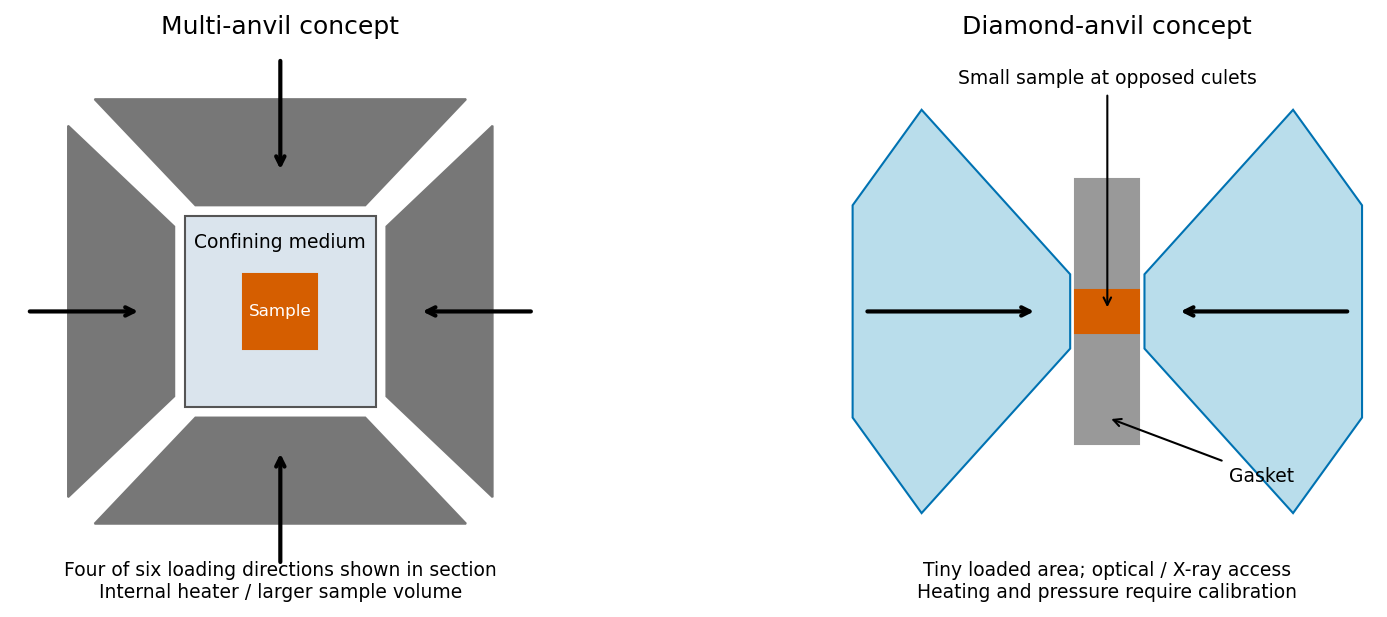
Original conceptual comparison of multi-anvil load transmission and opposed diamond culets, showing confinement and qualitative heating/access tradeoffs
. Details. 
Past exam of the materials science course of the University of Cambridge 2015 Paper 1 6 a Solution by Codex 0 2026-10-20
Codex 0 2026-10-20At equilibrium between two thermodynamic phases of a pure substance, their molar Gibbs free energies are equal. Along a coexistence line,Subtracting the two differentials givesFor a nonzero volume change,The second equality uses on coexistence. Total entropy and volume changes may be used instead if they refer to the same amount of material. The ratio must use one consistent transformation direction, so reversing the labels changes both signs and leaves the slope unchanged. This is the general Clapeyron equation; the ideal-vapour approximation often called Clausius-Clapeyron makes further assumptions not needed for two solids.
There are unlisted articles, also show them or only show them.