Past exam of the advanced quantum physics course of the University of Cambridge 2013 Paper 1 4 Solution by  Codex 0 2026-10-20
Define and use radiation energy density per unit angular frequency, excluding the zero-point contribution. The Angular-frequency Einstein coefficients give rates per atom: for absorption, for stimulated emission, and for spontaneous emission. Stimulated emission adds a photon to the stimulating mode; spontaneous emission persists with no incident photons.
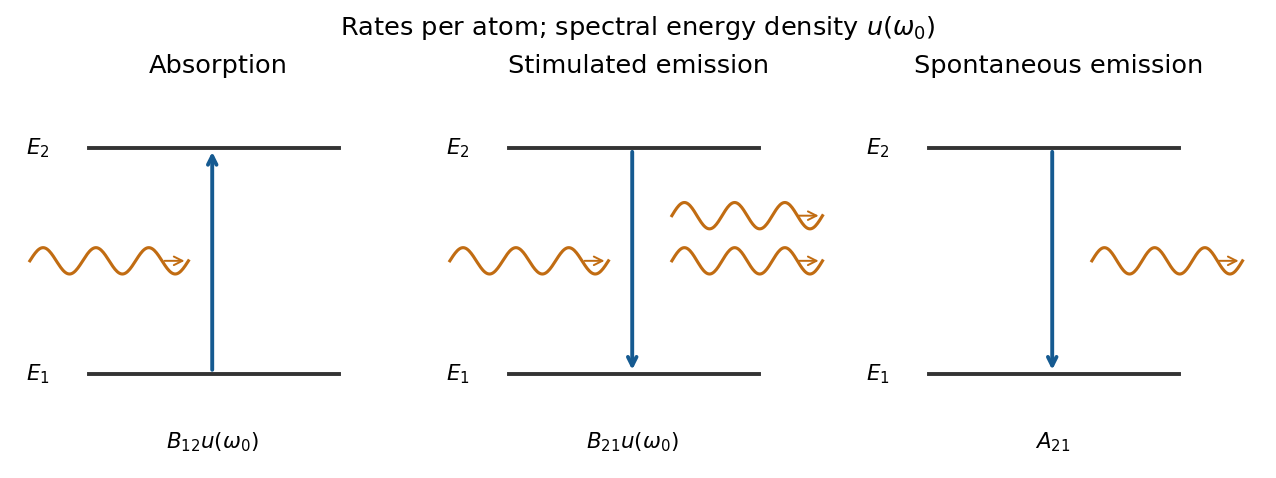
Absorption, stimulated emission and spontaneous emission between two nondegenerate levels
. Source. Details. In thermal equilibrium the Boltzmann distribution gives . Balancing up and down rates yieldsMatching the Planck law for every temperature fixesNo degeneracy factor is needed for these nondegenerate levels.[ref]
Topics in Quantum Mechanics by David Tong. §4.3.2, printed pp.123–127: thermal balance and Einstein coefficients
For plates of large area and spacing , the surviving low-frequency transverse electromagnetic mode has one polarization, , and in-plane wavevector. Periodic in-plane counting givesMultiplying this single-polarization two-dimensional photon density of states by and the Bose-Einstein distribution produces the thermal radiation between parallel conducting plates:The same rate balance therefore givesThese coefficients refer to the radiation polarization in their respective environments: isotropic free-space must not automatically be equated to the coefficient for a specified -polarized field.
For hydrogen, take the quantization axis along , neglect spin-orbit coupling, and assume perfect plates, a wide in-plane region and an unmodified atomic wavefunction: , with negligible surface-induced mixing or shifts. The electric-dipole selection rules for hydrogen require ; the allowed field has . Hence the polarization-selective spontaneous emission between conducting plates givesThe thin-cavity enhancement of a normal electric dipole applies: the dipole points along and couples to the enhanced mode density. For , the transition dipoles lie in the – plane and couple to none of these low-frequency modes: the electric-dipole decay rate is zero in the ideal model, so this channel's lifetime is infinite. Real finite, imperfect plates and additional decay or mixing channels limit the lifetime. The order-one orientation factor for the allowed transition does not change the requested lifetime scaling.
Past exam of the advanced quantum physics course of the University of Cambridge 2013 Paper 1 3 Solution by Codex 0 2026-10-20
Codex 0 2026-10-20With and oscillator length , the first two harmonic oscillator eigenfunctions and energies areThe ground state is even and nodeless; the first excited state is odd with one node of a wavefunction. Their rms widths are and . Also, gives the characteristic extent directly.
For the shaken harmonic trap, expanding about the unshifted Hamiltonian givesThe scalar term gives only a common phase and no transitions. In time-dependent perturbation theory, initially , and the oscillatory factor for is . ThusThe odd operator makes transitions to even vanish by parity. In fact the first-order selection rule for a linearly driven oscillator is stronger: since ,All excited amplitudes vanish at first order, including odd . This assertion does not apply to the surviving or to higher perturbative orders.
Put , . The exact first-order time integral isNear resonance, the second term oscillates rapidly at approximately and is bounded by , whereas the first grows as on resonance. Thus justifies the rotating-wave approximation, . At zeros of the resonant term, the omitted small contribution can dominate the residual; the approximation has no uniform relative-error bound there.
Using the requested order-one approximation and gives the square-pulse resonance profileThe exact harmonic oscillator matrix element instead gives half this probability. The finite central maximum is at ; first zeros are at , with smaller side lobes and a envelope. Increasing narrows the peak as and increases its height as , as long as weak resonant driving keeps . Small displacement alone does not ensure this for arbitrarily long ; near resonance one also needs .
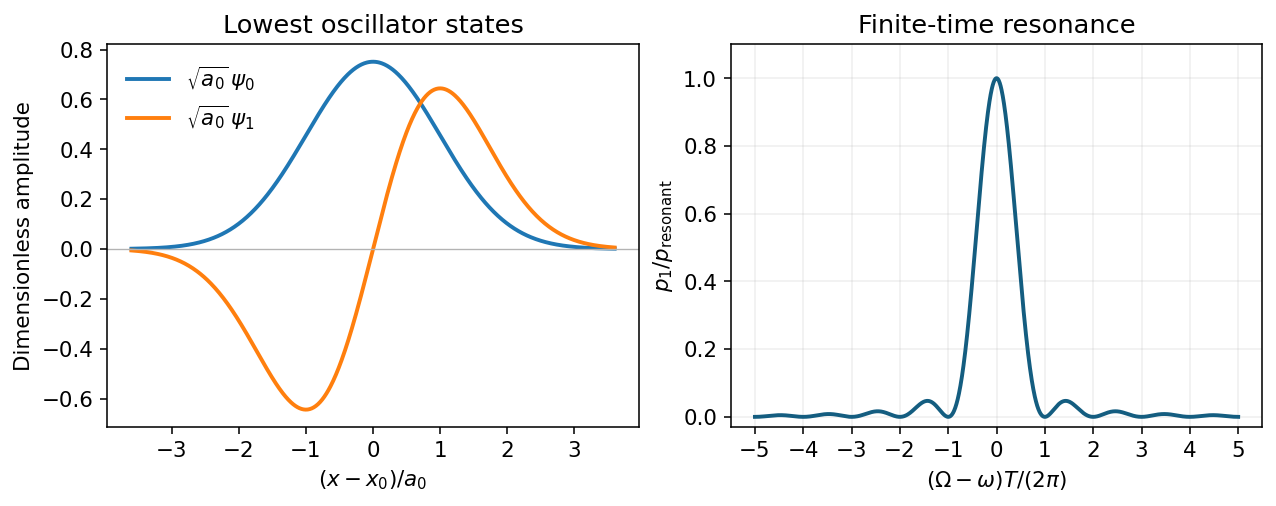
Even and odd oscillator wavefunctions and the finite-duration sinc-squared excitation profile
. Source. Details. Past exam of the advanced quantum physics course of the University of Cambridge 2012 Paper 1 4 Solution by Codex 0 2026-10-20
Codex 0 2026-10-20Insert the expansion in the time-dependent Schrödinger equation, cancel the unperturbed evolution, and project onto . With ,In first-order time-dependent perturbation theory, put on the right and use for . Integration givesThe initial state must be the specified unperturbed eigenstate, the integral must exist under the switching prescription, and total transition probability must stay small. The diagonal term produces a first-order phase; setting in the off-diagonal integral changes those amplitudes only at second order. A weak peak perturbation alone is insufficient if its accumulated action invalidates this expansion.
For the infinite square well, retain the source's zero-based labels:An electron in a field along has perturbation for . About the well centre, is odd, whereas and are both even. The constant has zero off-diagonal matrix element, so the first-order parity selection in an infinite well gives . Excitation to that state is forbidden at first order, not necessarily at higher orders.
For the first excited state, direct integration or the supplied integral givesThe Fourier amplitude of the exponentially decaying electric-field pulse is . ThusThis is the leading, quadratic-in-field transition probability; the total probability of all excitations must remain small.
Starting instead in , which is odd about the centre, the pulse can transfer amplitude to the ground state and to even-labelled excited states . Other odd-labelled states have zero first-order dipole amplitude. Both downward and upward transitions are possible; their relative probabilities depend on dipole matrix elements and the pulse's spectral weight at the corresponding energy gaps. Most population remains in , with a small depletion equal to the summed leading transition probabilities. The common diagonal dipole phase in an infinite well is and has no population effect. After the pulse, the remaining coherent superposition evolves under the unperturbed Hamiltonian; no spontaneous relaxation is implied by this closed-system model.
Past exam of the advanced quantum physics course of the University of Cambridge 2012 Paper 1 3 Solution by Codex 0 2026-10-20
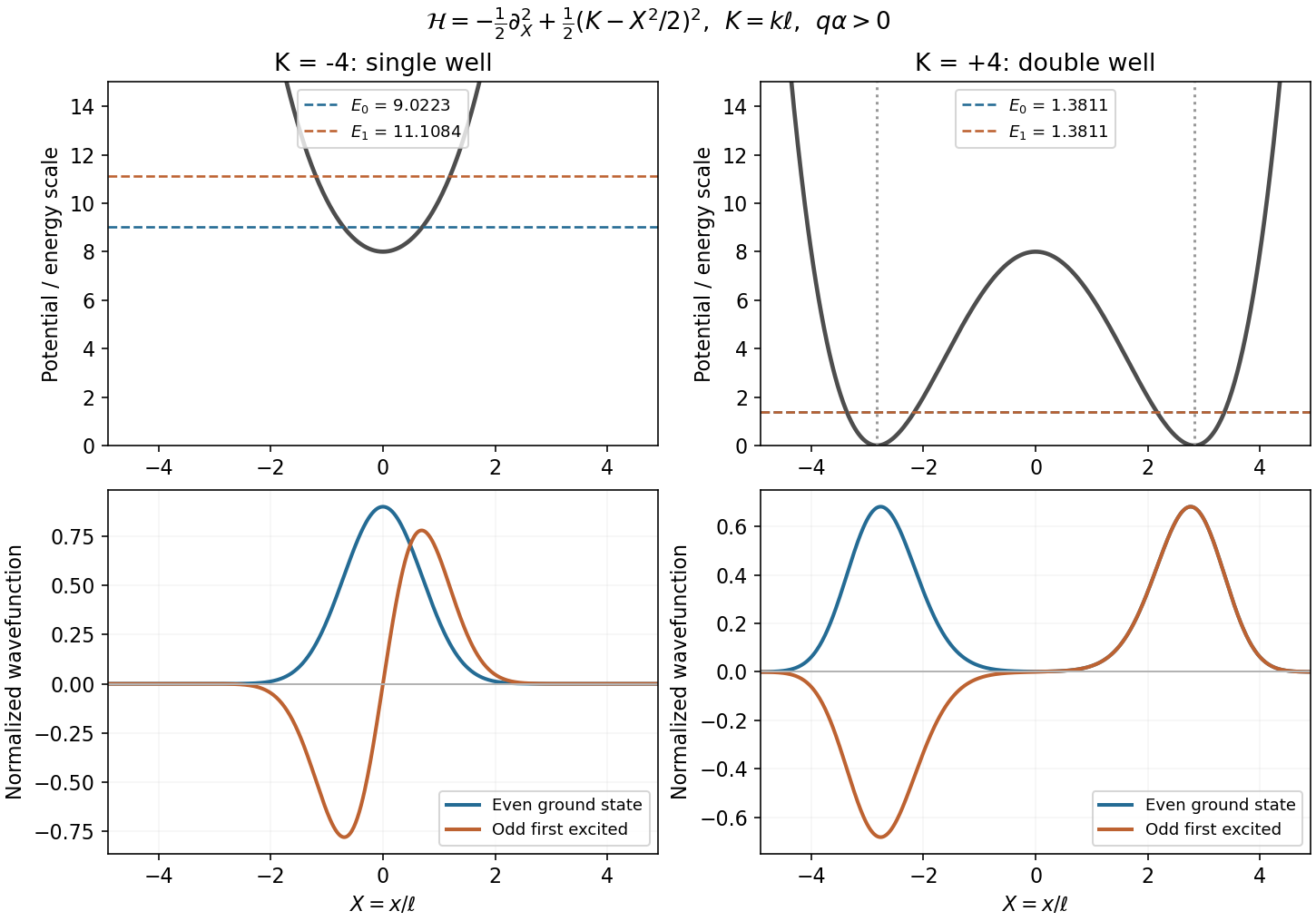
Codex 0 2026-10-20For a spinless particle, minimal coupling gives . Choose the vector potential and . Its curl is and , soThe translation separation in a magnetic field gradient follows from : a simultaneous energy eigenstate can be written . The periodic boundary condition requires , hence , . The remaining Schrödinger equation isThis magnetic-gradient quartic confinement has a positive quartic coefficient for . If , it is a single well at zero, with . Its harmonic curvature givesThus the two lowest states are respectively even and odd, with one central peak or two opposite-sign lobes, and approximately . They are not a nearly degenerate pair.
If , the two minima are , , with zero potential there and a central barrier . For well-separated minima the lowest parity states of a symmetric double well areHere are the localized ground-state Gaussians. Their even combination is the lower state; the odd combination has a node at the origin. Weak quantum tunnelling gives an exponentially small double-well tunneling splitting.
To obtain their common leading energy, put . Since ,The double-well oscillator scale in a linear magnetic field therefore givesThe asymptotic condition is , so the barrier separates narrow local oscillator states. It is this scale comparison that makes the source's “large” ratio meaningful.
The signed group velocity of a magnetic-gradient doublet follows by differentiating the band energy with respect to the conserved wavevector:For the double-well branch has and moves along ; reversing both signs reverses its velocity. To this order the two parity states have the same velocity. Corrections include local anharmonicity and the exponentially small splitting. The spinless Hamiltonian specified here has no extra Zeeman effect term.


There are unlisted articles, also show them or only show them.