
A gene promoter is a DNA region involved in initiating transcription. Moving a coding sequence into a nuclear genome does not guarantee that its original gene promoter can drive nuclear gene expression.
In the GAL1 gene promoter system used in the yeast cross-species complementation experiment, the inducing sugar galactose promotes gene expression from the engineered construct, whereas glucose provides a noninducing comparison. The comparison concerns an imposed regulatory system, not the donor species’ native regulation. [ref]
Pathways Over Time Plasmids Engage Students in Functional Genomics Research by Clare O’Connor. O’Connor (2018), Plasmid features enable multiple student experiments and Complementation reveals conservation of function: GAL1 promoter
An ovum is the female gamete. In an anisogamy system it is the larger gamete type, generally contributing substantial cytoplasm as well as a genetic contribution to the zygote.
An oocyte is a developing female germ biological cell; its stage of meiosis matters when describing the gamete precisely. Oogenesis often partitions most of the cytoplasm into one large product while small polar bodies receive the other chromosome complements.
A resident strategy is evolutionarily stable if every distinct mutant earns lower expected fitness when introduced at sufficiently small positive frequency. The upper bound on the frequency may depend on the mutant. In a finite symmetric matrix game, is the expected payoff, with the second argument representing the population strategy. Affineness in this argument yields the two-condition criterion for evolutionary stability. Every evolutionarily stable strategy is a symmetric Nash equilibrium, but a tied best response must also be strictly outperformed against its own mutant population. The Hawk-Dove game supplies an interior stable mixture despite equality of all payoffs against the resident mixture.
Players select sets of resources, and each resource's cost depends on its total number of users. Each player's cost is the sum of the costs of their selected resources. A unilateral deviation changes resource loads, so a finite-player Nash equilibrium compares costs after that change, not at the old loads. For cost functions , the potential changes by exactly the deviator's cost change. A minimizer of this potential in a finite game is therefore a pure Nash equilibrium.
In a nonatomic congestion game, a divisible population chooses resources whose costs depend on aggregate usage. Each individual has negligible size, so changing their choice does not alter those costs. For traffic on a flow network, strategies are routes and an equilibrium is a Wardrop equilibrium: every route with positive flow has minimum delay for its source-sink pair. This differs from a finite-player congestion game, where a deviation changes the load used to evaluate the deviator's new cost. Continuous nondecreasing link delays give a Beckmann potential whose minimizers are exactly the traffic equilibria.
Each voter chooses whether to incur a voting cost. The collective result changes each voter's payoff, and abstention can be optimal when other voters are likely to determine the outcome. The payoff difference between voting and abstaining is the benefit of being pivotal, weighted by the pivotal probability, minus the turnout cost.
// Target: mathematical-optimization.bigb
A payoff is the number assigned to a player's outcome at a strategy profile, with larger numbers preferred. In the usual expected utility model, expected payoffs are probability-weighted averages of these numbers. If a payoff is specified as money and a player has preferences involving risk, first apply the relevant utility function; maximizing expected money assumes risk neutrality. In a two-player zero-sum game, one player's payoff is the negative of the other's. General bimatrix games instead require a payoff matrix for each player.
A repeated game plays a stage game over several rounds, allowing actions to depend on earlier observations. Its payoff convention must specify a finite horizon, a discount factor or a long-time average; these need not have identical invasion properties.
Evolutionary game theory studies how a population's composition changes when the success of a pure strategy depends on which other pure strategies it encounters. The central feedback is a frequency-dependent payoff: becoming common changes the opponents a strategy meets, which can change whether it does well. In a coordination game, common behaviour can reinforce itself; in the coexistence example below, being rare is an advantage. This makes evolutionary game theory useful for asking which behaviours can persist and which initial compositions lead to different outcomes, without assuming that each participant solves an optimization problem.
In the basic model, a large, well-mixed population has finitely many inherited pure strategies; interactions sample opponents according to their population frequencies. Assume that a strategy's expected payoff determines its per capita net reproductive growth rate, with a common baseline allowed. These are modelling assumptions: reproduction must transmit the strategy, encounters must match the proposed sampling rule, and the conversion from payoff to growth must be justified for an application. The replicator equation below describes the resulting continuous-time frequencies. Taylor and Jonker's [ref]
https://static1.squarespace.com/static/5dc9917c4cdb1467e1e54c4c/t/6526a5647942e33b89ab7af1/1697031525653/1978%2Bevolutionarily%2Bstable%2Bstrategies%2Band%2Bgame%2Bdynamics.pdf. Evolutionarily Stable Strategies and Game Dynamics (1978), section 3, pp. 148–149
explicitly derive this growth model.For learned behaviour, reproduction can instead be replaced by an assumed copying rule: an individual samples another individual uniformly and copies a better-performing pure strategy at a rate proportional to the positive payoff difference. At frequencies , the net flow from to is , because the two directional positive parts subtract to . Summing over gives , the replicator equation. This derivation states a particular mechanism; an arbitrary rule for learning or imitation need not give the same dynamical system.
Three questions must be distinguished. A symmetric Nash equilibrium tests whether an individual can improve its expected payoff against the resident composition. An evolutionarily stable strategy tests whether each distinct rare mutant is outperformed after it is introduced. Dynamical stability tests the response of an actual dynamical system to small changes of composition, and asymptotic stability additionally requires nearby trajectories to converge. For a finite symmetric bimatrix game under the continuous-time replicator equation, every evolutionarily stable strategy is a symmetric Nash equilibrium and a locally asymptotically stable rest point; the converse from asymptotic stability to an evolutionarily stable strategy fails in general. See Ross Cressman and Yi Tao, The replicator equation and other game dynamics (2014), Theorems 1–2 and Example 1. These statements refer to stability on the full probability simplex, including perturbations introducing currently absent pure strategies.
A concrete experiment makes the frequency feedback visible. In 2009, Gore, Youk and van Oudenaarden competed two yeast strains: a producer of the enzyme invertase, which enables sucrose hydrolysis, and a mutant lacking the corresponding SUC2 gene. Released sugars can feed neighbours, so avoiding production can be advantageous. They used shaken 5 mL cultures with 5% sucrose at , diluted daily after 23 hours of growth. Different labelled proteins allowed the two strains to be counted separately by flow cytometry; selective plating periodically checked the counts. The cooperator required externally supplied histidine, so restricting that amino acid imposed an adjustable growth disadvantage. See Snowdrift game dynamics and facultative cheating in yeast, pp. 253 and 255–256, Methods Summary.
Starting with rare producers and, separately, rare nonproducers tested both invasion directions. Under the reported coexistence conditions each rare strain increased; changing histidine or added glucose shifted the eventual composition. Their explanation used nonlinear growth benefits, rather than a fixed pairwise payoff matrix. This motivates testing both rarity regimes before inferring an evolutionarily stable strategy or fitting a replicator equation; it does not identify the illustrative tables below with measured payoffs. See Gore, Youk and van Oudenaarden, Figures 1–3.
An early motivation was understanding why animal contests can involve restraint even when escalation might win an individual encounter. Maynard Smith and Price's [ref]
https://public.ek-cer.hu/~szabo/EGT20/library/maynard_n73.pdf. The Logic of Animal Conflict (1973), Nature 246, 15–18
introduced the evolutionarily stable strategy in this setting. Taylor and Jonker's [ref] then studied explicit continuous and discrete dynamics. Static resistance to invasion and the paths populations follow are related questions, but they require separate definitions.Two people can each have a clear incentive to choose an outcome that leaves both worse off. The prisoner's dilemma isolates this tension between individual best responses and Pareto efficiency. For example, two partners can each save effort by withholding a promised contribution, yet both would prefer a successful joint project to mutual withholding. The model applies when each person's payoffs really have the ordering below; the names “cooperate” and “defect” alone do not establish a prisoner's dilemma.
In the symmetric two-player normal-form game, each player chooses cooperation or defection simultaneously, without observing the other's current choice. The four payoffs are the mutual-cooperation reward , mutual-defection punishment , sole-defector temptation , and sole-cooperator payoff , with . Defection is a strictly dominant strategy: it beats cooperation against either opposing pure strategy. This definition and the resulting one-shot Nash equilibrium are discussed in Steven Kuhn, Prisoner's Dilemma, Stanford Encyclopedia of Philosophy, section 1.
Take the concrete payoffs , , , . Each entry below gives the row player's payoff followed by the column player's payoff:
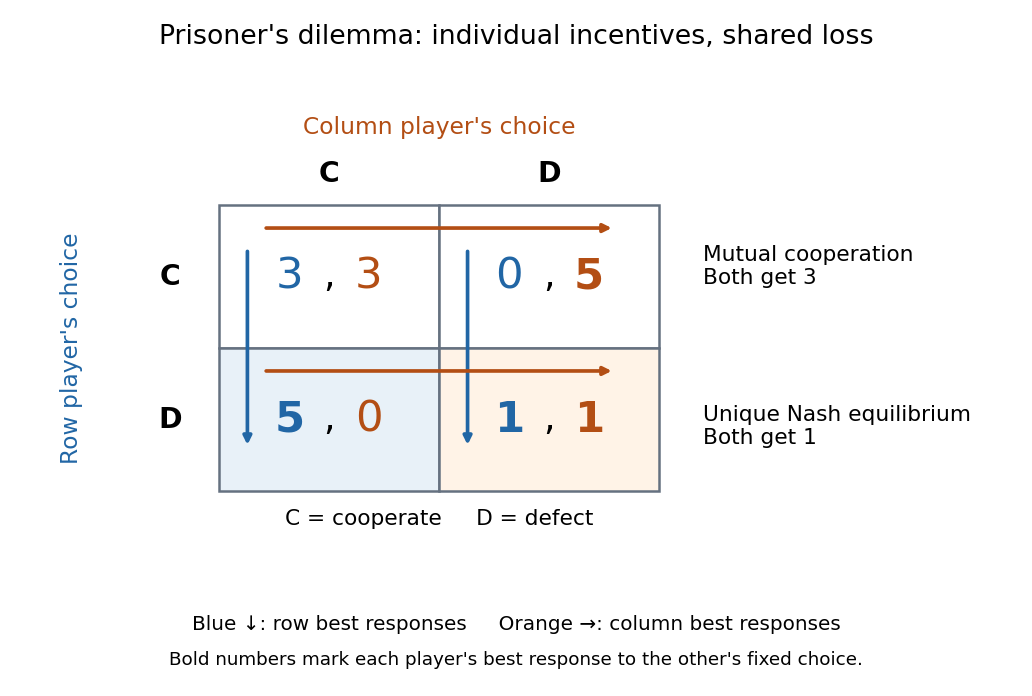
Prisoner's dilemma: best-response arrows lead to mutual defection despite the gains from mutual cooperation
. Details. 
For the row player, switching from to improves the payoff from to against , and from to against . The column player has the same comparisons, so is a strictly dominant strategy for each. Even against a mixed strategy choosing with probability , the expected payoff advantage is . Thus cooperation cannot appear with positive probability in a best response, and is the unique one-shot Nash equilibrium, including mixed strategies.
At , a unilateral deviation to lowers the deviator's payoff from to . A joint change to instead raises both payoffs from to : mutual cooperation Pareto dominates mutual defection, making the Nash equilibrium fail Pareto efficiency. A Nash equilibrium tests unilateral deviations, so it need not maximize shared gains. This is the useful lesson: improving the available outcome may require changing incentives, rather than telling each participant to choose a better best response.
The additional inequality says that mutual cooperation gives each player at least as much average payoff as equal-time alternation between the two asymmetric outcomes. It is a further assumption, not a consequence of . Here it holds strictly: , and alternating exploitation gives each player average payoff . This comparison concerns equal-time averages, not every discounted sequence. See Kuhn, section 3, on the additional cardinal-payoff condition.
A resolvent is an auxiliary polynomial built from expressions in the roots of a polynomial. The action of its Galois group on those expressions gives information about solvability and intermediate field extensions. A Lagrange resolvent for a cubic uses Fourier combinations of the three roots.
An algebraic extension in characteristic is purely inseparable when every one of its elements is purely inseparable over the base field.
An algebraic extension is separable when every element has a minimal polynomial with distinct roots.
An algebraic extension is normal when every irreducible polynomial over with a root in splits in . For finite extensions, equivalently every -embedding into an algebraic closure has image .
The inverse Galois problem asks which finite groups occur as Galois groups over a given field, with the classical problem taking the base field to be . A regular realization over and Galois-preserving Hilbert specialization solve an instance over a Hilbertian field. Realization over an algebraically closed constant field's rational function field alone does not supply descent to .
A spiral galaxy has a galactic disk with spiral structure, commonly cold interstellar gas and ongoing star formation as well as an older stellar population.
An irregular galaxy lacks a regular spiral or elliptical outline. Many contain substantial gas and recent star formation; irregular appearance alone does not determine a stellar population's age.
A star-forming galaxy is a galaxy with ongoing star formation. Its hot young stars can supply hydrogen-ionizing radiation to the intergalactic medium, with the contribution controlled by the ionizing photon escape fraction.
A stellar halo is the extended, approximately spheroidal stellar population surrounding a galaxy. It differs from the total dark matter halo. If its outer luminosity density is , its projected light follows the projection of a spherical power-law emissivity and scales as away from breaks and outer truncation.
There are unlisted articles, also show them or only show them.