
A point is periodic for an iterated map if for some positive integer . Its exact period is the least such , and the distinct points form its periodic orbit. For a holomorphic map its periodic-orbit multiplier is , computed in a local coordinate; at infinity use a reciprocal coordinate. The chain rule makes this the cyclic product of derivatives along the orbit, so it is the same at every point of that orbit.
A subset is completely invariant for a rational map if . This asserts invariance in both directions, including every preimage, rather than just invariance of one chosen inverse branch. For a nonconstant sphere map, the two inclusions and already imply the equalities, because the map is surjective. The Fatou set and Julia set are completely invariant. A Fatou component need not itself be completely invariant even though the union of all components is.
Holomorphic maps and are holomorphically conjugate if a biholomorphic coordinate change satisfies . Iterating gives , so periodic points and their exact periods correspond. Differentiating at a periodic point gives equality of return multipliers, since the nonzero derivative of cancels. Locally uniform convergence and normality transfer through the coordinate change, so it also transports Fatou sets and Julia sets. Between entire Riemann spheres the biholomorphic change is a Möbius transformation; an affine change is sufficient for many polynomial normalizations.
Rectify outputs of simple cells with similar orientations and varying phases or positions, then sum or pool them. Opposite-polarity subunits allow response to both light and dark features. Pooling gives approximate phase and position tolerance over the subunit coverage; its extent and contrast dependence depend on the pooling rule.
Two oriented linear filters in quadrature have responses and to a suitably matched narrowband grating. Their squared sum is , independent of phase , while orientation and spatial-frequency selectivity remain. A nonlinear output function or normalization can transform this energy into firing rate. Ideal quadrature gives an exact phase identity for the matched stimulus; finite approximate filter pairs need not have perfect invariance for arbitrary images.
Let be compact, and let be holomorphic on a neighborhood of . Choose a set of allowed poles in the Riemann sphere outside , meeting every connected component of its complement. Then rational functions with poles only in that allowed set approximate uniformly on . The point at infinity may serve as the pole in the unbounded component.
If is connected, one can allow only infinity, giving the polynomial Runge theorem. If is the unit circle, its complement has an inside and an outside component. The function is holomorphic near and is already a rational approximant with its pole in the hole; it cannot be uniformly approximated there by polynomials, since their contour integrals vanish while .
The proof first approximates a Cauchy integral by a finite rational sum with nearby poles. The pole-moving polynomial approximation argument transports poles through complementary components. This explains why complement geometry, rather than just smoothness of , governs the allowed approximation class.
An elliptic integral is an integral of a rational function of and , where is a cubic or quartic polynomial with distinct roots. The standard first, second and third kinds describe the essential normal forms. Choosing the full endpoint yields complete versions such as the complete elliptic integral of the first kind.
The right half-plane consists of complex numbers with positive real part. Its boundary is the imaginary axis. For example, is inside, is on the boundary, and is outside. Rotation takes the right half-plane onto the upper half-plane; the Cayley transform between the half-plane and disk uses for this convention.
The lower half-plane is the set of complex numbers with negative imaginary part. It is the reflection of the complex upper half-plane across the real axis.
For a compact set , its polynomial hull is the set displayed, where ranges over all complex multivariate polynomials. It contains . In one complex dimension, bounded complementary components are filled in: the maximum modulus principle bounds every polynomial inside those components by its boundary values. Polynomial approximation and separation distinguish points outside the hull.
A boundary limit taken while approaching within a cone that stays away from tangency. At zero in the complex upper half-plane, every fixed cone is allowed. A nontangential limit need not be a limit along all paths approaching the boundary.
// Destination: analysis.bigb
Homogeneous mixing assumes that contacts sample the whole modelled population without differences between groups or locations. In the SIR model, the chance that a sampled contact belongs to the infectious compartment is . This assumption makes a frequency-dependent transmission rule depend on the overall infectious compartment rather than a graph of individual contacts. Structured contacts require a different mathematical model, such as a discrete SIR epidemic on a graph.
Disease prevalence is the proportion of a population that is infected at a specified time. In a susceptible-infective model with total population , it is .
An SIS model divides a host population into a susceptible compartment and an infectious compartment. Recovery returns hosts directly to susceptibility, without lasting immunity or a separate recovered stage. Let be a constant population size and the infectious fraction, so the infectious count is and the susceptible count is .
For homogeneous frequency-dependent transmission at rate and recovery at rate , the count-level infection rate is . Dividing the net count rate by givesThe disease-free state is . For , the positive endemic equilibrium is . The derivative of the right-hand side at is , proving local stability. If , every positive fraction decreases toward zero; at , gives algebraic decay. The scalar model illustrates a transmission/recovery threshold; heterogeneous contacts or different infectious-duration assumptions require other equations.[ref]
The Mathematics of Infectious Diseases by Herbert W. Hethcote. Section 3, printed p. 621, SIS reductions and the constant-population Bernoulli equation; the no-demography specialization and scalar stability calculation are derived here
The epidemiological abbreviation is distinct from the singular-isothermal-sphere abbreviation in galaxy dynamics.
Any deterministic comparison sort correct for all orders of distinct sort keys needs at least comparisons on some input. Here is a factorial, a logarithm, and the brackets denote the ceiling function. This is a worst-case requirement, not a requirement on every input.[ref]
For three distinct sort keys, the diagram has one leaf for each possible ordering of the original entries . Some paths need two comparisons, others three; two comparisons cannot distinguish all six orders.
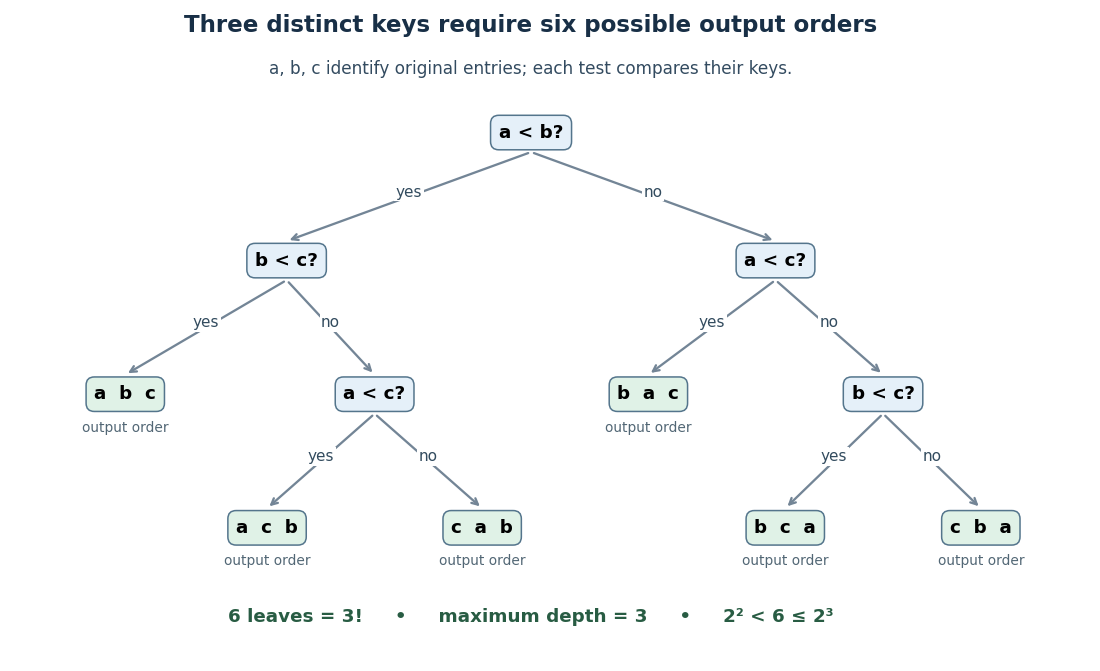

For the proof outline, represent adaptive comparisons by a binary tree: distinct sort keys give only two outcomes per comparison. A leaf fixes an output permutation; one leaf cannot correctly handle two different strict orders. Hence there must be at least leaves. Maximum depth permits at most leaves, so gives the bound. Even a three-way comparator has only two reachable outcomes on this distinct-key family.
The growth follows without a precise approximation to the factorial. At least of its factors are at least , so for ,The brackets denote the floor function. This gives a constant times lower bound for large , matching the worst-case comparison growth of merge sort.
Distinct sort keys are essential to the counting argument. Identical sort keys do not create different strict orders. If all sort keys coincide, stable sorting returns the arrival order. This does not remove the worst-case bound for a comparison sort required to handle arbitrary distinct-key inputs.
If is a commutative -algebra which is a finite free module over , its norm sends to the determinant of multiplication . The determinant is independent of the chosen basis and is multiplicative because . It commutes with scalar extension. On a separable field extension it becomes the product over embeddings, recovering the field norm. An invertible has invertible norm.
A combinatorial structure whose elements carry distinct labels from a prescribed finite set. For example, a rooted tree can have labelled vertices; assigning labels is part of the structure counted by an exponential generating function.
Electron impact can excite an ion into a state above an electron-emission threshold, which then ejects a bound electron by autoionization. This two-stage excitation-autoionization contributes to collisional ionization in addition to direct impact removal.
There are unlisted articles, also show them or only show them.