
State needed to resume a suspended execution stream, including saved processor registers and its position in a call stack. An operating-system kernel can keep parts in a per-task record and parts on a kernel call stack. An execution context identifies and preserves that stream's state; it is not a duplicate of all the computer memory reachable through its address space.
// Target: computer-science.bigb
A decomposer breaks down dead organic material and absorbs products of that breakdown; many bacteria and fungi perform this role. Decomposers connect detritus from different trophic levels to material recycling, so placing all decomposers at one final step of every food chain is misleading. See Clark, Douglas and Choi, Biology 2e, 46.1: grazing and detrital food webs.
For a smooth stationary wire and release from rest at height , the normal reaction does no work. The energy equation is . Integrating the travel time between turning points gives the displayed period. Its small-amplitude expansion is . The mass cancels because both gravitational and inertial forces are proportional to it.
A constitutive equation is frame indifferent when a superposed rigid spatial rotation changes its outputs by their tensor transformation rules. For an elastic Cauchy stress tensor, this requires . It differs from material isotropy, which rotates reference material directions.
The closure of the displayed connected spiral adds the unit circle. Its union with the closed unit disk is therefore connected but not path-connected. A path from the spiral to the disk would have a first contact time. Before contact its reciprocal radial offset defines a continuous parameter tending to infinity. The intermediate value theorem then forces sequences of path points with parameters integer and half-integer, approaching opposite circle points. This contradicts continuity at the first contact. Thus the spiral and disk form separate path-connected components.
A sequence of connected subsets with each consecutive pair intersecting has connected union. If the union admitted a separation, each connected subset would lie entirely on one side. Consecutive intersections force consecutive subsets onto the same side, hence all subsets onto one side, contradicting that both sides of the separation are nonempty.
Consider the graph of a function , using the sine of the multiplicative inverse of , together with a vertical closed interval:Give the subspace topology from the Euclidean plane. The symbol denotes a Cartesian product. The right endpoint belongs to . The continuous map sends the connected real interval onto . Hence is connected, and its closure is connected by closure of a connected set. Every height in is approached as tends to zero; for example,For , these inputs are and . For any other height , choose with ; then the sequence lies in and has limit of a sequence .
Nevertheless, has exactly two path components, and . Within , join inputs by the continuous path . Within , use for heights .
The obstruction to a continuous path between and is persistent oscillation, not a visible gap. Proof outline: suppose such a path exists, directed from to , and take its last time in . Immediately afterwards its first coordinate approaches zero and its second coordinate is . The intermediate value theorem forces the first coordinate to pass through inputs of both displayed types arbitrarily close to that departure time. The second coordinate therefore takes both values and arbitrarily close to that time, contradicting continuity. [ref]
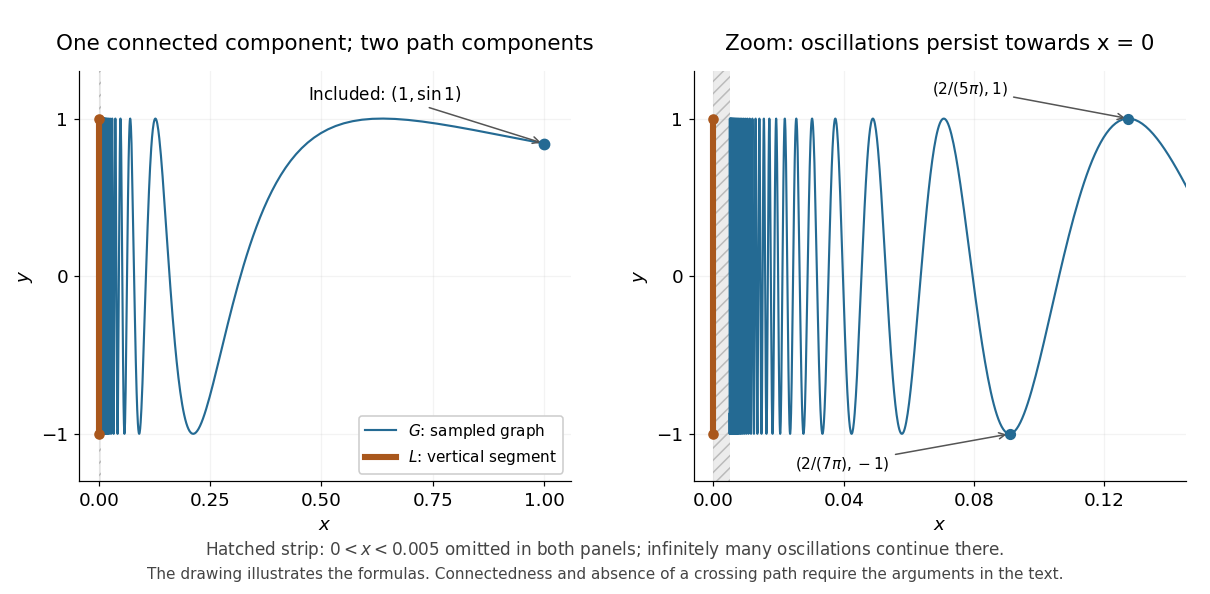
The topologist's sine curve has one connected component and two path components; the graph of a function is drawn only for , with further oscillations omitted near the vertical closed interval
. Details. 
The sampled graph of a function illustrates the formulas; it does not prove connectedness or the failure of path connectedness. Taking a closure preserves connectedness, but this example shows that it can destroy path connectedness.
For the conjugate base accepting a proton from water,This base dissociation constant uses the same water thermodynamic activity approximation and standard state conventions as the acid dissociation constant. Multiplying the two relations cancels the partner thermodynamic activities:Here is the aqueous ion product associated with self-ionization of water. At fixed temperature, a larger acid dissociation constant gives a smaller base dissociation constant for its own conjugate base; this reciprocal rule compares matching conjugate acid-base pairs. A weak acid does not necessarily have a conjugate base that reacts almost completely with water. For example, stipulated and give .[ref]
14.3 Relative Strengths of Acids and Bases. Chemistry 2e by Paul Flowers and others; §14.3, Relative Strengths of Conjugate Acid-Base Pairs, cancellation giving Ka Kb = Kw
The value of changes with temperature; is the familiar approximate value near , not a universal constant. If water is retained explicitly in both full equilibrium constants, their product instead equals , the full equilibrium constant for . The acid dissociation constant, base dissociation constant and self-ionization of water convention must agree.
A conjugate acid-base pair consists of two chemical species related by transfer of one proton. The conjugate acid has one more proton and one more positive unit of electric charge than the conjugate base.
The conjugate acid of a chemical base is the chemical species formed when it accepts one proton. This is a relationship between partners, rather than a claim that the partner is a strong acid.
For , the conformal map takes bijectively onto the upper half-plane. The exponential maps this half-strip onto the upper half-plane exterior to the unit circle; then is a scaled Joukowski map. All critical points of the entire map are , mapping alternately to and .
Conformal geometry studies a metric tensor only up to multiplication by a nowhere-zero positive scalar function on a real slice. A conformal class determines angles in Riemannian signature and null directions in Lorentzian signature. The complexified flat four-dimensional conformal geometry is encoded by the Klein quadric, whose incidence relation describes null separation.
The sine maps bijectively onto the upper half-plane: its imaginary part is , and the equality of two sine values forces either equal arguments modulo or arguments summing to an odd multiple of . Only equality is possible in this domain. For surjectivity, solve for . When , exactly one root has modulus below one and it has positive real part. The inverse therefore belongs to the half-strip. Composing with gives a conformal map onto the unit disc.
For the crescent inside and outside , inversion gives the horizontal strip . The affine map sends it to , and maps it bijectively onto the upper half-plane. A Cayley transform then maps it onto the unit disc. Tangency, rather than a separate enclosed hole, is why this domain is simply connected.
On , take the principal square root with positive real part. The Möbius transformation has image . The principal square root therefore maps to the right half-plane with omitted, and the final Möbius transformation gives exactly . The inverse is . Adding to the source on the Riemann sphere fills the missing value and gives a conformal map onto the full disk. Without , a loop surrounding the segment has nonzero winding number, so the source is not a simply connected space and cannot be conformally equivalent to a disk.
For the upper half disk slit along , , squaring maps onto minus . After scaling the radius-four disc, the disk automorphism sends this slit to . Its square root with argument in maps onto the upper half unit disc. There maps bijectively onto the lower half-plane: its imaginary part is , and the two roots of its inverse equation are reciprocal, with exactly one inside the unit circle. The final Möbius map gives the displayed conformal disk bijection.
Two intersecting circles bound a lens. A Möbius transformation sending their intersection points to zero and infinity sends the two boundary arcs to rays, and the lens to a sector. A suitable power straightens the sector to a half-plane. The chosen sector and its branch must be identified by an interior test point; merely squaring an arbitrary boundary-straightening map need not be injective on the intended domain. A Cayley transform then gives a conformal bijection to a disc.
The local angle-preservation property of a conformal map. At a regular point its derivative is a positive scaling times an orthogonal linear map. Consequently composition multiplies gradient lengths by that scaling, as follows directly from the chain rule.
If is rescaled to , a null geodesic retains its unparametrized path. For its original affine tangent , the changed connection gives . Rescaling the tangent by cancels this term and proves the displayed affine-parameter relation, up to a constant multiplier. A conformal boundary may therefore be reached at finite unphysical affine parameter while physical affine parameter is infinite.
There are unlisted articles, also show them or only show them.