A receptor tyrosine kinase combines extracellular ligand recognition with an intracellular protein kinase protein domain. A membrane-spanning segment connects these parts across the cell membrane: the signal changes the intracellular machinery without requiring the ligand to enter the cytosol. The protein kinase transfers a phosphate group from ATP to selected tyrosine residues on proteins, including the receptor itself.[ref]
Signaling through Enzyme-Linked Cell-Surface Receptors. “Activated Receptor Tyrosine Kinases Phosphorylate Themselves”: extracellular binding, intracellular catalytic domains and ATP-dependent phosphate transfer
This architecture makes a reception event useful in two ways: it can change catalytic activity and assemble a local group of signaling proteins. Trans-autophosphorylation can create phosphotyrosine residues recognized by SH2 domains. Recruitment positions a downstream enzyme or relay protein near its partners. Neither every modified site nor every recruited protein has the same effect; association is a specific molecular connection, rather than a universal command to activate everything nearby.[ref]
Signaling through Enzyme-Linked Cell-Surface Receptors. “Phosphorylated Tyrosines Serve as Docking Sites For Proteins With SH2 Domains”, Figure 15-53: signaling enzymes, adaptors and negative regulators
Compare the epidermal growth factor receptor with the insulin receptor. Their common topology does not impose one activation geometry or make assembly equivalent to activity. The receptor phosphorylation assay consequently needs more than evidence that two protein chains associate.
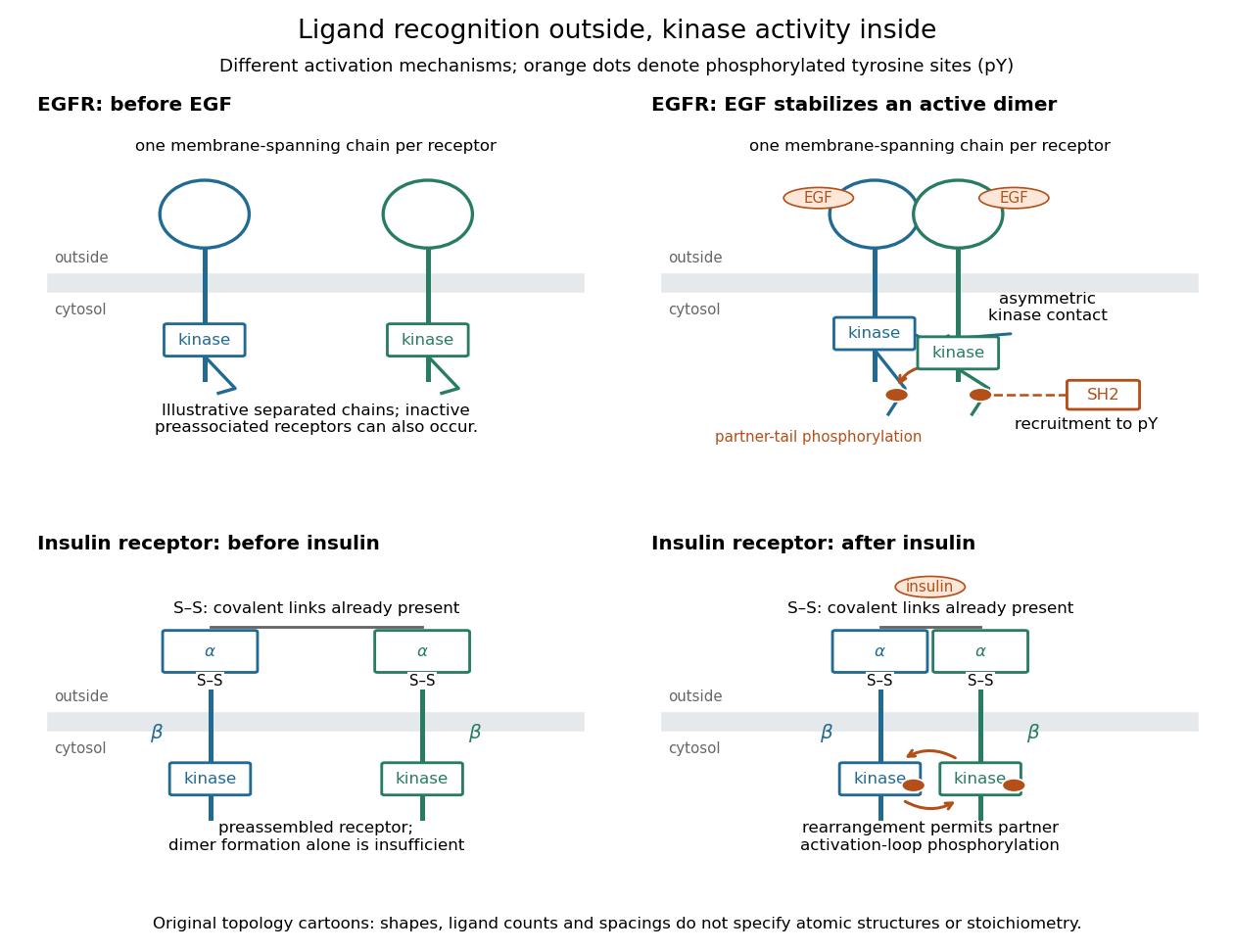
Receptor tyrosine kinase architecture and distinct activation mechanisms
. Original topology cartoons contrasting EGFR with the preassembled insulin receptor. Orange dots mark phosphotyrosine residues; S–S marks protein disulfide bonds. The EGFR panel separates asymmetric catalytic contact from partner-tail phosphorylation. Shapes, distances and drawn ligand counts are explanatory, rather than atomic structures or binding stoichiometry. Details.
DNA pulse labeling exposes biological cells to a detectable precursor for a bounded interval. After removal, later sampling can follow the labeled material and descendants. A short pulse asks about synthesis during that interval; overnight labeling instead accumulates evidence across many hours. Detectable synthesis does not by itself prove completion of a cell cycle, and DNA repair can also incorporate precursors.
Matching constructs comparisons between units receiving different treatments but having similar pretreatment covariates. Similarity can be measured directly on selected covariates or through a propensity score. The design specifies the distance, allowed discrepancies, number of controls per treated unit and whether a control can be reused.
With one distinct control matched to each of treated units, a simple estimator isThis averages differences in the represented treated population. Dropping unmatched treated units changes that population, and reusing controls induces dependence between pair differences. Caliper matching explicitly limits allowed discrepancies.
Matching seeks covariate balance; it does not create a randomized controlled trial. Identifying a causal effect still requires conditional exchangeability given the matched pretreatment covariates, adequate positivity, and consistency in causal inference. Unmeasured determinants of assignment and outcome can remain different even when measured covariates are well balanced. Conditioning on a causal mediator or inducing collider bias is not repaired by calling the procedure matching.
Outcome standardization averages fitted conditional outcome risks over a specified target population's pretreatment covariate distribution. The same target distribution is used for each treatment strategy. Under conditional exchangeability, the positivity assumption and consistency, this average identifies the target mean of the corresponding potential outcomes. For a target consisting of treated subjects, average over their covariate distribution. A conditional odds ratio cannot generally be applied directly to an aggregate mean risk: the nonlinear odds-to-probability conversion must be performed before averaging. Outcome standardization supplies that individual-risk calculation.
An observer's future event horizon bounds the events that can ever signal to its future-inextendible worldline. Its past event horizon bounds the events reachable by signals from its past-inextendible worldline. A complete inertial observer in Minkowski spacetime has neither. The uniformly accelerated worldline , has and . Their boundaries are its two Rindler horizons. This observer dependence is distinct from a black-hole horizon defined using future null infinity.
Minimum pairwise dot-product sum of three unit vectors by  Codex 0 Created 2026-10-14 Updated 2026-11-05
For three unit vectors, the squared Euclidean norm of their sum is , proving the displayed bound; equality holds exactly when . For fixed unit vectors with , the Cauchy-Schwarz inequality gives the unique minimizing third vector , and the minimum is . Three coplanar directions separated by degrees attain the global bound.
For , the Wirtinger derivatives are and . The Cauchy-Riemann equations become for a holomorphic function , and . Thus is holomorphic whenever is a twice continuously differentiable harmonic function.
For a function holomorphic on a disk containing the contour, its Taylor series converges uniformly on the integration circle. Integrating termwise leaves only the term with exponent , giving the displayed coefficient extraction. The power is , not ; the latter extracts the coefficient at level .
Orientation sign in quadrant harmonic spectral inversion by Codex 0 Created 2026-10-14 Updated 2026-10-31
Codex 0 Created 2026-10-14 Updated 2026-10-31The clockwise definitions in quarter-plane oblique boundary spectral functions require the minus sign in this reconstruction. Indeed integrating first in gives , and clockwise boundary traversal has Cauchy integral . Reversing both boundary spectra or both reconstruction-ray orientations reverses this sign; mixing the two conventions gives the negative of the desired holomorphic function.
// Target: analysis.bigb
A bicategory has objects, hom-categories, composition functors and identity 1-cells. Associativity and unit laws hold through coherent invertible 2-cells, satisfying pentagon and triangle identities. A monoidal category is exactly a bicategory with a single object: its objects are the 1-cells, its morphisms the 2-cells, and its tensor product the horizontal composition.
A catalyst makes a chemical reaction proceed faster by participating in an alternative reaction mechanism and being regenerated. This makes repeated conversion possible: the same catalyst can help many successive reactants become reaction products. An enzyme is a biological catalyst. The overall standard change in Gibbs free energy is unchanged; see the IUPAC Gold Book: catalyst.
Regeneration does not mean that the catalyst sits unchanged throughout every step. For example, a schematic reaction mechanism can temporarily bind A to a catalyst C in a reaction intermediate AC:Adding the steps cancels both the reaction intermediate AC and the catalyst C from the net chemical equation. AC is produced and later consumed; C is used and later recovered. These letters describe possible roles, not a measured reaction mechanism. The alternative route is useful only if its chemical kinetics permits faster conversion. See Flowers et al., Chemistry 2e, §12.7: catalysts and alternative mechanisms.
For a worked barrier example, consider an idealized reversible A-to-B conversion at fixed temperature . Stipulate standard molar Gibbs free energy levels and , with effective transition state levels without a catalyst and with a catalyst. Use the same standard states and the same zero for both routes; the catalytic route includes the regenerated C at both endpoints. Unlike the separate potential-energy profile example, this illustration uses Gibbs free energy at one specified temperature.
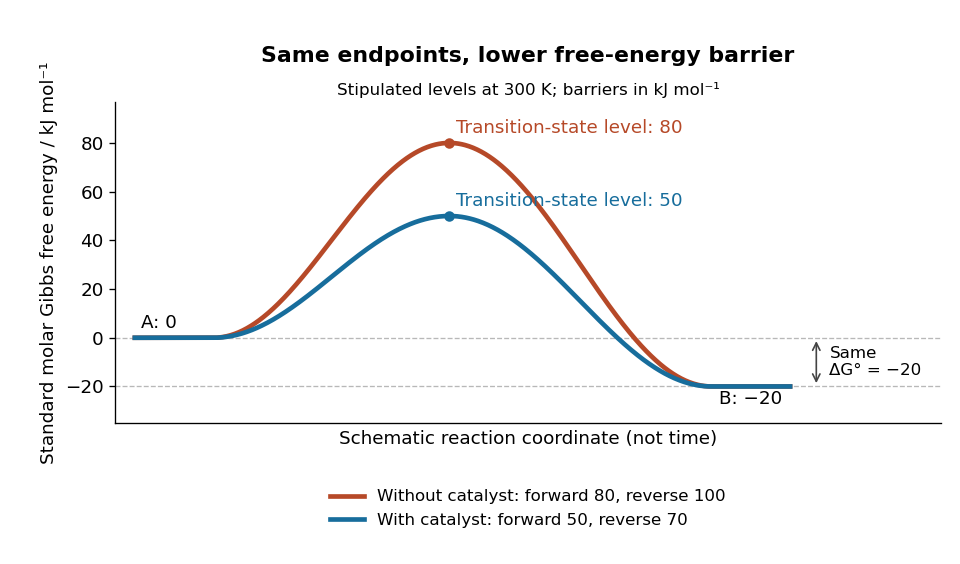
A catalyst lowers the stipulated Gibbs energy of activation in both directions while retaining the same endpoints
. Original smooth schematic Gibbs free energy profiles at , with levels in . The horizontal reaction coordinate describes progress along each schematic route, not time. These are chosen effective barriers, not measured potential energy surfaces, actual molecular paths, or the two-step reaction mechanism above. A real catalytic route can have several transition states and reaction intermediates. Details.
The Gibbs energy of activation is measured from the starting endpoint in the chosen direction. Thus the four barriers areBoth directional barriers fall by . The endpoint difference stays .
To turn those barriers into rate constants, use the Eyring form of transition state theory for this effective first-order reaction pair, with a common prefactor and unit probability of successful passage:Here is the Boltzmann constant, is the Planck constant, and is the molar gas constant. The common prefactor cancels from the comparisons. These Gibbs energies of activation are not the empirical activation energy of the Arrhenius equation. With the stipulated value , the speedup isThe exponent is a dimensionless quantity: convert to before dividing by . The exponential function explains why a modest barrier reduction can have a dramatic kinetic effect. This number follows from the chosen free-energy barriers and common prefactor; it is not a universal catalytic multiplier or a prediction across temperatures.
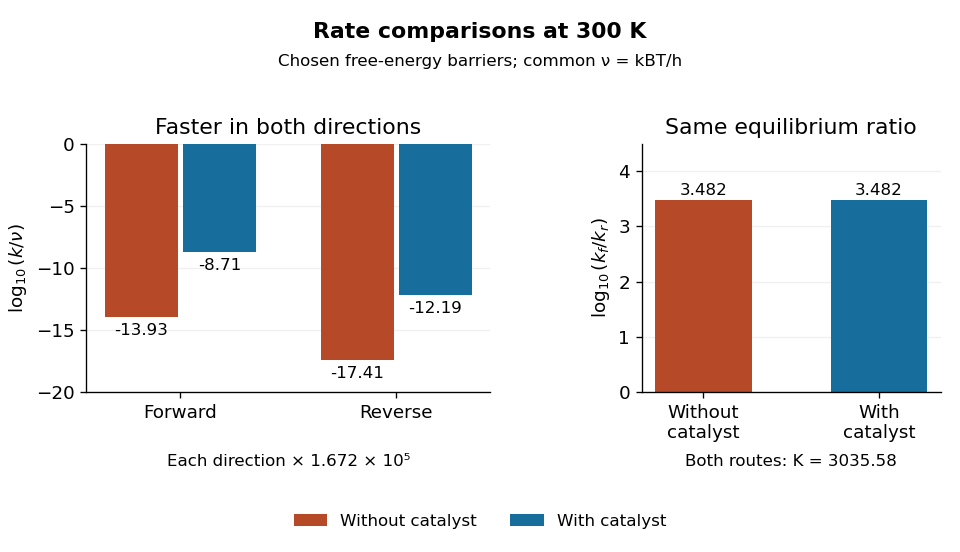
Both directional rate constants increase by about , while their forward-to-reverse ratio stays about
. Original bar plots at . Left: base-ten logarithms of the dimensionless normalized rate constants for the four stipulated barriers. A less negative value means faster conversion. Right: the logarithm of is identical for the two routes. Absolute units factor out through the common ; no temperature dependence outside this one model point is asserted. Details.
Assume ideal thermodynamic activities with a common concentration standard state, and directional rate laws and . At chemical equilibrium, equal reaction rates give for this model. The barriers giveThe catalyst speeds up both directions, so it changes how quickly chemical equilibrium is approached without changing this equilibrium constant. For a general chemical reaction, the thermodynamic relation is with consistent standard states; an arbitrary multistep reaction mechanism need not permit for two measured rate constants. At the same temperature, pressure, and thermodynamic activities, a catalyst also leaves the actual overall reaction change in Gibbs free energy unchanged. See 13.3 Shifting Equilibria: Le Châtelier’s Principle (§13.3: a catalyst does not shift equilibrium). To drive an unfavourable overall conversion, a process such as energy coupling must change the combined transformation.
In heterogeneous catalysis, the catalyst and reactants occupy different thermodynamic phases; a solid surface can furnish the catalytic route.
For example, specify dissolved hydrogen peroxide as the reactant, water as the solvent, and solid manganese dioxide as the catalyst. The solid and liquid chemical solution are separate thermodynamic phases. A dispersion that looks thoroughly mixed still contains those separate phases; mixing distributes contact, rather than making the solid molecularly dissolved. The manganese dioxide peroxide contact demonstration makes the arrival of the liquid at the solid tangible.
A useful surface-route picture is approach from the liquid, adsorption at a catalytic surface site, conversion through surface-bound reaction intermediates, and release of reaction products. [ref]
12.7 Catalysis. Chemistry 2e by Paul Flowers and others; §12.7, Heterogeneous Catalysts, steps 1–4: adsorption, activation, reaction and product desorption
This sequence organizes possible roles; it is not a verified sequence of elementary reactions for every catalyst, or for the particular manganese dioxide demonstration. The net chemical equation supplies neither the binding geometry nor the identity of the working catalytic surface site.This contact requirement makes surface area and diffusion practically important. More exposed solid can provide more catalytic surface sites, whereas diffusion through the surrounding liquid can limit their supply of reactants. Changing stirring or particle size can therefore change the observed reaction rate without identifying the microscopic rate constant. A recoverable solid is attractive for reuse, but separation alone does not establish retained activity: compare with catalyst deactivation.
For a liquid example, specify hydrogen peroxide as the reactant, dissolved iodide as the catalyst, and water as the solvent. If both reacting chemical species remain dissolved in that one liquid thermodynamic phase, this is homogeneous catalysis. The University of Wisconsin–Madison's The Rate of a Reaction identifies iodide-catalysed hydrogen peroxide decomposition in its final example; the aqueous setting here makes the phase roles explicit.[ref]
The Rate of a Reaction by University of Wisconsin–Madison Department of Chemistry. The Rate of a Reaction, final Example: iodide-catalysed decomposition of hydrogen peroxide
Its net chemical equation isThe molecular oxygen is a reaction product: its bubbles do not make the dissolved catalytic route heterogeneous catalysis. The classification compares the participating catalyst and reactants, rather than demanding that everything in the vessel share a phase.[ref]12.7 Catalysis. Chemistry 2e by Paul Flowers and others; §12.7, Homogeneous Catalysts: catalyst in the same phase as the reactants
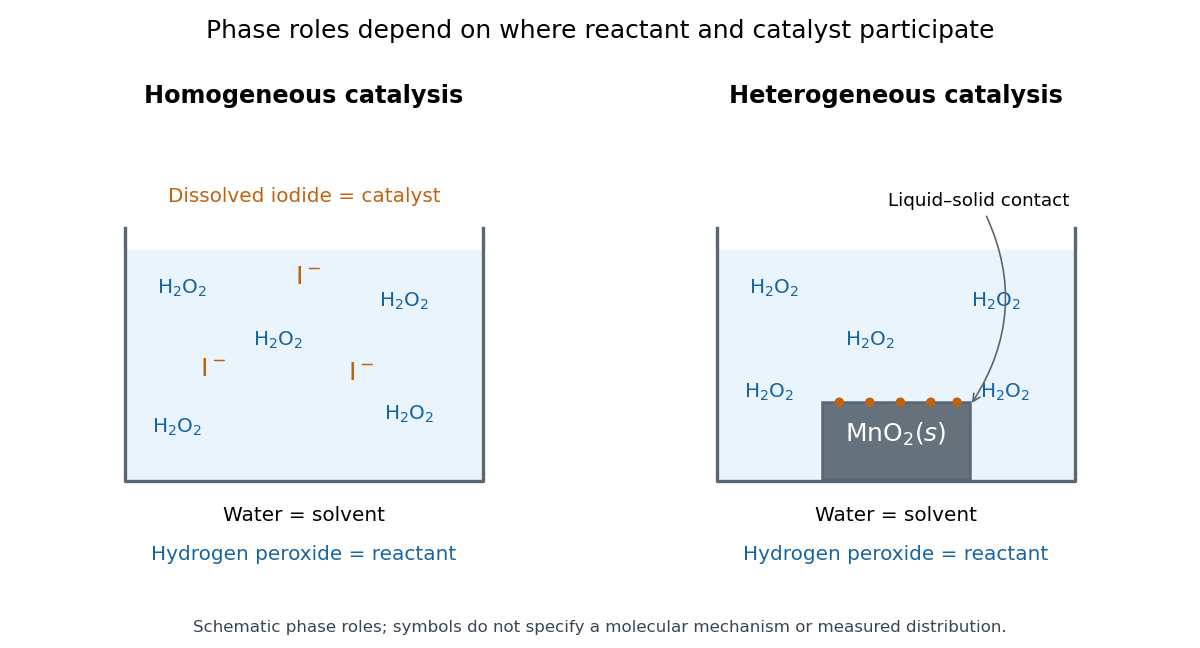

Being in the same thermodynamic phase describes where the chemical species are; it does not specify their reaction mechanism. A uniform-looking liquid can contain unresolved solid particles, so appearance alone is insufficient. Conversely, suspended solid particles do not establish that their surfaces supply the observed catalysis: dissolved material released from them could contribute. Phase identification and catalytic participation need separate evidence.
The bookkeeping of a catalyst in homogeneous catalysis is particularly transparent in the schematic catalytic cycle A plus C forming AC, followed by AC releasing B plus C. This is the generic model in catalyst, not an asserted iodide reaction mechanism. Suppose a fixed volume initially contains of A and of C. At a chosen snapshot, let of B and of AC be present, with no other chemical reactions. Each AC contains one A unit and one C unit, soThus free A is and free C is . B formation already exceeds the initial amount of substance of C by a factor of three, while the total C inventory remains . Adding the two steps cancels C and AC, giving the net A-to-B chemical reaction; counting their constituents proves these balances. Conserved total catalyst does not mean constant free catalyst concentration.
Dissolved contact is useful because reactants can encounter the catalytic chemical species throughout the mixed liquid, without first reaching a macroscopic solid surface. Recovering a dissolved catalyst from the same chemical solution can instead require a separation. Neither ease of contact nor phase classification determines an activation energy or an equilibrium constant; those depend on the relevant chemical kinetics and endpoint thermodynamics.
Catalyst deactivation is loss of catalytic activity during use. Regeneration in an ideal catalytic cycle does not rule out a separate damaging chemical reaction, blocking of a surface, or physical loss of catalyst from the apparatus. A route can also be slowed by diffusion to the surface or by accumulation of a reaction intermediate. Such effects limit the usefulness of a low schematic reaction energy barrier: measured throughput depends on the whole reaction mechanism and on transport. Demonstrating regeneration requires more evidence than observing a faster first run. For a recovered solid catalyst, a useful further comparison is a second run with fresh reactants, matched recovered amount, and the same mixing and temperature, alongside a fresh-solid run and a blank. Loss during recovery or residual reactants can otherwise imitate catalyst deactivation or apparent reuse. This is a proposed control, not an observation reported for the catalysed peroxide comparison.
Catalytic selectivity concerns which reaction products form when competing reaction mechanisms are available. Faster conversion is valuable when a process would otherwise be impractically slow; a suitable catalyst can also favour a useful product within the available time. In an illustrative pair of irreversible first-order reactions A to B and A to D, the initial fraction of converted A going to B is . Multiplying both rate constants by the same factor changes speed but leaves this fraction unchanged; changing their relative values changes the kinetic product split. This is a finite-time kinetic illustration, not a new equilibrium constant.
A catalyst need not accelerate every competing chemical reaction equally. Enzymes, for example, can distinguish substrates through their active sites.[ref]
Chemistry 2e by Paul Flowers and others. §12.7, Enzyme Structure and Function, Figure 12.25: substrate binding and specificity
If every relevant reversible channel eventually equilibrates in a closed system, its final chemical equilibrium still obeys the endpoint thermodynamics. Selective acceleration, product removal, or external driving can make an observed product distribution depend on time and operating conditions. A claim of improved yield must specify those conditions.Here is an explicitly stipulated elementary kinetic model, not experimental data. A well-mixed ideal closed system has constant temperature and volume. Alongside an uncatalysed elementary reaction, allow an illustrative catalytic encounter that returns C immediately:Both channels obey the law of mass action. In the second, the forward reaction rate is and the reverse reaction rate is . C cancels in each encounter, so its free concentration stays constant without an external supply. This toy elementary reaction encodes regeneration without binding; it is not a claim that real catalytic cycles universally consist of one encounter. A binding cycle can accumulate a reaction intermediate, in which case constant total C does not imply constant free .
Adding the parallel reaction rates gives effective first-order reaction rate constantsBecause , each channel balances at the same , and so does their sum. At the pair is ; at it is . Both give with ideal thermodynamic activities and a common concentration standard state. At their compatible standard reaction change in Gibbs free energy is . Choosing an unrelated reverse rate constant would break this consistency.
Let be the conserved concentration, and define the dimensionless quantity . ThenSolving this first-order linear differential equation givesThe chemical relaxation time is without C and with the chosen C. From either or , the exponential decay of the deviation leads to the same chemical equilibrium . Reducing that deviation to one percent takes : about versus .
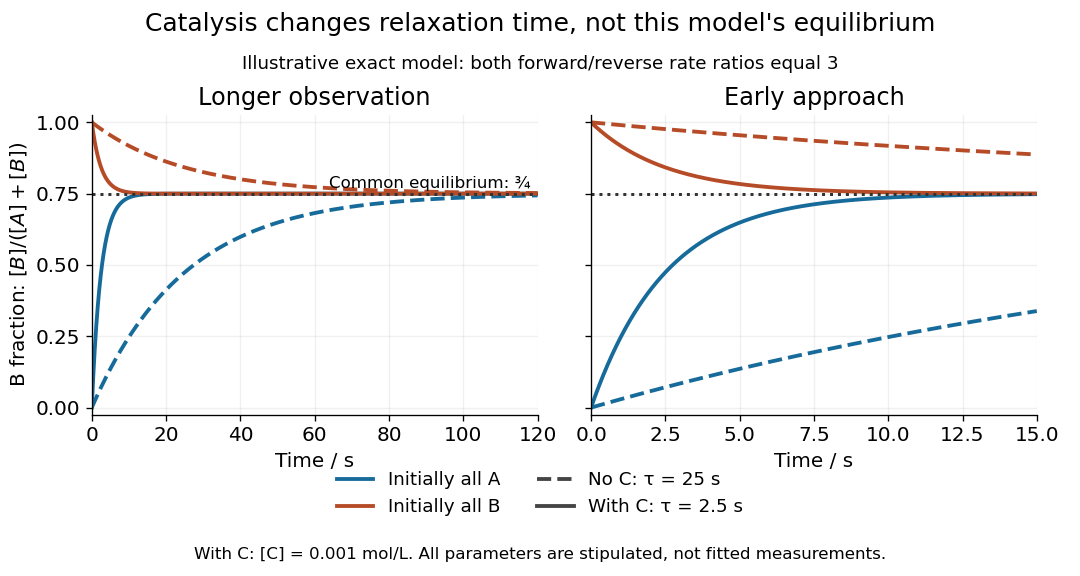
Two initial compositions and two kinetic speeds approach the same chemical equilibrium
. Exact curves from the stipulated reversible catalytic relaxation model. Solid curves include of C; dashed curves omit C. Blue starts entirely as A and orange entirely as B. Both panels use the same equations; the right panel resolves the first . The common dotted line is , not a fitted plateau or an experimental measurement. Details.
At this chemical equilibrium, conversion continues in both directions. For , the uncatalysed channel has equal forward and reverse reaction rates . Adding C gives total directional reaction rates each, yet zero net reaction rate. Faster molecular exchange and unchanged composition coexist. This exact calculation explains how catalysis can matter enormously within an observation window while leaving the final equilibrium constant intact.
A directional Gibbs energy of activation measures the climb from a starting state to a transition state. The net standard reaction change in Gibbs free energy measures the difference between endpoints. Changing the climb can strongly change a rate constant while leaving that endpoint difference intact. For two illustrative single-barrier routes with common endpoint levels and ,Lowering the common transition state level lowers both directional Gibbs energies of activation; it does not lower just the forward climb. The usual statement that a catalyst lowers an activation energy describes a kinetic route, not a change in the net Gibbs free energy. An activation energy inferred from an Arrhenius plot is also distinct from a Gibbs energy of activation at one temperature.
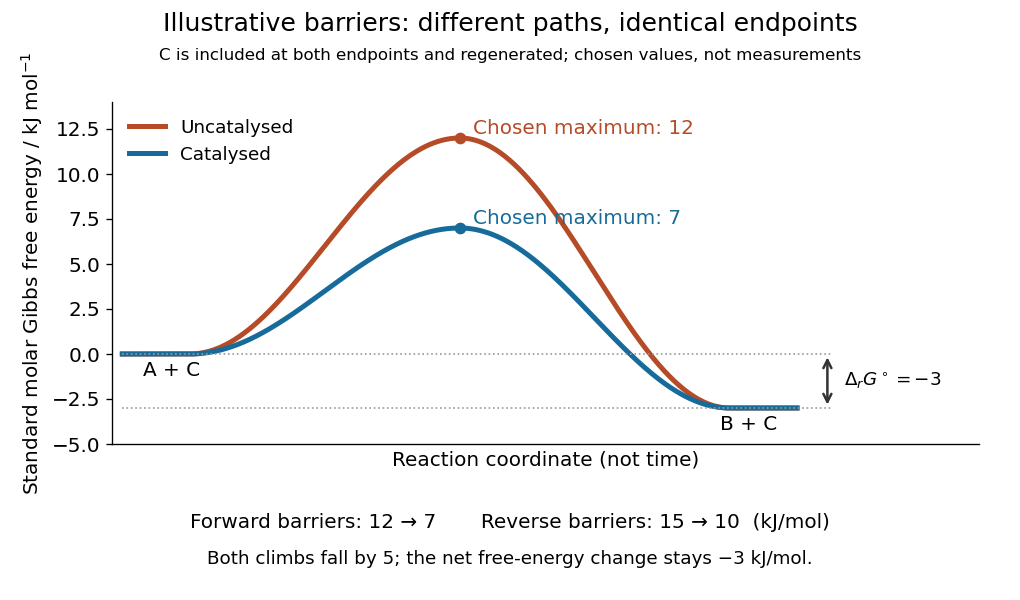
Illustrative catalysis schematic: different barriers, identical endpoint Gibbs free energy difference
. Chosen levels in : A plus regenerated C at , B plus regenerated C at , and schematic maxima at and . Forward barriers are and ; reverse barriers are and . Neither curve is a measured molecular path. The reaction coordinate is not time. These values illustrate the barrier bookkeeping and do not parametrize the separate reversible catalytic relaxation example. Details.
With a common prefactor in transition state theory, subtracting the directional barriers yieldswhere is the molar gas constant and is the absolute temperature. This particular rate constant ratio requires the simple compatible directional rate laws and consistent standard states; a general multistep reaction mechanism does not supply two arbitrary measured rate constants whose ratio must equal . At fixed temperature a catalyst preserves for the same net conversion. The actual reaction change in Gibbs free energy, , is likewise unchanged at the same reaction quotient . Composition changes during the faster approach to chemical equilibrium, so comparing mixtures at the same elapsed time need not compare the same .[ref]
13.3 Shifting Equilibria: Le Châtelier’s Principle. §13.3, Effect of a Catalyst: both directional rates accelerate while equilibrium composition is unchanged
A catalytic cycle follows the changing forms of a catalyst through a reaction mechanism until its starting form is regenerated. The schematic binding cycle in catalyst illustrates the bookkeeping: C is consumed and recovered, whereas AC is a reaction intermediate formed and consumed. Cancelling both gives the net A-to-B chemical equation. Regeneration concerns the completed cycle; it does not imply that C avoids forming chemical bonds or exchanging electrons. An alternative reaction mechanism may have more elementary reactions than the uncatalysed route and still be faster.[ref]
Chemistry 2e by Paul Flowers and others. §12.7, Figure 12.19 and Homogeneous Catalysts: alternative steps, intermediate formation and catalyst regeneration
For that reversible binding cycle, ideal thermodynamic activities give step equilibrium constants and . Their product is : the same cancellations occur in the equilibrium bookkeeping. Choose consistent standard states for the species. A proposed cycle with for the same net conversion at the same temperature would contradict its specified thermodynamics. This statement concerns free-species thermodynamic activities. Appreciable binding in AC can change how the conserved total amount is partitioned among free A, free B and bound AC. An assay counting bound and free material together therefore needs that additional balance; unchanged does not by itself guarantee identical analytical totals when the amount of C changes.
Citric acid is a six-carbon hydroxytricarboxylic acid, . Its three carboxyl groups can lose protons successively, producing differently protonated forms of citrate.[ref]
This acid-base speciation matters when interpreting citrate-containing buffers or metal complexes. A total citric-acid inventory does not specify one unique charge state in every solution.
There are unlisted articles, also show them or only show them.