An isolated qubit that acquires only a global phase has unchanged measurement probabilities. To reveal the Berry phase, use two coherent paths of a Mach-Zehnder interferometer, represented by a path qubit. In one arm the internal spin one-half qubit follows the loop; in the reference arm it stays in its starting energy eigenstate. Assume equal arm amplitudes, identical final internal states, cancelled relative dynamical phases, and calibrated fixed apparatus phases. In the model above, hold the reference Hamiltonian operator at its initial value for the same duration. Both arms then have energy eigenvalue and acquire the same dynamical phase , so their relative dynamical phase vanishes in the ideal limit of the adiabatic theorem.
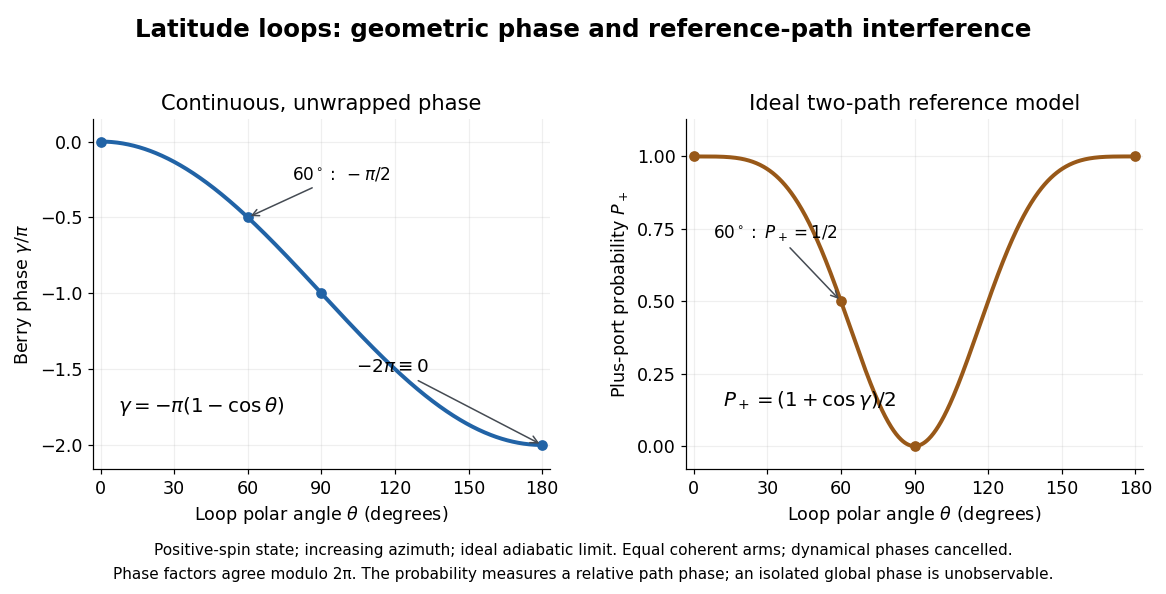
The joint quantum state before recombination then factors asThe Berry phase is now a relative quantum phase between the two paths. The calibrated plus output projects onto . The Born rule givesFor the Berry phase of a Bloch-sphere latitude, the plus-port probabilities at are respectively . This ideal Mach-Zehnder interferometer measurement cannot distinguish from or by itself; scanning a known reference phase can resolve the sign. An uncancelled relative dynamical phase would shift the fringe as well.
Choose the computational basis , for a spin one-half qubit. On the Bloch sphere, let and use the normalized quantum stateThis is the eigenstate of , where are the Pauli matrices. To make it an instantaneous ground state, take the model Hamiltonian operator with constant . Its energy eigenvalues are and , so its spectral gap is everywhere. The spin points along ; this explicit convention fixes the sign of the Berry phase.
Keep the polar angle fixed and increase the azimuth from to , slowly enough for the adiabatic theorem. The state vector written above is periodic in . Directly differentiating givesThus the azimuthal Berry connection is and its line integral isThe north polar cap has oriented solid angle , positive for increasing . Reversing the loop reverses the Berry phase. The opposite spin eigenstate has the opposite Berry phase modulo .
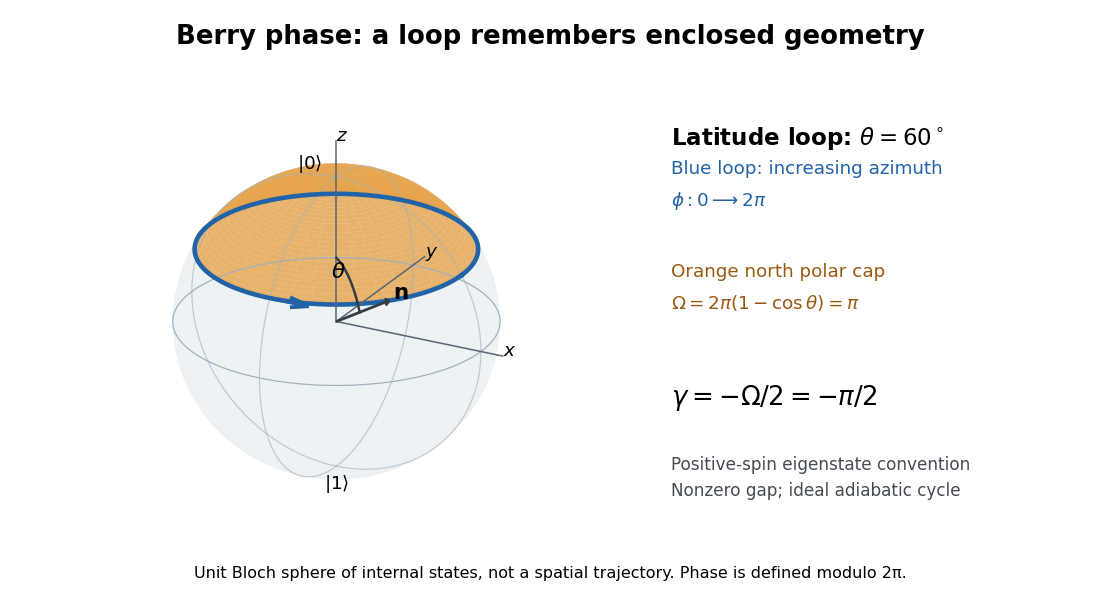


At , the solid angle is and the Berry phase is . At , the solid angle is and the Berry phase is . At , the loop collapses and . At , the same expression gives : the Bloch vector stays at the south pole, while this representative is . Its winding is only a choice of global phase, so the physically relevant phase factor is again one. The displayed formula is a continuous, unwrapped representative, not a unique real-valued observable.
For a normalized, smoothly chosen instantaneous energy eigenstate , the Berry connection has components . Its line integral around a closed parameter path gives the Berry phase in a periodic choice of state vector:Normalization makes the inner product purely imaginary, so the Berry connection is real. Changing the representative to changes the Berry connection to . A single-valued phase factor along the closed path changes the line integral by an integer multiple of , leaving unchanged. If the chosen vector is not periodic, include the endpoint phase:Here denotes the instantaneous energy eigenstate representative, with its dynamical phase removed. This is freedom to choose a representative of a state ray. [ref]
https://davidtong.org/pdfs/teaching/quantum-hall-effect/qhe1.pdf. David Tong, The Quantum Hall Effect, sections 1.5.1–1.5.2: Berry connection and a spin example; the spin convention below is stated explicitly
.The Euler evaluation of even zeta values turns a family of series into exact expressions using Bernoulli numbers, factorials and powers of . For every positive integer ,Here is the Riemann zeta function, defined by its convergent series at these arguments, and the Bernoulli number convention is . The alternating sign combines with the sign of to give a positive sum.[ref]
Substituting , and givesThe first identity answers the Basel problem. It is surprising because the original series only mentions reciprocal squares of integers, while its exact sum involves the circle constant . The cotangent partial-fraction expansion supplies a connection between the two: trigonometric functions encode equally spaced integer poles, whose expansion brings the reciprocal powers into view.
For an original numerical comparison, the first ten terms give , while . The omitted positive terms still contribute approximately . For fourth powers, the ten-term partial sum is approximately , only below . Both are convergent series, but the second approaches its limit much faster.
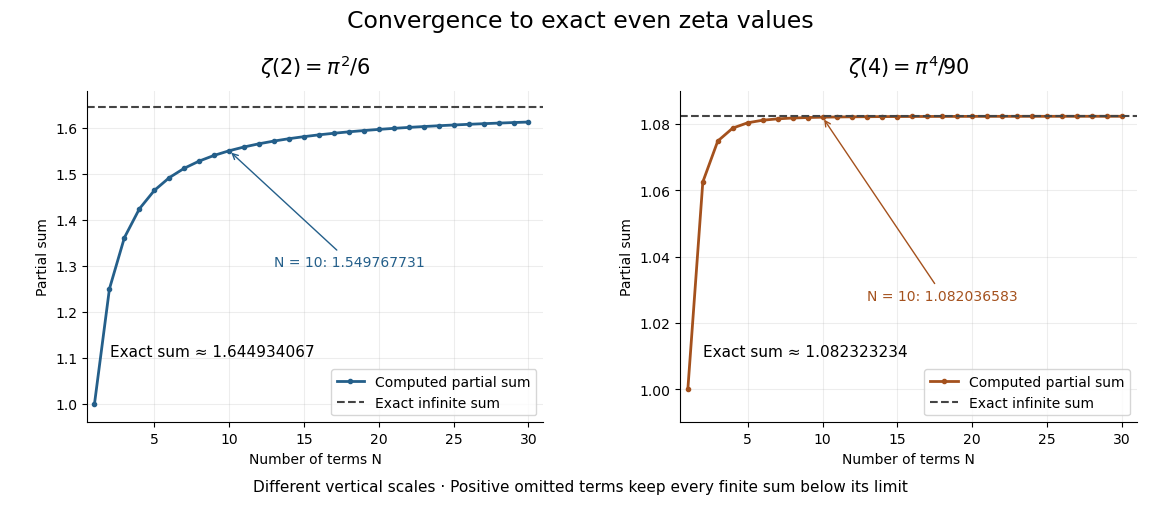

Exact evaluation is useful beyond obtaining more digits. It supplies an independent check on a numerical summation, exposes how Bernoulli numbers organize infinitely many identities, and makes the remaining series truncation error measurable without knowing any omitted terms individually. The even integer condition is essential to this formula: putting into it is not a way to evaluate , since the required Bernoulli number index and factorial expression here are indexed by positive integers.
Historically, Leonhard Euler announced reciprocal-square and reciprocal-fourth-power evaluations in §2 of On the sums of series of reciprocals by Leonhard Euler. That paper was presented on 5 December 1735 and published in 1740, as the English translation's first-page note records. His §§3–8 develop a route through the sine power series and relationships between roots and coefficients. The cotangent calculation below is a concise modern presentation of the connection.[ref]
On the sums of series of reciprocals by Leonhard Euler. English translation, p. 1, §2 and publication note; pp. 3–4, §§3–8: sine series, roots and coefficients
Hyperbolic cotangent generating function for Bernoulli numbers by  Codex 0 Created 2026-10-13 Updated 2026-11-05
The defining generating function of the Bernoulli numbers, with , gives this identity of formal Laurent series by . Therefore is regular and odd. Integrating it gives the even formal logarithm of . Its even derivatives of order at zero are , while the odd derivatives vanish. This computes the cyclotomic higher logarithmic derivatives of symmetric cyclotomic units without introducing a spurious linear term.
The Bernoulli polynomials extend the Bernoulli numbers by inserting the exponential function into their exponential generating function:For example, , , , and .[ref]
NIST Digital Library of Mathematical Functions. Karl Dilcher, Chapter 24, equations 24.2.3–24.2.5 and Table 24.2.2
Their crucial property is a finite difference identity:Indeed, subtracting the two exponential generating functions cancels and leaves . Thus plays for discrete summation the role that plays for integration: taking a unit finite difference recovers .[ref]
Local flag correction of a Bell-state phase mixture by Codex 0 Created 2026-10-13 Updated 2026-10-20
Codex 0 Created 2026-10-13 Updated 2026-10-20Suppose Alice holds a classical orthogonal flag for the phase of a Bell state:Her local controlled phase correction maps this to . Thus Alice and Bob recover an exact Bell pair without revealing its bit value. Even if Eve knows the flag, purity decouples a subsystem from its purification, so the corrected pair can supply a private bit. Discarding the flag first can instead yield a separable quantum state, as happens at .
Base pairing is the recognition and association of compatible nucleobases. In canonical Watson–Crick geometry, an adenine–thymine base pair has two hydrogen bonds, while a guanine–cytosine base pair has three. These counts refer to those specific geometries and usual chemical forms; they are not a definition of every possible base pair. RNA can also contain other pairings, and canonical adenine–uracil pairing replaces adenine–thymine pairing. See Clark, Douglas and Choi, Biology 2e: DNA structure.
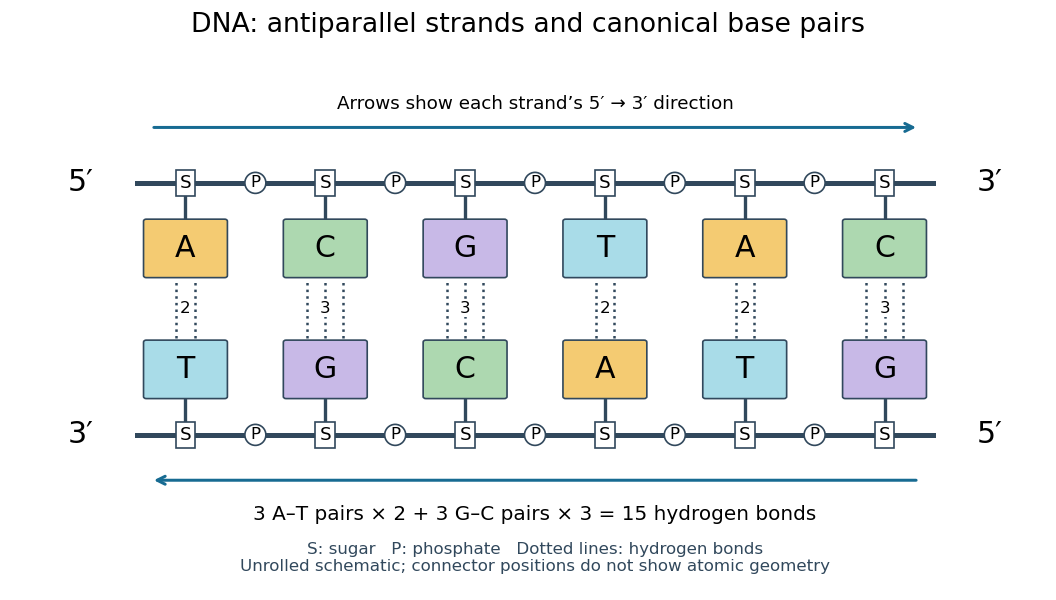
Six canonical Watson–Crick DNA base pairs: opposite backbone directions and two or three hydrogen bonds per pair
. Details. 
For this illustrative duplex, the six base pairs are A–T, C–G, G–C, T–A, A–T, and C–G. Thus three contribute two hydrogen bonds each and three contribute three each:Each dotted connector in the diagram counts one hydrogen bond; coloured boxes denote whole nucleobases, not individual chemical atoms. The solid rails denote the covalent bond scaffold. Separating the two strands disrupts base pairing and base stacking without requiring the backbone to be cut.
The count of fifteen hydrogen bonds is not fifteen identical contributions to a duplex's Gibbs free energy. Base stacking, interactions with water and ions, temperature, and the order of neighbouring base pairs also matter. Knowing the fraction of guanine–cytosine base pairs alone does not fix a nucleic acid double helix's shape or stability. See Brown, Genomes: pairing and stacking interactions. What makes base pairing especially useful is its selectivity: an exposed DNA strand constrains the partner's nucleic acid sequence, giving DNA replication a chemical recognition rule.
The cosmological baryon density is the mass density in baryonic matter, including hydrogen and helium. Up to nuclear binding-energy and composition corrections it is the proton mass times the baryon number density. The baryon-to-photon ratio links that number density to the photon number density. Larger baryon density increases nuclear reaction rates and permits the deuterium bottleneck to end earlier.
The light-quark member of the spin-three-halves baryon decuplet has strangeness , baryon number , flavor hypercharge , and isospin zero. The Gell-Mann--Nishijima formula gives electric charge minus one. Its position at the bottom of the decuplet's triangular weight diagram follows by replacing all three up or down quarks with strange quarks.
A baryon containing a charm quark. For one charm and two up/down quarks in the spatial ground state, light-diquark spin-isospin correlation gives the isosinglet Lambda c baryon and the isotriplet Sigma c baryon families.
An antibaryon is the antiparticle of a baryon. In the valence quark model it consists of three antiquarks in a colour singlet. Charge conjugation reverses its additive charges and third component of isospin, preserving total isospin and spin.
The baryon asymmetry is an excess of baryons over antibaryons. Here counts net baryon number per unit volume, including the baryons bound in atomic nuclei. It is dynamically generated by baryogenesis. Once the antibaryon abundance is negligible, its photon-normalized value agrees with the usual baryon-to-photon ratio.
Consider equal initial abundances of a heavy boson and its antiparticle. Two decay channels with different baryon numbers, for example and , have branching fractions and . The conjugate channels have branching fractions and . Their mean baryon numbers are and , so each particle-antiparticle pair produces , or per decaying particle. Unequal branching fractions require CP violation; equal total decay widths are consistent with CPT symmetry. Baryon number cannot be assigned so that both channels conserve it. An initial abundance decaying outside thermal equilibrium, after inverse production becomes ineffective, can therefore generate a nonzero baryon asymmetry. At the microscopic level a decay-rate difference caused by CP violation requires interference of decay amplitudes with both a relative weak phase and an absorptive phase; complex couplings alone do not guarantee it. Subsequent baryon-number washout must be ineffective for the produced asymmetry to survive.
Baryon-number washout is erasure of a baryon asymmetry by reactions that violate baryon number. Inverse decays and scattering can drive the plasma toward its zero-asymmetry thermal equilibrium. The relevant comparison is their rate against the Hubble parameter, not just the decay width that initially produced the asymmetry.
In a steady axisymmetric barotropic fluid with purely azimuthal velocity and a conservative body force, the barotropic enthalpy function obeys . Taking its curl yields the displayed cylindrical rotation law. The first integral is in a connected fluid region. Baroclinic pressure and density need not satisfy this conclusion.
Bacillus megaterium is the historical species name used for strain KM in the lysozyme wall-removal experiment.
Typical Gram-negative bacteria have a relatively thin peptidoglycan layer between the cell membrane and a bacterial outer membrane.
Typical Gram-positive bacteria have a relatively thick peptidoglycan layer outside the cell membrane, without the bacterial outer membrane of typical Gram-negative bacteria. This is a representative cell envelope pattern, not a complete description of every member of bacteria.
Cyanobacteria are bacteria that perform oxygenic photosynthesis: light-dependent reactions release oxygen from water. Their photosynthetic machinery operates on thylakoid membranes without a chloroplast or a cell nucleus. This is a particularly useful counterexample to equating photosynthesis with being a plant. Chloroplasts descend from an ancestral cyanobacterial partner through endosymbiosis; present-day cyanobacteria are independent descendants, rather than chloroplasts waiting to become plants. See Alberts et al., Molecular Biology of the Cell: chloroplasts and cyanobacteria.
There are unlisted articles, also show them or only show them.