
The black-hole sphere of influence is a characteristic radius where the central black hole appreciably changes surrounding stellar dynamics. Equating its Newtonian gravitational potential scale to the ambient squared velocity dispersion gives . Dynamical mass measurements depend on angular resolution , tracer brightness, and degeneracies in the orbital distribution, not solely on black hole mass.
For two positive measurements in the same photometric passband, using the same magnitude zero point, units, and weighting convention, their apparent magnitudes obeyThe logarithm takes a dimensionless ratio. An energy-weighted measurement must be compared with another energy-weighted measurement, and a photon-counting measurement with another consistently calibrated photon-counting measurement. Changing photometric passband or magnitude zero point requires the corresponding calibration, as in a colour index. [ref]
https://arxiv.org/pdf/1510.06262. IAU 2015 Resolution B2: Energy-flux magnitude convention
. [ref]https://xmm-tools.cosmos.esa.int/external/xmm_calibration/calib/documentation/CALHB/node597.html. ESA XMM-Newton: Filter-specific count-rate calibration
.An observed genetic marker tags an unobserved causal genetic variant when linkage disequilibrium correlates their allele indicators. Their squared allelic correlation measures prediction strength. Under standard local-alternative score-test approximations, using the marker rather than the causal allele reduces the noncentrality parameter by roughly , suggesting a sample-size multiplier about . This is an approximation requiring the same disease model and sampling design, not a universal power identity.
Complete asymptotically flat spin initial data obeying the Einstein constraints and the dominant energy condition have future-causal ADM four-momentum, under the appropriate decay and boundary hypotheses. A spinorial proof solves the Witten spinor equation and integrates the Nester two-form. Its divergence is a sum of a nonnegative spinor-gradient term and a matter-energy contraction with a future-causal Dirac current. Positivity for every asymptotic constant spinor yields the full inequality, rather than merely nonnegative energy in one frame.
For an asymptotically flat spatial metric and , the displayed surface integral gives ADM spatial momentum. Together with ADM energy it forms the asymptotic energy-momentum four-vector. Reversing the sign convention for extrinsic curvature reverses the corresponding surface-integral sign.
For an asymptotically flat stationary solution in its asymptotic rest frame, the ADM mass is the gravitational mass measured by the Arnowitt-Deser-Misner energy. It is fixed by the asymptotic metric falloff, not by a coordinate parameter's name. If spatial ADM momentum is present, distinguish the asymptotic energy component from the invariant mass obtained from the energy-momentum norm. For a static Schwarzschild-Tangherlini metric in dimensions with , the mass is ; the dimensional normalization is also reproduced by the Komar mass normalization in higher dimensions.
Colour each interval by the parity of . Every infinite arithmetic progression of positive common difference d meets every sufficiently large such interval, since the interval has length greater than d. Both colours occur infinitely often. Thus neither colour class contains an infinite arithmetic progression, despite the finite-length conclusion of the Van der Waerden theorem.
For nonnegative real numbers and positive weights with , the weighted geometric mean does not exceed the weighted arithmetic mean:For positive , this follows from Jensen's inequality and the concavity of the natural logarithm; a limit extends it to zero inputs. For two terms it gives when .
The pointwise product of arithmetic functions multiplies two arithmetic functions at the same input: . Thus and , using the constant-one arithmetic function and the identity arithmetic function. These differ from the corresponding Dirichlet convolution values and , because Dirichlet convolution sums over every positive integer divisor.
An arithmetic function is a multiplicative function when and for all coprime integers , meaning their greatest common divisor is . The condition excludes the identically zero function. This definition makes no assertion about a pair whose greatest common divisor exceeds . [ref]
Floor and arithmetic functions by Darij Grinberg. Darij Grinberg, MIT 18.781 lecture notes, Definition 2.2.1
For the divisor function, the integer divisors of are , those of are , and those of are . HenceHere and are coprime integers. In contrast, , because the integer divisors of are . Thus the divisor function is a multiplicative function but not a completely multiplicative function.
The practical gain is that prime factorization reduces all values to values at prime powers. For distinct prime numbers and positive exponents ,For instance, since and are coprime integers; replacing by additionally requires a completely multiplicative function. The short proof repeatedly applies the defining rule to prime powers belonging to different prime numbers, which are coprime integers.
An arithmetic function is additive when for coprime integers . Equivalently, . This concerns multiplication of integers, and differs from an additive function on a vector space.
Asgard archaea are an archaeal group important in studies of eukaryotic origins. Molecular comparisons connect their genes to the nuclear lineage of eukaryotes, rather than making modern Asgard archaea the direct ancestors of modern animals or plants. See the original analysis cited under two-domain system.
For every , such a scheme returns a feasible solution within relative error and runs in time polynomial in the encoded instance size and in . Dependence polynomial only for each fixed epsilon is the weaker polynomial-time approximation-scheme requirement.
For a nonnegative counting quantity , an FPRAS is a randomized algorithm with the displayed guarantee, running in time polynomial in encoded input length, and . The usual constant-success definition is equivalent by independent repetition and a median. This counting notion differs from a deterministic fully polynomial-time approximation scheme for optimization.
An optical pinhole is a small aperture used to select a narrow part of a beam or approximate an optical point source. Its finite diameter and diffraction limit that approximation; an illuminated optical pinhole at a collimator's optical focus supplies a narrow bundle of nearly parallel light rays.
Cross-reactivity occurs when an antibody also recognizes another antigen beyond the one against which it was raised. This may involve related features, but obvious overall similarity is not required. [ref]
Appendix I. Immunologists' Toolbox. Immunobiology, 5th edition, Appendix I, antiserum generation: cross-reactive antigens and absorption
For an imagined example, a paratope contacts a small surface patch shared by two otherwise different proteins. Both can bind even though their remaining surfaces differ. Increasing antibody concentration can reveal weak binding that was previously undetectable. Conversely, an extra Western blot band need not prove cross-reactivity: the intended protein may occur in multiple forms, or detection reagents may contribute background. The target-deleted and no-primary antibody comparisons under Western blot antibody specificity controls test different explanations.
A concrete comparison used a Biacore T100 with a CM5 chip bearing the target receptor; unused reactive surface groups were blocked. At in a pH 7.4 buffer solution, intact IgG and its Fab fragment were injected for at ; dissociation was monitored for . The optical response tracks changes in refractive index near the surface, rather than counting occupied paratopes directly. A reference surface and blank injections corrected background; association and dissociation responses were fitted with a 1:1 model. The reported intact-IgG detachment was slower than that of the Fab fragment. [ref]
Antibody-Unfolding and Metastable-State Binding in Force Spectroscopy and Recognition Imaging by Parminder Kaur and others. Kaur and others, Materials and Methods, Surface plasmon resonance; Table 1, whole IgG and Fab rows
This comparison supports format-dependent attachment, not an intrinsic single-site antibody affinity for intact IgG. The reference and blanks address background, not two-arm avidity, surface accessibility or delivery by diffusion. The paper's fitted 1:1 constants alone cannot distinguish those mechanisms. Its Fab fragment comparison therefore motivates specifying the binding format before interpreting a dissociation constant; a good fit does not establish a unique molecular model.
Antibody equilibrium occupancy counts occupied antibody binding sites, rather than retained assay label. For an original 1:1 model, let denote an unoccupied site, free antigen bearing one accessible epitope, and their complex. At chemical equilibrium, writeSquare brackets mean concentrations. The dissociation constant here has concentration units. This is the same independent-site calculation as receptor binding occupancy, now applied to an antibody binding site. The last equality follows by substituting into the occupied fraction and cancelling .
Assume identical independent sites, reversible 1:1 binding, dilute chemical solution behavior, fixed temperature and buffer solution, and enough time for chemical equilibrium. Exclude two-arm bridging, cross-reactivity and inaccessible sites from this model. Crucially, is free antigen concentration; substituting the amount supplied per volume requires negligible depletion by binding. Independent IgG arms could obey this model site by site, but it does not describe avidity from bridging a surface.
Stipulate , with . Free antigen concentrations , and give , and . A second stipulated dissociation constant of instead gives at . Both curves approach one at large : a nearly saturated readout can conceal an antibody affinity difference. These are invented values, with no universal threshold for a useful antibody.
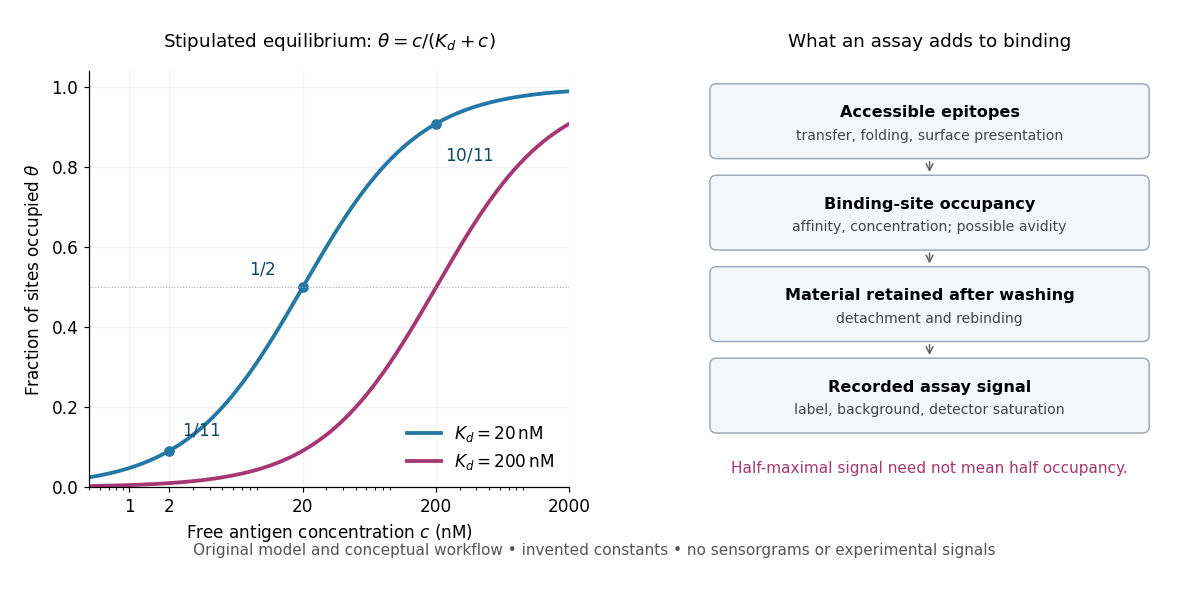
Antibody equilibrium occupancy and the additional steps in an assay readout
. Original analytic curves for stipulated dissociation constants of and ; marked examples belong to the first curve. The adjacent schematic separates epitope accessibility, binding, washing and detection. It contains no measured sensorgrams, fitted assay parameters or experimental signals. A logarithmic scale changes the display, not the independent-site assumptions. Details.
A Western blot readout additionally depends on Western blot transfer, accessible epitopes, loss during washing and Western blot antibody detection. Western blot response saturation can flatten the final signal even when binding itself remains responsive. An ELISA also reports retained label through an enzyme readout, rather than automatically reporting . Thus half of an assay's maximum signal need not occur at . Varying free antigen through concentrations near the candidate dissociation constant, while checking depletion and the readout's response, is more informative than comparing a single saturated point.
Associate with . The ambient quadratic form is ; hence the radius- anti-de Sitter quadric is with . The action gives . Its induced bi-invariant pseudo-Riemannian metric is , giving and cosmological constant . The antipodal quotient is ; unwrapping global time gives the universal covering group instead. The connected component is essential in the displayed orthogonal-group isomorphism.
The unit hyperboloid in ambient signature has , , . It gives the displayed metric with and periodic modulo . Its time circles are timelike, so the universal cover, with , removes these closed timelike curves. The metric alone does not prescribe the global identification. Both versions have constant negative curvature and two spatial ends.
There are unlisted articles, also show them or only show them.