Bending stiffness is the coefficient relating plate curvature to bending moment. In linear thin-plate theory a transverse displacement produces a restoring load .
An adjunction is monadic when its comparison functor from the right-hand category to the Eilenberg-Moore category of the induced monad is an equivalence.
The induced monad determines this comparison; Beck's monadicity theorem gives a criterion for it to be an equivalence of categories.
A finite-dimensional linear operator is diagonalizable over a specified field when it has an eigenbasis. Equivalently, its matrix admitswhere is an invertible matrix whose columns are eigenvectors, and is a diagonal matrix of the corresponding eigenvalues. This change of basis reveals a linear map as independent one-dimensional scalings. The matrix may look coupled in the original coordinates, but each coordinate in the eigenbasis evolves on its own.
For the symmetric matrix computed in eigenvector, takeThen , hence . The orthonormal basis version is , an orthogonal matrix satisfying . Every real symmetric matrix has an orthonormal eigenbasis by the spectral theorem; a general diagonalizable matrix need not have orthogonal eigenvectors.
The immediate payoff is repeated application: adjacent factors cancel, giving . In this example,The component in grows while the component in stays fixed. After division by its Euclidean norm, this particular sequence approaches . This is the mechanism behind the power method; an initial vector entirely in would stay there and never find the dominant eigenvalue .
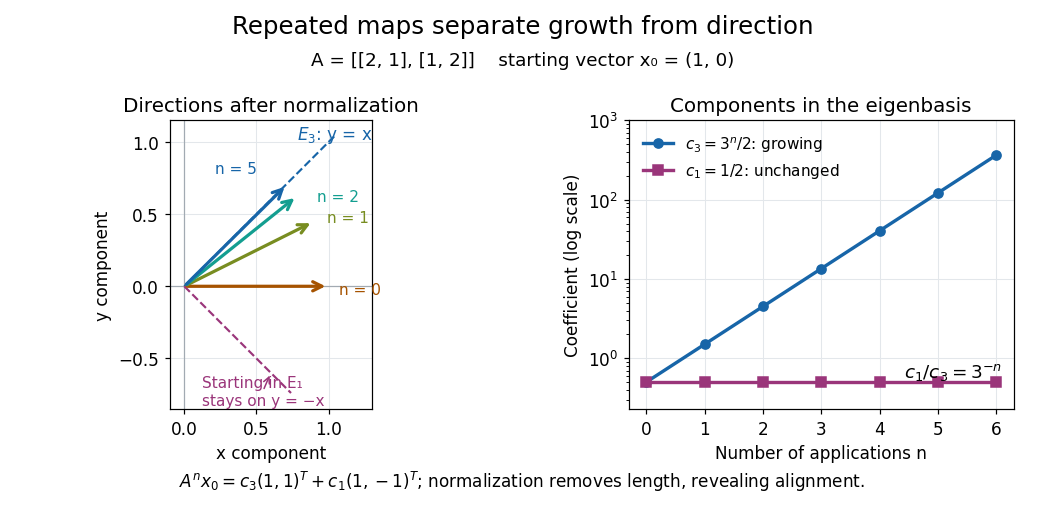
Repeated maps: eigenvalue growth, alignment, and the exceptional starting direction
. Details. Two different obstructions deserve comparison. The planar rotation in eigenvector is diagonalizable over but not over , because its eigenvalues are and . By contrast, the shear mappinghas only , of algebraic multiplicity two, and , of geometric multiplicity one. There is no second independent eigenvector, even over . This is a defective matrix, already a two-dimensional Jordan block. Its powers areThus even though both eigenvalues are one, repeated application can produce growth. Eigenvalues alone miss the coupling recorded by a Jordan block. A repeated eigenvalue is harmless when it has enough independent eigenvectors, as demonstrates. More generally, a matrix is diagonalizable exactly when its characteristic polynomial splits over the chosen field and every eigenvalue has equal geometric multiplicity and algebraic multiplicity. The proof outline is to join bases of the distinct eigenspaces; their direct sum fills the space exactly under these conditions.
A physical motivation is the separation of normal modes. Consider two equal masses between three identical springs of stiffness , with the outer ends fixed. By Hooke's law and Newton's second law, the displacement vector obeysThe eigenvectors and have eigenvalues and : the masses move together in the first normal mode and oppositely in the second. Writing separates the coupled equations into two harmonic oscillators,Their angular frequencies are and ; the eigenvalues give squared angular frequencies after multiplication by . This is the beauty of diagonalization: finding the right directions turns interacting motions into independent patterns. For a physical treatment, see Yen-Jie Lee's "Coupled Oscillators, Normal Modes" (MIT 8.03SC, 2016), and the local article normal modes of two equal masses between three springs.[ref]
An eigenvalue is simple when it has algebraic multiplicity one.
For an eigenvalue of a linear operator , its eigenspace isIt contains all eigenvectors for and the zero vector. Including zero makes this a linear subspace: if , then for any scalars . Every nonzero vector in this linear subspace has the same scaling under . Its dimension is the geometric multiplicity of the eigenvalue. If is not an eigenvalue, the shifted kernel is only .
For the symmetric matrix from eigenvector,Each eigenspace is a line. An eigenspace can also be a plane or the whole vector space: for , is a plane of dimension two, while for every vector belongs to . A repeated eigenvalue therefore need not prevent diagonalizability.
The useful unit of information is the whole eigenspace, rather than a particular choice of eigenvectors inside it. On , is simply multiplication by . Distinct eigenspaces fit together as a direct sum, and a finite-dimensional linear operator is diagonalizable exactly when they fill the whole vector space. For the example above, every vector splits uniquely asThis decomposition makes the independent scalings visible without multiplying out the original matrix again.
A nonzero vector is an eigenvector of a linear operator when for some eigenvalue . For a real vector space and , the line through is preserved: the image can point forward or backward, but cannot turn away from that line. When , the image is zero and has no direction. The zero vector is excluded because it satisfies the equation for every scalar and identifies no special direction.
Every nonzero scalar multiple of an eigenvector is an eigenvector for the same eigenvalue, since . Thus there is usually no preferred length or sign; choosing a unit vector is a convenient normalization. Eigenvectors for a fixed eigenvalue, together with zero, form its eigenspace.
For a fully computed example, consider the real symmetric matrixIts characteristic polynomial isFor , gives , so is an eigenvector. For , gives , so is an eigenvector. Direct multiplication checks both:The map stretches the line threefold and fixes the line pointwise. These eigenvectors are orthogonal because ; dividing each by gives an orthonormal basis. A general vector turns because its components along these two lines receive different scalings. For example, maps to and is not an eigenvector.
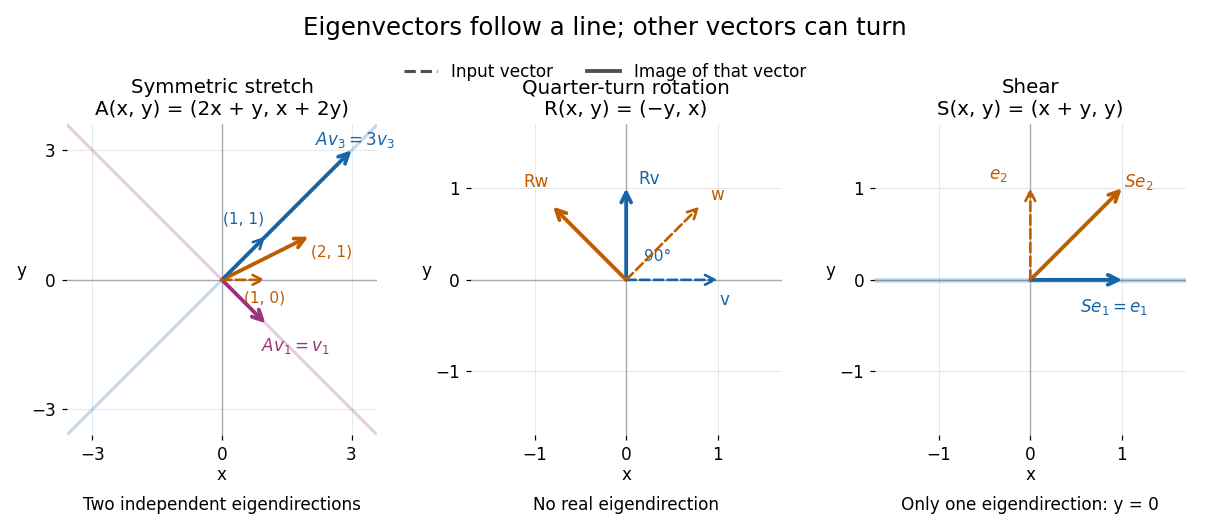


A contrasting example is the planar rotation through degrees:Every nonzero real vector turns to a perpendicular direction, so there are no real eigenvectors. Its characteristic polynomial is , which has no real roots. Over the complex numbers, however, and . The same matrix therefore has an eigenbasis in even though it has none in : the choice of field matters.
If , the smallest operator-norm perturbation that makes an exact eigenpair has norm . One such rank-one perturbation is
Edge-isoperimetric inequality in the discrete cube by  Codex 0 Created 2026-09-24 Updated 2026-10-14
Codex 0 Created 2026-09-24 Updated 2026-10-14For ,
Equivalently, spans at most cube edges. Induction on the dimension and concavity of binary entropy prove the inequality.
On a finite measure space, a positive functional defines the finite measure . The Radon-Nikodym theorem gives with . The boundand - norm duality imply , after which density extends the integral representation to every .
The double slice genus is the smallest genus of an unknotted closed orientable surface in whose transverse equatorial cross-section is .
If is a Sylow subgroup of a finite group and , some intersection is a Sylow subgroup of . Otherwise every double-coset sizewould be divisible by a larger power of than , as would their sum .
A discrete-time martingale with converges almost surely to an integrable random variable. If the martingale is uniformly integrable, convergence also holds in .
This is one of Doob's martingale convergence theorems; uniform integrability upgrades almost-sure convergence to convergence in mean.
Drag on a two-dimensional circular bubble from outer-flow dissipation by Codex 0 Created 2026-09-24 Updated 2026-09-24
Codex 0 Created 2026-09-24 Updated 2026-09-24For the zero-circulation flow around a circle, . Integration over the exterior plane gives dissipation per unit axial length and hence drag per unit length.
There are unlisted articles, also show them or only show them.